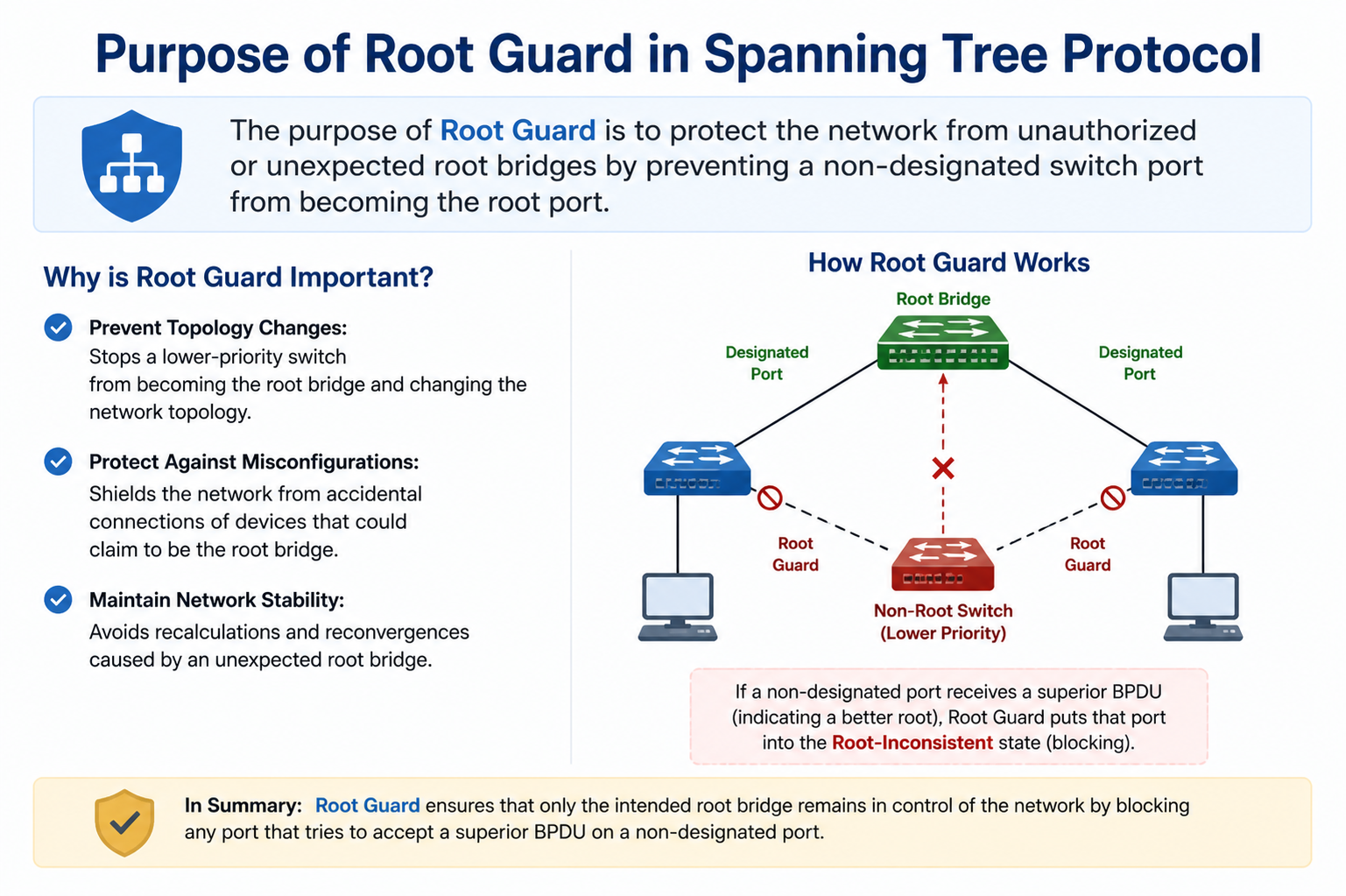
Root Guard is an important enhancement mechanism used in Spanning Tree Protocol environments to maintain a stable and predictable network topology. In modern switched networks, preventing unintended changes in the root bridge election process is critical because even a small topology change can affect the entire traffic flow of the network. Root Guard is specifically designed to enforce administrative control over which switch can become the root bridge, ensuring that the intended network design remains intact.
In a typical switching environment, Spanning Tree Protocol automatically selects a root bridge based on bridge priority and MAC address values. While this automatic selection is useful for dynamic environments, it can also lead to problems when an inferior or unauthorized switch attempts to become the root bridge. Root Guard addresses this challenge by preventing such switches from influencing the root election process.
Understanding the Role of Root Bridge in Network Stability
The root bridge is the central reference point in a Spanning Tree topology. All path calculations are made relative to the root bridge, and traffic is forwarded in a way that avoids loops while maintaining the most efficient paths. Because of this central role, the position of the root bridge directly impacts network performance, latency, and redundancy behavior.
If a non-optimal switch becomes the root bridge due to a misconfiguration or malicious activity, the entire topology may shift in an undesirable direction. This can result in suboptimal routing paths, increased congestion, and even temporary network disruptions while the topology reconverges. Root Guard ensures that only the intended device maintains root bridge status, preserving network efficiency and stability.
How Root Guard Enforces Control on Ports
Root Guard operates at the interface level on switches. When enabled on a port, it actively monitors Bridge Protocol Data Units (BPDUs) received on that interface. If the port receives a BPDU that advertises a superior root bridge compared to the current root, Root Guard intervenes.
Instead of allowing the port to participate in the topology change, it immediately places the port into a special state known as the “root-inconsistent” state. In this state, the port does not forward traffic and does not participate in the spanning tree process for that segment. This prevents the connected switch from influencing the root bridge election.
Once the superior BPDU stops being received, the port automatically recovers and returns to normal operation. This dynamic behavior ensures protection without requiring manual intervention, making Root Guard a self-correcting safeguard mechanism.
Preventing Unintended Root Bridge Election
One of the most important functions of Root Guard is preventing unintended root bridge election caused by misconfigured devices. In large enterprise networks, multiple administrators may manage different sections of the infrastructure, increasing the risk of configuration errors.
For example, if a new switch is introduced with a lower bridge priority than the existing root bridge, it could unintentionally become the new root. This may disrupt traffic flow and force recalculation of spanning tree paths across the entire network. Root Guard ensures that even if such a switch is introduced, it cannot override the existing root bridge selection.
This controlled behavior is essential in environments where network design is carefully planned, and topology consistency is critical for performance and reliability.
Behavior of Root Guard in Different Network Scenarios
Root Guard behaves differently depending on the type of BPDU it receives and the role of the port. On designated ports where Root Guard is enabled, the system constantly evaluates incoming BPDUs. If a superior BPDU is detected, the port is immediately moved to a blocked or inconsistent state.
In scenarios where the connected device is not attempting to become the root bridge, Root Guard has no effect and the port operates normally. This ensures that Root Guard does not interfere with regular spanning tree operations unless a violation occurs.
In redundant network designs, Root Guard is typically applied on ports that connect to downstream switches or access-layer devices, where there is no expectation that those devices should ever become the root bridge.
Root Guard and Network Hierarchy Protection
Modern network architectures often follow a hierarchical design consisting of core, distribution, and access layers. In such designs, the root bridge is intentionally placed in the core or distribution layer to optimize traffic flow.
Root Guard plays a key role in preserving this hierarchy. By enabling it on access-layer ports, network administrators ensure that no lower-level switch can override the carefully planned root placement. This protects the logical structure of the network and prevents topology instability.
This hierarchical protection is especially important in enterprise environments where predictable performance and minimal downtime are required.
Impact of Root Guard on Network Convergence
Spanning Tree Protocol relies on convergence to adapt to topology changes. When a change occurs, switches recalculate the best paths to the root bridge. However, unnecessary convergence events can cause temporary delays in traffic forwarding.
Root Guard helps reduce unnecessary convergence by preventing invalid root bridge changes from occurring in the first place. Since inferior switches are blocked from influencing the topology, the network remains stable and does not undergo repeated recalculations.
This leads to improved network performance, reduced packet loss during topology changes, and a more predictable forwarding behavior across the infrastructure.
Difference Between Root Guard and Other STP Security Features
While Root Guard is focused on protecting the root bridge placement, other Spanning Tree security features serve different purposes. For example, BPDU Guard protects against accidental connection of switches on edge ports, while Loop Guard prevents alternate or root ports from transitioning to forwarding state in case of BPDU loss.
Root Guard is unique because it specifically targets the prevention of superior BPDU influence. It does not block all BPDUs; instead, it selectively reacts only when a device attempts to become the root bridge. This makes it a specialized and targeted protection mechanism within the broader STP security framework.
Recovery Process After Root Guard Activation
When a port enters the root-inconsistent state due to Root Guard, it does not remain permanently blocked. The system continuously monitors incoming BPDU traffic. If the superior BPDU is no longer detected, the port automatically transitions back to its normal operational state.
This automatic recovery ensures that temporary misconfigurations or transient network conditions do not cause long-term disruptions. The port resumes participation in the spanning tree process without requiring manual intervention, maintaining operational efficiency.
Importance of Root Guard in Enterprise Networks
In enterprise environments, network reliability is a critical requirement. Root Guard contributes significantly to this reliability by enforcing design consistency and preventing unexpected topology changes.
Without Root Guard, a single misconfigured switch could potentially alter the entire spanning tree structure, leading to inefficient routing and service interruptions. By enforcing strict control over root bridge selection, Root Guard ensures that the network behaves according to its intended design.
This makes it an essential feature in environments such as data centers, corporate networks, and service provider infrastructures where stability and predictability are priorities.
Advanced Operational Behavior of Root Guard
Root Guard operates using a reactive control mechanism that continuously evaluates incoming Bridge Protocol Data Units on enabled interfaces. Unlike passive features that only observe topology changes, Root Guard actively enforces policy by intervening when an unexpected condition occurs. This intervention is triggered specifically when a port receives a BPDU indicating a superior root bridge compared to the current one.
When this condition is detected, the switch does not simply ignore the BPDU. Instead, it immediately transitions the port into a root-inconsistent state. This state is a protective blocking condition where the port is effectively isolated from participating in Spanning Tree decisions. The interface stops forwarding traffic while still maintaining its physical link status. This distinction is important because it allows the switch to quickly restore normal operations if the violation condition disappears.
The behavior ensures that Root Guard acts as a safeguard layer rather than a permanent blocking mechanism. It dynamically responds to network conditions while preserving overall topology integrity.
Interaction Between Root Guard and Spanning Tree Calculations
Spanning Tree Protocol continuously calculates the most efficient loop-free topology based on the root bridge location. Root Guard does not alter these calculations directly; instead, it influences the input conditions that affect them.
By preventing a downstream switch from becoming the root bridge, Root Guard indirectly stabilizes the spanning tree computation process. This means that path selection, port roles, and cost calculations remain consistent across the network. Without such control, frequent root bridge changes could force repeated recalculations, leading to instability and convergence delays.
In this way, Root Guard functions as a stabilizing constraint within the larger Spanning Tree decision-making system.
Root Guard in Redundant Network Topologies
Modern enterprise networks often use redundancy to ensure high availability. Multiple switches and links are deployed to prevent single points of failure. While redundancy improves resilience, it also increases the risk of unintended topology changes if control mechanisms are not properly enforced.
Root Guard is particularly effective in redundant topologies because it ensures that only designated core or distribution switches can influence root selection. Even if a redundant path introduces a switch with a lower bridge priority, Root Guard prevents it from disrupting the established hierarchy.
This controlled redundancy ensures that failover mechanisms work as intended without introducing instability or unpredictable root bridge changes.
Root Guard and Layered Network Design Enforcement
In a structured network design, different layers have specific roles. The core layer handles high-speed switching, the distribution layer manages routing policies, and the access layer connects end devices. Root Guard plays a crucial role in enforcing this separation of responsibilities.
By enabling Root Guard on access-layer uplinks, administrators ensure that access switches cannot influence the Spanning Tree topology beyond their designated role. This maintains a clear boundary between network layers and prevents accidental elevation of access devices into critical roles.
This enforcement of design boundaries is essential in large-scale networks where multiple teams may manage different segments independently.
Failure Scenarios Prevented by Root Guard
Root Guard helps mitigate several potential network failure scenarios. One common issue is misconfiguration during switch deployment. If a new switch is introduced with a lower bridge priority than the existing root, it could unintentionally take over as the root bridge without Root Guard protection.
Another scenario involves unauthorized or rogue devices connected to the network. Such devices may attempt to influence Spanning Tree topology by advertising superior BPDUs. Root Guard blocks these attempts, preventing potential disruption.
Additionally, software or configuration errors in downstream switches can also lead to incorrect BPDU advertisements. Root Guard ensures that these errors remain localized and do not propagate across the network.
Root Guard Recovery Mechanism in Detail
The recovery process in Root Guard is fully automated and relies on continuous BPDU monitoring. When a port is placed in the root-inconsistent state, it remains in that condition as long as superior BPDUs are detected.
Once the superior BPDU stops arriving, the switch reassesses the port state. If no further violations are detected, the port is automatically restored to its previous Spanning Tree role. This restoration happens without requiring administrative intervention.
This self-healing behavior ensures minimal downtime and reduces operational overhead for network administrators. It also allows the network to adapt quickly to legitimate topology changes while maintaining protection against unauthorized ones.
Design Considerations for Implementing Root Guard
Proper deployment of Root Guard requires careful planning. It is typically applied on ports where downstream devices are not expected to become root bridges. This includes access-layer uplinks and certain distribution-layer connections.
However, Root Guard should not be applied on ports where legitimate root bridge changes may occur. For example, links between core switches or distribution switches should remain flexible to allow proper Spanning Tree convergence in case of failures.
Misapplication of Root Guard can lead to unintended blocking of valid topology changes, which may disrupt network connectivity. Therefore, understanding the network design is essential before enabling this feature.
Impact on Network Stability and Performance
One of the key benefits of Root Guard is improved network stability. By preventing unexpected root bridge changes, it eliminates a major source of topology fluctuations. This leads to fewer reconvergence events and more predictable traffic flow.
Performance is also indirectly improved because stable topologies reduce the need for frequent recalculations and broadcast of updated Spanning Tree information. This reduces CPU load on switches and minimizes temporary traffic interruptions.
In large-scale networks, even small improvements in stability can translate into significant performance gains.
Root Guard in Modern Enterprise Architectures
As networks evolve, the importance of deterministic behavior increases. Modern enterprise architectures rely heavily on predictable paths for applications such as voice, video, and real-time data processing. Root Guard supports these requirements by ensuring that Spanning Tree topology remains consistent.
In environments with virtualization, cloud integration, and distributed services, maintaining a stable Layer 2 foundation is critical. Root Guard contributes to this stability by enforcing strict control over topology control points.
Integration of Root Guard with Other Spanning Tree Security Features
Root Guard is most effective when used alongside other Spanning Tree security mechanisms, each addressing different types of risks in a Layer 2 environment. While Root Guard focuses specifically on preventing unauthorized root bridge elections, other features complement its function by protecting against different failure or attack scenarios.
For example, BPDU Guard is typically used on edge ports to immediately shut down a port if any BPDU is received, protecting against accidental switch connections on access ports. Loop Guard helps prevent alternate or root ports from incorrectly transitioning into forwarding state when BPDUs stop arriving. In contrast, Root Guard does not shut down a port completely; it only blocks it when a superior BPDU is detected.
This layered approach ensures comprehensive protection. Root Guard maintains root bridge integrity, while other features safeguard against loops, misconfigurations, and unintended topology changes. Together, they form a robust Spanning Tree security framework.
Role of Root Guard in Preventing Topology Manipulation Attacks
In unmanaged or partially secured environments, malicious actors or misconfigured devices can attempt to influence Spanning Tree behavior. One common method is advertising a lower bridge priority to become the root bridge and manipulate traffic paths.
Root Guard effectively neutralizes this type of behavior. Even if a connected device attempts to send superior BPDUs, the port configured with Root Guard will immediately transition into a blocking state. This prevents any unauthorized influence on the root bridge election process.
By enforcing strict control over root selection, Root Guard reduces the attack surface of Layer 2 networks. It ensures that even if a malicious or compromised device is introduced into the network, it cannot disrupt the established topology hierarchy.
Behavior of Root Guard in Large-Scale Network Environments
In large enterprise or service provider networks, Spanning Tree domains can span hundreds or even thousands of switches. In such environments, maintaining consistency in root bridge placement is critical for performance and stability.
Root Guard is commonly deployed at scale on access-layer uplinks across multiple distribution blocks. This ensures that no local switch in any branch of the network can influence the global Spanning Tree root decision.
At scale, the benefits of Root Guard become more pronounced. Without it, a single misconfigured device in any part of the network could potentially trigger widespread topology recalculations, affecting multiple segments simultaneously. Root Guard localizes such issues, preventing them from propagating upward in the hierarchy.
Root Guard and Traffic Path Optimization
The placement of the root bridge has a direct impact on traffic flow within a Spanning Tree topology. Ideally, the root bridge is placed at a central and high-capacity location in the network to minimize path costs and reduce latency.
Root Guard ensures that this carefully chosen root placement remains intact. By blocking any attempt from downstream switches to become the root, it preserves the intended traffic engineering design.
This stability allows network engineers to optimize traffic paths with confidence, knowing that the root bridge will not change unexpectedly. As a result, end-to-end latency, bandwidth utilization, and load distribution remain consistent.
Impact of Root Guard on Network Convergence Events
Spanning Tree convergence occurs when a change in topology requires recalculation of port roles and paths. While convergence is necessary for fault tolerance, unnecessary convergence events can degrade network performance.
Root Guard significantly reduces the frequency of such events by preventing root bridge instability. Since the root bridge remains fixed, the network avoids repeated recalculations triggered by conflicting BPDU advertisements.
This leads to faster stabilization after legitimate failures and reduces temporary traffic disruptions caused by topology recalculations. In high-performance environments, this predictability is a key advantage.
Common Misconfigurations Involving Root Guard
Despite its usefulness, improper configuration of Root Guard can lead to unintended network issues. One common mistake is enabling Root Guard on ports where legitimate root bridge redundancy is required. This can prevent failover scenarios from working correctly.
Another misconfiguration occurs when Root Guard is applied without understanding traffic flow design. If enabled on inappropriate uplinks, it may block valid Spanning Tree updates, resulting in unexpected port blocking and potential connectivity loss.
Proper planning and understanding of network topology are essential before deploying Root Guard. It should always align with the intended Spanning Tree hierarchy and design objectives.
Best Practices for Deploying Root Guard
Effective use of Root Guard requires a structured approach. It should be applied primarily on ports connecting to downstream or edge switches, where root bridge election should never occur. It should not be used on inter-core or inter-distribution links where topology flexibility is required.
Network administrators should also document root bridge placement clearly to ensure consistency across the infrastructure. This helps avoid accidental misconfigurations and ensures that Root Guard aligns with the overall network design strategy.
Regular audits of Spanning Tree configuration are also recommended to ensure Root Guard is correctly applied and functioning as intended.
Operational Visibility and Troubleshooting with Root Guard
When Root Guard is triggered, it places the affected port into a root-inconsistent state. This state is typically visible in switch monitoring tools and logs. Administrators can use this information to identify potential misconfigurations or unauthorized devices in the network.
Troubleshooting Root Guard issues usually involves checking BPDU advertisements from connected devices and verifying whether a lower-priority switch is attempting to become root. Once the source is corrected, the port automatically recovers.
This visibility makes Root Guard not only a protective mechanism but also a diagnostic tool for identifying topology-related issues.
Long-Term Benefits of Root Guard in Network Design
Over time, the presence of Root Guard contributes to a more stable and predictable network environment. It reduces the risk of unexpected topology changes, improves operational efficiency, and minimizes downtime caused by misconfigurations.
It also supports scalable network growth by ensuring that new devices can be added without risking disruption to the existing Spanning Tree hierarchy. This makes network expansion safer and more controlled.
In environments where uptime and reliability are critical, Root Guard becomes an essential part of long-term infrastructure planning.
Root Guard in Enterprise Network Resilience Strategy
Root Guard is an important component in building resilient enterprise networks where stability and predictability are prioritized over frequent topology changes. In such environments, network engineers design the Spanning Tree topology in advance, carefully selecting the root bridge location to optimize traffic flow, redundancy, and fault tolerance.
Once this design is implemented, Root Guard ensures that the chosen structure remains stable. It acts as a protective enforcement layer that prevents any accidental or unauthorized change to the root bridge role. This stability is especially important in mission-critical systems such as financial services, healthcare networks, and large corporate infrastructures where even brief disruptions can have significant operational impact.
By locking down root bridge authority, Root Guard contributes to a deterministic network behavior model where traffic paths remain consistent unless explicitly re-engineered.
Impact of Root Guard on Network Predictability
One of the most valuable outcomes of using Root Guard is improved predictability in network behavior. In Spanning Tree Protocol, unpredictability often arises when multiple switches attempt to influence root selection. Without control mechanisms, the network may continuously adjust its topology based on changing BPDU advertisements.
Root Guard eliminates this uncertainty by ensuring that only authorized devices can participate in root bridge selection. This means that path selection, port roles, and forwarding behavior remain consistent over time.
Predictability is crucial for application performance, especially for latency-sensitive services such as voice over IP, video conferencing, and real-time financial transactions. A stable Layer 2 environment reduces jitter, packet loss, and unnecessary reconvergence delays.
Root Guard and Fault Containment in Network Segments
Another key benefit of Root Guard is its ability to contain faults within specific network segments. When a misconfigured or unauthorized switch attempts to become a root bridge, Root Guard prevents the impact from spreading beyond the local segment.
Instead of triggering a full network-wide Spanning Tree recalculation, the affected port is isolated in a root-inconsistent state. This containment ensures that the rest of the network continues to operate normally while the issue remains localized.
This behavior is particularly important in large hierarchical networks, where a single fault should not be allowed to cascade into multiple distribution or core layers.
Behavior During Network Changes and Maintenance
During planned maintenance activities, network topologies often change temporarily. Devices may be replaced, links may be reconfigured, or switches may be rebooted. Root Guard continues to enforce its policies during these events.
If a replacement device is introduced with incorrect Spanning Tree configuration, Root Guard will immediately block any attempt by that device to influence root bridge selection. This helps prevent accidental disruptions during maintenance windows.
Once maintenance is completed and correct configurations are restored, Root Guard automatically allows normal operation without requiring manual reset of the affected ports.
Root Guard in Multi-Vendor Network Environments
In environments where multiple networking vendors are used, Spanning Tree implementations are generally compatible but may differ in default behaviors and enhancements. Root Guard provides a consistent enforcement mechanism across such mixed environments.
Regardless of vendor-specific implementations, the principle of blocking superior BPDU influence remains the same. This makes Root Guard a reliable feature in heterogeneous infrastructures where consistency is more important than platform differences.
It ensures that root bridge selection remains centralized and controlled even when different hardware and software platforms are interconnected.
Scalability Considerations with Root Guard Deployment
As networks scale, the number of switch interconnections increases significantly. Without proper controls, this can increase the likelihood of unintended root bridge changes. Root Guard scales effectively because it is applied at the port level and does not require global recalculations.
Each enabled interface independently enforces root bridge protection, meaning the mechanism remains efficient even in very large deployments. This distributed enforcement model avoids adding unnecessary processing overhead to the network.
Because of its lightweight nature, Root Guard can be deployed broadly without impacting performance, making it suitable for both medium and large-scale infrastructures.
Limitations of Root Guard in Spanning Tree Design
Although Root Guard is highly effective, it is not a complete solution for all Spanning Tree-related issues. It specifically addresses root bridge election control but does not prevent all forms of Layer 2 loops or misconfigurations.
For example, it does not replace Loop Guard or BPDU Guard, which handle different failure conditions. Additionally, Root Guard does not prevent legitimate topology changes initiated from the root bridge side or higher-level design modifications.
It must therefore be viewed as one component of a broader Spanning Tree protection strategy rather than a standalone solution.
Operational Monitoring and Root Guard States
Network administrators often monitor Root Guard status to ensure proper functioning. When a port is in root-inconsistent state, it indicates that a superior BPDU is being received from a connected device.
This state is an important diagnostic indicator. It often reveals misconfigurations, incorrect priority settings, or unexpected device behavior in the network. Monitoring tools and logs can be used to track these events and identify their source.
Once the underlying issue is resolved, the port automatically returns to normal spanning tree operation, confirming that the network has stabilized.
Root Guard and Long-Term Network Evolution
As networks evolve toward higher levels of automation and virtualization, the need for deterministic Layer 2 behavior remains critical. Even in modern software-defined architectures, Spanning Tree Protocol is still used in many environments to prevent loops and maintain redundancy.
Root Guard continues to play a relevant role in these evolving designs by ensuring that foundational Layer 2 stability is maintained. It provides a reliable enforcement mechanism that supports long-term network evolution without sacrificing control over topology decisions.
This makes it a persistent and valuable feature even as higher-level networking technologies continue to advance.
Root Guard is a foundational Spanning Tree Protocol feature that ensures controlled and stable root bridge selection across complex networks. By preventing unauthorized or unintended switches from becoming the root bridge, it preserves network hierarchy, enhances predictability, and reduces the risk of topology instability.
Across all parts of its behavior—whether in small networks or large enterprise infrastructures—Root Guard consistently enforces design intent. It supports resilience, improves operational visibility, and integrates seamlessly with other Spanning Tree protections.
In modern networking environments where reliability and consistency are essential, Root Guard remains a critical safeguard for maintaining a stable and well-structured Layer 2 topology.
Root Guard in High Availability Network Designs
Root Guard plays a significant role in high availability (HA) network environments where uptime and continuity are critical. In these designs, redundancy is built into every layer of the network, and Spanning Tree Protocol is responsible for preventing loops while maintaining backup paths.
In such systems, Root Guard ensures that the carefully planned primary and secondary roles of switches are not unintentionally reversed. If a lower-tier switch attempts to assert itself as the root bridge during a failover event or misconfiguration, Root Guard prevents it from disrupting the intended HA design.
This guarantees that even during failure scenarios, the network converges in a controlled and predictable manner, preserving service continuity and minimizing downtime.
Root Guard and Controlled Redundancy Behavior
Redundancy in networks is meant to provide alternative paths, not to introduce instability. Root Guard supports this principle by ensuring redundancy behaves in a controlled manner. It allows backup links and switches to exist without giving them the ability to influence root election.
This separation of roles ensures that redundancy is passive until needed. When a primary path fails, Spanning Tree recalculates based on pre-defined rules, not on unintended root changes caused by inferior devices.
As a result, redundancy becomes reliable and deterministic rather than unpredictable.
Root Guard in Campus Network Architectures
In campus networks, where multiple access switches connect to distribution and core layers, Root Guard is commonly deployed at the distribution layer. This ensures that access switches cannot interfere with the root bridge election process.
Campus environments often include large numbers of endpoint devices and access-layer switches, increasing the risk of misconfiguration. Root Guard protects the higher layers from being influenced by these edge devices.
This creates a stable hierarchical model where the core and distribution layers maintain control over topology decisions, ensuring consistent performance across the entire campus infrastructure.
Root Guard and Spanning Tree Stability in Dynamic Networks
Even though many enterprise networks are designed to be stable, changes still occur due to scaling, maintenance, and device replacement. In dynamic environments, Root Guard provides a stabilizing influence that prevents these changes from unintentionally affecting root bridge selection.
By isolating root bridge control to designated devices, Root Guard ensures that dynamic changes remain localized and do not cascade into full topology recalculations.
This is especially useful in environments with frequent onboarding of new devices or periodic infrastructure upgrades.
Behavior During BPDU Storm Conditions
In rare cases, networks may experience BPDU storms, where a large number of Bridge Protocol Data Units are generated due to misconfigurations or loops. During such events, Root Guard helps limit the impact on root bridge selection.
While it does not directly stop BPDU storms, it ensures that even during high BPDU activity, unauthorized switches cannot influence the root bridge decision. This adds a layer of stability during abnormal network conditions.
Combined with other protective features, Root Guard contributes to maintaining control during unstable events.
Root Guard in Service Provider Networks
Service provider networks require extremely high levels of stability and traffic predictability. In such environments, Root Guard is often used to enforce strict control boundaries between customer-facing and core infrastructure.
It ensures that customer or edge devices cannot influence internal Spanning Tree topology. This separation is essential for maintaining service integrity across shared or multi-tenant infrastructures.
By preventing external influence on root bridge selection, Root Guard helps service providers maintain consistent service levels.
Root Guard and Configuration Management Practices
Proper configuration management is essential for effective Root Guard deployment. Network administrators must ensure that switch priorities, root bridge selection, and port roles are consistently documented and enforced.
Root Guard acts as a safety layer that enforces these configurations in real time. However, it does not replace the need for proper planning and documentation. Instead, it complements configuration management by preventing unintended deviations.
Regular audits and configuration reviews help ensure that Root Guard is aligned with overall network design goals.
Troubleshooting Root Guard in Operational Networks
When troubleshooting networks with Root Guard enabled, administrators typically look for ports in the root-inconsistent state. This state indicates that a connected device is attempting to advertise a superior root bridge.
Troubleshooting involves identifying the source of these BPDUs and verifying whether the connected device is correctly configured. In many cases, the issue is caused by incorrect bridge priority settings or unexpected switch connections.
Once corrected, the port automatically returns to normal operation, confirming that the network has stabilized without manual intervention.
Root Guard and Network Security Posture
Although Root Guard is not a traditional security feature, it significantly contributes to network security by limiting Layer 2 manipulation attempts. Unauthorized devices attempting to influence topology are effectively neutralized.
This reduces the risk of topology-based attacks that could redirect traffic or create instability. In combination with other security mechanisms, Root Guard strengthens the overall Layer 2 security posture of the network.
It helps ensure that only trusted infrastructure components participate in critical topology decisions.
Summary
Across all its operational contexts, Root Guard consistently serves one primary purpose: protecting the integrity of the Spanning Tree root bridge selection process. It ensures that only authorized devices can become or influence the root bridge, preserving network design intent.
From enterprise campuses to service provider networks and high availability environments, Root Guard provides stability, predictability, and controlled redundancy. It limits the impact of misconfigurations, prevents unintended topology changes, and supports long-term network reliability.
When combined with other Spanning Tree protections, it becomes a key building block in maintaining a stable, scalable, and resilient Layer 2 network infrastructure.