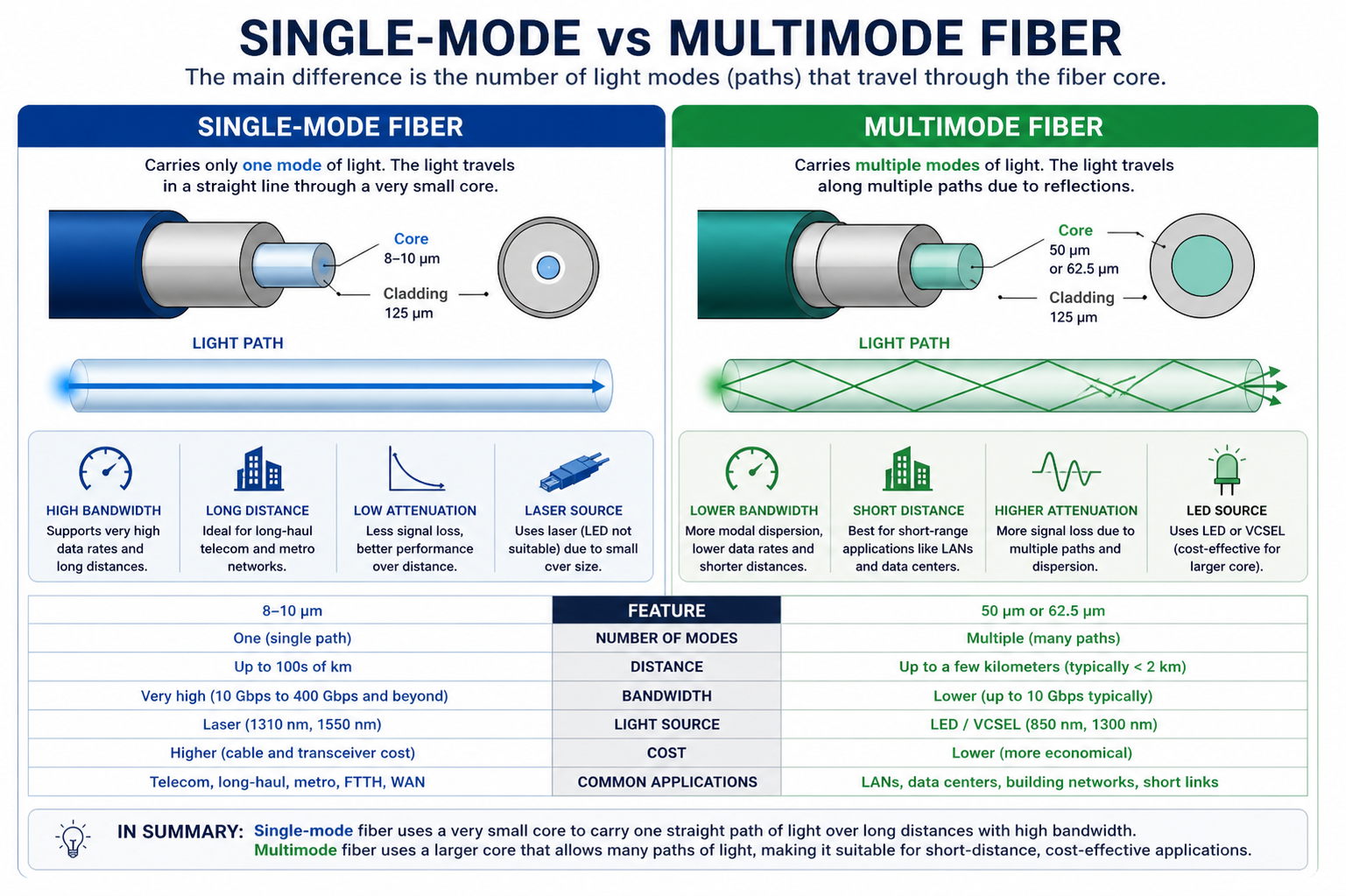
Optical fiber technology is the backbone of modern communication systems, enabling the high-speed transmission of data over long and short distances. Among the two primary types of optical fiber used in networking and telecommunications are single-mode fiber and multimode fiber. While both serve the same fundamental purpose of carrying light signals, they differ significantly in structure, performance, application, and cost. Understanding these differences is essential for designing efficient communication networks that meet specific performance requirements.
Fundamental Working Principle of Optical Fiber
Optical fiber works on the principle of total internal reflection, where light signals are transmitted through a core surrounded by a cladding layer that reflects light back into the core. This ensures that the signal remains confined within the fiber as it travels. The nature of how light behaves inside the fiber depends on the core size and the type of light source used, which is what ultimately distinguishes single-mode fiber from multimode fiber.
In single-mode fiber, light travels in a straight, narrow path, which minimizes reflection and dispersion. In multimode fiber, light follows multiple paths or modes, bouncing at different angles within the core, which can lead to variations in signal arrival time.
Core Structure and Physical Differences
One of the most significant differences between the two fiber types lies in the core diameter. Single-mode fiber has an extremely small core, typically around 9 microns in diameter. This narrow core allows only one light mode to propagate, which helps eliminate modal dispersion and maintain signal integrity over long distances.
Multimode fiber, by contrast, has a much larger core size, generally ranging between 50 and 62.5 microns. This larger core allows multiple modes of light to travel simultaneously through the fiber. While this increases the amount of light that can be transmitted, it also introduces dispersion because different light paths take different amounts of time to reach the destination.
The cladding in both types of fiber is usually 125 microns in diameter, but the difference in core size is what fundamentally determines their behavior and performance.
Light Propagation Behavior
The way light travels inside the fiber plays a major role in determining performance. In single-mode fiber, the small core forces the light to travel in a single, straight line. This reduces reflection, minimizes signal distortion, and allows data to travel over very long distances with minimal loss.
In multimode fiber, light travels in multiple rays that bounce at different angles within the core. These multiple paths cause what is known as modal dispersion, where signals spread out over time. This limits the effective distance over which multimode fiber can maintain high-quality signal transmission.
Because of this difference, single-mode fiber is preferred for long-haul communication systems, while multimode fiber is more suitable for shorter distances.
Signal Attenuation and Dispersion
Signal attenuation refers to the loss of signal strength as it travels through the fiber. Single-mode fiber experiences significantly lower attenuation compared to multimode fiber, making it ideal for long-distance communication without the need for frequent signal boosting.
Dispersion is another critical factor. In multimode fiber, modal dispersion occurs because different light modes travel at different speeds and arrive at different times. This results in signal overlap and reduced clarity, especially over longer distances. Single-mode fiber largely avoids this issue because only one light path is used.
As a result, single-mode fiber maintains higher signal quality and data integrity over extended distances, while multimode fiber is more limited in this regard.
Bandwidth and Data Transmission Capacity
Bandwidth is a measure of how much data can be transmitted over a communication channel within a given time. Single-mode fiber offers significantly higher bandwidth capabilities because it avoids modal dispersion and signal interference. This makes it suitable for high-speed internet, telecommunications backbones, and long-distance data transmission systems.
Multimode fiber, while still capable of high data rates, has lower bandwidth potential compared to single-mode fiber. The presence of multiple light paths introduces limitations that restrict its performance over longer distances. However, within short-range environments such as buildings or data centers, multimode fiber can still support very high data speeds effectively.
Light Sources Used in Transmission
The type of light source used also differs between the two fiber types. Single-mode fiber typically uses laser diodes, which produce a highly focused and coherent beam of light. This precision is necessary for maintaining a single light path through the narrow core.
Multimode fiber usually uses light-emitting diodes or vertical-cavity surface-emitting lasers, which are less focused and more cost-effective. These light sources are sufficient for short-distance transmission but are not as precise as lasers, which contributes to dispersion over longer distances.
The choice of light source directly impacts both performance and cost, making single-mode systems more expensive but more efficient for long-range communication.
Distance Limitations and Performance Range
One of the most practical differences between single-mode and multimode fiber is the distance each can effectively cover. Single-mode fiber is capable of transmitting data over distances of tens or even hundreds of kilometers without significant signal loss. This makes it the preferred choice for telecommunications companies, internet service providers, and long-haul network infrastructure.
Multimode fiber is typically limited to much shorter distances, often within a range of a few hundred meters to a couple of kilometers depending on the data rate and fiber quality. Beyond this range, signal degradation becomes too significant to maintain reliable communication.
This distinction makes multimode fiber ideal for local area networks, campus environments, and data center connections where long-distance transmission is not required.
Cost Considerations and Installation Factors
Cost is another major factor influencing the choice between single-mode and multimode fiber. Single-mode fiber systems are generally more expensive due to the precision required in manufacturing, the cost of laser-based transmitters, and the need for more sensitive alignment during installation.
Multimode fiber is more cost-effective and easier to install because it uses simpler light sources and has less stringent alignment requirements. This makes it an attractive option for organizations that need high-speed connectivity over shorter distances without the higher investment associated with single-mode systems.
However, while multimode fiber is cheaper initially, it may require upgrades or replacement in the future if higher distance or bandwidth requirements arise.
Application Areas in Modern Networks
Single-mode fiber is widely used in telecommunications networks, submarine cables, long-distance internet infrastructure, and metropolitan area networks. Its ability to carry data over vast distances with minimal loss makes it essential for global communication systems.
Multimode fiber is commonly used in data centers, enterprise networks, and within buildings where devices are located relatively close to each other. It is also used in audio-video systems, local communication setups, and short-range high-speed connections.
The choice between the two depends heavily on the scale and requirements of the network being designed.
Performance Efficiency and Future Trends
As technology continues to evolve, the demand for higher data speeds and more reliable communication networks is increasing. Single-mode fiber is increasingly becoming the standard for new long-distance installations due to its scalability and superior performance.
Multimode fiber, while still widely used, is gradually being limited to specific use cases where cost efficiency and short-range performance are more important than maximum distance capability.
Advancements in optical technology may continue to improve both fiber types, but the fundamental physical differences between single-mode and multimode fiber will remain a defining factor in their applications.
The differences between single-mode and multimode fiber are rooted in their physical structure, light transmission behavior, and performance characteristics. Single-mode fiber excels in long-distance, high-bandwidth communication with minimal signal loss, while multimode fiber offers a cost-effective solution for shorter distances with simpler installation requirements.
Both types play essential roles in modern networking systems, and the choice between them depends on specific technical and economic needs.
Bandwidth Scalability and Network Growth
As communication networks continue to expand, the ability of a fiber system to scale with increasing bandwidth demands becomes a critical factor. Single-mode fiber provides excellent scalability because it supports extremely high data rates over long distances without significant degradation. This makes it suitable for future-proof infrastructure, where upgrades in transmission speed can often be achieved by changing the transmitting and receiving equipment rather than replacing the fiber itself.
Multimode fiber also supports high data rates, but its scalability is more limited due to modal dispersion. As transmission speeds increase, the effects of signal spreading become more pronounced, reducing effective distance and reliability. While newer multimode standards have improved performance, they still cannot match the long-term scalability of single-mode systems. This is why multimode fiber is often chosen for environments where future expansion is expected but remains within a confined physical area, such as data centers or enterprise buildings.
Installation Complexity and Alignment Requirements
Installation requirements differ significantly between the two fiber types. Single-mode fiber requires highly precise alignment during installation because of its extremely small core. Even minor misalignment between connectors can lead to significant signal loss. As a result, installation often demands specialized tools, trained technicians, and more careful calibration.
Multimode fiber is more forgiving in terms of alignment due to its larger core size. Light entering the fiber has more space to propagate, which reduces sensitivity to slight installation imperfections. This makes multimode systems easier and faster to deploy, especially in environments where multiple connections need to be established quickly, such as office networks or internal data center links.
The difference in installation complexity also affects maintenance procedures. Single-mode systems require more careful handling during repairs or upgrades, while multimode systems tend to be simpler to maintain.
Connector Types and Compatibility
Both single-mode and multimode fiber use standardized connectors, but their internal construction is optimized differently. Single-mode connectors are designed to maintain extremely precise alignment between fiber cores, often using tighter tolerances and specialized polishing techniques to reduce signal reflection.
Multimode connectors are generally easier to manufacture and align due to the larger core size. However, compatibility between the two types is not interchangeable. Using the wrong type of connector or mixing fiber types within the same link can lead to severe performance issues or complete signal failure.
This distinction is important when designing hybrid networks, where both fiber types may exist in different segments of the infrastructure. Proper planning ensures that each section operates within its optimal performance range.
Signal Quality and Interference Resistance
Signal quality is a key performance indicator in fiber optic communication. Single-mode fiber provides superior signal quality because it eliminates modal dispersion and reduces the chances of signal overlap. This results in a clean, stable transmission that is less affected by external interference.
Multimode fiber, while still highly effective over short distances, is more susceptible to signal distortion due to multiple light paths. Over longer distances, this can lead to reduced clarity and increased error rates. However, in controlled environments such as data centers, where distances are short and conditions are stable, multimode fiber can still deliver reliable performance.
Another advantage of both fiber types is their resistance to electromagnetic interference. Unlike copper cables, fiber optic cables are immune to electrical noise, making them ideal for environments with high levels of electromagnetic activity.
Power Consumption and Efficiency
Power efficiency is an often-overlooked aspect of fiber optic systems. Single-mode fiber systems typically require more precise and powerful laser transmitters, which can increase initial power requirements. However, because they transmit data over longer distances with fewer repeaters or amplifiers, overall system efficiency can be higher in large-scale networks.
Multimode fiber uses less complex and less power-intensive light sources, such as LEDs or VCSELs. This makes individual components more energy-efficient and cost-effective for short-range applications. However, when used over extended networks requiring multiple repeaters, overall energy consumption may increase.
The balance between power efficiency and transmission distance plays a key role in determining which fiber type is more suitable for a specific deployment.
Temperature and Environmental Sensitivity
Environmental conditions can affect fiber performance, although both single-mode and multimode fibers are generally robust. Single-mode fiber, due to its precision requirements, can be more sensitive to bending losses and installation stress. Excessive bending or improper handling can result in signal degradation.
Multimode fiber, with its larger core, tends to be slightly more tolerant of physical stress and minor bends. However, both types must be installed within recommended bend radius limits to ensure optimal performance.
Temperature variations can also impact fiber performance, especially at connection points. In large infrastructure systems, proper insulation and protective housing are used to minimize environmental effects.
Data Center Applications and Modern Usage
In modern data centers, multimode fiber is widely used for short-distance, high-speed interconnects between servers, switches, and storage systems. Its ease of installation and lower cost make it ideal for dense networking environments where large numbers of connections are required within a limited space.
Single-mode fiber is increasingly being used within and between data centers, especially for longer interconnects or campus-wide data center networks. As cloud computing and large-scale distributed systems grow, single-mode fiber is becoming more common even in environments traditionally dominated by multimode systems.
The combination of both fiber types allows organizations to optimize cost, performance, and scalability depending on the specific section of the network.
Technological Advancements and Evolution
Advancements in fiber optic technology continue to improve both single-mode and multimode systems. In single-mode fiber, innovations in laser technology and signal amplification have significantly increased transmission distances and data rates. This has made it possible to support global communication networks and undersea cable systems that connect continents.
In multimode fiber, improvements in laser sources and fiber design have extended its usable bandwidth and improved performance for short-range applications. New standards have allowed multimode fiber to support higher speeds than previously possible, making it relevant in modern high-performance computing environments.
Despite these advancements, the fundamental physical differences between the two fiber types remain unchanged, ensuring that each continues to serve distinct roles in communication infrastructure.
Reliability and Long-Term Performance
Reliability is a critical factor in network design. Single-mode fiber offers long-term stability due to its low attenuation and minimal signal distortion. Once installed, it can operate for many years with consistent performance, making it a preferred choice for backbone networks and critical infrastructure.
Multimode fiber is also reliable but is more dependent on distance limitations and environmental conditions. Within its intended range, it performs consistently well, but exceeding its operational limits can quickly degrade performance.
Long-term maintenance costs are generally lower for single-mode systems in large-scale deployments because fewer signal boosters and repeaters are required over long distances.
Operational Differences
When comparing operational characteristics, single-mode fiber is optimized for long-distance, high-capacity, and high-precision communication. It prioritizes performance, scalability, and long-term efficiency. Multimode fiber, on the other hand, is optimized for cost-effective, short-range, and high-density environments where ease of installation and affordability are more important than extreme distance capability.
Both systems complement each other in modern networking infrastructure, often working together within the same organization to create balanced and efficient communication networks.
Cost Efficiency Over Time
While initial installation cost is an important factor, long-term cost efficiency plays an even greater role in choosing between single-mode and multimode fiber. Single-mode fiber typically requires a higher upfront investment because of its precise components, laser-based transmitters, and skilled installation requirements. However, over time, it often becomes more cost-effective in large-scale or long-distance networks because it requires fewer signal boosters, fewer repeaters, and less frequent infrastructure upgrades.
Multimode fiber, in contrast, has a lower initial cost due to cheaper light sources and simpler installation processes. This makes it highly attractive for small to medium-scale deployments. However, as network demands grow, multimode systems may require more frequent upgrades or even replacement to keep up with increasing bandwidth and distance requirements. This can increase long-term operational costs in environments where expansion is expected.
Network Architecture and Design Considerations
The choice between single-mode and multimode fiber has a direct impact on network architecture design. Single-mode fiber is often used as the backbone of large-scale networks, connecting cities, data centers, or telecom infrastructure. Its ability to maintain signal integrity over long distances allows network designers to build simplified architectures with fewer intermediate signal regeneration points.
Multimode fiber is typically used in the access layer or within localized network segments. It is commonly found in building wiring systems, campus networks, and internal data center connections. Because of its shorter range, network designers must carefully plan layout distances to avoid signal degradation. This often results in more segmented designs where multimode links are strategically placed within confined areas.
Latency and Signal Performance
Latency, or the delay in data transmission, is another factor influenced by fiber type. Single-mode fiber generally provides lower latency over long distances because the signal travels in a single path with minimal scattering. This makes it highly suitable for applications where speed and real-time data transmission are critical, such as financial trading systems or global communication networks.
Multimode fiber can experience slightly higher latency over longer distances due to modal dispersion, where multiple light paths cause signals to arrive at different times. While this difference is minimal in short-range applications, it becomes more noticeable as distance increases. In controlled environments like data centers, this latency difference is usually negligible, but in larger networks, it can impact performance-sensitive operations.
Fiber Bend Sensitivity and Physical Handling
Physical handling and installation conditions can influence fiber performance. Single-mode fiber is generally more sensitive to bending because of its narrow core. Sharp bends or improper cable routing can cause signal loss, known as bend-induced attenuation. Therefore, careful installation practices are essential to maintain optimal performance.
Multimode fiber, with its larger core, is slightly more tolerant of bending and physical stress. This makes it easier to handle during installation in tight spaces or complex wiring environments. However, even multimode fiber has limits, and excessive bending can still degrade signal quality.
Proper cable management, protective conduits, and adherence to manufacturer guidelines are essential for both fiber types to ensure long-term reliability.
Transmission Equipment and Technology Integration
The equipment used in conjunction with fiber optic cables plays a crucial role in overall system performance. Single-mode fiber relies on highly precise optical transceivers, which are designed to handle laser-based transmission. These components are generally more advanced and expensive but offer superior performance and longer reach.
Multimode fiber uses simpler transceivers that are compatible with LED or VCSEL light sources. These devices are more cost-effective and widely available, making them suitable for large-scale deployments where cost control is important.
Compatibility between fiber type and transmission equipment is essential. Using mismatched components can result in signal loss, reduced performance, or complete communication failure. This makes careful system design a critical part of network planning.
Upgrade Path and Future Proofing
Future-proofing is a key consideration in modern network design. Single-mode fiber offers a strong advantage in this area because it can support increasing data rates without requiring physical cable replacement. Upgrades are often achieved by improving transceiver technology rather than changing the fiber infrastructure itself.
Multimode fiber, while capable of upgrades, has more limited scalability. As bandwidth demands increase, especially beyond certain thresholds, multimode systems may struggle to maintain performance without reducing distance or replacing infrastructure. This makes single-mode fiber a more future-ready solution for rapidly growing networks.
Security and Data Integrity
Security is an often overlooked advantage of fiber optic communication. Both single-mode and multimode fibers are inherently more secure than copper cables because they do not emit electromagnetic signals that can be easily intercepted. However, single-mode fiber provides slightly better data integrity over long distances due to reduced signal distortion.
Multimode fiber, while still secure, may experience more signal variations over distance, which can indirectly affect data integrity in high-speed or sensitive applications. In controlled environments such as internal networks, this is generally not a concern, but in critical infrastructure systems, single-mode fiber is preferred for maximum reliability.
Use in Telecommunications Infrastructure
Single-mode fiber is the dominant choice in telecommunications infrastructure. It is used for internet backbones, long-distance telephone systems, submarine cables, and intercontinental communication networks. Its ability to transmit data over extremely long distances without significant loss makes it essential for global connectivity.
Multimode fiber is rarely used in large-scale telecom infrastructure due to its distance limitations. Instead, it plays a supporting role in localized segments of communication networks, such as within central offices or equipment rooms where distances are short.
Use in Enterprise and Commercial Networks
In enterprise environments, both fiber types are commonly used together. Multimode fiber is often used for internal building connections, linking floors, departments, or server rooms. Its cost-effectiveness and ease of installation make it ideal for these applications.
Single-mode fiber is used when connecting multiple buildings across a campus or when linking enterprise networks to external data centers or internet service providers. This hybrid approach allows organizations to balance cost and performance efficiently.
Performance in High-Density Environments
High-density environments such as data centers require fast, reliable, and compact networking solutions. Multimode fiber is widely used in these settings for short-distance connections between servers and switches due to its simplicity and cost efficiency.
However, as data centers grow larger and more distributed, single-mode fiber is increasingly being adopted even within these environments. It allows for greater flexibility in layout design and supports higher data rates across longer internal distances, which is becoming more important in modern cloud infrastructure.
Maintenance and Operational Stability
Maintenance requirements differ between the two fiber types. Single-mode fiber systems require more precise monitoring and maintenance due to their sensitivity and long-distance applications. However, once properly installed, they tend to operate with high stability and minimal signal degradation over time.
Multimode fiber systems are generally easier to maintain in short-range environments. Fault detection and replacement are simpler due to less complex transmission behavior. However, performance limitations may require more frequent upgrades as network demands increase.
Comparative Understanding
Both single-mode and multimode fiber play essential roles in modern communication systems, but they are designed for different operational environments. Single-mode fiber excels in long-distance, high-performance, and future-ready applications, while multimode fiber provides a cost-effective and practical solution for short-range, high-density networking needs.
Understanding their differences allows engineers and network designers to build efficient, scalable, and reliable communication systems that meet both current and future demands.
Single-Mode vs Multimode Fiber in Modern Cloud and AI Networks
In today’s rapidly evolving digital landscape, cloud computing and artificial intelligence workloads have significantly increased the demand for high-speed, low-latency, and highly reliable network infrastructure. Single-mode fiber plays a crucial role in connecting large-scale cloud data centers across regions and countries. Its ability to carry data over long distances with minimal loss makes it ideal for distributed computing systems where servers are geographically separated but must function as a unified environment.
Multimode fiber, while not typically used for long-haul cloud connectivity, remains extremely important within individual data centers that host AI workloads. These environments require extremely fast communication between servers, storage systems, and switching equipment over short distances. Multimode fiber provides the necessary speed and cost efficiency for these dense internal networks, where thousands of connections operate simultaneously in a confined space.
Role in High-Performance Computing Systems
High-performance computing systems, such as scientific research clusters and AI training environments, rely heavily on fiber optic networks to handle massive data exchanges. Single-mode fiber is often used to connect multiple computing clusters located in different buildings or locations, ensuring uninterrupted high-speed communication.
Within individual computing racks or clusters, multimode fiber is preferred due to its ability to handle high data rates over short distances. The balance between the two fiber types allows high-performance systems to maintain both scalability and efficiency, ensuring that computational tasks are processed quickly and reliably without network bottlenecks.
Evolution of Fiber Standards and Speed Enhancements
Over time, both single-mode and multimode fiber technologies have evolved through improved standards that increase data transmission speeds and efficiency. Single-mode fiber has seen continuous advancements in long-distance transmission, enabling terabit-level communication across global networks. These improvements are driven by innovations in laser technology, modulation techniques, and optical amplification.
Multimode fiber has also evolved through enhanced standards that allow it to support higher speeds such as 10G, 40G, and even 100G over short distances. These improvements have extended its relevance in modern data centers, although its fundamental limitation in distance still remains unchanged. As a result, multimode fiber continues to serve as a high-performance yet localized solution.
Environmental Impact and Sustainability Considerations
As global technology infrastructure expands, environmental sustainability has become an important consideration in network design. Single-mode fiber systems, due to their long lifespan and lower need for active signal regeneration over distance, can contribute to reduced energy consumption in large-scale networks. Fewer repeaters and amplifiers mean lower power usage across vast communication systems.
Multimode fiber, while energy-efficient in short-range applications, may require additional networking equipment when used beyond its optimal range. This can increase energy consumption in larger or expanding networks. However, in controlled environments like data centers, multimode fiber remains an efficient solution due to its compact design and low-cost operation.
Reliability in Critical Communication Systems
Critical communication systems such as emergency services, financial networks, and military communication rely heavily on stable and uninterrupted data transmission. Single-mode fiber is widely used in these applications because of its superior reliability over long distances and its resistance to signal degradation.
Multimode fiber is typically used in supporting roles within these systems, particularly in localized communication hubs or internal infrastructure. While it provides excellent performance in short-range environments, its limitations make it less suitable for mission-critical long-distance communication. The combination of both fiber types often ensures a layered and resilient communication architecture.
Impact of Technological Convergence
Modern networks are increasingly moving toward converged infrastructures where data, voice, and video traffic share the same communication backbone. Single-mode fiber plays a key role in this convergence by providing the long-distance capacity required to handle large volumes of mixed traffic efficiently.
Multimode fiber supports convergence at the local level, especially within enterprise environments where multiple services are integrated within a single building or campus. This convergence allows organizations to simplify their network design while maintaining high performance and flexibility.
Security Enhancements in Fiber Networks
As cyber threats continue to evolve, physical network security has become an important concern. Fiber optic systems are inherently more secure than traditional copper-based networks because they do not emit electromagnetic signals that can be easily intercepted. However, single-mode fiber provides an additional layer of security in long-distance communication due to its reduced signal dispersion and more controlled transmission path.
Multimode fiber, while still secure, is more commonly used in internal environments where physical access is already restricted. In both cases, securing the physical infrastructure remains essential to maintaining data integrity and preventing unauthorized access.
Maintenance Strategies and Network Lifecycle
The maintenance approach for fiber optic networks depends heavily on the type of fiber used. Single-mode fiber networks are typically designed for long-term operation with minimal physical intervention. Once installed, they can remain operational for decades with proper equipment upgrades rather than cable replacement.
Multimode fiber networks may require more frequent updates as technology evolves, particularly when higher bandwidth demands exceed the fiber’s optimal performance range. However, because of their simpler installation and lower cost, replacing or upgrading multimode segments is generally more manageable in localized environments.
Hybrid Network Designs and Practical Implementation
In real-world applications, single-mode and multimode fiber are rarely used in isolation. Instead, most modern networks adopt a hybrid approach that leverages the strengths of both technologies. Single-mode fiber is used for backbone connections between cities, campuses, or data centers, while multimode fiber is used within buildings and internal systems.
This hybrid design allows organizations to optimize both performance and cost efficiency. It ensures that long-distance communication remains stable and high-speed while keeping internal networking affordable and easy to manage.
Technological Limitations and Physical Constraints
Despite continuous advancements, both fiber types are ultimately governed by physical principles that define their limitations. Single-mode fiber, while highly efficient, requires precise alignment and high-quality components, making it more complex to deploy. Its small core also makes it sensitive to installation errors.
Multimode fiber, although easier to install and less expensive, is fundamentally limited by modal dispersion, which restricts its effectiveness over long distances. These inherent physical constraints ensure that both fiber types will continue to coexist rather than one fully replacing the other.
Future Outlook of Fiber Optic Communication
The future of fiber optic communication is expected to be driven by increasing demand for higher speeds, lower latency, and more scalable infrastructure. Single-mode fiber is likely to dominate long-distance and global communication systems as data traffic continues to grow exponentially.
Multimode fiber will continue to evolve within its niche, particularly in data centers and enterprise environments where short-range high-speed communication is essential. Innovations in optical technology may further enhance its capabilities, but its fundamental role as a short-distance solution will remain unchanged.
Final Comparative Perspective
When viewed as a whole, single-mode and multimode fiber represent two complementary technologies rather than competing alternatives. Single-mode fiber provides the foundation for global communication networks, enabling high-speed data transmission across continents and oceans. Multimode fiber supports the internal structure of modern digital systems, ensuring fast and efficient communication within localized environments.
Together, they form the backbone of modern digital infrastructure, each optimized for different layers of connectivity. Understanding their differences allows engineers, businesses, and network designers to build systems that are not only efficient and scalable but also adaptable to future technological demands.
Conclusion
Single-mode and multimode fiber are both essential technologies in modern communication networks, but they are designed to serve different purposes based on distance, performance, and cost requirements. Single-mode fiber stands out for its ability to transmit data over very long distances with extremely low signal loss and high bandwidth capacity, making it the preferred choice for telecommunications backbones, global internet infrastructure, and large-scale data transmission systems. Its precision-based design ensures stable, high-quality communication even across vast geographic regions.
Multimode fiber, on the other hand, is optimized for short-distance communication where cost efficiency, ease of installation, and high-speed internal connectivity are more important than long-range transmission. It is widely used in data centers, enterprise networks, and building-level connections where large volumes of data need to move quickly within limited distances.
Ultimately, neither type is universally superior; instead, they complement each other in building efficient and scalable networks. Single-mode fiber supports long-distance, high-capacity communication, while multimode fiber enables fast, cost-effective local networking. Together, they form a balanced and reliable foundation for the world’s modern digital communication systems.