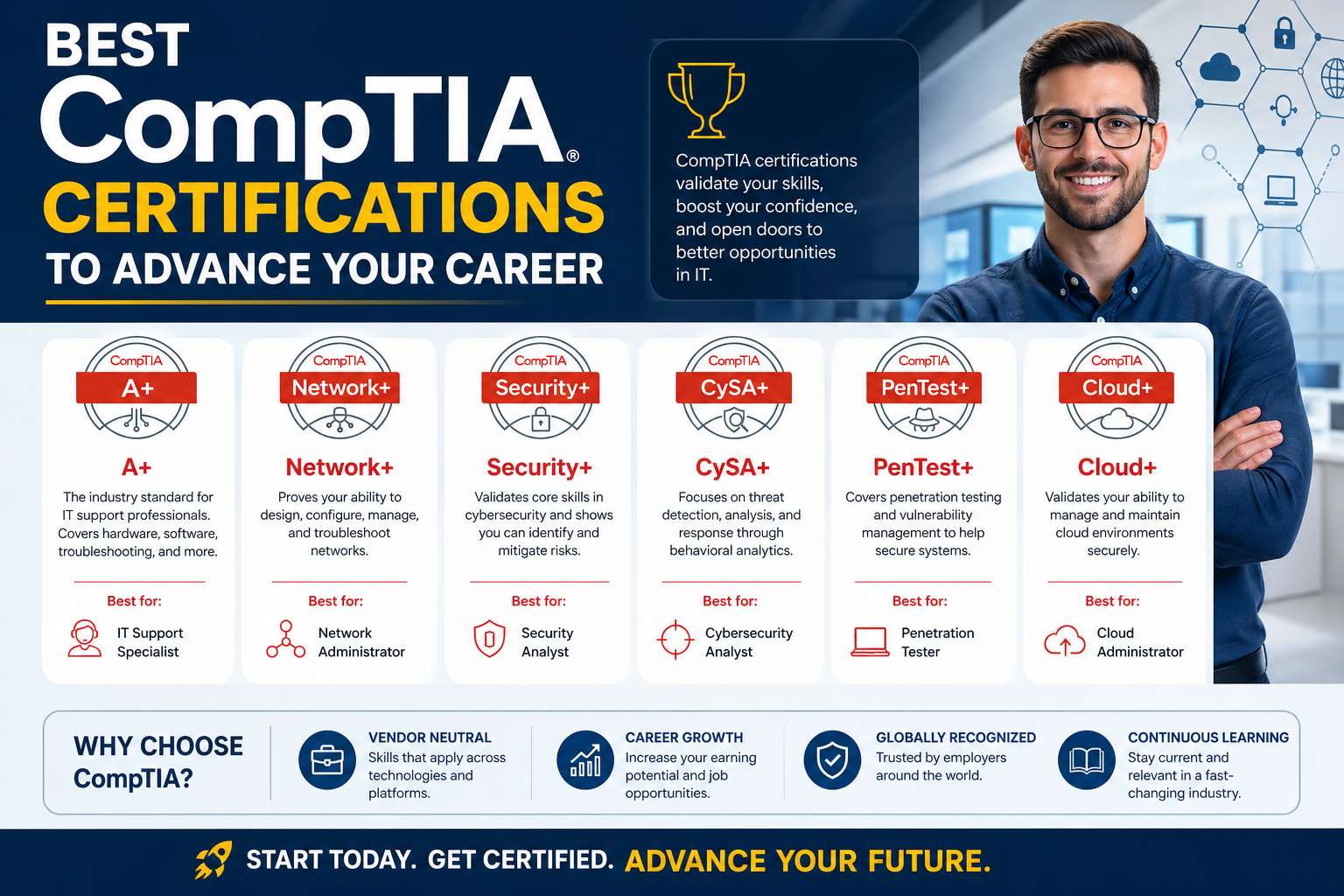
CompTIA Advanced Security Practitioner (CASP+) is a high-level certification designed for experienced cybersecurity professionals who want to validate advanced technical skills in enterprise security architecture, risk management, and incident response. Unlike management-focused security certifications, CASP+ emphasizes hands-on problem-solving and practical implementation of advanced security solutions. This certification is ideal for professionals who already have several years of cybersecurity experience and are looking to move into senior technical roles. In 2026, organizations are prioritizing professionals who can secure complex enterprise environments against increasingly sophisticated cyber threats. CASP+ demonstrates the ability to assess risks, design resilient security infrastructures, and implement effective security controls across large-scale systems. Professionals with this certification are often considered for roles such as security architect, senior security engineer, and advanced cybersecurity consultant.
CompTIA Cloud+
Cloud computing has become an essential part of modern business operations, making CompTIA Cloud+ one of the most valuable certifications to consider in 2026. This certification focuses on cloud architecture, deployment models, virtualization, cloud security, automation, and troubleshooting within hybrid and multi-cloud environments. As businesses continue migrating applications and services to cloud platforms, professionals with cloud management expertise are becoming increasingly valuable. Cloud+ is particularly beneficial because it provides vendor-neutral cloud knowledge, allowing professionals to work across multiple cloud ecosystems rather than being limited to one platform. It is a strong option for system administrators, cloud engineers, and infrastructure specialists who want to expand their expertise and remain competitive in an evolving technology landscape.
CompTIA Linux+
Linux remains one of the most widely used operating systems for servers, cloud environments, cybersecurity tools, and enterprise infrastructure. CompTIA Linux+ validates the ability to manage Linux systems, configure services, automate tasks, secure environments, and troubleshoot operational issues. In 2026, Linux skills continue to be essential for professionals working in cloud administration, DevOps, system engineering, and cybersecurity operations. This certification demonstrates practical technical proficiency and shows employers that a professional can effectively manage Linux-based environments. Since many critical enterprise systems rely on Linux, this certification can significantly improve career opportunities for IT professionals seeking infrastructure or system administration roles.
CompTIA Data+
Data has become a core business asset, and organizations increasingly depend on professionals who can collect, analyze, and interpret information effectively. CompTIA Data+ is designed for professionals who want to build foundational data analytics skills. It covers data mining, visualization, governance, quality control, statistical analysis, and reporting techniques. In 2026, companies across industries are placing greater emphasis on data-driven decision-making, making this certification highly relevant. Professionals who earn Data+ gain the skills needed to transform raw information into actionable insights that support business growth and operational efficiency. This certification is an excellent choice for business analysts, data specialists, and IT professionals looking to expand into analytics-focused roles.
CompTIA Server+
CompTIA Server+ is specifically designed for professionals responsible for server deployment, administration, maintenance, and troubleshooting. It validates skills related to server hardware, storage systems, virtualization, disaster recovery, security, and performance optimization. As organizations continue relying on both on-premises and hybrid infrastructure, server management expertise remains highly valuable. In 2026, professionals with strong server administration skills are needed to ensure reliability, scalability, and performance across critical systems. Server+ is particularly useful for system administrators, data center technicians, and IT professionals who work with enterprise-level server environments.
Choosing the Right Certification Path
Selecting the best CompTIA certification depends on your current experience level, career goals, and area of interest. For beginners entering the IT industry, starting with A+ provides a strong foundation in technical support and hardware troubleshooting. After building foundational knowledge, many professionals progress to Network+ to strengthen networking expertise and then move to Security+ to develop cybersecurity knowledge. This pathway provides a balanced understanding of core IT concepts and opens doors to multiple career directions.
For professionals interested specifically in cybersecurity, Security+ is often the logical starting point. Once foundational security skills are established, progressing to CySA+ or PenTest+ allows professionals to specialize in either defensive security operations or offensive security testing. Experienced professionals seeking senior-level technical positions often pursue CASP+ to demonstrate advanced expertise.
Those interested in infrastructure and cloud technologies may find Cloud+, Linux+, and Server+ more aligned with their career objectives. These certifications provide specialized knowledge for managing modern enterprise environments. Professionals with analytical interests may benefit greatly from Data+, which supports careers focused on reporting, business intelligence, and data analysis.
Choosing a certification path strategically ensures each credential builds upon previous knowledge while aligning with long-term career ambitions.
How CompTIA Certifications Improve Career Opportunities
CompTIA certifications provide measurable career benefits because they demonstrate validated technical competence to employers. Hiring managers often use certifications as indicators of readiness, especially when evaluating candidates for technical roles. In many organizations, certifications help candidates stand out during recruitment and can serve as proof of commitment to professional development.
Certifications also help bridge the gap between theoretical learning and practical application. Many professionals gain technical knowledge through self-study, academic coursework, or job experience, but certifications provide standardized validation that employers can trust. This can be especially valuable for career changers entering the IT industry without extensive work experience.
In 2026, the job market continues to reward specialized skills. Organizations increasingly seek professionals with expertise in cybersecurity, cloud management, systems administration, and data analysis. CompTIA certifications allow candidates to showcase focused knowledge in these areas, making them more competitive for interviews and promotions.
Beyond securing new job opportunities, certifications can also support career progression within existing roles. Employees who pursue relevant certifications often gain increased responsibility, access to higher-level projects, and improved chances of advancement. Employers frequently recognize certified professionals as valuable assets capable of handling more complex technical challenges.
The Growing Demand for Cybersecurity Skills
Cybersecurity remains one of the fastest-growing sectors in technology, making CompTIA security certifications particularly valuable in 2026. As organizations face increasing cyber threats, they require skilled professionals to secure systems, monitor vulnerabilities, and respond to incidents effectively.
Security+ provides foundational knowledge for professionals entering cybersecurity, while CySA+ builds analytical expertise for identifying threats and responding to incidents. PenTest+ supports offensive security careers focused on vulnerability discovery and remediation, while CASP+ validates advanced architectural and implementation capabilities.
Businesses are investing heavily in cybersecurity because digital threats can result in financial loss, reputational damage, and operational disruption. This growing investment creates strong demand for qualified professionals across industries, including healthcare, finance, government, education, and technology.
Professionals who pursue cybersecurity-focused CompTIA certifications position themselves for some of the most stable and lucrative opportunities in the IT sector. The practical, hands-on nature of these certifications ensures candidates are prepared for real-world challenges.
How to Prepare Effectively for CompTIA Exams
Success in CompTIA certification exams requires structured preparation and consistent practice. The first step is understanding the official exam objectives, which outline the topics covered in each certification. Reviewing these objectives helps candidates focus on essential concepts and create an organized study plan.
Hands-on practice is especially important because many CompTIA exams test practical application rather than memorization alone. Setting up virtual labs, practicing system configurations, troubleshooting technical issues, and working with simulated environments can significantly improve readiness.
Practice exams are another valuable preparation tool. They help identify weak areas, familiarize candidates with question formats, and improve time management during the actual exam. Reviewing incorrect answers carefully helps reinforce understanding and close knowledge gaps.
Study groups and online learning communities can also support preparation by providing shared resources, explanations, and encouragement. Engaging with others preparing for the same certification often improves motivation and understanding.
Consistency is key. Setting aside regular study time and following a realistic schedule helps ensure thorough preparation without burnout. Effective preparation not only increases exam success rates but also builds practical knowledge that can be applied immediately in professional environments.
Why Vendor-Neutral Certifications Remain Valuable
One of the strongest advantages of CompTIA certifications is their vendor-neutral approach. Unlike certifications tied to specific technologies or platforms, CompTIA focuses on universal concepts and practical skills applicable across diverse environments.
This flexibility is particularly valuable in 2026, as organizations increasingly operate complex hybrid infrastructures that combine multiple platforms, cloud services, and technologies. Vendor-neutral certifications prepare professionals to adapt to changing tools and environments rather than being limited to a single ecosystem.
Employers appreciate this versatility because it allows certified professionals to contribute across a broad range of technical situations. It also gives professionals greater career mobility, enabling them to transition between industries, organizations, and technology stacks more easily.
Vendor-neutral certifications often provide the foundational knowledge needed before pursuing platform-specific specializations. For example, a professional may earn Network+ before specializing in advanced networking technologies or complete Cloud+ before focusing on specific cloud platforms.
This broad applicability makes CompTIA certifications a strong long-term investment for career development.
Building a Future-Proof IT Career
Technology evolves rapidly, and professionals must continuously adapt to remain competitive. CompTIA certifications provide a structured way to build current, relevant skills that align with industry needs. They help professionals stay updated with modern technologies while demonstrating commitment to ongoing learning.
In 2026, employers are increasingly looking for candidates who combine technical competence with adaptability. Certifications show not only knowledge but also the willingness to invest in professional growth.
A future-proof IT career requires both foundational understanding and specialized expertise. CompTIA offers certifications across multiple domains, allowing professionals to build a balanced skill set that evolves with changing market demands.
By carefully selecting certifications that align with emerging trends such as cybersecurity, cloud computing, data analytics, and infrastructure management, professionals can create a resilient career path capable of adapting to future technological shifts.
The Role of CompTIA Certifications in Professional Growth
Professional growth in the information technology industry often depends on continuous learning and the ability to demonstrate updated technical skills. CompTIA certifications play a critical role in helping professionals remain competitive as technology continues to evolve. These certifications provide structured learning paths that allow individuals to deepen their expertise while aligning with industry demands. In 2026, employers are increasingly looking for candidates who can prove both technical knowledge and practical problem-solving capabilities. CompTIA certifications offer this validation by covering real-world scenarios and hands-on technical concepts that directly translate into workplace performance.
Technology professionals who earn certifications often gain greater confidence in their abilities because the preparation process reinforces practical understanding. This confidence becomes especially valuable when handling technical challenges, collaborating on projects, or pursuing leadership opportunities. Certified professionals frequently stand out because they demonstrate initiative, discipline, and a commitment to staying current in a rapidly changing field.
How Entry-Level Professionals Benefit from CompTIA Certifications
For individuals entering the IT industry, CompTIA certifications provide a clear starting point. Beginning a technology career can feel overwhelming because of the wide range of available roles, including technical support, networking, systems administration, cloud engineering, and cybersecurity. Certifications such as A+ and Network+ help narrow this uncertainty by providing foundational knowledge that applies across multiple technical disciplines.
Entry-level certifications give new professionals the confidence to apply for roles they might otherwise consider out of reach. Employers often use these certifications as evidence that candidates possess baseline technical competency, even if they lack extensive professional experience. This is especially beneficial for recent graduates, career changers, and self-taught learners who need a recognized credential to validate their skills.
The practical nature of these certifications also helps candidates perform better during technical interviews. Understanding troubleshooting methodologies, networking concepts, operating systems, and security basics allows candidates to answer questions more effectively and demonstrate real understanding rather than theoretical familiarity.
Mid-Level Career Advancement Through Specialized Certifications
As professionals gain experience, specialized CompTIA certifications become valuable tools for career advancement. Mid-level roles often require more focused technical expertise, and certifications such as Security+, CySA+, PenTest+, Cloud+, and Linux+ help professionals demonstrate readiness for more complex responsibilities.
At this stage, certifications can support transitions into specialized career paths. A help desk professional with several years of experience may pursue Network+ and Security+ to move into systems administration or cybersecurity. A system administrator may earn Cloud+ to transition into cloud engineering roles. A security analyst may pursue CySA+ or PenTest+ to move into threat analysis or ethical hacking.
Specialized certifications not only improve technical competence but also signal career direction to employers. They show intentional professional development and indicate that a candidate is building expertise aligned with organizational needs.
The Financial Value of CompTIA Certifications
One of the most compelling reasons to pursue CompTIA certifications is their potential financial impact. While salaries depend on location, industry, experience, and role, certified professionals often gain access to higher-paying opportunities because certifications increase perceived value in the job market.
Employers frequently view certifications as evidence of lower onboarding risk. Certified candidates often require less initial training because they already possess validated knowledge. This can make them more attractive during hiring decisions and salary negotiations.
Certifications may also contribute to internal salary increases. Many organizations reward employees who complete relevant certifications by offering promotions, bonuses, or expanded responsibilities. In some cases, employers reimburse certification costs because they recognize the long-term value of investing in employee development.
In 2026, technology continues to command strong salaries, particularly in cybersecurity, cloud infrastructure, and systems management. CompTIA certifications can serve as stepping stones into these lucrative areas.
CompTIA Certifications and Career Flexibility
Career flexibility has become increasingly important in the modern workforce. Professionals often change roles, industries, or technical specializations throughout their careers. CompTIA certifications support this flexibility because they provide broad, transferable knowledge.
A professional who begins in technical support may later transition into networking, cybersecurity, or cloud administration. The foundational skills learned through certifications make these transitions smoother. This adaptability is especially valuable as technological priorities shift and new opportunities emerge.
Vendor-neutral certifications are particularly useful because they focus on concepts rather than proprietary tools. This allows professionals to work across different environments and adapt to various organizational technology stacks.
Career flexibility also supports resilience during economic or industry changes. Professionals with broad technical capabilities are often better positioned to pivot into high-demand roles when market conditions evolve.
The Importance of Practical Knowledge
A key strength of CompTIA certifications is their emphasis on practical application. Employers increasingly value professionals who can apply technical knowledge effectively rather than simply recall theoretical concepts.
CompTIA exams often test real-world scenarios that require troubleshooting, analysis, and decision-making. This approach ensures certified professionals understand how to solve practical problems rather than relying solely on memorization.
Hands-on preparation further strengthens these abilities. Building virtual labs, configuring systems, testing network environments, and practicing security assessments allow candidates to develop confidence and technical fluency.
Practical knowledge is especially important in fast-paced IT environments where professionals must diagnose issues quickly and implement effective solutions. Certifications that emphasize applied skills prepare candidates for these real-world demands.
Why Continuous Learning Matters in 2026
Technology evolves rapidly, making continuous learning essential for long-term success. New cybersecurity threats emerge regularly, cloud platforms expand their capabilities, networking architectures become more sophisticated, and data systems grow increasingly complex.
CompTIA certifications encourage continuous learning by providing clear progression paths. Professionals can begin with foundational certifications and gradually move toward more advanced specializations.
This structured development helps individuals maintain relevance throughout their careers. Employers value professionals who stay current because they bring updated knowledge and can contribute to modern technical initiatives.
Continuous learning also supports personal confidence and professional satisfaction. Staying informed about emerging technologies enables professionals to engage with innovation rather than feeling left behind by industry changes.
Certification Stacking for Stronger Career Outcomes
Certification stacking is a strategic approach that involves earning multiple complementary certifications to build comprehensive expertise. This method is highly effective for CompTIA certifications because the credentials are designed to build upon one another.
For example, a professional pursuing cybersecurity may earn Network+ to establish networking knowledge, followed by Security+ for foundational security concepts, CySA+ for defensive analytics, and PenTest+ for offensive testing skills.
Someone focused on infrastructure might combine A+, Network+, Linux+, Server+, and Cloud+ to create a strong systems and cloud administration profile.
Stacking certifications provides broader competence while reinforcing interconnected technical concepts. Employers often appreciate candidates with layered expertise because they can contribute across multiple operational areas.
This approach also creates clearer long-term career progression by helping professionals move from foundational knowledge toward advanced specialization.
CompTIA Certifications for Career Changers
Career changers often face the challenge of demonstrating credibility in a new field. CompTIA certifications provide an effective solution because they offer recognized validation without requiring years of prior industry experience.
Individuals transitioning from unrelated industries can use certifications to demonstrate technical readiness. The structured learning paths help build foundational understanding while preparing candidates for entry-level opportunities.
For many career changers, certifications provide confidence by creating measurable milestones. Completing an exam validates progress and provides reassurance that they are developing marketable skills.
The technology industry remains one of the most accessible fields for motivated learners willing to invest in skill development. CompTIA certifications make this transition more achievable by offering clear, respected pathways into technical careers.
Long-Term Career Planning with CompTIA
Successful career growth requires long-term planning. CompTIA certifications support this by offering credentials across multiple domains and experience levels.
Professionals can map certifications to specific career goals. Someone aiming for cybersecurity leadership may progress from Security+ to CySA+ and eventually CASP+. A future cloud architect might build through Network+, Linux+, Server+, and Cloud+.
This strategic planning helps professionals avoid random certification choices and ensures each credential contributes to a coherent development path.
Long-term certification planning also helps professionals stay motivated. Seeing clear progression milestones provides direction and makes professional development more purposeful.
Industry Recognition and Employer Trust
CompTIA certifications maintain strong recognition because they are developed to reflect current industry needs. Employers trust these credentials because they assess practical competencies relevant to real-world roles.
Many organizations specifically reference CompTIA certifications in job postings. Government agencies, private enterprises, managed service providers, educational institutions, and healthcare organizations often seek certified candidates.
This widespread recognition increases the value of CompTIA credentials across industries. Certified professionals benefit from stronger mobility and broader employment opportunities.
Employer trust also contributes to professional credibility. Holding respected certifications can improve confidence during interviews, team collaborations, and project discussions.
Building Confidence Through Certification Achievement
Certification success often creates momentum for broader professional growth. Preparing for and passing a challenging exam requires discipline, persistence, and technical focus.
This achievement builds confidence that extends beyond certification itself. Professionals often feel more prepared to take on challenging projects, pursue promotions, or explore advanced technical areas.
Confidence plays a major role in career advancement because it influences communication, initiative, and problem-solving effectiveness. Certified professionals frequently demonstrate stronger professional presence because they trust their validated abilities.
This psychological benefit should not be underestimated. Confidence often opens doors to opportunities that technical knowledge alone might not secure.
Preparing for Future Technology Trends
The future of technology will continue to emphasize automation, cybersecurity resilience, cloud-native systems, data intelligence, and infrastructure optimization. CompTIA certifications help professionals prepare for these evolving trends.
Foundational certifications establish versatile technical understanding, while specialized credentials build expertise aligned with future demands.
Preparing for future trends requires both technical depth and adaptability. CompTIA’s broad certification ecosystem supports this balance by enabling professionals to expand and refine skills over time.
Those who invest in continuous certification-based learning position themselves to thrive as new technologies emerge and reshape the IT landscape.
Building Technical Expertise Through CompTIA Certification Paths
CompTIA certifications provide structured learning paths that help professionals systematically build technical expertise over time. Instead of learning disconnected concepts, candidates progress through carefully designed certification tracks that reinforce foundational principles while introducing increasingly advanced topics. This layered approach allows professionals to develop deeper understanding and practical competence.
For example, foundational certifications introduce core concepts such as hardware components, network fundamentals, and operating system management. As professionals advance, they encounter more specialized topics like cybersecurity monitoring, penetration testing, cloud deployment, and enterprise security architecture. This progression mirrors real-world career development, where professionals begin with broad technical exposure before narrowing into specialized domains.
In 2026, organizations increasingly prefer candidates with clear, progressive learning histories because these individuals often demonstrate stronger adaptability and technical maturity. Certification paths help create that progression while ensuring each new credential builds naturally on prior knowledge.
The Expanding Influence of Cybersecurity Certifications
Cybersecurity continues to dominate technology hiring priorities. As digital systems become more interconnected and threats grow increasingly sophisticated, organizations are making cybersecurity one of their highest investment areas. This has significantly increased the value of CompTIA cybersecurity certifications.
Security+ remains one of the most recognized entry points into security-focused careers. It establishes essential knowledge of threat management, access control, risk mitigation, and incident response. For many professionals, it serves as the first step toward deeper specialization.
CySA+ expands these capabilities by focusing on behavioral analytics, threat intelligence, and continuous monitoring. Professionals with this certification are equipped to detect suspicious activity, analyze vulnerabilities, and respond effectively to security incidents.
PenTest+ addresses offensive security practices by validating penetration testing and vulnerability assessment skills. Ethical hacking continues to grow as organizations proactively identify weaknesses before malicious actors can exploit them.
CASP+ represents advanced technical expertise in designing and implementing enterprise-level security solutions. It is especially valuable for professionals seeking senior technical leadership roles.
The expanding influence of these certifications reflects broader market realities. Cybersecurity is no longer optional for organizations; it is a core operational necessity. Professionals with validated security skills remain among the most sought-after candidates in the technology workforce.
Cloud Transformation and Certification Relevance
Cloud technology has transformed how businesses operate. Organizations increasingly depend on scalable, flexible infrastructure to support applications, data storage, remote collaboration, and digital services.
CompTIA Cloud+ is especially relevant because it addresses cloud architecture, deployment, operations, troubleshooting, and security in hybrid and multi-cloud environments. Unlike vendor-specific certifications, Cloud+ focuses on universal concepts applicable across diverse cloud platforms.
This broad applicability is particularly valuable in 2026 because organizations rarely rely on a single cloud ecosystem. Many operate hybrid infrastructures combining public cloud, private cloud, and on-premises systems.
Professionals with Cloud+ certification demonstrate the ability to manage these complex environments effectively. This makes them attractive candidates for roles involving infrastructure modernization, cloud migration, and operational optimization.
Cloud transformation also intersects with automation, DevOps practices, and cybersecurity. As a result, cloud-certified professionals often find opportunities to contribute across multiple technical domains.
Networking Skills Remain Essential
Despite rapid advancements in cloud and cybersecurity technologies, networking remains a foundational discipline in information technology. Every digital system depends on reliable communication between devices, services, and users.
CompTIA Network+ continues to hold strong value because it provides essential understanding of network design, protocols, routing, switching, troubleshooting, and security principles.
Networking expertise supports numerous career paths, including systems administration, cloud engineering, cybersecurity, and technical support. Even professionals specializing in unrelated domains benefit from understanding how data moves across networks.
In 2026, networking has become even more critical as organizations support distributed workforces, edge computing, and increasingly connected environments. Network performance, resilience, and security directly affect business continuity.
Professionals with strong networking foundations often adapt more easily to specialized technical roles because they understand the underlying infrastructure supporting modern systems.
Linux and Open-Source Skills in Modern IT
Linux continues to power much of the world’s digital infrastructure. From web servers and cloud platforms to containerized applications and cybersecurity tools, Linux remains central to enterprise technology operations.
CompTIA Linux+ validates practical administration skills, including system configuration, scripting, security management, process monitoring, and troubleshooting.
In 2026, Linux knowledge is particularly valuable because modern infrastructure increasingly depends on open-source technologies. Container orchestration platforms, automation tools, and cloud-native systems frequently operate within Linux-based environments.
Professionals with Linux expertise often gain advantages in cloud engineering, DevOps, cybersecurity, and systems administration roles.
Linux also encourages deeper technical understanding because working within command-line environments often requires stronger conceptual knowledge than relying solely on graphical interfaces. This depth contributes to stronger troubleshooting and problem-solving capabilities.
The Strategic Importance of Data Skills
Data-driven decision-making has become essential across nearly every industry. Organizations collect massive amounts of information but require skilled professionals to transform that data into actionable insights.
CompTIA Data+ addresses this need by validating skills in data collection, analysis, visualization, governance, and interpretation.
While often associated with analytics roles, data literacy benefits professionals across technical disciplines. Cybersecurity analysts use data to detect anomalies. Infrastructure engineers analyze performance metrics. Cloud administrators evaluate resource utilization.
In 2026, professionals who combine technical infrastructure knowledge with data analysis capabilities often stand out because they can connect operational performance with strategic decision-making.
Data+ provides a practical foundation for this growing skill area and helps professionals contribute more effectively to data-informed business initiatives.
Server Management in Hybrid Environments
Although cloud adoption continues to expand, server administration remains highly relevant. Many organizations maintain hybrid environments where on-premises servers work alongside cloud-based systems.
CompTIA Server+ validates expertise in server deployment, maintenance, security, virtualization, storage management, and troubleshooting.
Hybrid infrastructure introduces complexity because professionals must manage interoperability between traditional and cloud systems. Server+ prepares candidates to handle these challenges effectively.
In industries with strict compliance requirements or specialized operational needs, on-premises infrastructure often remains critical. This ensures ongoing demand for server administration expertise.
Professionals with server management skills frequently support business continuity, system performance, and operational reliability, making them indispensable in enterprise environments.
How Certifications Strengthen Problem-Solving Skills
One of the most valuable benefits of CompTIA certification preparation is the development of stronger problem-solving skills.
Certification exams often present scenario-based questions requiring candidates to analyze situations, identify issues, and determine effective solutions. This approach mirrors workplace problem-solving demands.
During preparation, candidates frequently encounter troubleshooting exercises involving network failures, security incidents, configuration errors, and system performance issues.
Working through these scenarios strengthens analytical thinking and technical reasoning.
Problem-solving ability is highly valued because technology roles often involve diagnosing unfamiliar issues under pressure. Employers seek professionals who can think critically and resolve challenges efficiently.
CompTIA certifications help cultivate this capability by emphasizing applied knowledge rather than passive memorization.
The Value of Certification Discipline
Preparing for certification requires consistency, planning, and disciplined study habits. These qualities often translate directly into professional success.
Candidates must set goals, manage time effectively, maintain focus, and persist through challenging material.
This discipline reflects positively in workplace settings, where successful professionals must often manage deadlines, learn new systems, and adapt to evolving requirements.
Employers often recognize certification achievement as evidence of self-motivation and professional commitment.
In 2026, where technology professionals must continuously update skills, the discipline developed through certification preparation becomes an important long-term advantage.
Using Certifications to Build Professional Credibility
Credibility is critical in technical careers. Professionals often need to earn trust from employers, colleagues, and clients when recommending solutions or managing systems.
CompTIA certifications strengthen credibility by providing recognized, objective validation of technical competence.
This can be especially important for early-career professionals who are still building practical experience.
Certification-backed credibility often helps professionals gain opportunities to lead projects, participate in technical discussions, and contribute to strategic initiatives.
Over time, this increased visibility supports stronger career advancement.
Creating a Balanced Skill Portfolio
Long-term career success often depends on maintaining a balanced mix of foundational knowledge and specialized expertise.
CompTIA certifications support this balance by covering diverse domains including hardware, networking, security, cloud, Linux, servers, and data analytics.
Professionals who combine broad foundational understanding with focused specialization often adapt more effectively to changing market demands.
For example, a cybersecurity professional with networking and Linux expertise may perform more effectively than someone with security knowledge alone.
Similarly, a cloud administrator with server and data analysis skills may contribute more strategically to organizational initiatives.
Balanced skill portfolios increase versatility, resilience, and long-term career opportunities.
The Importance of Certification Renewal and Skill Maintenance
Technology changes rapidly, which means certification achievement should not mark the end of professional development.
Many CompTIA certifications require continuing education or renewal to ensure professionals remain current.
This encourages ongoing learning and prevents knowledge stagnation.
In 2026, maintaining current skills is especially important because technologies evolve quickly and outdated knowledge can limit effectiveness.
Renewal processes often expose professionals to emerging trends, updated best practices, and evolving technical standards.
This continuous engagement strengthens long-term career relevance.
Positioning Yourself for Future Leadership
Technical leadership increasingly requires more than technical expertise alone. Leaders must understand systems holistically, communicate effectively, assess risks, and support organizational strategy.
CompTIA certifications help build this foundation by encouraging broad technical understanding and structured progression.
Advanced certifications such as CASP+ particularly support leadership readiness by emphasizing enterprise-level thinking and strategic implementation.
Professionals who combine technical certifications with communication and project management skills often position themselves well for leadership opportunities.
In 2026, organizations seek leaders who can bridge technical depth with business alignment. Certification-based development supports this transition.
A Long-Term Investment in Career Success
CompTIA certifications remain one of the most effective long-term investments for technology professionals.
They provide practical knowledge, strengthen professional credibility, support specialization, and create structured pathways for advancement.
As technology continues evolving, professionals who commit to continuous learning and validated skill development remain best positioned for success.
Whether pursuing foundational credentials or advanced technical certifications, each step contributes to broader competence and stronger career resilience.
The value of these certifications extends beyond immediate job opportunities. They build confidence, discipline, adaptability, and professional identity.
For anyone serious about building a lasting technology career in 2026 and beyond, CompTIA certifications continue to offer a reliable and respected route toward meaningful professional growth.
Adapting to Industry Changes Through CompTIA Certifications
The technology industry evolves at an extraordinary pace, making adaptability one of the most valuable qualities any professional can possess. New frameworks, emerging cybersecurity threats, infrastructure transformations, and cloud innovations constantly reshape how businesses operate. CompTIA certifications provide a practical way for professionals to keep pace with these changes while building technical skills that remain relevant across shifting industry trends.
In 2026, adaptability is no longer an optional advantage. It has become a professional necessity. Organizations need individuals who can quickly learn new systems, adjust to evolving security requirements, and support changing technical environments. CompTIA certifications prepare professionals for this reality by emphasizing broad technical understanding and practical application rather than narrow theoretical learning.
By continuously pursuing relevant certifications, professionals position themselves as adaptable contributors capable of handling technological transitions with confidence. This flexibility not only supports job security but also opens doors to emerging career opportunities.
The Competitive Advantage of Certified Professionals
In an increasingly crowded job market, standing out requires more than listing general technical experience. Employers often receive applications from candidates with similar educational backgrounds and comparable work histories. Certifications help differentiate professionals by providing clear, measurable evidence of competency.
CompTIA certifications create a competitive advantage because they demonstrate initiative. Earning a certification requires commitment, focused study, and technical understanding. Employers recognize that candidates who pursue certifications are often proactive learners willing to invest in professional growth.
This advantage becomes especially important when competing for promotions or specialized technical roles. A certified candidate may be viewed as better prepared to take on advanced responsibilities, contribute to strategic projects, or support organizational transformation efforts.
The competitive edge provided by certifications extends beyond hiring decisions. It often influences project assignments, leadership opportunities, and professional recognition within organizations.
CompTIA Certifications as a Foundation for Specialization
One of the greatest strengths of CompTIA certifications is their ability to serve as stepping stones toward deeper specialization. Technology careers rarely remain static. Professionals often begin with broad foundational roles before moving into highly specialized domains.
For example, a professional starting with CompTIA A+ may later pursue Network+ to strengthen infrastructure knowledge. From there, Security+ can open the path toward cybersecurity specialization. Further certifications such as CySA+, PenTest+, or CASP+ can support advanced expertise.
Similarly, someone interested in infrastructure may combine Network+, Linux+, Server+, and Cloud+ to build a comprehensive systems engineering profile.
This progression allows professionals to explore career directions while developing technical depth. It creates flexibility without sacrificing focus.
Specialization is particularly valuable in 2026 because organizations increasingly seek experts who can solve specific technical challenges. CompTIA certifications provide the structure needed to build that expertise systematically.
How Certifications Support Organizational Success
The benefits of certification extend beyond individual career advancement. Organizations also gain significant value from employing certified professionals.
Certified employees often contribute to improved operational efficiency because they possess validated technical skills that reduce errors, improve troubleshooting accuracy, and enhance system reliability.
In cybersecurity, certified professionals help organizations strengthen defenses against threats, reducing risk exposure and improving incident response readiness.
In infrastructure and cloud operations, certified staff contribute to optimized performance, smoother deployments, and more effective resource management.
Many organizations actively encourage certification because it enhances internal capability and reduces dependency on external consultants.
This mutual benefit creates strong incentives for employers to support certification efforts through reimbursement programs, training opportunities, and recognition initiatives.
Professionals who pursue certifications often become valuable internal resources, contributing to both technical excellence and organizational resilience.
Bridging Knowledge Gaps Through Structured Learning
One challenge many technology professionals face is identifying knowledge gaps.
Practical experience often develops unevenly depending on specific job responsibilities. Someone working primarily in technical support may have strong troubleshooting skills but limited exposure to cloud architecture. A network administrator may understand infrastructure deeply but lack cybersecurity analytics experience.
CompTIA certifications help bridge these gaps by providing structured, comprehensive coverage of technical domains.
Certification preparation exposes candidates to concepts they may not encounter regularly in their current roles. This broadens understanding and creates more well-rounded professionals.
Bridging knowledge gaps improves career versatility and strengthens confidence when tackling unfamiliar technical challenges.
It also prepares professionals for role transitions, ensuring they possess the foundational knowledge required to succeed in new responsibilities.
The Psychological Benefits of Certification Achievement
While technical and career benefits are often emphasized, the psychological impact of earning certifications is equally important.
Certification achievement reinforces self-confidence and creates a sense of accomplishment.
Technology careers can be demanding, and professionals sometimes doubt their readiness for advanced roles or challenging projects. Successfully earning a respected certification provides objective validation of capability.
This confidence often influences professional behavior in meaningful ways.
Certified professionals may feel more comfortable contributing to technical discussions, proposing solutions, pursuing promotions, or applying for ambitious roles.
Confidence also supports stronger decision-making under pressure, which is especially valuable in technical environments where rapid problem-solving is essential.
The psychological momentum created by certification success often encourages continued learning and greater professional ambition.
The Importance of Strategic Certification Selection
Not every certification offers equal value for every professional.
The most effective certification strategy involves aligning credentials with career goals, market demand, and personal interests.
A professional interested in cybersecurity should prioritize Security+, CySA+, or PenTest+ rather than focusing solely on unrelated infrastructure certifications.
Someone pursuing cloud engineering may benefit more from Cloud+, Linux+, and Server+.
Strategic selection ensures time and effort produce meaningful career returns.
Before choosing a certification, professionals should assess current skills, target roles, and industry trends.
Researching job descriptions can provide valuable insight into which certifications employers prioritize.
In 2026, strategic planning is especially important because technology offers many specialization paths. Choosing certifications thoughtfully helps create focused professional growth.
Preparing for Lifelong Learning
Technology careers require continuous development.
No single certification guarantees permanent relevance because tools, threats, and best practices evolve constantly.
CompTIA certifications help establish a lifelong learning mindset by encouraging professionals to regularly update skills and pursue new knowledge.
This mindset becomes a major career advantage over time.
Professionals who embrace continuous learning adapt more easily to change, remain competitive, and often progress faster into advanced roles.
Lifelong learning also fosters curiosity and innovation.
Professionals who consistently expand their knowledge are more likely to identify opportunities, propose improvements, and contribute creatively to technical challenges.
CompTIA’s certification ecosystem supports this journey by offering multiple pathways for ongoing development.
Future Opportunities for Certified Professionals
The future technology landscape will continue creating opportunities across cybersecurity, cloud infrastructure, automation, data analysis, systems engineering, and emerging digital technologies.
Certified professionals are well positioned to capitalize on these opportunities because they possess validated skills aligned with evolving market needs.
As organizations continue digitizing operations, expanding cloud adoption, and strengthening cybersecurity defenses, demand for technically capable professionals will remain strong.
Professionals with recognized certifications often gain earlier access to these opportunities because employers trust their validated expertise.
This trust can accelerate career progression and increase access to innovative, high-impact roles.
The opportunities created by certification extend globally as well. CompTIA’s international recognition supports career mobility across industries and geographic regions.
For professionals seeking long-term growth, this broad recognition adds significant value.
Building a Personal Brand Through Certification
Professional success increasingly involves building a recognizable personal brand.
Certifications contribute to this by signaling expertise, discipline, and commitment to excellence.
A strong certification portfolio can enhance resumes, professional networking profiles, and credibility during interviews or industry discussions.
It communicates a clear message about technical capability and professional seriousness.
Over time, this contributes to stronger professional reputation.
Certified professionals often attract more opportunities because they are perceived as reliable, knowledgeable, and growth-oriented.
Building a personal brand through certification is especially valuable in competitive technical fields where reputation influences career momentum.
Creating Long-Term Career Stability
One of the most practical reasons to pursue CompTIA certifications is career stability.
Technology remains dynamic, but professionals with validated, adaptable skills are better positioned to navigate uncertainty.
Certifications provide transferable expertise that supports resilience during organizational changes, economic fluctuations, or shifting industry priorities.
Professionals with broad technical foundations and specialized certifications can pivot more effectively when circumstances change.
This flexibility reduces vulnerability and strengthens long-term employability.
Career stability is not simply about holding one position for many years. It is about maintaining the ability to secure meaningful opportunities throughout an evolving professional journey.
CompTIA certifications support this stability by reinforcing relevant, marketable capabilities.
Conclusion
CompTIA certifications continue to represent some of the most valuable credentials for technology professionals seeking career advancement in 2026. Their practical focus, vendor-neutral approach, and strong industry recognition make them powerful tools for building technical competence and professional credibility.
Whether starting an IT career, transitioning into a specialized field, or pursuing senior technical leadership, CompTIA offers certifications that align with every stage of professional development.
These certifications do more than validate technical knowledge. They strengthen confidence, support continuous learning, create career flexibility, and improve long-term professional resilience.
The technology industry will continue evolving, bringing both challenges and opportunities. Professionals who invest in recognized, practical skill development will remain best positioned to thrive.
Choosing the right CompTIA certification is ultimately an investment in future success. With strategic planning, disciplined preparation, and a commitment to growth, these certifications can open doors to rewarding opportunities and help build a stable, future-ready technology career for years to come.