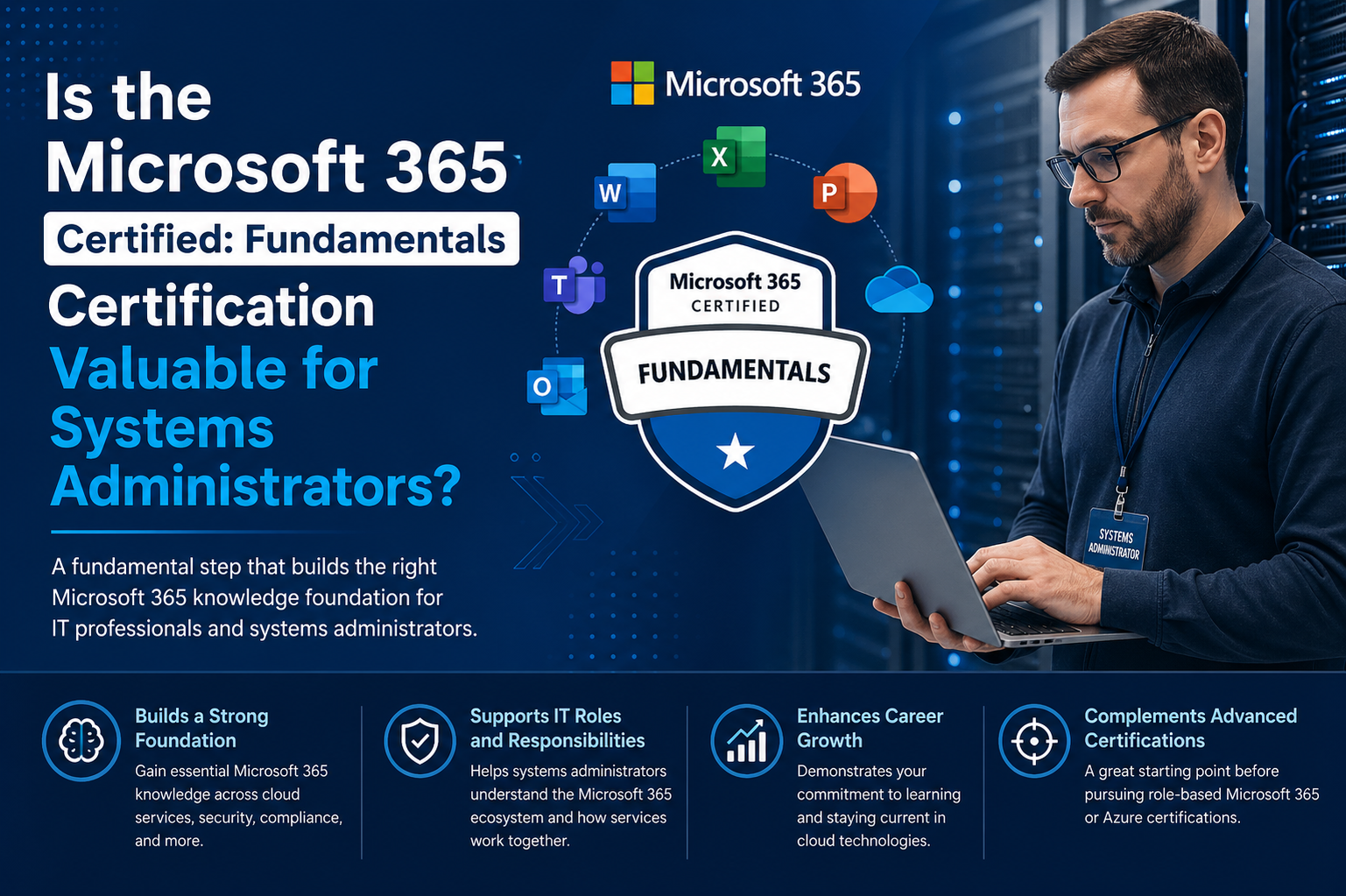
The Microsoft 365 Certified: Fundamentals certification is often seen as an entry point into the Microsoft cloud ecosystem, but its real value for systems administrators depends heavily on their current experience level, career direction, and familiarity with cloud technologies. In modern IT environments, where traditional on-premises infrastructure is rapidly merging with cloud-based services, understanding Microsoft 365 is becoming increasingly important. Systems administrators are no longer responsible only for servers, networks, and local identity systems; they are also expected to manage hybrid environments, cloud identities, security policies, and productivity platforms that operate across distributed systems.
For many professionals in systems administration, this certification represents a structured introduction to these evolving responsibilities. While it is not designed to be a deep technical credential, it plays a role in establishing foundational knowledge of cloud computing concepts and Microsoft’s ecosystem of services. This includes understanding how Microsoft 365 integrates applications like Exchange Online, SharePoint, Teams, and Entra ID (formerly Azure Active Directory) into a unified productivity and identity management environment.
Understanding the Purpose of the Certification
The Microsoft 365 Fundamentals certification is primarily designed to validate basic knowledge of cloud services and Microsoft 365 workloads. It focuses on conceptual understanding rather than hands-on technical implementation. This distinction is important for systems administrators because their day-to-day responsibilities typically require deeper technical expertise. However, before advanced administration can be effectively performed in cloud environments, a clear understanding of the underlying structure and services is essential.
This certification introduces key concepts such as cloud computing models, Software as a Service (SaaS), and the differences between Microsoft’s cloud offerings and traditional IT infrastructure. It also covers how organizations use Microsoft 365 for communication, collaboration, and security management. For systems administrators, these concepts provide a framework that helps them understand how end-user services are delivered and maintained at scale.
The Evolving Role of Systems Administrators
Systems administration has undergone a significant transformation over the past decade. In traditional environments, administrators focused heavily on physical servers, Active Directory management, patching systems, and maintaining local networks. While these responsibilities still exist in many organizations, they are increasingly integrated with cloud-based services.
Today, systems administrators are expected to manage hybrid infrastructures where on-premises systems coexist with cloud platforms. This requires knowledge of identity synchronization, conditional access policies, cloud security frameworks, and remote device management. Microsoft 365 plays a central role in this transformation because it serves as the productivity and identity backbone for many enterprises.
The Fundamentals certification helps bridge this gap by introducing how cloud services fit into the broader IT ecosystem. It does not replace technical certifications or hands-on experience, but it provides a conceptual map that helps administrators understand how different services interact within Microsoft’s cloud environment.
Core Areas Covered in the Certification
One of the key strengths of the certification is its structured introduction to Microsoft 365 services. It covers several major areas that are relevant to systems administrators, including cloud concepts, Microsoft 365 productivity tools, security and compliance fundamentals, and identity management basics.
Cloud concepts introduce the foundational ideas behind cloud computing, including scalability, elasticity, and shared responsibility models. These ideas are essential for administrators transitioning from traditional infrastructure to cloud-based systems.
Microsoft 365 services cover tools such as Exchange Online for email, SharePoint for document management, Teams for collaboration, and OneDrive for personal storage. Understanding how these services function at a high level helps administrators support users more effectively and troubleshoot issues in hybrid environments.
Security and compliance fundamentals introduce concepts such as data protection, threat management, and compliance frameworks. Even at a basic level, this knowledge is increasingly important as organizations face growing cybersecurity challenges and regulatory requirements.
Identity management introduces the role of cloud-based identity systems like Entra ID, which is central to authentication, authorization, and access control in Microsoft environments. For systems administrators, identity is often one of the most critical components of infrastructure management, especially in hybrid deployments.
Relevance in Modern IT Infrastructure
In modern IT environments, Microsoft 365 is not just a set of productivity tools; it is a core platform that connects users, devices, and services. Systems administrators are often responsible for ensuring seamless integration between on-premises infrastructure and cloud services. This includes managing user identities, enforcing security policies, and maintaining service availability across multiple platforms.
The Fundamentals certification helps professionals understand how these components fit together. While it does not provide deep technical training, it establishes a mental model of how Microsoft 365 operates within an enterprise environment. This is particularly useful when working with more advanced tools such as Intune for device management, Defender for security, or hybrid identity configurations.
For administrators who are new to cloud environments, this certification can significantly reduce the learning curve. It provides context that makes advanced topics easier to understand later. For example, understanding how Exchange Online differs from traditional Exchange Server deployments helps administrators transition more smoothly into hybrid email environments.
Value for Early-Career Professionals
For individuals who are just starting their careers in systems administration or IT support, this certification can be a valuable first step. It provides structured learning that introduces key concepts without requiring deep technical experience. This makes it accessible to beginners while still offering meaningful industry recognition.
It also helps build confidence when transitioning into more complex certifications. Many professionals use it as a stepping stone toward associate-level Microsoft certifications focused on administration, security, or enterprise management. By establishing a foundation in cloud concepts, learners are better prepared for hands-on roles that require deeper technical skills.
Limitations of the Certification
Despite its benefits, the certification has clear limitations. It is not designed to validate advanced technical skills or hands-on experience with Microsoft 365 administration. Systems administrators who already have significant experience in enterprise environments may find that it does not provide new technical depth.
It also does not cover advanced configuration tasks such as managing hybrid identity synchronization, configuring complex security policies, or administering enterprise-scale deployments. These responsibilities require more specialized training and experience.
Because of its introductory nature, the certification should be viewed as a starting point rather than a career-defining credential. It is most effective when combined with practical experience and further technical certifications.
Strategic Value in Career Development
Even with its limitations, the certification holds strategic value in career development. It signals to employers that a candidate has a foundational understanding of Microsoft 365 and cloud computing concepts. In many hiring scenarios, especially for entry-level or junior systems administrator roles, this can help differentiate candidates.
It also demonstrates a willingness to learn and adapt to evolving technologies. In the IT industry, continuous learning is essential due to rapid changes in tools, platforms, and security requirements. Having a recognized certification in cloud fundamentals can support career progression into more advanced roles.
For experienced systems administrators, the certification may serve a different purpose. It can act as a refresher or formal validation of existing knowledge, especially for those transitioning from on-premises environments to hybrid or cloud-focused roles.
Real-World Application in System Administration
In practical terms, the knowledge gained from this certification can be applied in several everyday scenarios. Systems administrators often need to support users who rely heavily on Microsoft 365 applications for communication and collaboration. Understanding how these services operate helps in troubleshooting issues such as email delivery problems, file access errors, or authentication failures.
It also supports better decision-making when configuring hybrid environments. For example, understanding how identity synchronization works between on-premises Active Directory and cloud-based identity systems can help prevent configuration errors and improve security.
Additionally, knowledge of Microsoft 365 services helps administrators collaborate more effectively with security and compliance teams. As organizations adopt stricter data protection policies, systems administrators play a key role in implementing and maintaining these controls across cloud platforms.
Hiring Perspective and Industry Recognition
From a hiring perspective, the Microsoft 365 Fundamentals certification is generally viewed as an entry-level credential. It is not typically required for senior or highly technical roles, but it can be beneficial for candidates applying for junior positions or internships.
Employers often see it as evidence that a candidate understands basic cloud concepts and is familiar with Microsoft’s ecosystem. However, it is usually combined with other qualifications or experience when evaluating candidates for systems administration roles.
In competitive job markets, certifications alone are rarely sufficient. They are most effective when paired with hands-on experience, problem-solving ability, and deeper technical certifications.
Foundation for Advanced Learning
One of the most important aspects of this certification is its role as a foundation for further learning. After completing it, many professionals move on to more advanced Microsoft certifications focused on administration, security, or enterprise architecture.
It helps build a structured learning path by introducing core concepts early. This reduces confusion when later encountering complex topics such as conditional access policies, advanced threat protection, or hybrid cloud architectures.
For systems administrators aiming to specialize in Microsoft environments, this certification can serve as the first step in a broader certification journey.
Is the Microsoft 365 Certified: Fundamentals Certification Valuable for Systems Administrators? (Part 2)
Building on the foundational understanding of Microsoft 365 Certified: Fundamentals, it is important to explore its deeper implications for systems administrators in real-world environments. While Part 1 focused on the purpose, structure, and general relevance of the certification, this section goes further into practical impact, career strategy, and how it aligns with modern enterprise expectations. In today’s IT landscape, where cloud-first strategies are becoming the default, even entry-level certifications can influence how professionals adapt to evolving responsibilities.
Practical Impact on Day-to-Day System Administration Work
For systems administrators working in hybrid or cloud-integrated environments, the concepts introduced in this certification often appear indirectly in daily tasks. Even though the certification itself is theoretical, it aligns with practical responsibilities such as managing user access, supporting cloud-based applications, and troubleshooting Microsoft 365 services used across organizations.
One of the most common real-world applications is identity and access management. Systems administrators frequently deal with user provisioning, password policies, multi-factor authentication, and access control across both on-premises and cloud systems. Understanding how Microsoft 365 integrates with Entra ID helps administrators visualize how authentication flows occur between services, even if they are not directly configuring advanced identity systems yet.
Another practical area is end-user support. Many organizations rely heavily on Microsoft 365 applications for email, document collaboration, and communication. Systems administrators are often the first line of support when issues arise in Outlook, Teams, or OneDrive. While troubleshooting requires technical skills, having a conceptual understanding of how these services are structured helps identify whether issues are user-related, service-related, or infrastructure-related.
Hybrid Environments and Transition to Cloud Administration
A major reason this certification has relevance today is the widespread adoption of hybrid IT environments. Few organizations operate purely in the cloud or purely on-premises. Instead, they maintain a mix of legacy systems and cloud-based services. This creates complexity that systems administrators must manage effectively.
The Microsoft 365 Fundamentals certification introduces key ideas that support this transition. For example, understanding how cloud services differ from traditional infrastructure helps administrators adapt their mindset from hardware-centric management to service-centric management. Instead of focusing only on servers and networks, administrators must also consider service availability, subscription-based licensing, and cloud security policies.
In hybrid environments, administrators often work with synchronization tools that connect on-premises directories with cloud identities. While the certification does not dive deeply into configuration, it provides the conceptual groundwork needed to understand why such synchronization exists and how it supports unified identity management across platforms.
This becomes especially important when troubleshooting login issues, access delays, or permission mismatches between systems. Without a foundational understanding of Microsoft 365 architecture, these problems can be difficult to diagnose efficiently.
Security Awareness and Compliance Understanding
Security has become one of the most critical aspects of modern systems administration. Organizations are increasingly concerned with data protection, regulatory compliance, and threat prevention. While the Fundamentals certification does not train administrators in advanced security engineering, it introduces essential concepts that shape security thinking.
Systems administrators benefit from understanding how Microsoft 365 approaches security at a high level. This includes awareness of data classification, threat detection, and compliance frameworks. Even basic familiarity with these concepts helps administrators make better decisions when configuring systems or responding to security incidents.
For example, when working with Microsoft 365 services, administrators may need to understand how policies affect data sharing, email retention, or external collaboration. The certification introduces the idea that security in cloud environments is shared between the provider and the organization, which is a significant shift from traditional infrastructure security models.
This awareness becomes increasingly valuable when collaborating with cybersecurity teams. Systems administrators often act as implementers of security policies, even if they are not the ones designing them. Having a shared understanding of Microsoft 365 security principles improves communication and reduces configuration errors.
Career Development and Long-Term Growth
From a career development perspective, the Microsoft 365 Fundamentals certification should be viewed as a stepping stone rather than a final destination. Its value lies in preparing professionals for more advanced roles in cloud administration, systems engineering, and enterprise IT management.
For early-career systems administrators, it can help establish credibility and demonstrate initiative. Employers often appreciate candidates who show a willingness to learn cloud technologies, especially as organizations continue migrating to Microsoft 365 environments.
However, career advancement in systems administration typically depends on deeper technical skills. This includes managing Active Directory environments, configuring group policies, deploying enterprise applications, and working with advanced cloud services. The Fundamentals certification alone is not sufficient for these responsibilities, but it can serve as an entry point into more specialized learning paths.
Many professionals use it as a foundation before progressing to associate-level certifications that focus on administration, security, or infrastructure management. These advanced certifications carry more weight in job roles that require hands-on technical expertise.
Should Experienced Systems Administrators Pursue It?
For experienced systems administrators, the value of this certification depends on context. If an individual already has years of experience working with Microsoft environments, on-premises infrastructure, and hybrid systems, the certification may not offer significant technical benefit.
However, it can still serve useful purposes in certain situations. For example, professionals transitioning into cloud-focused roles may use it to formalize their understanding of Microsoft 365 concepts. It can also be helpful for those who have primarily worked in legacy systems and are now adapting to modern cloud-based infrastructures.
In some organizations, certifications are also used for compliance or internal training requirements. In such cases, even foundational certifications can help align teams with standardized knowledge frameworks.
That said, experienced administrators are generally better served by pursuing more advanced certifications that focus on real-world configuration, security implementation, and enterprise management rather than foundational theory.
Industry Recognition and Employer Perspective
From an industry standpoint, the Microsoft 365 Fundamentals certification is widely recognized but positioned at the entry level. Employers typically do not consider it a differentiator for senior roles, but it can be beneficial for junior positions, internships, or career transitions into IT.
Hiring managers often view it as an indicator of basic cloud literacy. It suggests that a candidate understands modern IT terminology and has been exposed to Microsoft’s ecosystem. However, it is rarely a deciding factor on its own when evaluating candidates for systems administration roles.
In competitive job markets, employers prioritize hands-on experience and advanced certifications. The Fundamentals certification is most effective when combined with practical skills and demonstrated ability to work in real environments.
Role in Microsoft Certification Pathway
One of the strongest aspects of this certification is its placement within the broader Microsoft certification ecosystem. It is designed to act as a starting point that leads into more specialized and technical certifications.
After completing this certification, many professionals move toward associate-level certifications focused on Microsoft 365 administration, security operations, or Azure infrastructure. These certifications require deeper technical understanding and practical experience, making the Fundamentals certification a useful introduction.
It helps reduce the learning curve by introducing terminology, service structures, and conceptual models early in the learning process. This structured progression is particularly beneficial for individuals new to cloud technologies.
Limitations in Real Technical Scenarios
Despite its advantages, the certification has clear limitations when applied to real technical scenarios. It does not prepare systems administrators for complex configuration tasks or troubleshooting at an advanced level.
For example, tasks such as managing enterprise identity synchronization, configuring conditional access policies, or deploying advanced security solutions require significantly more technical expertise than what is covered in the Fundamentals curriculum.
Additionally, it does not involve hands-on labs or real-world simulations, which are critical for systems administration roles. Without practical experience, the knowledge gained remains theoretical, limiting its immediate applicability in complex environments.
This is why the certification is best viewed as a complement to practical experience rather than a substitute for it.
Strategic Value in a Cloud-First IT World
Even with its limitations, the certification has strategic importance in today’s cloud-first IT landscape. Organizations are increasingly relying on Microsoft 365 as a central platform for productivity, communication, and identity management. Systems administrators must therefore understand how this ecosystem functions at a conceptual level.
The certification helps professionals align with this shift by introducing cloud-native thinking. Instead of focusing solely on physical infrastructure, administrators begin to understand services, subscriptions, scalability, and cloud governance.
This shift in mindset is essential for long-term success in modern IT roles. Even if the certification itself is basic, the concepts it introduces are foundational to more advanced cloud operations.
Final Perspective on Its Value for Systems Administrators
Ultimately, the Microsoft 365 Certified: Fundamentals certification holds moderate but meaningful value for systems administrators, depending on their experience level. For beginners, it provides an accessible introduction to cloud computing and Microsoft’s ecosystem. For intermediate professionals, it offers structured reinforcement of existing knowledge. For experienced administrators, it serves more as a formal overview than a technical advancement.
Its greatest strength lies in building foundational understanding rather than technical mastery. In an IT industry that is rapidly shifting toward cloud-based operations, having this foundational awareness can improve adaptability, communication, and readiness for more advanced roles.
Is the Microsoft 365 Certified: Fundamentals Certification Valuable for Systems Administrators? (Part 3)
To fully understand the value of the Microsoft 365 Certified: Fundamentals certification for systems administrators, it is important to examine its impact on salary expectations, job opportunities, and overall return on investment in a modern IT career path. While earlier sections focused on knowledge value and practical relevance, this part focuses on real-world career outcomes and whether the certification justifies the time and cost involved in 2026’s competitive job market.
Impact on Salary and Earning Potential
The Microsoft 365 Fundamentals certification alone does not significantly increase salary levels for systems administrators. This is because it is positioned as an entry-level credential, and employers typically do not assign premium compensation based solely on foundational certifications. However, its indirect impact on salary should not be completely dismissed.
For entry-level IT professionals or junior systems administrators, having this certification can improve employability. It may help candidates secure their first role in IT support or system administration, where salaries are naturally higher than non-technical entry jobs. In this sense, the certification can act as a gateway rather than a direct salary booster.
For mid-level and senior systems administrators, salary growth is driven more by advanced skills such as cloud architecture, security engineering, automation, and enterprise systems management. Certifications at the Fundamentals level do not influence compensation in these roles, but they can still contribute to structured career progression when combined with more advanced credentials.
In competitive job markets, salary increases are typically tied to certifications that demonstrate hands-on expertise. Therefore, while Microsoft 365 Fundamentals adds credibility, it is not a deciding factor in high-paying system administration roles.
Job Roles That Benefit from the Certification
Although the certification is not advanced, it still aligns with several job roles in the IT ecosystem. It is most useful for positions that involve basic administration, user support, and cloud service awareness.
One of the most common roles is IT support technician, where professionals assist users with Microsoft 365 applications such as email, Teams, and OneDrive. In these roles, understanding how cloud services function improves troubleshooting efficiency and user communication.
Another relevant role is junior systems administrator, where individuals begin managing basic infrastructure tasks alongside cloud-based services. In these positions, the certification helps build confidence in handling hybrid environments and understanding identity systems.
Help desk analysts also benefit from this certification, as they frequently deal with end-user issues related to Microsoft 365 applications. A foundational understanding of service architecture helps them resolve issues more effectively and escalate problems correctly when needed.
In some cases, cloud support associate roles or entry-level Microsoft-focused positions may list this certification as a preferred qualification. However, it is rarely a strict requirement, and most employers prioritize problem-solving ability and practical experience.
Relevance in 2026 IT Hiring Trends
In 2026, IT hiring trends continue to favor cloud expertise, automation skills, and cybersecurity awareness. Microsoft 365 remains a dominant platform in enterprise environments, which ensures that familiarity with its ecosystem remains valuable. However, the expectations for systems administrators have evolved significantly.
Employers now expect even junior administrators to have some level of hands-on cloud experience. This reduces the standalone value of foundational certifications. As a result, Microsoft 365 Fundamentals is no longer seen as a differentiating credential in most hiring decisions.
Instead, it is viewed as an introductory step within a broader certification path. Candidates who combine it with practical experience or more advanced certifications such as Microsoft 365 Administrator Associate or Azure-related certifications are significantly more competitive.
Despite this, the certification still holds relevance in structured learning environments, training programs, and organizations that prioritize standardized onboarding for IT staff.
Cost vs Value Consideration
When evaluating whether the certification is worth pursuing, it is important to consider both financial cost and time investment. The exam fee for Microsoft certifications is relatively modest compared to advanced certifications, making it accessible to most learners. However, the real question is whether the return justifies even this small investment.
For beginners entering IT, the value is generally positive. It provides structured learning, recognized validation, and a clear introduction to cloud concepts. In this case, the cost is often justified by improved job readiness and confidence.
For experienced systems administrators, the value proposition is weaker. Since the content is introductory, many professionals may already be familiar with most of the material. In such cases, spending time on more advanced certifications or hands-on projects may yield a higher return.
Time investment is often more important than financial cost. Even though the exam is not difficult, preparation still requires study time that could otherwise be spent developing advanced technical skills. This is why experienced professionals often prioritize associate or expert-level certifications instead.
Strategic Role in Career Progression
The Microsoft 365 Fundamentals certification should be viewed as part of a long-term career strategy rather than an isolated achievement. Its primary role is to introduce foundational knowledge that supports future specialization.
For systems administrators aiming to move into cloud administration, security engineering, or enterprise IT architecture, this certification can serve as the first step in a structured learning path. It helps establish baseline understanding that makes advanced topics easier to grasp later.
It also supports career transitions. Professionals moving from non-technical or legacy IT roles into cloud-focused environments often use this certification to validate their understanding of modern IT systems.
However, its strategic value diminishes if it is not followed by more advanced learning. Without progression into deeper technical areas, its impact on career growth remains limited.
Comparison with Other Entry-Level Certifications
In the broader certification landscape, Microsoft 365 Fundamentals competes with other entry-level IT certifications that cover cloud concepts, networking basics, or general IT knowledge. What sets it apart is its focus on Microsoft’s ecosystem, which is widely used in enterprise environments.
Compared to general IT fundamentals certifications, it is more specialized but still introductory. This makes it particularly useful for individuals targeting Microsoft-centric environments rather than general IT roles.
However, compared to associate-level certifications, it is significantly less valuable in terms of technical depth and job impact. Systems administrators aiming for long-term career growth typically move beyond fundamentals relatively quickly.
Employer Expectations and Practical Reality
Employers generally do not expect experienced systems administrators to hold foundational certifications. Instead, they focus on demonstrated skills, problem-solving ability, and hands-on experience with enterprise systems.
In interviews and technical assessments, practical knowledge carries far more weight than entry-level certifications. However, having the Microsoft 365 Fundamentals certification can still serve as a positive signal during early screening stages, especially for candidates with limited experience.
It demonstrates that a candidate has taken initiative to learn cloud concepts and understands the basics of Microsoft’s platform. While this is not sufficient for advanced roles, it can help candidates move past initial resume filtering in junior positions.
Long-Term Value in a Cloud-Driven Industry
As IT continues to shift toward cloud-first architectures, foundational knowledge of platforms like Microsoft 365 will remain relevant. Even if the certification itself does not hold long-term career weight, the concepts it teaches remain important.
Systems administrators who understand cloud fundamentals are better positioned to adapt to evolving technologies. This includes automation tools, security frameworks, and hybrid infrastructure models that dominate modern IT environments.
The certification’s long-term value is therefore educational rather than promotional. It builds understanding that supports future learning, even if the credential itself becomes less important over time.
Final Evaluation of Its Worth
When evaluating whether the Microsoft 365 Certified: Fundamentals certification is worth it in 2026, the answer depends entirely on career stage and goals.
For beginners and career changers, it is a worthwhile investment that provides structure, confidence, and an entry point into cloud computing. For intermediate professionals, it offers limited but still useful reinforcement of existing knowledge. For experienced systems administrators, its value is minimal unless used as part of a broader certification strategy or organizational requirement.
Overall, its importance lies not in direct career advancement but in foundational understanding. It is a stepping stone that supports progression into more advanced and impactful certifications within the Microsoft ecosystem.
Is the Microsoft 365 Certified: Fundamentals Certification Valuable for Systems Administrators? (Part 4)
To complete the evaluation of the Microsoft 365 Certified: Fundamentals certification for systems administrators, it is necessary to bring together all aspects discussed earlier and form a balanced final perspective. While the certification has been examined from the angles of knowledge value, practical application, career impact, salary influence, and industry relevance, this final section focuses on long-term positioning, realistic expectations, and an overall conclusion regarding its place in a systems administrator’s career journey.
Long-Term Relevance in Systems Administration Careers
Over the long term, systems administration continues to evolve toward cloud integration, automation, and security-focused operations. Microsoft 365 remains a central platform in this transformation, especially in enterprise environments where communication, identity management, and collaboration are heavily cloud-dependent.
In this context, the Microsoft 365 Fundamentals certification plays a supporting role rather than a central one. Its long-term relevance is not tied to technical mastery but to conceptual awareness. Systems administrators who understand the structure and purpose of Microsoft 365 services are better equipped to adapt to changes in infrastructure design and enterprise IT strategies.
However, as professionals progress in their careers, the importance of foundational certifications naturally decreases. Employers begin to prioritize advanced skills such as cloud architecture, identity governance, security operations, automation, and hybrid infrastructure management. These areas require deeper expertise than what the Fundamentals certification provides.
As a result, its long-term value is primarily educational. It remains useful as a reference point, but not as a credential that drives sustained career advancement on its own.
Role in Building Professional Confidence
One often overlooked benefit of the certification is the confidence it provides to individuals entering cloud-based environments for the first time. Systems administration can be complex, especially when transitioning from traditional infrastructure to cloud-integrated systems.
The Microsoft 365 Fundamentals certification helps reduce this complexity by breaking down key concepts into structured learning. It introduces terminology, service relationships, and operational models in a way that is easier to digest before moving into technical implementation.
For many professionals, this early exposure creates a sense of readiness when working with Microsoft 365 environments in real-world scenarios. Even if the certification itself does not directly influence job responsibilities, the knowledge gained often improves comfort levels when interacting with cloud-based systems.
This confidence becomes particularly important in hybrid environments, where administrators must navigate both legacy systems and modern cloud platforms simultaneously.
Limitations in Advanced Systems Administration Work
Despite its benefits, it is important to clearly understand what the certification does not provide. It does not prepare systems administrators for advanced configuration, enterprise-level troubleshooting, or complex infrastructure design.
Tasks such as managing large-scale identity synchronization, implementing advanced security frameworks, configuring conditional access policies, or designing hybrid cloud architectures require significantly more in-depth training and experience.
The certification also does not include hands-on lab environments, which are essential for developing real-world technical skills. Systems administration is a highly practical field, and theoretical understanding alone is not sufficient for most professional responsibilities.
Because of these limitations, relying solely on this certification for career advancement would be insufficient. It must be complemented with practical experience and more advanced certifications to achieve meaningful technical proficiency.
How It Fits Into a Modern Learning Path
In modern IT learning pathways, Microsoft 365 Fundamentals is best viewed as the starting point of a structured progression. It introduces foundational cloud concepts that prepare learners for more advanced certifications and real-world responsibilities.
A typical progression for systems administrators might begin with foundational knowledge, followed by associate-level certifications focused on Microsoft 365 administration or cloud infrastructure. From there, professionals often move into specialized areas such as security, identity management, or cloud architecture.
This structured progression ensures that learning builds logically from basic concepts to advanced technical implementation. Without the foundational step, some learners may struggle to understand the broader context of more complex systems.
However, it is important to note that this foundational step should not be overemphasized. It is a starting point, not a milestone. The real career value comes from the progression beyond it.
Industry Perception in 2026
In the current IT landscape of 2026, industry perception of entry-level certifications has become more practical and experience-driven. Employers are increasingly focused on demonstrable skills rather than theoretical knowledge alone.
As a result, Microsoft 365 Fundamentals is generally viewed as a learning credential rather than a hiring differentiator. It is recognized and respected, but not considered competitive in isolation.
Its strongest value lies in structured training programs, onboarding processes, and early career development. In these contexts, it helps standardize knowledge and ensure consistency across teams.
However, for experienced systems administration roles, it holds little weight compared to hands-on expertise and advanced certifications.
Final Conclusion
The Microsoft 365 Certified: Fundamentals certification has a clearly defined but limited role in the career of a systems administrator. It is valuable as an introduction to cloud computing concepts and Microsoft’s ecosystem of services, particularly for individuals who are new to IT or transitioning into cloud-based environments.
It provides structured foundational knowledge that helps professionals understand how modern enterprise systems operate, especially in hybrid environments where cloud and on-premises infrastructure coexist. It also supports early career development by building confidence and improving familiarity with essential Microsoft 365 tools and services.
However, its limitations are equally important to recognize. It does not provide advanced technical skills, does not significantly impact salary progression, and does not replace hands-on experience or higher-level certifications. For experienced systems administrators, its value is minimal unless used as part of broader learning or organizational requirements.
Ultimately, the certification should be seen as a starting point rather than a destination. Its real importance lies in how it supports progression toward more advanced technical knowledge and certifications. When combined with practical experience and continuous learning, it can contribute meaningfully to a systems administrator’s overall development.
In conclusion, the Microsoft 365 Certified: Fundamentals certification is worth pursuing for beginners and career changers, moderately useful for intermediate professionals, and optional for experienced systems administrators. Its true value is not in career transformation on its own, but in laying the groundwork for long-term growth in a cloud-driven IT industry.