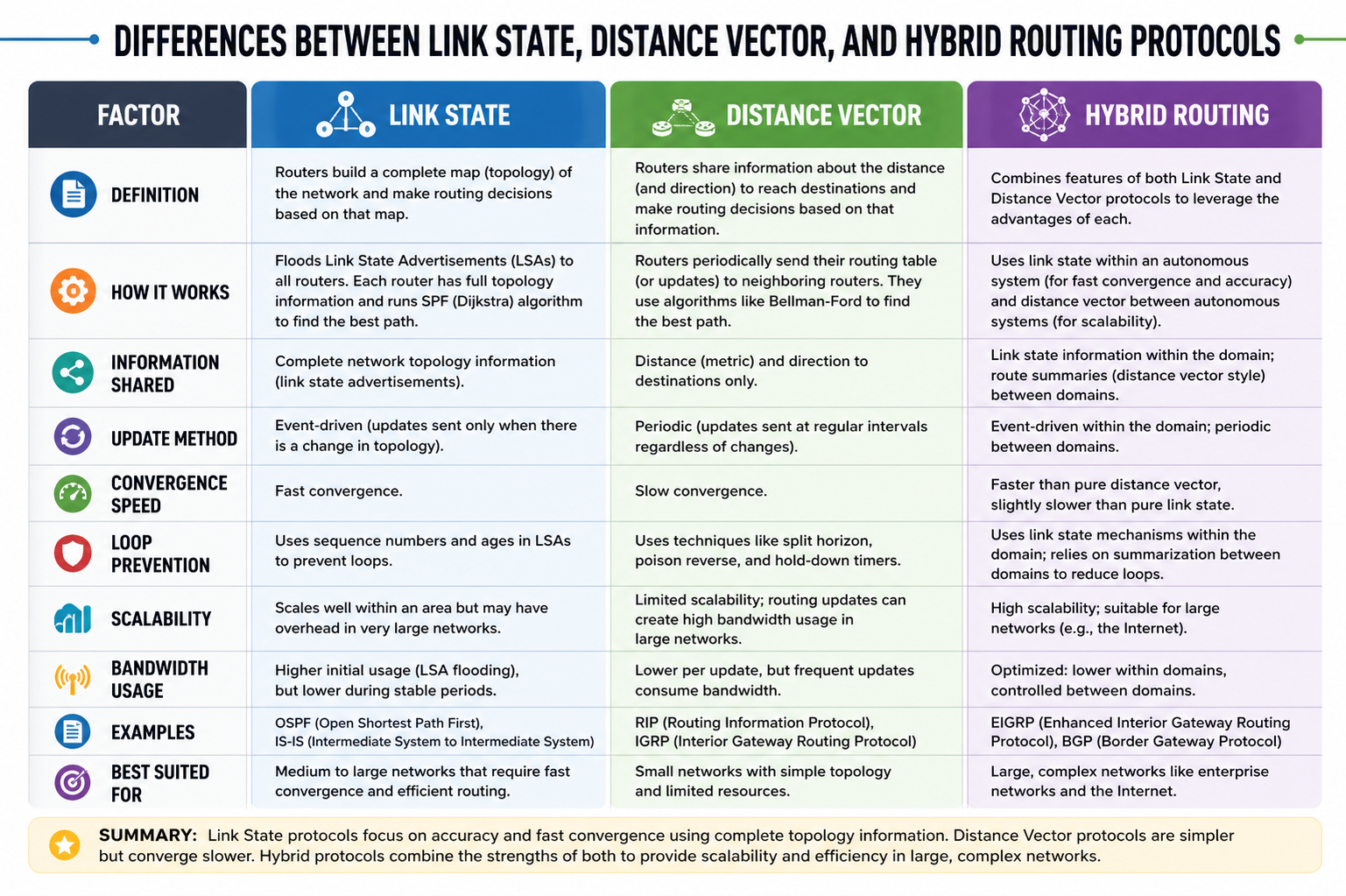
Link state routing protocols are designed to provide routers with a complete and synchronized understanding of the network structure. Instead of relying only on information from immediate neighbors, each router gathers detailed data about all directly connected links in the network. This information includes link status, cost, and connectivity. Once this data is collected, it is shared across the entire network so that every router can construct an identical map of the topology.
Each router then independently processes this information using a shortest path algorithm. The most commonly used method is the shortest path first calculation, which allows the router to determine the most efficient route to every destination. Because all routers have the same network view, routing decisions tend to be highly accurate and consistent across the system.
One of the strongest advantages of link state routing is its fast convergence. When a change occurs in the network, such as a link failure or a new connection, the updated information is quickly propagated to all routers. This ensures that routing tables are updated rapidly, reducing the chances of outdated or incorrect paths being used.
However, this efficiency comes at a cost. Link state protocols require significant processing power and memory because each router must maintain a full database of the entire network topology. In large networks, this can become resource-intensive. Additionally, the process of flooding updates to all routers introduces overhead traffic, especially when frequent changes occur.
Despite these challenges, link state routing is widely used in modern networks because of its reliability, scalability, and precision in selecting optimal paths.
Distance Vector Routing Protocols
Distance vector routing protocols function in a much simpler way compared to link state systems. Instead of building a full map of the network, each router only knows the distance and direction to reach various destinations. This means a router is only aware of its immediate neighbors and relies on them to learn about the rest of the network.
Routers periodically share their routing tables with directly connected neighbors. These updates include information about how far different destinations are and which direction packets should be sent. When a router receives this information, it compares it with its own table and updates it if a shorter or better path is found.
This method makes distance vector protocols easy to implement and less demanding on system resources. They do not require complex calculations or large memory storage, which makes them suitable for smaller or less complex networks.
However, the simplicity of distance vector routing also leads to certain limitations. One major issue is slow convergence. When a change occurs in the network, it may take time for all routers to receive and process the updated information. During this delay, inconsistent routing information can exist across the network.
Another common problem is routing loops, where packets circulate continuously between routers due to outdated or incorrect routing information. The count-to-infinity problem is also a known challenge, where routers gradually increase the cost metric in an attempt to correct routing errors, but this process can take a long time to stabilize the network.
To reduce these issues, techniques such as split horizon, route poisoning, and hold-down timers are often used. These mechanisms help improve stability but do not completely eliminate the inherent limitations of distance vector routing.
Hybrid Routing Protocols
Hybrid routing protocols are designed to combine the strengths of both link state and distance vector approaches while minimizing their weaknesses. These protocols aim to provide faster convergence and better scalability without requiring excessive computational resources.
In hybrid routing systems, routers still exchange routing information with neighbors, similar to distance vector protocols. However, they also incorporate advanced mechanisms that improve accuracy and reduce the chances of routing loops. Instead of relying solely on periodic full-table updates, hybrid protocols often use triggered updates, which are sent only when a significant change occurs in the network.
This approach reduces unnecessary network traffic and ensures that updates are more relevant and timely. Hybrid protocols also use sophisticated algorithms to calculate the best routes more efficiently than traditional distance vector systems.
One of the main advantages of hybrid routing is its balance between performance and resource usage. It does not require each router to maintain a complete network topology like link state protocols, but it still provides faster convergence and better stability compared to basic distance vector methods.
Hybrid routing is especially useful in large and complex networks where neither pure link state nor pure distance vector approaches are ideal. It offers improved scalability and adaptability, making it suitable for enterprise-level environments.
Key Differences in Operational Approach
The fundamental difference between link state, distance vector, and hybrid routing protocols lies in how routers share and process network information. Link state protocols rely on a complete view of the network, distance vector protocols depend on neighbor-based sharing, and hybrid protocols use a combination of both strategies.
In link state routing, each router independently calculates the best path using a global view of the network. In contrast, distance vector routing depends on incremental updates passed between neighbors without a full understanding of the entire topology. Hybrid routing strikes a middle ground by improving neighbor-based communication with enhanced update mechanisms.
This difference in operational design directly affects performance, accuracy, and resource usage across each protocol type.
Convergence Behavior and Network Stability
Convergence refers to the time it takes for all routers in a network to agree on the current topology after a change occurs. Link state protocols generally have fast convergence because updates are quickly distributed to all routers, and each router recalculates routes based on complete information.
Distance vector protocols, on the other hand, have slower convergence. Since updates are passed step-by-step between neighbors, it can take longer for the entire network to stabilize. This delay increases the risk of temporary routing inconsistencies.
Hybrid protocols improve convergence speed by using more efficient update mechanisms. They reduce unnecessary delays while still maintaining a relatively lightweight structure compared to full link state systems.
Resource Usage and Scalability
Resource consumption is another major difference among these routing protocols. Link state routing requires more memory and processing power because each router stores and processes a complete network database. This makes it more resource-intensive but also more accurate.
Distance vector routing uses fewer resources because routers only store limited information about destinations and next hops. This simplicity makes it suitable for smaller networks but less effective in large or dynamic environments.
Hybrid routing balances resource usage by avoiding full topology storage while still enhancing routing accuracy. It is designed to scale better than distance vector protocols while remaining less demanding than link state systems.
Routing Accuracy and Efficiency
Link state protocols provide the highest level of routing accuracy because every router has access to identical and complete network information. This allows them to calculate optimal paths with precision.
Distance vector protocols are less accurate because routers rely on second-hand information from neighbors. This can sometimes lead to suboptimal routing decisions.
Hybrid protocols improve accuracy by refining how routing updates are shared and processed. While they may not achieve the full precision of link state systems, they offer a significant improvement over basic distance vector approaches.
Network Traffic and Update Mechanisms
The way routing updates are transmitted also differs significantly. Link state protocols generate more initial traffic due to flooding mechanisms, where updates are sent to all routers in the network. However, this results in faster overall synchronization.
Distance vector protocols generate regular periodic updates, which can lead to unnecessary traffic even when no major changes occur. This can reduce efficiency in larger networks.
Hybrid protocols optimize this process by using event-driven updates, which are only sent when changes happen. This reduces unnecessary traffic and improves overall efficiency.
Overall Functional Comparison
When comparing all three routing approaches, it becomes clear that each has its own strengths and limitations. Link state routing is highly accurate and fast but requires more resources. Distance vector routing is simple and lightweight but slower and less reliable in large networks. Hybrid routing provides a balanced solution that improves speed and stability while maintaining moderate resource usage.
Each protocol is designed for specific network environments, and the choice between them depends on the size, complexity, and performance requirements of the network.
Loop Prevention and Error Handling Mechanisms
One of the most critical aspects of any routing protocol is how it handles routing loops and errors in path calculation. Routing loops occur when data packets circulate endlessly between routers due to incorrect or outdated routing information. Each routing protocol addresses this problem differently based on its design principles.
Link state routing protocols are inherently resistant to routing loops because every router builds a complete and consistent map of the network. Since all routers use the same topology data and independently compute routes using a shortest path algorithm, the chances of inconsistencies are extremely low. Even when a change occurs, updates are quickly propagated throughout the network, ensuring that all routers recompute their routing tables almost simultaneously. This synchronized behavior greatly reduces the possibility of loops.
Distance vector routing protocols, however, are more vulnerable to routing loops. Because each router relies on information shared by its neighbors, outdated or incorrect data can easily propagate through the network. This can lead to situations where routers continuously forward packets in a circular path. To address this issue, several corrective techniques are used. Split horizon prevents a router from sending information back in the direction from which it was received. Route poisoning marks failed routes with an infinite metric to prevent their reuse. Hold-down timers delay updates temporarily to allow the network to stabilize. These mechanisms reduce loop formation but cannot eliminate it entirely.
Hybrid routing protocols take a more advanced approach by combining neighbor-based updates with intelligent loop prevention techniques. They often use triggered updates, route summarization, and advanced metrics to minimize inconsistencies. As a result, hybrid systems significantly reduce the risk of loops compared to traditional distance vector protocols while maintaining efficiency.
Speed of Adaptation to Network Changes
Network adaptability refers to how quickly a routing protocol responds to changes such as link failures, congestion, or the addition of new nodes. This is an important factor in determining overall network performance.
Link state routing protocols adapt very quickly to changes. When a modification occurs in the network, only the affected routers generate updates, which are then flooded across the system. Because every router recalculates its routing table using the same updated topology, convergence happens rapidly. This allows the network to stabilize quickly and resume optimal operation.
Distance vector routing protocols adapt more slowly. Since updates are exchanged only between neighboring routers, it takes time for changes to propagate across the entire network. Each router must wait to receive updated information from its neighbors before adjusting its own routing table. This sequential process delays convergence and can lead to temporary inconsistencies in routing decisions.
Hybrid routing protocols improve adaptation speed by combining rapid update mechanisms with efficient propagation strategies. They reduce unnecessary delays by using event-driven updates instead of relying solely on periodic updates. This allows the network to respond more quickly to significant changes while avoiding excessive overhead.
Scalability in Different Network Sizes
Scalability is a key factor when choosing a routing protocol for networks of varying sizes. It refers to how well a protocol performs as the number of routers and network complexity increases.
Link state protocols are highly scalable in terms of accuracy but require significant resources. In very large networks, maintaining a full topology database can consume a large amount of memory and processing power. Despite this, they are still widely used in enterprise and service provider environments because of their reliability and precise routing capabilities.
Distance vector protocols have limited scalability. While they work well in small networks, their performance degrades as the network grows. The slow convergence and potential for routing loops become more pronounced in larger systems, making them less suitable for complex environments.
Hybrid routing protocols are designed with scalability in mind. They balance resource usage with performance, allowing them to function effectively in medium to large networks. By reducing unnecessary updates and improving convergence speed, they provide a more efficient solution for expanding network infrastructures.
Complexity of Implementation and Maintenance
The complexity of implementing and maintaining routing protocols varies significantly among the three types.
Link state protocols are the most complex to implement. They require each router to maintain a complete database of the network and perform complex calculations to determine the best paths. This increases both configuration and maintenance requirements. Network administrators must also ensure proper synchronization of routing information to avoid inconsistencies.
Distance vector protocols are much simpler to implement. Their basic structure relies on periodic updates and simple distance calculations. This makes them easier to configure and manage, especially in small-scale networks. However, simplicity comes at the cost of performance limitations in larger environments.
Hybrid protocols fall between the two extremes. They are more complex than distance vector protocols but less demanding than full link state systems. Their configuration often requires careful tuning to balance performance and efficiency, but they offer better long-term manageability in dynamic environments.
Bandwidth Consumption and Network Efficiency
Bandwidth usage is another important factor in evaluating routing protocols. It determines how efficiently a protocol uses available network resources.
Link state protocols can initially consume more bandwidth due to flooding mechanisms used to distribute topology information. However, after convergence, they generate relatively low overhead traffic since updates are only triggered by network changes.
Distance vector protocols generate periodic full-table updates, which can consume bandwidth even when no changes occur in the network. This continuous exchange of information can reduce overall efficiency, especially in larger networks.
Hybrid protocols optimize bandwidth usage by minimizing unnecessary updates. They use selective and triggered updates, which significantly reduce overhead traffic while still maintaining accurate routing information.
Fault Tolerance and Network Reliability
Fault tolerance refers to the ability of a routing protocol to maintain stable operation even when parts of the network fail.
Link state protocols provide strong fault tolerance because they quickly detect and propagate changes across the network. Since all routers maintain a synchronized view, they can quickly adapt to failures and reroute traffic efficiently.
Distance vector protocols offer moderate fault tolerance but may experience delays in detecting and responding to failures. This can temporarily disrupt network performance until updated information fully propagates.
Hybrid protocols enhance fault tolerance by combining rapid detection mechanisms with efficient update distribution. This allows them to recover from failures more quickly than traditional distance vector systems while avoiding excessive overhead.
Suitability for Different Network Environments
Each routing protocol type is suited for different kinds of network environments based on performance needs and complexity.
Link state protocols are ideal for large, complex, and high-performance networks where accuracy and fast convergence are critical. They are commonly used in backbone networks and enterprise infrastructures.
Distance vector protocols are better suited for small or simple networks where ease of configuration and low resource usage are more important than advanced performance features.
Hybrid protocols are best suited for medium to large-scale networks that require a balance between efficiency, scalability, and reliability. They are particularly useful in dynamic environments where network conditions change frequently.
When examining all three routing approaches together, it becomes clear that each protocol represents a different design philosophy. Link state routing prioritizes accuracy and speed at the cost of higher resource usage. Distance vector routing emphasizes simplicity and low overhead but sacrifices convergence speed and stability. Hybrid routing attempts to merge the best features of both, offering a balanced solution for modern networking needs.
The choice between these protocols depends heavily on network size, performance expectations, and available system resources.
Routing Metric Differences
Routing metrics are the values used by routing protocols to determine the best path for data transmission. These metrics vary depending on the type of routing protocol and play a major role in how decisions are made across the network.
Link state routing protocols use multiple sophisticated metrics such as bandwidth, delay, load, reliability, and sometimes even cost assigned by administrators. Since each router has a complete view of the network, it can evaluate all possible paths using these detailed metrics and select the most efficient one. This results in highly optimized routing decisions that improve overall network performance.
Distance vector routing protocols generally rely on simpler metrics. The most common metric is hop count, which represents the number of routers a packet must pass through to reach its destination. Some advanced implementations may also consider delay or cost, but the system remains relatively basic. This simplicity makes decision-making faster but can sometimes lead to less efficient routing paths.
Hybrid routing protocols use a more advanced approach by combining multiple metrics. They often evaluate routes using composite metrics that include bandwidth, delay, and reliability. This allows them to make more informed routing decisions than traditional distance vector systems while avoiding the full complexity of link state calculations.
Update Frequency and Communication Style
The way routing information is updated and communicated is another major difference among the three protocols.
Link state routing protocols use event-driven updates. When a change occurs in the network, such as a link failure or new connection, only the affected routers generate updates. These updates are then flooded across the entire network to ensure that all routers are synchronized. Once the network stabilizes, no unnecessary updates are sent, which helps reduce long-term overhead.
Distance vector routing protocols rely on periodic updates. Each router sends its entire routing table to its neighbors at regular intervals, even if no changes have occurred. While this ensures continuous information sharing, it can also lead to unnecessary bandwidth usage and slower convergence in dynamic environments.
Hybrid routing protocols improve upon this by using a combination of periodic and triggered updates. Routine updates maintain baseline connectivity information, while triggered updates are sent immediately when significant changes occur. This hybrid approach improves responsiveness while reducing unnecessary network traffic.
Convergence Efficiency in Dynamic Networks
Convergence efficiency refers to how quickly a network stabilizes after a change in topology. This is a crucial factor in determining network reliability and performance.
Link state routing protocols achieve high convergence efficiency because every router recalculates routes using the same updated network map. Once information about a change is distributed, all routers quickly adjust their routing tables simultaneously, minimizing inconsistency.
Distance vector routing protocols experience slower convergence because updates travel incrementally from one router to another. This step-by-step propagation creates delays and can result in temporary routing inconsistencies across the network.
Hybrid routing protocols improve convergence efficiency by reducing propagation delays and using smarter update mechanisms. They are designed to detect changes quickly and distribute updates more effectively, leading to faster stabilization compared to traditional distance vector systems.
Memory and Processing Requirements
Memory and processing requirements differ significantly across the three routing approaches and influence their deployment in various environments.
Link state routing protocols require high memory and processing power because each router maintains a complete database of the entire network topology. Additionally, routers must run complex algorithms to compute the shortest paths. This makes them resource-intensive but highly accurate.
Distance vector routing protocols require minimal memory and processing power. Routers only store information about the best path to each destination and rely on simple calculations to update routing tables. This makes them suitable for low-resource environments but limits their scalability.
Hybrid routing protocols require moderate resources. They do not store full topology maps like link state systems, but they use more advanced processing than distance vector protocols to improve routing decisions. This balance allows them to perform well in medium to large networks without overwhelming system resources.
Error Propagation and Network Stability
Error propagation refers to how routing errors spread through the network and affect stability.
In link state routing protocols, error propagation is minimal because updates are quickly distributed to all routers. Since each router independently calculates routes using the same data, inconsistencies are rare and short-lived. This results in high network stability.
In distance vector routing protocols, error propagation can be more significant. Incorrect routing information can spread gradually from one router to another, leading to temporary routing loops or incorrect paths. Stability improves only after multiple update cycles.
Hybrid routing protocols reduce error propagation by using faster detection mechanisms and selective update strategies. This limits the spread of incorrect information and helps maintain better network stability compared to traditional distance vector approaches.
Network Overhead and Efficiency Trade-offs
Network overhead refers to the amount of additional traffic generated by routing protocols to maintain accurate routing information.
Link state protocols generate higher initial overhead due to flooding of topology information. However, once the network stabilizes, overhead becomes minimal because updates are only sent when changes occur.
Distance vector protocols generate continuous overhead because routers regularly exchange full routing tables. This can reduce efficiency, especially in large networks with limited bandwidth.
Hybrid protocols aim to reduce overhead by combining periodic updates with event-driven mechanisms. This reduces unnecessary communication while still ensuring that routers remain updated about important network changes.
Security Considerations in Routing Protocols
Security is an important aspect of routing protocol design, especially in modern network environments where threats such as spoofing and routing manipulation exist.
Link state protocols are generally more secure because routers validate and share detailed topology information. However, they still require authentication mechanisms to prevent malicious updates from spreading.
Distance vector protocols are more vulnerable to routing attacks because they rely heavily on neighbor information. If a malicious router sends incorrect updates, it can influence routing decisions across the network. This makes security enforcement critical in such systems.
Hybrid routing protocols improve security by incorporating validation techniques and reducing reliance on single-source information. They often include authentication and route verification methods to minimize the impact of false routing data.
Practical Deployment Scenarios
Different routing protocols are used in different real-world scenarios based on their strengths and limitations.
Link state routing protocols are commonly deployed in large enterprise networks, internet service provider backbones, and environments where high performance and fast convergence are essential.
Distance vector routing protocols are typically used in smaller networks, educational environments, or simple organizational setups where ease of configuration is more important than advanced performance.
Hybrid routing protocols are widely used in modern enterprise networks that require a balance between scalability, efficiency, and reliability. They are especially useful in environments where network conditions frequently change.
Overall Functional Evolution
Routing protocols have evolved over time to address the limitations of earlier designs. Distance vector protocols represent the simplest form of routing, focusing on ease of implementation. Link state protocols introduced advanced network awareness and faster convergence. Hybrid protocols emerged as a solution to combine the advantages of both while reducing their weaknesses.
This evolution reflects the growing complexity of modern networks, where efficiency, scalability, and stability must all be balanced.
Administrative Control and Configuration Flexibility
Administrative control refers to how easily a routing protocol can be configured, tuned, and managed within a network environment. This becomes important in real-world systems where network administrators need flexibility to adjust routing behavior based on performance requirements or organizational policies.
Link state routing protocols offer a high level of control and customization. Administrators can define detailed link costs, influence route selection, and fine-tune convergence behavior. However, this flexibility comes with increased complexity. Proper configuration requires technical expertise, and misconfiguration can lead to inefficient routing or instability. Because of the detailed nature of link state databases, even small changes can have a significant impact on overall network behavior.
Distance vector routing protocols provide simpler administrative control. Configuration is usually straightforward, with fewer parameters to manage. Administrators typically focus on basic settings such as network advertisement and metric adjustments. While this simplicity makes distance vector protocols easier to deploy, it also limits fine-grained control over routing decisions.
Hybrid routing protocols offer a balanced level of control. They allow administrators to influence routing behavior without requiring deep manipulation of complex topology data. This makes them suitable for environments where moderate customization is needed without the overhead of full link state management.
Load Balancing Capabilities
Load balancing is the ability of a routing protocol to distribute network traffic evenly across multiple available paths. This helps improve performance, reduce congestion, and ensure efficient use of network resources.
Link state routing protocols excel in load balancing because they have complete knowledge of the network topology. This allows them to identify multiple optimal or near-optimal paths and distribute traffic intelligently. Some implementations even support equal-cost multi-path routing, enabling simultaneous use of multiple routes.
Distance vector routing protocols have limited load balancing capabilities. Since their decision-making is based on simpler metrics like hop count, they often select a single best path rather than distributing traffic across multiple routes. This can sometimes lead to congestion on preferred links while other paths remain underutilized.
Hybrid routing protocols improve load balancing compared to distance vector systems. By using more advanced metrics and better update mechanisms, they can identify alternative paths and distribute traffic more efficiently. While not always as precise as link state systems, they offer a practical balance between performance and simplicity.
Real-Time Performance Under Network Stress
Network stress occurs during high traffic loads, frequent topology changes, or link failures. The ability of a routing protocol to maintain performance under such conditions is a key measure of its effectiveness.
Link state routing protocols handle network stress very well because of their fast convergence and accurate topology awareness. Even during heavy changes, routers quickly update their databases and recalculate optimal paths. This minimizes downtime and maintains stable performance.
Distance vector routing protocols struggle more under stress. Frequent changes can cause slow convergence, outdated routing information, and temporary routing loops. These issues can degrade performance and lead to packet loss or delays until the network stabilizes.
Hybrid routing protocols perform better under stress compared to distance vector systems. Their improved update mechanisms and faster convergence help maintain more stable routing behavior during dynamic conditions. While not always as robust as link state protocols, they offer significantly improved resilience.
Comparative Strength Summary
Each routing protocol type offers distinct strengths that make it suitable for specific networking needs. Link state routing is known for accuracy, fast convergence, and strong adaptability, making it ideal for large and complex networks. However, it requires more memory and processing resources.
Distance vector routing is valued for its simplicity, low overhead, and ease of configuration. It works well in small networks but struggles with scalability, convergence speed, and loop prevention in larger environments.
Hybrid routing protocols combine the advantages of both approaches. They provide better scalability than distance vector systems and require fewer resources than full link state implementations. This makes them a practical choice for many modern networking environments.
Limitations Across All Protocol Types
Despite their differences, all routing protocols have certain limitations. Link state protocols can become resource-intensive in extremely large networks. Distance vector protocols are prone to slow convergence and routing loops. Hybrid protocols, while balanced, can still face challenges in highly complex or rapidly changing environments where neither pure approach is perfect.
Another shared limitation is dependency on accurate information exchange. If routing updates are delayed, lost, or corrupted, all three types of protocols can experience temporary inefficiencies. This highlights the importance of reliable network infrastructure to support routing operations.
Conclusion
Routing protocols form the backbone of network communication by determining how data travels from source to destination. Link state, distance vector, and hybrid routing protocols each represent different design philosophies that address the challenges of network management in unique ways.
Link state routing provides a highly accurate and fast-converging system based on complete network awareness. It is best suited for large, performance-critical environments where precision is essential, although it requires higher computational resources.
Distance vector routing offers a simpler and more lightweight approach, relying on neighbor-based information exchange. While easy to implement and suitable for small networks, it suffers from slower convergence and potential routing instability in larger systems.
Hybrid routing protocols bridge the gap between these two models by combining their strengths. They improve convergence speed, reduce overhead, and enhance scalability while maintaining moderate resource requirements. This makes them well-suited for modern, dynamic network environments where efficiency and adaptability are both important.
In conclusion, no single routing protocol is universally superior. The choice depends on network size, performance expectations, resource availability, and operational complexity. Understanding the differences between these routing approaches helps in designing more efficient, stable, and scalable networks that meet specific organizational needs.