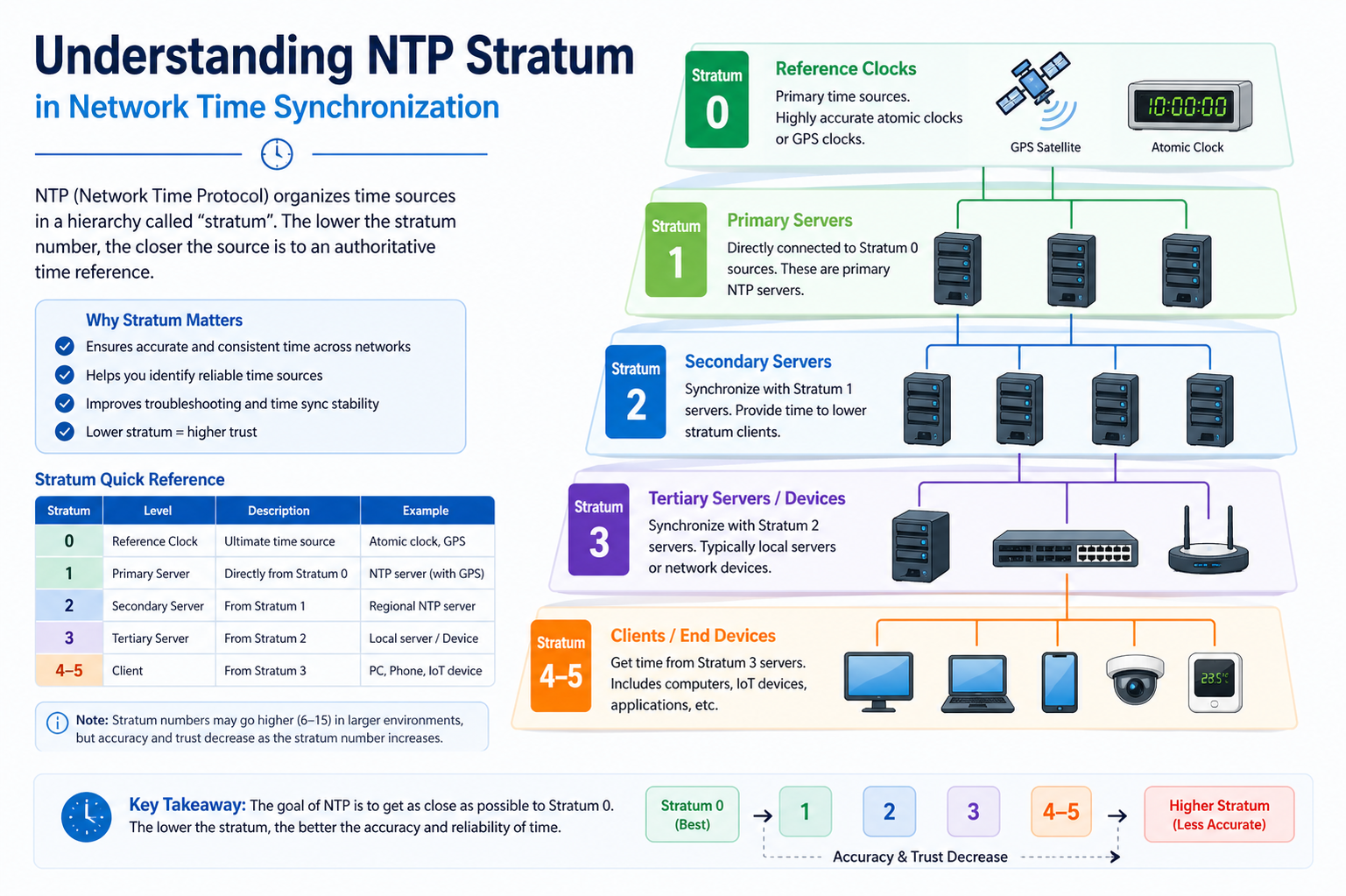
NTP (Network Time Protocol) is one of the most widely used systems for synchronizing clocks across computer networks. It ensures that devices such as servers, routers, and workstations all maintain a consistent and accurate sense of time. Within this system, the concept of stratum plays a central role in defining the quality, accuracy, and distance of time sources from the original reference clock.
The idea of stratum is not just a technical classification but a structured way of organizing time sources into layers. Each layer represents how far a device is from the most accurate time source available. This layered approach helps maintain order in complex networks where thousands or even millions of devices may need synchronized time.
Foundations of Time Synchronization
Time synchronization is essential in modern computing systems because nearly every digital operation depends on accurate timekeeping. Whether it is logging events in a database, securing communications, or coordinating distributed systems, consistent time is required for reliability and correctness.
Before systems like NTP were widely used, computers relied on their internal clocks. These internal clocks, however, tend to drift over time due to hardware limitations and environmental factors. Even small differences in clock timing can lead to serious issues in distributed systems, such as mismatched logs, authentication errors, or data inconsistency.
To solve this, NTP was developed to allow devices to synchronize with external time sources. These external sources are arranged in a hierarchy known as the stratum system, which ensures that time flows from highly accurate sources to less accurate ones in a controlled and predictable manner.
Concept of Stratum Levels
Stratum levels define the distance of a device from the reference clock. A reference clock is the most accurate time source available, often based on atomic clocks, GPS signals, or radio time signals. These are considered the ultimate authority in timekeeping.
A device that directly connects to a reference clock is classified as a lower stratum server. As time is distributed from this device to others, each subsequent layer increases in stratum level. This means that a device receiving time from a stratum 1 server becomes stratum 2, and so on.
This structure ensures that time synchronization remains organized and traceable. It also helps administrators understand the reliability of a time source based on its position in the hierarchy.
Role of Reference Clocks
At the top of the hierarchy are reference clocks, which are considered stratum 0 devices. These are not part of the network in a traditional sense but are directly connected to highly precise time sources such as atomic clocks or GPS satellites.
Reference clocks do not communicate over the network. Instead, they provide time to stratum 1 servers, which act as the first point of distribution within the network. These stratum 1 servers are critical because they form the bridge between absolute time sources and network-based systems.
Without reference clocks, the entire system would lose its anchor to real-world time, making synchronization less accurate over long periods.
Stratum 1 Servers and Their Importance
Stratum 1 servers are directly connected to reference clocks. They are considered highly reliable and are often used by organizations that require extremely accurate timekeeping, such as financial institutions, telecommunications providers, and scientific research facilities.
These servers distribute time to lower-level servers and clients. Because they are directly synchronized with reference clocks, their accuracy is very high, with minimal delay or drift.
However, even stratum 1 servers are affected by network conditions, hardware performance, and processing delays. Despite this, they remain the most trusted network-based time sources in most systems.
Propagation of Time Through Stratum Levels
Once time is distributed from stratum 1 servers, it flows down through multiple layers of devices. Each device that receives time from a higher-level server becomes part of the next stratum level.
For example, a stratum 2 server receives time from a stratum 1 server and then distributes it to stratum 3 devices. This chain continues as needed depending on the size and structure of the network.
Each step introduces a small amount of delay, which can slightly reduce accuracy. However, NTP is designed to minimize these delays through algorithms that adjust for network latency and jitter.
Accuracy and Reliability Across Stratum Levels
The accuracy of time decreases slightly as the stratum level increases. This is because each device introduces small variations due to processing time and network delays. However, these differences are usually minimal and carefully controlled.
Lower stratum levels are generally more reliable because they are closer to the original time source. Higher stratum levels are still useful but may not be suitable for systems requiring extremely precise synchronization.
Despite this, NTP’s design ensures that even high-stratum devices maintain acceptable accuracy for most applications, including logging, authentication, and scheduled operations.
Stratum 0 and Its Unique Position
Stratum 0 devices are not directly part of the network hierarchy but are essential for providing the most accurate time input. These devices include atomic clocks, GPS receivers, and other high-precision timing instruments.
They act as the foundation of the entire system. Without them, all other stratum levels would eventually drift and lose accuracy over time.
Because stratum 0 devices do not communicate over networks, they are always connected to stratum 1 servers through direct physical or specialized connections.
Stratum 2 and Beyond
As we move further down the hierarchy, stratum 2 and higher levels become more common in large-scale networks. These servers are typically used to distribute time within organizations or across geographic regions.
Stratum 2 servers receive time from stratum 1 servers and then serve multiple clients or lower-level servers. This helps reduce load on primary servers and improves scalability.
Stratum 3 and higher levels continue this distribution pattern. While they are less accurate than lower levels, they are still synchronized closely enough for most general computing purposes.
Why Multiple Stratum Levels Are Necessary
The use of multiple stratum levels is essential for scalability and efficiency. If every device in a network had to connect directly to a stratum 1 server, the system would become overloaded and inefficient.
Instead, the hierarchical structure allows time to be distributed gradually, reducing strain on primary servers while maintaining acceptable accuracy across the network.
This design also improves redundancy. If one server fails, other servers at similar or higher stratum levels can continue providing time services.
Network Delays and Their Impact
One of the challenges in time synchronization is network delay. As time packets travel across networks, they experience latency due to routing, processing, and congestion.
NTP accounts for these delays using statistical algorithms that estimate and adjust for variations. This ensures that even with network inconsistencies, time remains as accurate as possible.
However, as stratum levels increase, the impact of these delays becomes more noticeable, which is why lower stratum servers are preferred for critical systems.
Stratum Selection in Practical Systems
Organizations typically choose stratum servers based on their needs. For high-precision environments, stratum 1 or stratum 2 servers are preferred. For general-purpose systems, higher stratum levels are often sufficient.
The selection also depends on availability, geographic location, and network reliability. Many systems use multiple time sources to ensure redundancy and improve accuracy.
The NTP stratum system is a carefully designed hierarchy that ensures accurate and reliable time distribution across networks. By organizing devices into structured levels based on their distance from reference clocks, it allows millions of systems to stay synchronized efficiently.
This structure balances accuracy, scalability, and reliability, making it a fundamental part of modern network infrastructure.
Stratum Behavior in Real Network Environments
In real-world network environments, the behavior of NTP stratum levels is influenced by many practical factors such as network congestion, server load, routing paths, and hardware performance. Although the theoretical structure of stratum is strictly hierarchical, actual deployments often show a more dynamic and adaptive pattern of time synchronization.
Devices do not always rely on a single time source. Instead, they may query multiple NTP servers simultaneously and select the most accurate and stable one based on response time and consistency. This means that a device classified as stratum 3 in one moment may effectively behave closer to stratum 2 if it switches to a better-performing upstream server.
This flexibility is a key strength of NTP, allowing it to maintain accuracy even in unstable or large-scale networks where conditions frequently change.
Dynamic Selection of Time Sources
One of the most important mechanisms in NTP systems is the ability to dynamically select the best available time source. Rather than strictly following a fixed path from higher to lower stratum levels, NTP clients continuously evaluate multiple servers.
They measure factors such as delay, jitter, and offset to determine which server provides the most reliable time. The system then selects the best candidate or combines results from multiple sources to calculate a weighted average.
This adaptive behavior ensures that even if a lower-stratum server becomes unreliable, the system can still maintain accurate time by switching to an alternative source.
Stratum Misinterpretation in Complex Networks
In some cases, stratum levels can be misunderstood or misconfigured in real environments. A server may report itself as a lower stratum than it actually is, or network administrators may incorrectly configure hierarchy relationships.
Such misconfigurations can lead to misleading assumptions about time accuracy. However, NTP clients are designed to validate time based on actual performance metrics rather than relying solely on declared stratum values.
This means that even if a server claims to be closer to a reference clock, clients will still evaluate its accuracy before trusting it.
Role of Jitter and Offset in Accuracy
Two important factors that affect NTP performance across stratum levels are jitter and offset. Jitter refers to the variability in time delay between successive packets, while offset represents the difference between the local clock and the reference time.
Lower stratum servers generally have smaller jitter and offset values because they are closer to the reference source. Higher stratum servers may experience greater variability due to multiple layers of communication.
NTP continuously measures these values and adjusts system clocks gradually to avoid sudden changes that could disrupt applications.
Time Discipline Mechanism
NTP does not simply set the system clock instantly. Instead, it uses a process called time discipline, which gradually adjusts the clock to match the correct time.
This gradual adjustment prevents sudden jumps in system time that could cause errors in logging, transactions, or scheduled tasks. Even when large differences exist, NTP carefully corrects the clock over time to ensure system stability.
This mechanism operates across all stratum levels, ensuring consistent behavior regardless of how far a device is from the reference clock.
Stratum and Redundancy in Time Systems
Redundancy is a critical aspect of time synchronization systems. Relying on a single time source can lead to failure if that source becomes unavailable or inaccurate.
To address this, NTP systems typically use multiple servers at different stratum levels. These servers act as backups for each other, ensuring continuous availability of accurate time.
If a primary stratum 1 server fails, clients can automatically switch to another available server, often without any noticeable disruption.
Impact of Geographic Distribution
Geographic distribution of servers also plays a significant role in stratum-based synchronization. In large networks spread across different regions or countries, latency can vary significantly depending on physical distance.
To reduce delays, organizations often deploy multiple stratum 2 or stratum 3 servers closer to end users. This reduces the time it takes for synchronization packets to travel, improving overall accuracy.
Even though these local servers are at higher stratum levels, their proximity helps compensate for network delays.
Stratum in Large-Scale Internet Systems
On the internet, stratum-based time synchronization operates at a massive scale. Thousands of public NTP servers are distributed globally, many of which are stratum 1 or stratum 2 systems.
These servers collectively ensure that millions of devices worldwide can maintain accurate time. The hierarchical structure allows efficient distribution without overwhelming primary time sources.
This global network of time servers is essential for internet security protocols, financial systems, communication networks, and distributed computing platforms.
Security Considerations in NTP Stratum Systems
Security is an important aspect of time synchronization. If attackers manipulate time data, they can potentially disrupt authentication systems, certificates, or transaction logs.
Higher stratum servers are often more vulnerable to attacks because they are further from trusted reference sources and may rely on intermediate nodes.
To mitigate risks, modern NTP implementations include authentication mechanisms that verify the integrity of time packets. This ensures that only trusted servers can influence system time.
Drift Correction Across Stratum Levels
All system clocks naturally drift over time due to hardware imperfections. NTP continuously corrects this drift by comparing local time with upstream servers.
At lower stratum levels, drift correction is highly precise because the time source is very accurate. At higher levels, correction still occurs but may be slightly less precise due to accumulated delays.
Despite this, NTP ensures that drift remains within acceptable limits for most computing applications.
Stratum Stability Over Time
Although stratum levels are hierarchical, they are not always static. A server’s stratum level can change depending on its connection to upstream sources.
For example, if a stratum 2 server loses connection to its stratum 1 parent, it may temporarily increase its stratum level or switch to another available source.
This dynamic adjustment helps maintain stability in the overall system even when parts of the network are disrupted.
Importance of Monitoring Stratum Levels
Monitoring stratum levels is essential for system administrators who manage network infrastructure. It helps identify potential issues in time synchronization, such as misconfigurations, failures, or degraded performance.
By observing stratum distribution, administrators can ensure that critical systems are receiving time from reliable sources and that no unexpected increases in stratum levels are affecting accuracy.
Practical Use in Enterprise Systems
In enterprise environments, stratum hierarchy is carefully planned to balance performance and reliability. Dedicated time servers are often deployed at different levels within the organization.
Core servers are usually placed at lower stratum levels, while departmental or regional servers operate at higher levels. This structure ensures efficient distribution of time across the entire organization.
It also reduces dependency on external sources, improving resilience and control over time synchronization.
Advanced Stratum Behavior
NTP stratum is more than just a numerical classification; it is a dynamic system that ensures accurate time distribution across complex and distributed networks. Its behavior adapts to real-world conditions, including network delays, server availability, and system load.
Through mechanisms such as redundancy, drift correction, dynamic selection, and hierarchical distribution, NTP maintains reliable synchronization even in large and unpredictable environments.
Stratum Hierarchy and Clock Precision Relationship
The relationship between stratum level and clock precision is one of the core principles of NTP-based synchronization. In general, the closer a device is to the reference clock, the higher the precision of its time data. This is because fewer network hops are involved, and each hop introduces a small amount of delay and potential error.
However, precision is not determined by stratum alone. It is also influenced by network quality, server performance, and synchronization frequency. A well-maintained higher-stratum server can sometimes provide better real-world accuracy than a poorly maintained lower-stratum server.
This makes stratum a useful indicator of potential accuracy, but not an absolute guarantee of it.
Clock Stability and Hardware Influence
Hardware plays a significant role in time synchronization quality. System clocks rely on oscillators, which are sensitive to temperature changes, electrical noise, and aging effects.
Even if a device is connected to a low-stratum server, poor hardware stability can still cause time drift. On the other hand, high-quality hardware with stable oscillators can maintain more consistent timing behavior even at higher stratum levels.
This is why enterprise-grade systems often use specialized time hardware or external synchronization modules to improve stability.
Role of Network Topology in Stratum Efficiency
Network topology significantly affects how efficiently time is distributed across stratum levels. In a well-designed topology, time flows in a structured and balanced way from upper levels to lower levels with minimal delay.
In poorly designed networks, routing inefficiencies can increase latency and introduce inconsistencies in time distribution. This can make higher-stratum devices behave unpredictably in terms of accuracy.
To optimize performance, network administrators often design time distribution paths that minimize unnecessary hops and ensure balanced load across servers.
Synchronization Frequency Across Stratum Levels
Different stratum levels may synchronize at different frequencies depending on configuration and load. Lower stratum servers, being closer to reference clocks, may require less frequent adjustment because their time source is highly stable.
Higher stratum devices often synchronize more frequently to correct accumulated drift caused by multiple layers of delay. This helps ensure that time remains consistent even as it propagates further from the original source.
The synchronization interval is carefully balanced to avoid excessive network traffic while maintaining accuracy.
Effect of Packet Delay Variation
Packet delay variation, also known as jitter, is one of the most important challenges in maintaining accurate time across stratum levels. Since NTP relies on exchanging time packets between servers and clients, any variation in transmission time can affect accuracy.
Lower stratum servers generally experience lower jitter because they are closer to the reference source and often operate within controlled environments. Higher stratum servers, especially those spread across wide geographic regions, may experience more variability.
NTP compensates for this by analyzing multiple samples over time and filtering out inconsistent measurements.
Stratum and Fault Tolerance
Fault tolerance is a critical feature of NTP systems, and the stratum hierarchy supports it effectively. When a server at a particular stratum level becomes unavailable, systems can automatically switch to another server without disrupting time synchronization.
This redundancy ensures continuous operation even in the presence of network failures or hardware issues. Multiple servers at similar or different stratum levels can work together to provide stable time sources.
This distributed approach prevents single points of failure and improves system reliability.
Transition Between Stratum Levels
Stratum levels are not fixed permanently for a device. A server can move between stratum levels depending on its connection to upstream time sources.
For example, if a stratum 2 server loses connection to its stratum 1 parent but connects to another stratum 1 server, its synchronization path may change while maintaining its position in the hierarchy.
In some cases, temporary disconnections may cause a server to operate in a “free-running” mode until synchronization is restored.
Time Filtering and Selection Algorithms
NTP uses advanced filtering and selection algorithms to ensure that the best available time source is chosen. These algorithms evaluate multiple factors such as consistency, delay, offset, and stability over time.
Rather than relying on a single measurement, NTP continuously collects data and applies statistical analysis to determine the most reliable source.
This approach helps eliminate outliers and ensures that stratum-based decisions are supported by real performance data rather than theoretical hierarchy alone.
Impact of Load on Stratum Servers
Server load can also influence time synchronization quality. When a server is heavily loaded with requests, its response times may increase, affecting its perceived accuracy.
Lower stratum servers are often designed with higher performance capabilities to handle large numbers of synchronization requests efficiently. However, even these servers can experience degradation under extreme load conditions.
To manage this, networks often distribute traffic across multiple servers to maintain consistent performance.
Stratum in Virtualized and Cloud Environments
In modern computing environments, virtualization and cloud infrastructure have introduced new challenges for time synchronization. Virtual machines often depend on the host system’s clock, which may itself be synchronized at a certain stratum level.
This layered dependency can introduce additional delays or inconsistencies if not properly managed. Cloud providers typically implement dedicated time synchronization services to ensure consistency across virtual systems.
These services often operate at carefully controlled stratum levels to maintain reliability across distributed environments.
Drift Accumulation Over Long Stratum Chains
As time moves further away from the reference clock through multiple stratum levels, small inaccuracies can accumulate. While each individual step introduces only a minor error, these can add up over long chains.
NTP is designed to continuously correct these errors before they become significant. However, extremely deep stratum chains are generally avoided in well-designed systems to minimize potential drift accumulation.
This is why most practical networks limit the number of stratum levels used for critical synchronization paths.
Time Consistency in Distributed Systems
Distributed systems rely heavily on consistent time to coordinate operations. Whether it is database replication, event ordering, or transaction processing, synchronized time ensures that systems behave predictably.
Stratum-based synchronization provides the foundation for this consistency by ensuring that all devices reference a common time hierarchy.
Without this structure, distributed systems would struggle to maintain order, leading to inconsistencies and potential failures.
Stratum and Logging Accuracy
Accurate logging is one of the most important applications of NTP. Logs are used for debugging, security analysis, and system monitoring. If system clocks are not synchronized, log entries from different systems may appear out of order.
Stratum levels help ensure that logs across systems are aligned in time, making it easier to reconstruct events accurately. Lower stratum systems typically provide more precise log timestamps, but even higher stratum systems remain sufficiently accurate for most use cases.
Long-Term Stability of NTP Systems
Over long periods, NTP systems demonstrate strong stability due to continuous correction and hierarchical design. Even though individual devices may drift slightly, the system as a whole remains tightly synchronized.
Stratum levels play a key role in maintaining this stability by ensuring that time flows from reliable sources in a structured manner.
This long-term stability is one of the reasons NTP remains the standard for time synchronization in modern networks.
The stratum concept is fundamental to how NTP achieves scalable and reliable time synchronization. It organizes devices into structured layers based on their distance from reference clocks, while still allowing flexibility, redundancy, and adaptation.
Through careful design and continuous correction mechanisms, stratum-based systems ensure that even large and complex networks maintain accurate and consistent time across all devices.
Stratum and Real-Time System Dependence
Modern real-time systems depend heavily on precise and synchronized time to function correctly. Applications such as telecommunications, financial trading platforms, industrial automation, and distributed databases require clocks that are not only accurate but also consistent across all participating devices.
In these environments, stratum levels become a practical indicator of trust in time sources. Systems closer to lower stratum levels are generally preferred because they reduce uncertainty in timing decisions. Even small timing errors in such environments can lead to significant operational consequences, such as incorrect transaction ordering or misaligned control signals.
However, real-time systems also rely on continuous validation rather than blindly trusting a stratum label. They evaluate actual performance metrics like offset stability and response delay to ensure that the selected time source remains reliable over time.
Propagation of Time Corrections
Time synchronization is not a one-time event but a continuous correction process. As time flows through stratum levels, each device constantly adjusts its internal clock based on incoming data.
When a correction is made at a higher-level server, that adjustment gradually propagates down to lower levels. This propagation is not instantaneous; instead, it spreads in a controlled manner to avoid instability across the network.
This gradual correction process ensures that even if a major adjustment occurs at a reference or stratum 1 server, the impact on downstream systems remains smooth and predictable.
Stratum and Clock Discipline Algorithms
Clock discipline algorithms are at the core of how NTP maintains accurate time across stratum levels. These algorithms analyze differences between local system time and received network time, then apply controlled adjustments.
The discipline mechanism ensures that clocks do not abruptly jump to a new time value, which could disrupt applications relying on continuous time progression. Instead, the system either slightly speeds up or slows down the clock until synchronization is achieved.
This method is especially important in higher stratum levels where accumulated delays may require gradual correction over time.
Influence of Synchronization Interval on Accuracy
The interval at which devices synchronize with upstream servers has a direct impact on overall accuracy. Shorter intervals generally improve accuracy because errors are corrected more frequently, but they also increase network traffic and processing load.
Longer intervals reduce system overhead but allow more drift to accumulate between synchronization cycles. This trade-off is carefully balanced depending on the stratum level and the role of the device within the network.
Lower stratum servers may use longer intervals due to their stability, while higher stratum systems often synchronize more frequently to maintain acceptable precision.
Stratum Hierarchy in Multi-Region Networks
In large-scale multi-region networks, stratum hierarchy becomes more complex due to geographic distribution. Organizations often deploy multiple time servers across different regions to reduce latency and improve reliability.
Each region may have its own set of stratum 2 or stratum 3 servers that synchronize with higher-level servers located in data centers or central hubs. This structure helps maintain consistency while minimizing the impact of long-distance network delays.
Regional time distribution also improves resilience, ensuring that local systems can continue operating even if connectivity to central servers is temporarily disrupted.
Failover Mechanisms in Stratum Systems
Failover mechanisms are essential in maintaining continuous time synchronization. When a primary time source becomes unavailable, systems automatically switch to secondary or backup servers.
These backup servers may exist at the same or slightly higher stratum levels, depending on network design. The transition is typically seamless, with minimal impact on system accuracy.
Failover ensures that no single point of failure can disrupt time synchronization across the entire network, which is critical for mission-critical applications.
Clock Offset Correction Behavior
Clock offset refers to the difference between a device’s local time and the reference time provided by the network. NTP continuously measures and corrects this offset across all stratum levels.
At lower stratum levels, offsets are usually very small and require minimal adjustment. At higher levels, offsets may be larger due to accumulated delays and network variability.
The system gradually reduces offset over time using controlled adjustments rather than abrupt changes, ensuring system stability while improving accuracy.
Stratum Impact on Security Protocols
Security protocols such as authentication systems, encryption key validation, and digital certificates rely heavily on accurate time. Even small discrepancies can lead to validation failures or security vulnerabilities.
Stratum hierarchy helps maintain trustworthy time sources, especially in secure environments where precise timing is essential. Lower stratum servers are often used in security-critical systems to reduce the risk of time manipulation or inconsistency.
Time-based security mechanisms, such as token expiration or certificate validation, depend on synchronized clocks to function correctly.
Time Consistency in Transaction Systems
In financial and transactional systems, time consistency is essential for ensuring correct ordering of events. Stratum-based synchronization ensures that all participating systems agree on the sequence of operations.
Without proper synchronization, transactions could appear out of order, leading to inconsistencies in records or potential financial errors. Lower stratum servers are often prioritized in such environments to minimize timing discrepancies.
Even in distributed systems spread across multiple data centers, stratum hierarchy ensures that all systems maintain a shared sense of time.
Behavior Under Network Congestion
Network congestion can significantly affect time synchronization accuracy. When network traffic is high, packet delays become less predictable, increasing jitter and offset variations.
NTP compensates for this by using multiple measurements and selecting the most stable samples. However, higher stratum levels are more susceptible to congestion effects due to their increased distance from reference sources.
To mitigate this, systems often implement redundant pathways and distributed time servers to reduce congestion impact.
Adaptive Correction in High-Stratum Devices
High-stratum devices rely heavily on adaptive correction mechanisms because they accumulate more drift and delay variations over time. These devices continuously refine their time estimates using statistical filtering and historical data.
Instead of reacting to every small variation, they focus on long-term trends to avoid instability caused by short-term fluctuations.
This adaptive behavior ensures that even devices far from reference clocks maintain usable and stable time synchronization.
Stratum Role in Distributed Logging Systems
Distributed logging systems rely on synchronized time to merge and analyze logs from multiple sources. Stratum hierarchy ensures that log timestamps remain consistent across different systems.
Without synchronization, logs from different servers could appear mismatched, making troubleshooting and analysis difficult. Lower stratum systems provide higher precision logs, while higher stratum systems still maintain sufficient accuracy for correlation purposes.
This consistency is essential for debugging complex distributed applications.
Long-Term Drift Management Strategies
Over long periods, even well-synchronized systems experience gradual drift. NTP manages this through continuous correction and periodic recalibration.
Stratum hierarchy helps control drift by ensuring that corrections originate from reliable sources and propagate gradually through the network.
This long-term management strategy ensures that systems remain stable even after extended uptime without manual intervention.
Final Perspective on Stratum Importance
Stratum is not just a classification system but a foundational structure that enables scalable, reliable, and accurate time synchronization across global networks. It defines how time flows from precise reference sources to millions of connected devices.
Through hierarchical distribution, continuous correction, redundancy, and adaptive algorithms, NTP ensures that even complex and geographically distributed systems maintain consistent time.
This structured approach makes stratum one of the most critical concepts in modern network time synchronization.
Conclusion
The NTP stratum system is a structured hierarchy that ensures accurate and reliable time distribution across interconnected devices in a network. It defines how closely a system is connected to a trusted reference clock and helps determine the expected accuracy of its time information. Lower stratum levels indicate closer proximity to highly precise sources, while higher levels represent increasing distance and dependency on intermediate servers.
Despite this layered structure, NTP is not strictly rigid. It adapts dynamically to changing network conditions, server availability, and performance variations. This flexibility allows systems to continuously select the best available time source rather than relying only on fixed hierarchy positions.
Stratum levels also play an important role in scalability. They allow time to be distributed efficiently across large and complex networks without overwhelming primary reference servers. At the same time, redundancy ensures that if one time source fails, others can seamlessly take over, maintaining uninterrupted synchronization.
In practice, stratum is not just about hierarchy but about balancing precision, reliability, and network efficiency. Combined with mechanisms like jitter correction, offset adjustment, and clock discipline, it ensures that systems across the world can operate with consistent and coordinated time.
Overall, the stratum concept forms the backbone of NTP-based synchronization, making it possible for modern digital systems to function reliably in environments where accurate time is essential.