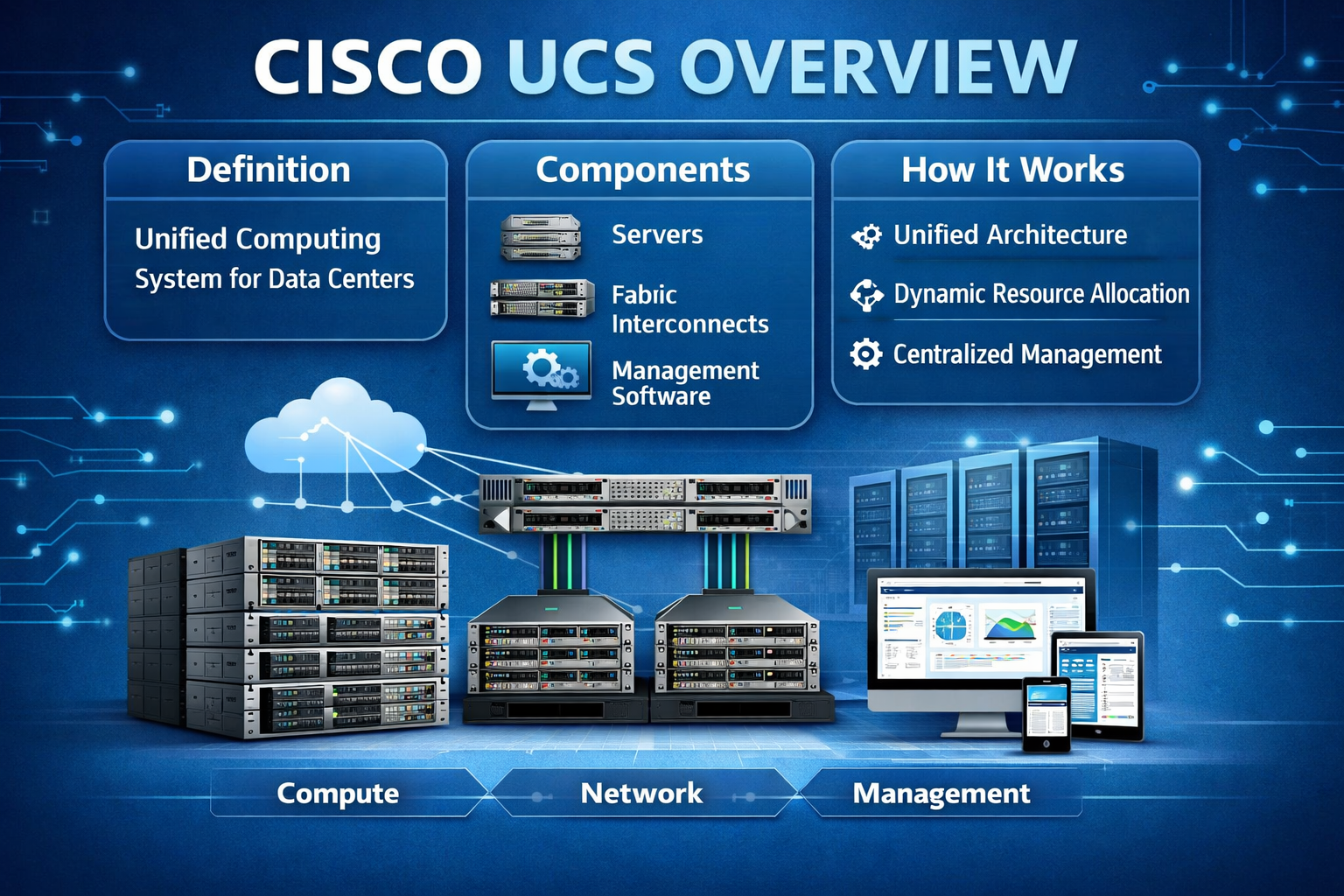
Cisco Unified Computing System is designed as a converged infrastructure architecture that brings together compute, networking, storage access, and virtualization into a tightly integrated system. Unlike traditional data center environments where each component is managed separately, Cisco UCS unifies all major infrastructure elements under a single management domain. This architectural approach reduces operational complexity and increases deployment speed while ensuring consistency across the entire environment.
At its core, UCS is built around the principle of abstraction. Physical hardware is separated from logical configuration through a policy-driven model. This means that servers are not individually configured in the traditional sense; instead, they inherit their identity, network settings, storage access rules, and operational behavior from centrally defined profiles. This abstraction layer is one of the key reasons UCS is widely adopted in enterprise data centers.
The architecture is generally divided into three primary layers: compute, network, and management. Each layer is deeply integrated with the others, ensuring seamless communication and centralized control. The design eliminates redundancy in configuration tasks and enables organizations to scale infrastructure without increasing administrative overhead.
Compute Layer in Cisco UCS
The compute layer in Cisco UCS consists of physical servers, typically blade servers and rack-mounted servers, that deliver processing power for applications and workloads. These servers are designed to operate as stateless computing nodes, meaning they do not store persistent configuration data locally. Instead, their identity and configuration are assigned dynamically through centralized management.
Blade servers are housed in chassis that provide shared power, cooling, and connectivity. This design allows high-density computing while reducing physical footprint. Rack servers, on the other hand, are standalone units that provide flexibility for environments that require independent scaling or mixed infrastructure models.
A key element in the compute layer is the use of adapters, specifically virtual interface cards. These adapters allow a single physical interface to carry multiple types of traffic such as storage, management, and data communication. This consolidation reduces the number of physical cables and network interfaces required, simplifying infrastructure design.
The compute layer is also tightly integrated with virtualization platforms. UCS is optimized to work with hypervisors, allowing virtual machines to be deployed efficiently across physical resources. This integration ensures that compute resources can be dynamically allocated based on workload demands.
Networking Layer and Fabric Interconnects
The networking layer in Cisco UCS is centered around fabric interconnects, which serve as the backbone of the entire system. These devices function as both network switches and management controllers, creating a unified point of connectivity for all servers within the UCS domain.
Fabric interconnects handle all data traffic between servers and external networks. They also manage internal communication between compute nodes. By consolidating switching functions into a centralized system, UCS eliminates the need for multiple independent network switches within the server environment.
One of the most important aspects of fabric interconnects is their role in policy enforcement. Instead of manually configuring network settings on each server, administrators define policies at the management level. These policies are then automatically applied through the fabric interconnects to all connected resources.
The networking layer supports high-speed connectivity options and is designed for low-latency communication. It ensures that workloads distributed across multiple servers can communicate efficiently without performance bottlenecks. This is particularly important for applications that require real-time data processing or high throughput.
Management Layer and UCS Manager
The management layer of Cisco UCS is handled through a centralized software component that provides complete control over the infrastructure. This system allows administrators to configure, monitor, and manage all hardware components from a single interface.
Instead of managing each server individually, UCS introduces a policy-based management model. Policies define how servers should behave, including network configurations, storage access rules, boot settings, and identity parameters. These policies are grouped into service profiles, which can be assigned to any physical server within the system.
This approach significantly reduces manual configuration effort and eliminates inconsistencies that often occur in traditional environments. It also enables rapid provisioning of new servers. When a new physical server is added to the system, it can instantly assume the role of any predefined service profile.
The management system also provides real-time monitoring capabilities. Administrators can track performance metrics, hardware health, and system status from a unified dashboard. This visibility helps in proactive maintenance and reduces system downtime.
Service Profiles and Stateless Computing
One of the most powerful concepts in Cisco UCS is the service profile. A service profile is a logical representation of a server that defines its identity, configuration, and operational parameters. It includes settings such as MAC addresses, WWN identifiers, BIOS settings, firmware levels, and network configurations.
Because of service profiles, UCS servers are considered stateless. This means that no configuration is permanently tied to the physical hardware. Instead, the identity of a server is dynamically assigned through its service profile. If a server fails, the same profile can be applied to a replacement server instantly, ensuring minimal disruption.
This stateless approach provides significant advantages in terms of disaster recovery and system scalability. It allows organizations to replace hardware without reconfiguration and ensures consistent deployment across multiple environments.
Service profiles also support mobility. They can be moved from one physical server to another without affecting the running workloads. This makes workload balancing and maintenance operations far more efficient.
Storage Connectivity in Cisco UCS
Storage integration in Cisco UCS is designed to be flexible and scalable. The system supports both direct-attached storage and network-based storage systems. Through its unified architecture, UCS simplifies how servers connect to storage resources.
Storage traffic is typically carried over the same infrastructure used for network communication, reducing the need for separate storage networks. This convergence improves efficiency and reduces infrastructure complexity.
UCS supports integration with storage area networks and network-attached storage systems. These integrations allow servers to access shared storage resources, enabling features such as virtualization, clustering, and high availability.
By abstracting storage connectivity through policies, UCS ensures that storage configurations are consistent across all servers. This eliminates manual configuration errors and improves overall system reliability.
Virtualization Integration
Cisco UCS is highly optimized for virtualization environments. It provides direct integration with leading hypervisors, enabling virtual machines to run efficiently on physical infrastructure. The system is designed to support high virtual machine density while maintaining performance and stability.
Virtualization in UCS benefits from unified networking and storage access. Since all resources are centrally managed, virtual machines can be provisioned quickly and moved between hosts without complex reconfiguration.
This tight integration allows organizations to build highly flexible cloud-like environments within their data centers. Workloads can be dynamically allocated based on demand, improving resource utilization and reducing costs.
Policy-Based Infrastructure Management
A defining feature of Cisco UCS is its policy-based infrastructure management model. Instead of configuring individual hardware components, administrators define policies that describe how systems should behave.
These policies cover all aspects of infrastructure, including compute configuration, networking behavior, storage access, and security settings. Once defined, policies are applied automatically across all relevant components.
This approach eliminates configuration drift, where systems become inconsistent over time due to manual changes. It also improves operational efficiency by reducing repetitive administrative tasks.
Policy-based management is especially useful in large-scale environments where hundreds or thousands of servers need to be managed consistently.
Scalability and Flexibility of Cisco UCS
Cisco UCS is designed to scale both vertically and horizontally. Vertical scaling is achieved by increasing the capacity of existing servers, while horizontal scaling is achieved by adding new servers to the system.
Because of its unified architecture, scaling does not require significant reconfiguration. New resources automatically integrate into the existing management framework and inherit predefined policies.
This flexibility makes UCS suitable for a wide range of environments, from small data centers to large enterprise infrastructures. It can support growing workloads without requiring major architectural changes.
Operational Efficiency and Automation
Automation is a key advantage of Cisco UCS. Many operational tasks that would normally require manual intervention are automated through policies and service profiles.
Server provisioning, configuration updates, and workload deployment can all be automated. This reduces human error and speeds up IT operations significantly.
Automation also extends to monitoring and maintenance. The system can detect hardware issues and trigger alerts or corrective actions automatically, improving overall system reliability.
Use Cases and Industry Applications
Cisco UCS is widely used across industries that require high-performance computing and reliable infrastructure. It is commonly deployed in enterprise data centers, cloud environments, financial institutions, healthcare systems, and telecommunications networks.
Organizations use UCS to support virtualization platforms, database systems, enterprise applications, and cloud services. Its ability to unify infrastructure management makes it particularly valuable in environments where scalability and efficiency are critical.
Foundation of Unified Infrastructure Design
At a broader level, Cisco UCS represents a shift in how data center infrastructure is designed and managed. Instead of treating compute, network, and storage as separate entities, UCS integrates them into a single cohesive system.
This unified approach simplifies operations, improves performance, and enables faster deployment of IT services. It also provides a foundation for modern cloud and hybrid infrastructure models, where agility and scalability are essential.
Cisco UCS continues to evolve as organizations demand more efficient and flexible infrastructure solutions, making it a key component in modern enterprise computing environments.
Cisco UCS Fabric Interconnect Role in Depth
The fabric interconnect is one of the most critical elements in Cisco Unified Computing System because it acts as the central nervous system of the entire infrastructure. It is responsible for handling both data traffic and management traffic, effectively merging what would traditionally be separate network switching and system control functions into a single unified device.
In a conventional data center, multiple layers of switches are required to manage communication between servers, storage systems, and external networks. Cisco UCS simplifies this structure by consolidating these roles into fabric interconnects. This consolidation reduces hardware complexity, lowers latency, and ensures that all communication flows through a controlled and optimized path.
Fabric interconnects operate in a clustered configuration, meaning two devices are typically paired together for redundancy and high availability. If one interconnect fails, the other continues to manage the entire system without interruption. This design ensures continuous uptime and eliminates single points of failure within the core network layer.
Beyond switching functions, fabric interconnects also serve as the enforcement point for policies defined in the management layer. Every configuration decision, whether related to networking, storage access, or server identity, is translated into operational behavior through these devices. This makes them essential not just for connectivity, but for maintaining consistency across the entire infrastructure.
Cisco UCS Chassis and Blade Server Interaction
The blade server chassis is another fundamental building block within Cisco UCS architecture. It acts as a shared enclosure that houses multiple blade servers, providing them with centralized power distribution, cooling systems, and connectivity modules.
Inside the chassis, blade servers do not operate as isolated units. Instead, they are tightly integrated into the UCS ecosystem through midplane connectivity. This midplane allows direct communication between servers, fabric interconnects, and other system components without requiring individual network cabling for each server.
Each chassis includes I/O modules that connect directly to fabric interconnects. These modules serve as communication gateways, ensuring that all traffic from blade servers is routed through the unified network infrastructure. This design significantly reduces cable clutter and simplifies physical infrastructure management.
Blade servers within the chassis are designed to be modular and replaceable. If a server fails, it can be removed and replaced without affecting the rest of the system. Since configuration is not stored locally but assigned through service profiles, replacement servers can immediately assume the role of the failed unit.
This modular approach allows organizations to scale compute resources efficiently. Additional chassis can be added to expand capacity without redesigning the existing infrastructure, making UCS highly adaptable to growing workloads.
Virtualization Integration and Resource Optimization
Cisco UCS is deeply aligned with virtualization technologies, which play a central role in modern IT environments. Virtualization allows multiple operating systems and applications to run on a single physical server, improving resource utilization and flexibility.
Within UCS, virtualization is supported through tight integration between compute, network, and storage layers. This integration ensures that virtual machines can be deployed rapidly and operate efficiently without manual configuration of underlying infrastructure.
One of the key advantages of UCS in virtualized environments is its ability to maintain consistent network identity for virtual machines. Through virtual interface cards, UCS assigns virtual network adapters that behave like physical interfaces. This ensures that virtual machines can move between physical servers without losing network configuration or connectivity.
Resource allocation in UCS is dynamic. As workloads increase or decrease, virtual machines can be moved across servers to balance demand. This process is supported by the unified management system, which ensures that all necessary configurations follow the workload automatically.
The result is a highly efficient infrastructure where compute resources are continuously optimized based on real-time demand. This reduces waste, improves performance, and supports cloud-like operational models within on-premises environments.
Cisco UCS Networking Fabric Architecture
The networking fabric in Cisco UCS is designed to eliminate traditional network segmentation complexity. Instead of relying on multiple layers of switching equipment, UCS uses a unified fabric approach that carries different types of traffic over the same physical infrastructure.
This unified fabric supports Ethernet, storage, and management traffic simultaneously. By converging these communication types, UCS reduces the number of required network interfaces and simplifies overall design.
Traffic classification is handled intelligently within the fabric interconnects. Different types of data are separated logically, ensuring that performance-sensitive workloads are not impacted by less critical traffic. This logical separation maintains quality of service while preserving infrastructure simplicity.
The networking fabric also supports high-speed data transfer capabilities, which are essential for modern applications that require low latency and high throughput. This is particularly important in environments such as virtualization clusters, database systems, and cloud platforms.
By integrating networking directly into the compute architecture, UCS eliminates the need for external switching complexity and ensures that all communication remains tightly controlled within a single ecosystem.
Identity Management and Hardware Abstraction
One of the most innovative aspects of Cisco UCS is its approach to identity management. In traditional systems, server identity is tied directly to physical hardware components such as network interface cards and storage controllers. In UCS, identity is abstracted and managed independently of physical hardware.
This abstraction is achieved through service profiles, which define all identity-related parameters for a server. These include MAC addresses, World Wide Names, boot configurations, and firmware settings. Since these identities are virtualized, they can be assigned to any physical server within the system.
This capability provides significant operational flexibility. If hardware needs to be replaced or upgraded, the same identity can be applied to new equipment without affecting applications or services. This reduces downtime and simplifies hardware lifecycle management.
Identity abstraction also enhances disaster recovery capabilities. Entire server configurations can be recreated on different hardware instantly, ensuring business continuity even in failure scenarios.
Automation and Lifecycle Management in UCS
Automation is deeply embedded into Cisco UCS architecture, extending across provisioning, configuration, monitoring, and maintenance processes. This automation is driven by policy definitions that govern how infrastructure behaves throughout its lifecycle.
During server provisioning, administrators do not manually configure individual components. Instead, they assign service profiles that automatically apply all necessary settings. This process significantly reduces deployment time and eliminates human error.
Lifecycle management is also automated. Firmware updates, configuration changes, and hardware replacements can be managed centrally without requiring manual intervention on each server. This ensures consistency across the entire infrastructure and reduces operational overhead.
Monitoring tools integrated into UCS provide real-time visibility into system health. These tools can detect hardware failures, performance degradation, or configuration inconsistencies and trigger automated responses to resolve issues.
The combination of automation and centralized management allows organizations to operate large-scale infrastructures with minimal administrative effort while maintaining high levels of reliability and performance.
Security Model in Cisco UCS
Security in Cisco UCS is implemented at multiple layers, ensuring comprehensive protection across compute, network, and management domains. Access to the system is controlled through role-based administration, which defines what actions different users can perform.
At the network level, traffic segmentation and policy enforcement ensure that data flows are controlled and isolated where necessary. This prevents unauthorized access and reduces the risk of internal threats.
At the management level, secure authentication protocols are used to protect access to configuration interfaces. Only authorized administrators can modify system policies or service profiles.
In addition, UCS supports encryption technologies for data in transit, ensuring that sensitive information remains protected as it moves across the infrastructure.
This layered security approach makes UCS suitable for environments with strict compliance requirements, such as financial institutions and healthcare organizations.
High Availability and Fault Tolerance Design
Cisco UCS is built with high availability as a core design principle. Every critical component within the system is designed to eliminate single points of failure.
Fabric interconnects operate in redundant pairs, ensuring continuous network and management connectivity. Blade chassis include redundant power supplies and cooling systems to maintain operational stability even during hardware failures.
Service profiles contribute to fault tolerance by enabling rapid recovery from hardware issues. If a server fails, its configuration can be instantly applied to another server without reconfiguration delays.
Storage and networking redundancy are also built into the architecture, ensuring that data remains accessible even in failure scenarios. This multi-layered redundancy ensures that UCS environments can maintain continuous operation under adverse conditions.
Operational Advantages of Cisco UCS
The operational benefits of Cisco UCS stem from its unified architecture and automation-driven design. By consolidating infrastructure management into a single system, organizations can reduce administrative complexity and improve efficiency.
Deployment times are significantly reduced due to automated provisioning. Maintenance operations are simplified through centralized control, and scalability is achieved without major redesign efforts.
Resource utilization is optimized through virtualization and policy-based allocation. This ensures that compute capacity is used efficiently and that workloads are distributed effectively across available resources.
Overall, UCS enables organizations to operate more agile and responsive IT environments while reducing operational costs and complexity.
Strategic Role in Modern Data Centers
Cisco UCS plays a strategic role in modern data center transformation by enabling convergence of compute, network, and storage resources. This convergence supports the shift toward cloud computing, hybrid infrastructures, and software-defined data centers.
Its ability to abstract hardware, automate operations, and unify management makes it a foundational technology for digital transformation initiatives. Organizations use UCS to build scalable, resilient, and efficient infrastructure capable of supporting evolving business demands.
As IT environments continue to evolve, systems like UCS provide the architectural foundation needed to support future growth, automation, and cloud integration.
Cisco UCS Service Profiles and Identity Lifecycle
Service profiles are one of the most defining features of Cisco Unified Computing System, as they completely change the way server identity and configuration are handled. Instead of binding configuration settings to physical hardware, UCS separates identity from the server itself and stores it in a logical construct known as a service profile.
A service profile acts like a complete blueprint of a server. It contains every detail required for a system to function, including network identities, storage connectivity rules, boot order, firmware specifications, and hardware configuration policies. This allows servers to become interchangeable resources rather than fixed, individually configured machines.
When a service profile is assigned to a physical server, that server instantly adopts all the characteristics defined within the profile. This means that a brand-new or replacement server can be brought online in a matter of minutes without manual configuration. The system automatically applies all required settings, ensuring consistency and eliminating human error.
The lifecycle of a service profile begins with creation, where administrators define all operational requirements. It then moves to assignment, where the profile is mapped to a physical server. During operation, the profile can be modified dynamically, and changes are automatically applied across all associated resources. Finally, in case of failure or replacement, the same profile can be reassigned to different hardware without disruption.
This lifecycle approach makes infrastructure highly flexible and resilient. It also simplifies hardware upgrades because servers can be replaced without affecting application availability or system configuration.
Cisco UCS Policy Model and Infrastructure Consistency
The policy model in Cisco UCS is the foundation of its automation and consistency. Instead of configuring individual components manually, administrators define high-level policies that describe how systems should behave. These policies are then applied uniformly across the infrastructure.
Policies in UCS cover multiple domains, including networking, storage access, server identity, BIOS settings, and firmware management. Each policy defines a specific aspect of system behavior, and multiple policies are combined into service profiles to form complete server configurations.
This approach ensures that every server within the environment follows the same standards. Configuration drift, which is a common problem in traditional data centers where systems gradually become inconsistent, is eliminated entirely.
Policy-based management also improves scalability. As new servers are added to the environment, they automatically inherit existing policies. This allows infrastructure to expand rapidly without requiring additional configuration effort.
Another important advantage of this model is predictability. Since every server is configured through predefined rules, system behavior remains consistent across all environments, whether development, testing, or production.
Cisco UCS Network Interface Virtualization
Network interface virtualization is a key innovation within Cisco UCS that enables efficient use of physical networking resources. Instead of assigning a dedicated physical network card for each traffic type, UCS uses virtual interfaces that operate over shared physical adapters.
These virtual interfaces are created through virtual interface cards, which allow a single physical connection to represent multiple logical network connections. Each virtual interface can be assigned to a different function, such as management traffic, data traffic, or storage communication.
This design significantly reduces hardware complexity. Fewer physical network interfaces are required, which reduces cabling, simplifies infrastructure design, and lowers costs.
At the same time, performance is not compromised. Virtual interfaces are fully isolated at the logical level, ensuring that traffic types do not interfere with one another. Quality of service policies can also be applied to prioritize critical workloads.
This virtualization of network interfaces is particularly beneficial in environments that rely heavily on virtualization platforms, where multiple virtual machines require independent network identities on the same physical server.
Cisco UCS Storage Connectivity Architecture
Storage connectivity in Cisco UCS is designed to support both traditional and modern storage architectures. The system integrates seamlessly with external storage networks while also enabling direct access to shared storage resources.
Instead of requiring separate storage networks, UCS converges storage traffic onto the same unified infrastructure used for data and management communication. This reduces complexity and improves efficiency.
Storage access is controlled through policies defined in service profiles. These policies specify how servers connect to storage systems, what type of access they have, and how storage resources are allocated.
This policy-based approach ensures that storage configurations remain consistent across the entire environment. It also simplifies provisioning, as new servers automatically receive the correct storage access settings when assigned a service profile.
UCS supports both block-level and file-level storage systems, allowing organizations to deploy a wide range of applications, from databases to file sharing systems, within the same unified infrastructure.
Cisco UCS Virtualization Optimization and Workload Mobility
Cisco UCS is highly optimized for virtualized environments, where multiple workloads run on shared physical infrastructure. One of its key strengths is its ability to support workload mobility, allowing virtual machines to move seamlessly between physical servers.
This mobility is enabled by the stateless nature of UCS servers and the abstraction provided by service profiles. Since server identity is not tied to hardware, workloads can be relocated without reconfiguration.
When a virtual machine is moved from one host to another, its network identity, storage access, and configuration settings remain unchanged. This ensures continuous operation without downtime or disruption.
Workload mobility is particularly important in cloud and enterprise environments where resource optimization is critical. It allows administrators to balance loads across servers, perform maintenance without service interruption, and respond dynamically to changing demand.
UCS also integrates closely with virtualization management platforms, enabling automated workload distribution based on performance and capacity metrics.
Cisco UCS High-Density Computing Design
Cisco UCS supports high-density computing through blade server architecture, which allows multiple servers to be housed within a single chassis. This design maximizes compute power while minimizing physical space requirements.
High-density computing is particularly useful in data centers where space, power, and cooling resources are limited. By consolidating multiple servers into a compact form factor, UCS reduces infrastructure footprint while maintaining high performance.
The shared infrastructure within blade chassis, including power and cooling systems, improves efficiency and reduces operational costs. It also simplifies maintenance, as fewer individual components need to be managed.
Despite the high density, UCS maintains strong isolation between servers. Each blade operates independently while still benefiting from shared resources and centralized management.
This balance between density and manageability makes UCS well-suited for large-scale enterprise deployments and cloud infrastructure environments.
Cisco UCS Monitoring and Telemetry System
Monitoring and telemetry are integral parts of Cisco UCS, providing real-time visibility into system performance and health. The monitoring system continuously collects data from all components, including servers, fabric interconnects, and chassis modules.
This data includes metrics such as CPU usage, memory consumption, network traffic, temperature, and hardware status. The information is aggregated and presented through a centralized management interface.
Telemetry data is used not only for monitoring but also for predictive analysis. The system can identify patterns that indicate potential hardware failures or performance issues before they occur.
This predictive capability allows administrators to take proactive measures, such as replacing components or redistributing workloads, before problems impact system availability.
Monitoring is also closely tied to automation. When specific thresholds are reached, the system can trigger automated responses, such as alerts, workload migration, or configuration adjustments.
Cisco UCS Firmware and Software Management
Firmware and software management in Cisco UCS is centralized and policy-driven. Instead of updating individual components manually, administrators define firmware policies that apply consistently across the entire infrastructure.
These policies ensure that all servers and components run compatible firmware versions, reducing the risk of configuration conflicts or system instability.
Firmware updates can be applied in a controlled and automated manner. The system ensures that updates do not disrupt ongoing operations by coordinating changes across redundant components.
This centralized approach simplifies maintenance and improves reliability. It also ensures compliance with organizational standards by maintaining consistent software versions across all systems.
Cisco UCS Scalability and Modular Expansion
Scalability in Cisco UCS is achieved through a modular design that allows infrastructure to grow incrementally. Organizations can start with a small deployment and expand gradually by adding new chassis, servers, and fabric interconnect capacity.
Each new component integrates automatically into the existing management framework. There is no need to redesign or reconfigure the system when scaling up.
This modularity supports both horizontal and vertical growth. Additional servers increase processing capacity, while upgraded components enhance performance and bandwidth.
Scalability is also supported by policy inheritance. New resources automatically adopt existing configurations, ensuring consistency across expanding environments.
This makes UCS suitable for dynamic environments where workloads and resource demands change frequently.
Cisco UCS Role in Modern Hybrid and Cloud Environments
Cisco UCS plays a significant role in hybrid and cloud infrastructure models. Its unified architecture aligns well with the requirements of modern IT environments, where flexibility, automation, and scalability are essential.
In hybrid environments, UCS can integrate on-premises infrastructure with cloud services, enabling seamless workload movement between environments. This allows organizations to optimize cost and performance by distributing workloads based on requirements.
Its automation capabilities and policy-based management make it suitable for cloud-like operations within enterprise data centers. This enables organizations to achieve cloud efficiency without fully migrating to external providers.
UCS also supports containerized and microservices-based architectures, making it relevant for modern application development and deployment strategies.
Strategic Importance of Cisco UCS in Enterprise IT
Cisco UCS is strategically important for enterprises seeking to modernize their IT infrastructure. It provides a unified foundation that simplifies operations, improves efficiency, and supports digital transformation initiatives.
By integrating compute, networking, storage, and virtualization into a single system, UCS eliminates the complexity of traditional data center architectures. This allows organizations to focus more on innovation and less on infrastructure management.
Its automation capabilities reduce operational costs, while its scalability ensures long-term adaptability. As businesses continue to evolve, UCS provides a stable and flexible platform that supports growth and technological advancement.
Cisco UCS Integration with Automation and Orchestration Tools
Cisco Unified Computing System is designed to work seamlessly with modern automation and orchestration frameworks, which are essential in large-scale IT environments. Instead of relying solely on manual administration, UCS supports integration with external tools that can automate deployment, configuration, and lifecycle management tasks across the infrastructure.
Automation in UCS is achieved through APIs and programmatic interfaces that allow external systems to interact with its management layer. This enables administrators to define workflows that automatically provision servers, assign service profiles, and configure network and storage settings without human intervention.
Orchestration platforms can coordinate multiple infrastructure components at once, ensuring that compute, storage, and networking resources are deployed in a synchronized manner. This is particularly useful in cloud environments where speed and consistency are critical.
By enabling automation at scale, UCS reduces operational workload and improves efficiency. It also allows IT teams to respond quickly to changing business requirements, such as sudden increases in workload demand or deployment of new applications.
Cisco UCS Performance Optimization and Resource Efficiency
Performance optimization in Cisco UCS is achieved through a combination of hardware design, virtualization support, and policy-based resource allocation. The system is engineered to maximize utilization of compute, network, and storage resources while minimizing waste.
Compute resources are dynamically allocated based on workload requirements. This ensures that processing power is not wasted on idle systems and can be redirected where it is needed most. Virtualization plays a key role in this optimization by allowing multiple workloads to share the same physical infrastructure efficiently.
Network performance is optimized through unified fabric architecture, which reduces latency and improves data flow efficiency. Since all traffic types are handled through a centralized system, communication paths are streamlined and performance bottlenecks are reduced.
Storage efficiency is achieved through centralized policies that define how data is accessed and distributed. This ensures that storage resources are used effectively and consistently across the entire environment.
Overall, UCS is designed to deliver high performance without requiring excessive hardware expansion, making it both cost-effective and scalable.
Cisco UCS Disaster Recovery and Business Continuity
Disaster recovery is a critical aspect of Cisco UCS architecture, and the system is designed to support rapid recovery from hardware or system failures. The stateless nature of servers plays a central role in ensuring business continuity.
Since server identity and configuration are stored in service profiles rather than physical hardware, recovery becomes significantly faster. In the event of a failure, the same service profile can be assigned to a replacement server, restoring full functionality almost immediately.
Redundancy is built into all key components, including fabric interconnects, chassis systems, and network connections. This ensures that even if one component fails, the system continues operating without interruption.
Backup and replication strategies are also supported through integration with external storage systems. This allows critical data to be duplicated and restored in case of major failures or disasters.
These capabilities make UCS highly reliable for mission-critical applications where downtime is not acceptable.
Cisco UCS Security Architecture and Protection Mechanisms
Security in Cisco UCS is implemented through multiple layers that protect both infrastructure and data. Access control is enforced through role-based permissions, ensuring that only authorized personnel can make configuration changes.
At the infrastructure level, network segmentation and policy enforcement prevent unauthorized communication between different system components. This helps isolate workloads and reduce the risk of internal threats.
Data protection is enhanced through encryption mechanisms that secure traffic moving across the unified fabric. This ensures that sensitive information remains protected during transmission.
Management access is secured using authentication protocols and secure communication channels. Administrative actions are logged and monitored to ensure accountability and traceability.
These security measures work together to create a controlled and protected environment suitable for enterprise-grade deployments.
Cisco UCS Operational Monitoring and Predictive Maintenance
Operational monitoring in Cisco UCS provides continuous visibility into system health and performance. The monitoring framework collects real-time data from all infrastructure components, including servers, networking devices, and storage connections.
This data is analyzed to detect anomalies, performance degradation, or hardware issues. The system can generate alerts when predefined thresholds are exceeded, allowing administrators to take corrective action.
Predictive maintenance is an advanced capability that uses historical and real-time data to anticipate potential failures before they occur. This allows organizations to replace or repair components proactively, reducing the risk of unexpected downtime.
Monitoring tools also provide detailed reporting and analytics, which help organizations understand resource usage patterns and optimize infrastructure performance over time.
Cisco UCS Multi-Tenancy and Resource Isolation
Multi-tenancy is an important feature in modern IT environments, and Cisco UCS supports it through logical separation of resources. This allows multiple departments, applications, or clients to share the same physical infrastructure while maintaining isolation.
Resource isolation is achieved through policy-based segmentation and virtualized network interfaces. Each tenant can have its own defined set of compute, storage, and network resources without interfering with others.
This approach improves resource utilization while maintaining security and performance boundaries between different workloads.
Multi-tenancy is especially useful in cloud environments and large enterprises where infrastructure is shared across multiple business units.
Cisco UCS Evolution and Technological Advancement
Cisco UCS has evolved significantly since its introduction, adapting to changes in data center architecture and IT requirements. Early versions focused primarily on server unification, while modern iterations extend into cloud integration, automation, and software-defined infrastructure.
The system has continuously incorporated new technologies such as enhanced virtualization support, improved automation capabilities, and deeper integration with cloud platforms.
This evolution reflects the broader shift in IT toward software-defined infrastructure, where hardware is abstracted and managed through intelligent software layers.
As technology continues to advance, UCS is expected to further integrate with artificial intelligence-driven management systems and hybrid cloud environments.
Cisco UCS in Modern Enterprise Transformation
Cisco UCS plays a central role in enterprise digital transformation initiatives by enabling organizations to modernize their IT infrastructure. Its unified architecture simplifies operations and allows businesses to focus on innovation rather than infrastructure management.
By reducing complexity and increasing automation, UCS helps organizations become more agile and responsive to market changes. It supports rapid deployment of applications, efficient resource utilization, and scalable infrastructure growth.
Enterprises use UCS to transition from traditional data center models to more flexible, cloud-like environments. This transition is essential for supporting modern applications, data analytics, and digital services.
The system’s ability to integrate with virtualization, automation, and cloud technologies makes it a key enabler of digital transformation strategies.
Conclusion
Cisco Unified Computing System represents a major shift in how data center infrastructure is designed, managed, and operated. By integrating compute, networking, storage, and virtualization into a single unified platform, it eliminates traditional complexity and introduces a more efficient, scalable, and automated approach to IT infrastructure.
Its core strengths lie in policy-based management, service profiles, and stateless computing, which together enable rapid provisioning, consistent configuration, and simplified lifecycle management. These capabilities significantly reduce operational overhead while improving reliability and performance.
The architecture’s emphasis on automation and integration allows organizations to respond quickly to changing business demands while maintaining control and visibility across the entire environment. Built-in redundancy, security, and monitoring features ensure high availability and operational resilience.
As enterprises continue to adopt cloud computing, virtualization, and hybrid infrastructure models, Cisco UCS remains a foundational technology that supports these transformations. Its unified design not only simplifies data center operations but also provides the flexibility needed for future growth.
Ultimately, Cisco UCS is more than just a server platform; it is a complete infrastructure framework that enables organizations to build modern, efficient, and scalable IT environments capable of meeting the demands of today and the challenges of tomorrow.