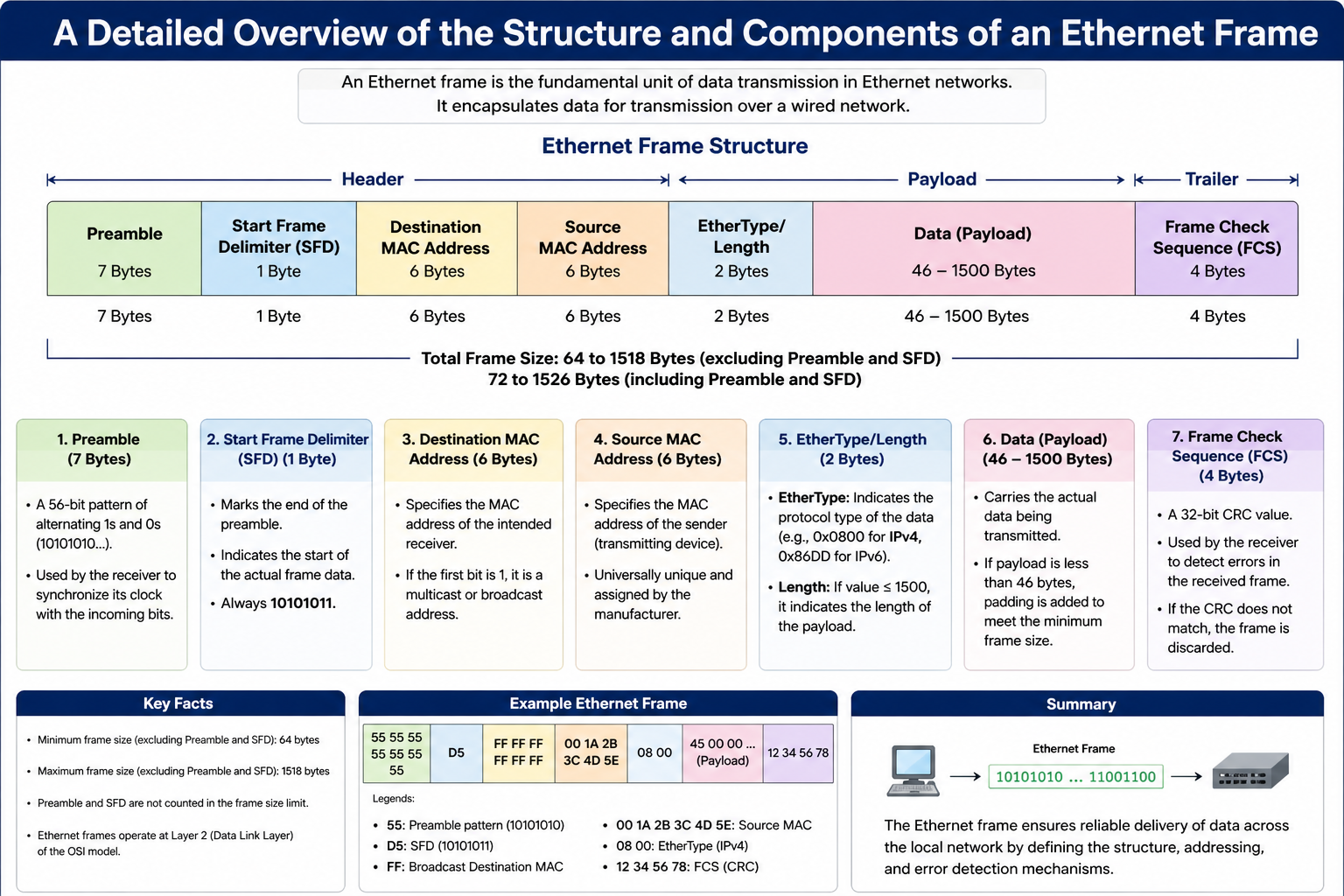
An Ethernet frame is a carefully organized structure that allows devices in a local area network to communicate efficiently and reliably. It acts as a container for data, ensuring that information is properly packaged, addressed, transmitted, and verified upon arrival. The structure is standardized so that all networking devices can interpret it consistently regardless of manufacturer or internal design differences. Understanding the Ethernet frame in detail is essential for grasping how modern wired networks function at a fundamental level.
Role of Ethernet in Network Communication
Ethernet is one of the most widely used networking technologies in the world, forming the backbone of most wired local area networks. It operates at the data link layer of the OSI model and is responsible for node-to-node delivery of data. Instead of focusing on end-to-end communication like higher layers, Ethernet ensures that data reaches the correct device within a shared or switched network environment. This is achieved through a structured frame format that includes addressing, control information, payload data, and error detection mechanisms.
Preamble and Synchronization Process
The Ethernet frame begins with a preamble, which is a sequence of alternating bits that allows the receiving device to synchronize its internal clock with the incoming signal. This synchronization is essential because Ethernet communication relies on precise timing to interpret binary data correctly. Without this synchronization phase, the receiver may misinterpret the incoming bitstream.
Following the preamble is the start frame delimiter, which marks the end of synchronization and the beginning of the actual frame content. This field acts as a clear indicator that the structured part of the Ethernet frame is about to begin, allowing the receiver to shift from preparation mode to data processing mode.
Destination MAC Address Functionality
The destination MAC address is one of the most critical components of the Ethernet frame. It identifies the specific device on the local network that should receive the frame. Every network interface card has a unique MAC address assigned by the manufacturer, ensuring that each device can be individually identified.
When a frame is transmitted, switches in the network examine the destination MAC address to determine where to forward the frame. If the destination is known, the frame is directed only to the appropriate port, reducing unnecessary traffic. If the address is unknown, the frame may be broadcast to multiple ports until the correct device responds.
Source MAC Address and Device Identification
The source MAC address identifies the device that originated the frame. This information is essential for communication because it allows the receiving device to know where the data came from and where responses should be sent. It also plays a key role in network management and troubleshooting, as it helps administrators trace traffic back to specific devices.
Switches use source MAC addresses to build MAC address tables, which map devices to specific ports. This process, known as MAC learning, allows networks to become more efficient over time by reducing unnecessary flooding of frames.
EtherType and Protocol Identification
The EtherType field indicates which protocol is encapsulated within the payload of the frame. It helps the receiving system understand how to process the incoming data. For example, different EtherType values can indicate whether the payload contains IPv4, IPv6, or other network-layer protocols.
In some variations of Ethernet standards, this field may represent the length of the payload instead of the protocol type. This distinction depends on the framing standard being used, but modern Ethernet networks predominantly use EtherType to identify protocols.
Payload and Data Transmission
The payload section carries the actual data being transmitted across the network. This data can vary widely depending on the application, ranging from small control messages to large packets of user data such as web content, file transfers, or streaming information.
To maintain efficiency and compatibility, Ethernet frames must meet a minimum payload size requirement. If the actual data is too small, padding bits are added to meet this requirement. This ensures that all frames maintain a consistent structure and can be processed correctly by networking hardware.
The maximum payload size is also limited to prevent excessive frame sizes that could lead to network congestion or inefficiency. Standard Ethernet frames typically support a payload size that ensures a balance between performance and reliability.
Frame Check Sequence and Error Detection
At the end of the Ethernet frame is the frame check sequence, which is used for error detection. This field contains a value generated using a cyclic redundancy check algorithm. Before transmission, the sender calculates this value based on the contents of the frame. When the frame arrives at its destination, the receiver performs the same calculation and compares the result.
If the values match, the frame is considered valid and is processed normally. If there is a mismatch, it indicates that the data may have been corrupted during transmission, and the frame is discarded. This mechanism ensures data integrity across potentially noisy network environments.
Minimum and Maximum Frame Sizes
Ethernet frames are subject to strict size rules that define their minimum and maximum lengths. The minimum frame size ensures that collisions can be detected in shared network environments. If frames were too small, a device might finish transmitting before a collision could be detected, leading to data loss without detection.
The maximum frame size prevents excessively large frames from dominating network bandwidth and causing delays. Standard Ethernet frames have a maximum size that balances efficiency and performance. In some advanced network configurations, larger frames known as jumbo frames may be used to improve performance in specific environments such as data centers.
Ethernet Frame Variants and Standards
Over time, several Ethernet frame formats have been developed. The most widely used is Ethernet II, which uses the EtherType field to identify upper-layer protocols. Another format, defined by IEEE standards, uses a length field followed by a logical link control header.
Although these formats differ slightly in structure, they coexist within modern networks, and most devices are capable of interpreting both. Ethernet II has become the dominant standard due to its simplicity and widespread adoption in IP-based networking.
VLAN Tagging and Frame Extension
In modern networks, Ethernet frames may include an additional field for virtual local area network tagging. This tag allows a single physical network to be divided into multiple logical networks, improving organization, security, and traffic management.
The VLAN tag is inserted into the frame without altering its fundamental structure. It identifies which virtual network the frame belongs to, enabling switches to segregate traffic accordingly. This is particularly useful in enterprise environments where multiple departments share the same physical infrastructure but require isolated communication channels.
Encapsulation and Decapsulation Process
When data is transmitted over a network, it undergoes a process called encapsulation. At higher layers, data is packaged into segments or packets, which are then passed down to the data link layer. Here, Ethernet adds its own header and trailer to form a complete frame.
At the receiving end, the process is reversed through decapsulation. The Ethernet frame is stripped of its header and trailer, and the remaining payload is passed up to higher layers for processing. This layered approach ensures modularity and allows different protocols to work together seamlessly.
Role of Switches in Frame Forwarding
Switches play a critical role in handling Ethernet frames within a network. When a switch receives a frame, it examines the destination MAC address and determines the appropriate output port. This decision-making process is based on a dynamically built MAC address table.
If the destination is unknown, the switch floods the frame to all ports except the one it was received on. Over time, as devices communicate, the switch learns their locations and reduces unnecessary flooding, improving network efficiency.
Collision Domains and Modern Ethernet Behavior
In early Ethernet networks that used hubs, collisions were common because multiple devices shared the same communication medium. Ethernet frames played a key role in detecting and managing these collisions.
In modern switched Ethernet networks, each connection typically operates in a separate collision domain, significantly reducing or eliminating collisions. Full-duplex communication further improves efficiency by allowing simultaneous sending and receiving of data without interference.
Frame Timing and Transmission Efficiency
The timing of Ethernet frame transmission is carefully controlled to ensure efficient use of network resources. Devices follow specific rules about when they can transmit, especially in older shared-media networks. These rules help prevent data collisions and ensure fair access to the communication medium.
In modern networks, switching and full-duplex communication have largely eliminated the need for complex collision management, allowing frames to be transmitted more smoothly and efficiently.
Importance of Standardization in Ethernet Frames
One of the key strengths of Ethernet technology is its strict standardization. Every field in the frame is defined in detail, ensuring that devices from different manufacturers can communicate without compatibility issues. This universality has contributed to Ethernet becoming the dominant wired networking technology worldwide.
Standardization also allows continuous evolution. New features such as VLAN tagging, higher speeds, and improved error handling can be added without breaking compatibility with existing systems.
Ethernet Frame Structure
The Ethernet frame is a foundational element of modern networking, combining addressing, control information, payload data, and error detection into a single structured unit. Its design ensures reliable communication, efficient data transfer, and compatibility across a wide range of devices and network environments. Each component, from the preamble to the frame check sequence, plays a specific role in maintaining the integrity and efficiency of data transmission. Understanding this structure provides essential insight into how digital communication operates at the most fundamental level.
Evolution of Ethernet Frame Design
The Ethernet frame has evolved significantly since the early development of networking technologies. Initially, Ethernet was designed for small-scale local communication with relatively low data rates and simple hardware requirements. As networks expanded and speeds increased, the frame structure was refined to support higher efficiency, better error handling, and improved compatibility across diverse systems.
Modern Ethernet frames retain the same fundamental structure, but enhancements such as VLAN tagging, higher payload capacities, and optimized switching behavior have made them far more versatile. Despite these improvements, backward compatibility has always been a priority, ensuring that older systems can still interpret basic frame formats.
Logical Structure and Layer Interaction
The Ethernet frame operates at the data link layer but interacts closely with both the physical layer below and the network layer above it. This layered approach is part of the OSI model, which separates networking functions into distinct responsibilities. The Ethernet frame serves as the bridge between raw electrical or optical signals and structured network data.
At the physical layer, the frame is converted into electrical signals, light pulses, or radio waves depending on the medium. At the network layer, protocols such as IP rely on Ethernet frames to deliver packets across local networks. This interaction ensures smooth communication between different layers of the networking stack.
Importance of Address Resolution in Frames
Before an Ethernet frame is sent, the sending device must determine the correct destination MAC address. This is often achieved using address resolution protocols that map logical IP addresses to physical MAC addresses. Without this mapping, devices would not know how to properly construct frames for delivery within a local network.
Once the address is resolved, it is placed into the destination MAC field of the frame. This ensures that the frame reaches the correct hardware interface, even in complex network environments with multiple interconnected devices.
Unicast, Broadcast, and Multicast Frame Delivery
Ethernet frames can be classified based on how they are delivered across a network. Unicast frames are sent from one device directly to another specific device using its unique MAC address. This is the most common type of communication in Ethernet networks.
Broadcast frames are sent to all devices within a local network segment. They use a special destination address that indicates all devices should process the frame. This type of communication is useful for discovery processes, such as finding available services or resolving addresses.
Multicast frames are sent to a group of devices that have expressed interest in receiving specific types of data. This allows efficient distribution of information to multiple recipients without flooding the entire network.
Role of Switch Intelligence in Frame Handling
Modern Ethernet switches use intelligent mechanisms to manage frame traffic efficiently. When a switch receives a frame, it examines both the source and destination MAC addresses. It updates its internal MAC address table based on the source address and uses the destination address to decide where to forward the frame.
This learning process allows switches to build a detailed map of the network topology over time. As a result, frames are forwarded only to relevant ports, reducing congestion and improving overall network performance.
Impact of Duplex Modes on Frame Transmission
Ethernet communication can operate in either half-duplex or full-duplex mode. In half-duplex mode, devices cannot send and receive data simultaneously, which increases the likelihood of collisions. Ethernet frames in such environments must be carefully managed to avoid data loss.
In full-duplex mode, devices can transmit and receive data at the same time without collisions. This significantly improves efficiency and is the standard mode in modern switched Ethernet networks. The structure of the Ethernet frame remains unchanged, but its transmission behavior becomes more efficient.
Frame Padding and Minimum Transmission Requirements
Ethernet frames must meet a minimum size requirement to ensure proper collision detection in shared network environments. If the data being transmitted is smaller than the minimum required size, padding bytes are added to the payload.
This padding ensures that the frame maintains a consistent length and can be properly processed by receiving devices. Although padding does not carry meaningful data, it is necessary for maintaining protocol integrity and ensuring reliable transmission.
Error Handling Beyond Frame Check Sequence
While the frame check sequence is the primary mechanism for detecting transmission errors, Ethernet networks also rely on higher-layer protocols for additional reliability. If a frame is discarded due to errors, upper-layer protocols may request retransmission of the lost data.
This layered error-handling approach ensures that even if individual frames are corrupted, the overall communication session remains reliable. It also allows Ethernet to remain simple at the data link layer while delegating complexity to higher layers when needed.
Role of Physical Media in Frame Transmission
Ethernet frames are ultimately transmitted over physical media such as twisted pair cables, fiber optic cables, or wireless links in hybrid systems. Each medium has different characteristics that influence how frames are carried at the physical level.
Despite differences in transmission methods, the structure of the Ethernet frame remains consistent. This abstraction allows Ethernet to operate independently of the underlying hardware, making it highly adaptable to different networking environments.
Frame Efficiency and Bandwidth Utilization
The design of the Ethernet frame is optimized for efficient use of bandwidth. By combining addressing, control information, and payload into a single structured unit, Ethernet reduces overhead and improves throughput.
Efficient frame design also minimizes processing requirements for networking hardware. Switches and network interface cards can quickly interpret frame headers and make forwarding decisions without complex computations, enabling high-speed communication.
Jumbo Frames in High-Performance Networks
In some specialized environments, standard Ethernet frame sizes may be increased to improve performance. These larger frames, known as jumbo frames, allow more data to be transmitted in a single frame, reducing overhead and improving efficiency in high-throughput networks.
Jumbo frames are commonly used in data centers and storage networks where large data transfers are frequent. However, they must be supported by all devices along the communication path to function correctly.
Security Considerations in Ethernet Frames
Although Ethernet itself does not provide strong security features, certain mechanisms can be implemented at the frame level to enhance protection. VLAN tagging can isolate traffic between different network segments, reducing the risk of unauthorized access.
Additionally, network administrators often use monitoring tools to inspect Ethernet frames for unusual patterns or malicious activity. While encryption is typically handled at higher layers, frame analysis remains an important part of network security.
Frame Handling in Modern Network Architectures
Modern networks often combine Ethernet with advanced technologies such as virtualization, cloud computing, and software-defined networking. In these environments, Ethernet frames may be encapsulated, tunneled, or modified to support complex routing and virtualization requirements.
Despite these enhancements, the core Ethernet frame structure remains unchanged, demonstrating its flexibility and long-term relevance in evolving network architectures.
Troubleshooting Using Ethernet Frame Analysis
Network administrators frequently analyze Ethernet frames to diagnose connectivity issues. By inspecting source and destination MAC addresses, error rates, and frame sequences, they can identify problems such as misconfigured devices, faulty cables, or overloaded switches.
Frame analysis tools provide detailed insights into network behavior, making Ethernet frames a valuable resource for maintaining network health and performance.
Interaction with Higher Layer Protocols
Ethernet frames do not operate in isolation; they serve as carriers for higher-layer protocols that define how data is structured and interpreted beyond local delivery. When a frame reaches its destination, the payload is passed upward to protocols such as IP, which then determine routing and delivery across broader networks. This layered interaction ensures that Ethernet remains focused on local communication while supporting complex global networking systems.
Each frame acts as a transport vessel for packets generated by these upper-layer protocols. The Ethernet layer does not interpret the meaning of the payload itself; instead, it ensures that the data arrives intact and is correctly delivered to the appropriate protocol handler.
Encapsulation Across Network Layers
Encapsulation is a fundamental concept in networking where each layer adds its own information to the data before passing it down to the next layer. In the case of Ethernet, data from higher layers is encapsulated into an Ethernet frame by adding a header and trailer.
This process ensures that all necessary information for local delivery, such as MAC addresses and error-checking data, is included. Once encapsulated, the frame is transmitted over the physical medium. At the receiving end, decapsulation removes these additional fields step by step until the original data is revealed.
This structured wrapping and unwrapping process allows multiple protocols to work together seamlessly within the same communication system.
Timing and Frame Transmission Control
Ethernet communication relies on precise timing rules to manage how frames are transmitted over a network. In earlier shared-media networks, devices used collision detection mechanisms to determine when they could safely transmit data. If two devices transmitted simultaneously, a collision would occur, and both would need to resend their frames.
Although modern switched networks have largely eliminated collisions, timing control remains important for maintaining synchronization and efficient data flow. Devices still follow standardized rules to ensure orderly transmission and prevent congestion in high-traffic environments.
Flow Control Mechanisms in Ethernet Networks
Flow control is used to manage the rate at which frames are transmitted between devices. If a receiving device becomes overwhelmed with incoming data, it can signal the sender to pause transmission temporarily. This prevents buffer overflow and ensures that frames are not lost due to congestion.
This mechanism is especially important in high-speed networks where data can arrive faster than it can be processed. By controlling flow at the frame level, Ethernet helps maintain stability and reliability even under heavy network load.
Error Detection and Recovery Strategy
While the frame check sequence is effective at detecting corrupted frames, Ethernet itself does not handle retransmission. Instead, error recovery is handled by higher-layer protocols. If a frame is found to be corrupted, it is simply discarded, and the responsibility of retransmission is passed upward.
This design choice keeps Ethernet simple and efficient, focusing only on detection rather than correction. It also allows flexibility, as different applications can implement their own recovery strategies depending on their requirements.
Importance of Frame Ordering in Communication
Ethernet does not guarantee that frames will arrive in the same order in which they were sent. This is because frames may take different paths through the network or experience varying delays. As a result, ordering is managed by higher-layer protocols.
For example, transport protocols may assign sequence numbers to data segments to ensure that information can be reassembled correctly at the destination. Ethernet simply ensures that each individual frame is delivered as accurately as possible.
Impact of Network Congestion on Frames
Network congestion can significantly affect how Ethernet frames are transmitted. When too many frames are sent simultaneously, switches and network devices may experience buffer limitations. This can lead to frame delays or drops.
To manage congestion, modern networks use techniques such as traffic prioritization and quality of service controls. These mechanisms ensure that critical frames are transmitted with higher priority, improving overall network performance during heavy usage.
Role of Frame Prioritization in Modern Networks
Frame prioritization allows certain types of traffic to be treated more favorably than others. For example, voice and video communication often require low latency and are therefore assigned higher priority compared to standard data transfers.
This prioritization is typically implemented using additional tagging within the Ethernet frame structure. By marking frames according to their importance, networks can ensure that time-sensitive data is delivered efficiently even during congestion.
Security Risks Associated with Ethernet Frames
Although Ethernet is highly efficient, it is not inherently secure. Frames can potentially be intercepted or manipulated if proper security measures are not in place. Since MAC addresses are visible within the frame, attackers within the same network segment may attempt to exploit this information.
To mitigate such risks, modern networks often use encryption at higher layers, access control policies, and segmentation techniques. These measures ensure that even if frames are intercepted, their contents remain protected.
Frame Modification in Virtualized Environments
In virtualized network environments, Ethernet frames may be modified or encapsulated multiple times as they pass through virtual switches and hypervisors. This allows multiple virtual machines to share the same physical network infrastructure while maintaining logical separation.
Each virtual network may add its own header information, which is later removed as the frame moves closer to its final destination. Despite this added complexity, the core Ethernet structure remains intact.
Role of Ethernet in Data Centers
Ethernet frames play a crucial role in data center environments where massive amounts of data are transmitted between servers, storage systems, and network devices. High-speed Ethernet standards are used to ensure fast and reliable communication across these systems.
In such environments, efficiency and low latency are critical. The Ethernet frame structure supports these requirements by minimizing overhead and enabling rapid forwarding of data across complex network topologies.
Scalability of Ethernet Frame-Based Networks
One of the key strengths of Ethernet is its scalability. The same basic frame structure can be used in small home networks as well as large enterprise systems. This scalability is achieved through hierarchical network design, switching technologies, and advanced routing strategies.
As networks grow, Ethernet frames continue to function without modification, demonstrating the robustness of the design. This makes Ethernet suitable for both simple and highly complex communication systems.
Influence of Hardware on Frame Processing
Network interface cards and switches are specifically designed to process Ethernet frames efficiently. Hardware acceleration allows many frame-handling tasks to be performed at high speed without burdening the main processor.
This includes tasks such as MAC address filtering, frame forwarding, and error detection. By offloading these tasks to hardware, network devices can handle large volumes of traffic with minimal latency.
Energy Efficiency Considerations in Ethernet Communication
Modern Ethernet standards also consider energy efficiency. Devices may enter low-power states when network activity is low, reducing energy consumption without affecting frame structure or compatibility.
This is particularly important in large-scale deployments where thousands of devices operate continuously. Efficient frame handling helps reduce overall power usage while maintaining performance.
Advanced Frame Functionality
The Ethernet frame is far more than a simple data container; it is a highly engineered structure that supports complex, high-speed, and reliable communication across diverse network environments. Its ability to integrate with higher-layer protocols, adapt to modern technologies, and maintain efficiency under heavy load makes it one of the most important components in networking.
Through continuous evolution and strong standardization, the Ethernet frame remains at the core of digital communication systems, supporting everything from basic local networks to advanced global infrastructures.
Frame Handling in Wireless and Hybrid Networks
Although Ethernet is traditionally associated with wired communication, its frame structure is also used in hybrid and bridged wireless environments. In such systems, Ethernet frames may be encapsulated for transmission over wireless links and then converted back once they reach a wired segment. This allows seamless integration between Wi-Fi networks and wired Ethernet infrastructure.
In these hybrid setups, the Ethernet frame acts as a universal transport format, ensuring that devices can communicate regardless of the underlying transmission medium. Even when signals travel through different technologies, the logical structure of the frame remains consistent.
Virtual LAN Segmentation and Frame Isolation
Virtual LANs introduce logical segmentation within a single physical network by modifying Ethernet frames with tagging information. This allows administrators to divide a network into multiple isolated sections, improving security, performance, and organization.
When a frame enters a VLAN-enabled switch, the tag is used to determine which virtual network it belongs to. Frames are then forwarded only within that VLAN unless explicitly routed. This prevents unnecessary traffic leakage between different departments or systems sharing the same infrastructure.
Quality of Service and Frame Prioritization
Quality of Service mechanisms rely heavily on Ethernet frame enhancements to prioritize certain types of traffic. Frames can be marked with priority values that indicate their importance relative to other network data.
Time-sensitive applications such as voice communication, video conferencing, and real-time control systems benefit from higher priority handling. These frames are processed and transmitted ahead of less critical data, reducing latency and improving user experience in demanding network environments.
Frame Aggregation in High-Speed Networks
In modern high-speed Ethernet systems, frame aggregation techniques are sometimes used to improve efficiency. Multiple smaller frames or data units may be combined into a larger transmission unit to reduce overhead and increase throughput.
This approach reduces the proportion of header and control information relative to actual data, allowing more efficient use of available bandwidth. However, careful management is required to ensure that latency-sensitive traffic is not negatively affected.
Impact of Network Topology on Frame Flow
The structure of a network has a direct influence on how Ethernet frames are transmitted and forwarded. In star topologies, frames typically pass through a central switch, which manages all forwarding decisions. In more complex hierarchical networks, frames may traverse multiple switching layers before reaching their destination.
Each hop introduces processing time, but modern switches are designed to handle frames at extremely high speeds, minimizing delays. The overall efficiency of frame delivery depends heavily on how well the network topology is designed and optimized.
Frame Duplication and Loop Prevention
Network loops can cause serious issues in Ethernet environments, including frame duplication and broadcast storms. To prevent this, mechanisms such as loop detection and prevention protocols are used.
These systems ensure that Ethernet frames do not circulate indefinitely within the network. When a loop is detected, redundant paths are disabled, maintaining stability and preventing excessive traffic that could degrade network performance.
Role of Spanning Tree Logic in Frame Control
Spanning tree mechanisms are used in Ethernet networks to create a loop-free logical topology. By selectively blocking certain network paths, they ensure that there is only one active path between any two devices.
This prevents multiple copies of the same frame from circulating through redundant paths. If a primary path fails, the system automatically activates a backup path, ensuring continuous connectivity without manual intervention.
Frame Processing Delays and Latency Factors
Although Ethernet is designed for high-speed communication, frames may still experience delays due to processing time within network devices. Factors such as switch load, buffer availability, and link congestion can all influence latency.
In well-designed networks, these delays are minimized through efficient hardware and optimized routing paths. However, understanding these factors is important when designing systems that require real-time or near-real-time communication.
Role of Buffers in Frame Management
Network devices use buffers to temporarily store Ethernet frames when immediate forwarding is not possible. These buffers help smooth out traffic fluctuations and prevent data loss during short-term congestion.
However, buffer overflows can occur if traffic exceeds the processing capacity of a device for extended periods. When this happens, frames may be dropped, highlighting the importance of proper network capacity planning.
Evolution Toward Higher Speed Ethernet Standards
Ethernet technology has evolved from early low-speed implementations to extremely high-speed standards capable of supporting multi-gigabit and terabit-level communication. Despite these speed increases, the basic frame structure has remained largely unchanged.
This consistency is a key strength of Ethernet, allowing new technologies to be introduced without disrupting existing systems. Improvements are typically made in transmission methods, hardware efficiency, and frame handling speed rather than altering the fundamental frame format.
Importance of Backward Compatibility
One of the most important design principles of Ethernet is backward compatibility. Newer Ethernet systems are designed to work seamlessly with older frame structures, ensuring that devices from different generations can still communicate.
This compatibility has allowed Ethernet to remain relevant for decades, even as networking demands have grown significantly. It also reduces the cost and complexity of upgrading network infrastructure.
Troubleshooting Ethernet Frame Issues
Network administrators often rely on Ethernet frame analysis to diagnose performance and connectivity problems. By examining frame headers, error counts, and transmission patterns, they can identify issues such as misconfigured devices, faulty cables, or overloaded network segments.
Tools that capture and analyze frames provide detailed insights into network behavior, making it easier to isolate and resolve problems quickly. Frame-level analysis is one of the most effective methods for maintaining network reliability.
Future of Ethernet Frame Technology
While the basic Ethernet frame structure is likely to remain stable, future developments may focus on improving efficiency, reducing latency, and enhancing security. Advances in hardware acceleration, artificial intelligence-driven network management, and ultra-high-speed transmission will continue to shape how frames are handled.
Even as networking technology evolves, the simplicity and reliability of the Ethernet frame ensure that it will remain a core component of digital communication systems for the foreseeable future.
Conclusion
The Ethernet frame is a foundational element of modern networking, providing a structured and reliable method for data transmission across local networks. Its carefully designed components—including addressing fields, payload data, and error-checking mechanisms—work together to ensure accurate and efficient communication.
Over time, the Ethernet frame has adapted to support new technologies such as VLANs, high-speed transmission, virtualization, and quality of service controls, while maintaining its original structure and compatibility. This balance of stability and flexibility has made it one of the most enduring and widely used networking constructs in the world.
From simple device-to-device communication to complex data center operations, Ethernet frames continue to play a vital role in enabling seamless digital communication across all types of modern networks.