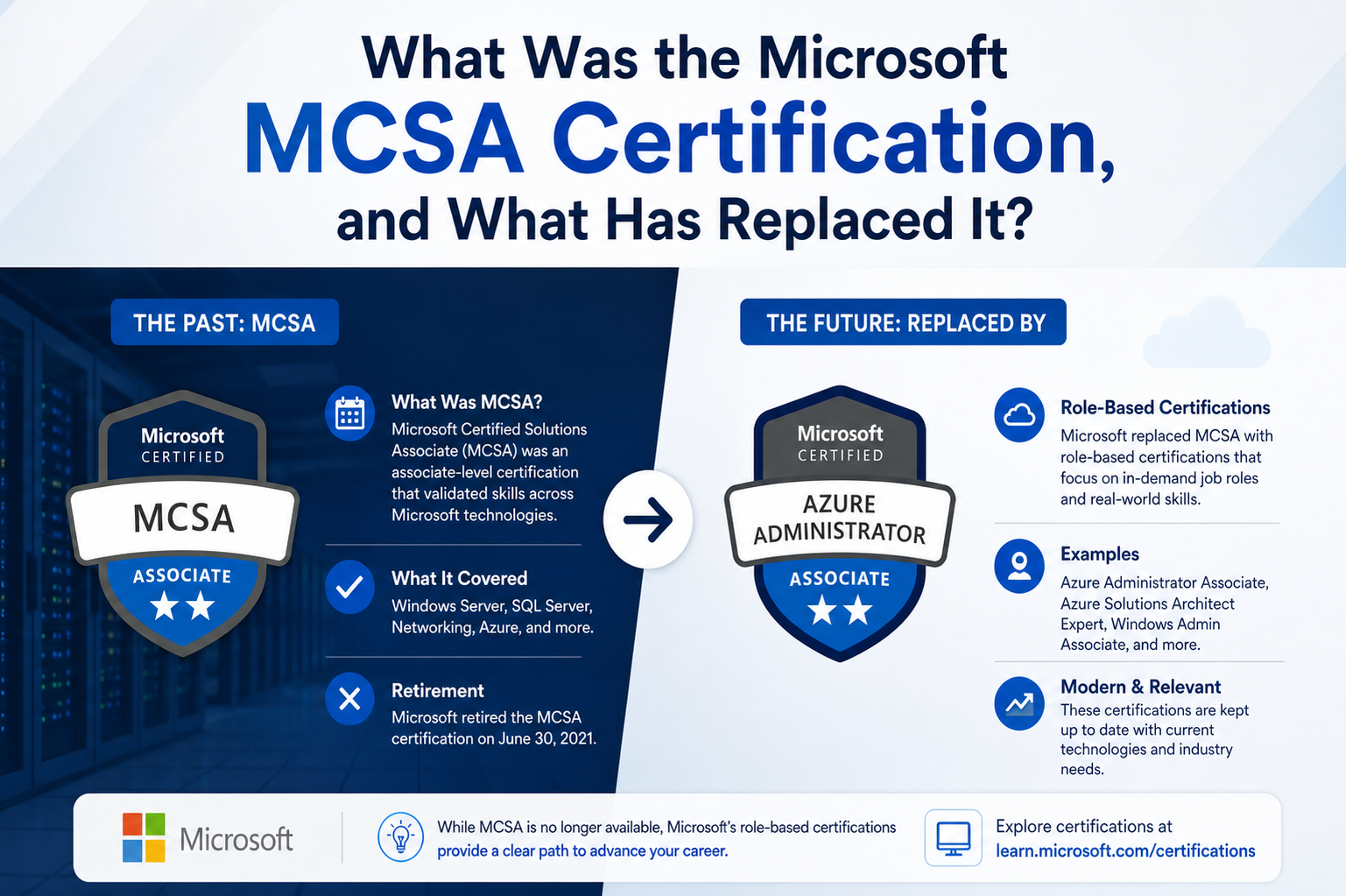
Microsoft certifications have gone through several major transformations over the years, reflecting the constant evolution of technology and industry requirements. The Microsoft Certified Solutions Associate (MCSA) was once a central part of this ecosystem, acting as a bridge between entry-level knowledge and advanced expertise. It was introduced during a period when on-premises infrastructure dominated the IT landscape, and organizations heavily relied on Windows Server environments, local databases, and traditional networking systems.
The certification structure at that time was built around product versions. Each certification was tied to a specific technology release, such as Windows Server editions or SQL Server versions. This meant that professionals had to repeatedly update their certifications as new versions were released. While this ensured technical relevance, it also created a cycle of re-certification that focused more on products than job roles.
Over time, as cloud computing began reshaping the IT industry, Microsoft recognized that this product-based approach was becoming less effective. Organizations were no longer relying solely on on-premises infrastructure but were instead adopting hybrid and fully cloud-based environments. This shift required IT professionals to develop broader, more flexible skill sets rather than narrowly focused product knowledge.
Purpose and Structure of the MCSA Certification
The MCSA certification was designed to validate intermediate-level technical expertise. It was not considered a beginner credential, nor was it an expert-level qualification. Instead, it occupied a middle position in Microsoft’s certification hierarchy. Candidates were expected to already understand basic IT concepts before attempting MCSA-level exams.
The certification typically required passing multiple exams, each focusing on a specific area of a technology ecosystem. For example, someone pursuing a Windows Server track would need to demonstrate skills in installation, configuration, storage management, virtualization, and system maintenance. Similarly, a database-focused track would require knowledge of database creation, querying, optimization, and security management.
This multi-exam structure ensured that certified professionals had a well-rounded understanding of the platform they specialized in. It was not enough to pass a single test; candidates had to demonstrate consistency across multiple technical domains. This made the certification highly respected in the IT industry for many years.
Skills Validated by MCSA Certification
The MCSA certification validated a wide range of practical skills that were essential for IT administrators and support engineers. These skills included system installation and configuration, user and group management, network services configuration, and troubleshooting system issues.
In addition, candidates were expected to understand security fundamentals such as access control, authentication mechanisms, and policy management. In database-related tracks, skills extended to writing queries, managing data integrity, and optimizing performance.
One of the most important aspects of the MCSA certification was its emphasis on hands-on experience. It was not purely theoretical; instead, it required candidates to understand how systems functioned in real environments. This practical orientation made it especially valuable for employers seeking professionals who could immediately contribute to operational tasks.
Why MCSA Was Widely Recognized
The MCSA certification gained widespread recognition because it aligned closely with industry needs during the era of on-premises computing. Most organizations operated their own servers, managed internal networks, and maintained local databases. As a result, there was a strong demand for professionals who could manage these systems efficiently.
Holding an MCSA certification often served as proof that a candidate had the necessary technical foundation to work in IT support, system administration, or infrastructure management roles. It also acted as a stepping stone toward more advanced certifications, such as Microsoft Certified Solutions Expert (MCSE), which represented higher-level expertise.
For many IT professionals, MCSA was the starting point of a structured certification journey. It provided credibility, improved job prospects, and helped individuals transition into more specialized technical roles.
Transition Toward Cloud Computing
As cloud computing technologies began to dominate the IT landscape, the limitations of product-based certification models became more apparent. Organizations started adopting platforms such as Microsoft Azure and Microsoft 365, which offered scalable, flexible, and globally accessible services.
This shift required IT professionals to move beyond traditional server management and embrace cloud architecture, automation, identity management, and security in distributed environments. The skills required were no longer tied to a single product version but instead focused on broader job responsibilities.
Microsoft recognized that continuing with the MCSA model would not adequately prepare professionals for this new environment. As a result, the company gradually phased out role-based certifications in favor of a more modern structure aligned with real-world job functions.
Retirement of MCSA Certification
The MCSA certification was officially retired as part of Microsoft’s certification overhaul. This decision marked the end of an era in which certifications were primarily product-focused. The retirement was not due to a lack of value but rather due to the changing nature of the IT industry.
Maintaining certifications tied to specific software versions became less practical as cloud services continuously evolve without traditional versioning cycles. Instead of major product releases every few years, cloud platforms are updated constantly, requiring a more dynamic certification approach.
With the retirement of MCSA, Microsoft encouraged professionals to transition toward newer certifications that better reflect modern IT environments.
Introduction of Role-Based Certifications
The most significant replacement for MCSA is Microsoft’s role-based certification model. Instead of focusing on individual products, these certifications are structured around job roles. This means that each certification aligns with the responsibilities of specific positions in the IT industry.
For example, instead of a general server administration certification, professionals can now pursue certifications such as Azure Administrator, Microsoft 365 Administrator, or Security Engineer. Each of these paths focuses on real-world tasks associated with those roles.
This approach ensures that learning is more practical and directly applicable to workplace responsibilities. It also allows professionals to specialize more effectively based on their career goals.
Microsoft Azure Certifications as a Key Replacement
One of the most important areas that replaced MCSA is the Azure certification track. Azure certifications focus on cloud infrastructure, deployment, management, and security. These certifications are designed to prepare professionals for cloud-first environments, which are now widely adopted across industries.
Azure certifications cover topics such as virtual machines, networking in the cloud, identity management, storage solutions, and automation. Unlike the older MCSA structure, these certifications are continuously updated to reflect the latest cloud technologies.
This ensures that certified professionals remain relevant in a rapidly changing technological landscape where cloud services are central to most IT operations.
Microsoft 365 Certifications and Modern Workplace Skills
Another major replacement for MCSA is the Microsoft 365 certification path. This focuses on modern workplace environments, including collaboration tools, identity services, and endpoint management.
Microsoft 365 certifications validate skills related to managing enterprise communication platforms, securing user identities, and supporting remote work environments. These skills have become increasingly important as organizations adopt hybrid work models and cloud-based productivity tools.
Unlike traditional server-focused certifications, Microsoft 365 certifications emphasize user experience, collaboration, and security across distributed systems.
Security and Data-Focused Certifications
As cybersecurity threats have increased, Microsoft has also introduced certifications focused specifically on security, compliance, and data management. These certifications replace some of the technical depth previously covered under MCSA but expand it into more specialized areas.
Security certifications focus on protecting cloud environments, managing identity access, and responding to security incidents. Data certifications, on the other hand, emphasize analytics, database management, and artificial intelligence integration.
This specialization reflects the growing importance of data protection and intelligent systems in modern IT infrastructure.
Impact on IT Professionals
The transition from MCSA to role-based certifications has had a significant impact on IT professionals. While MCSA provided a broad technical foundation, the new certifications require more focused learning paths.
Professionals now need to choose career directions more carefully, as certifications are closely tied to specific job roles. This can be beneficial because it creates clearer career pathways, but it also requires more strategic planning in terms of skill development.
Many experienced IT professionals who held MCSA certifications have transitioned into Azure, Microsoft 365, or security-focused certifications to stay relevant in the industry.
Relevance of MCSA Skills Today
Although MCSA has been retired, the skills it represented are still relevant in many ways. Concepts such as networking, system administration, and server management remain foundational to IT operations.
However, these skills are now applied within cloud and hybrid environments rather than purely on-premises systems. This means that while the certification itself is no longer active, its underlying knowledge base continues to influence modern IT practices.
Professionals with MCSA backgrounds often find it easier to transition into newer certifications because they already understand core infrastructure concepts.
Long-Term Direction of Microsoft Certifications
Microsoft’s certification strategy is now fully aligned with cloud computing, automation, and role-based expertise. This shift reflects the broader direction of the IT industry, where flexibility, scalability, and continuous learning are essential.
Future certifications are likely to evolve even further, incorporating artificial intelligence, machine learning, and advanced security frameworks. The goal is to ensure that professionals remain capable of handling increasingly complex digital environments.
This ongoing evolution ensures that certifications remain relevant not just as credentials but as practical tools for career development.
Why Microsoft Moved Away from Product-Based Certifications
The decision to move away from certifications like MCSA was largely driven by the rapid transformation of the IT industry. In earlier computing environments, systems were relatively stable, and software versions changed slowly over time. This made product-based certifications practical because professionals could specialize in a specific version of Windows Server, SQL Server, or other Microsoft technologies and remain relevant for several years.
However, the rise of cloud computing changed this stability completely. Cloud platforms introduced continuous updates, meaning there were no longer clear “version releases” in the traditional sense. Instead, features were added, removed, or modified regularly. In such an environment, tying certifications to specific product versions became less meaningful and more difficult to maintain.
Microsoft recognized that employers were no longer looking for professionals who could manage a single product version. Instead, they needed individuals who could perform job functions across evolving systems. This shift in demand required a new certification structure that focused on skills, responsibilities, and real-world roles rather than static technical knowledge.
Shift Toward Real-World Job Roles
One of the most important changes in the certification system was the introduction of role-based learning paths. Instead of studying isolated technologies, candidates now prepare for certifications that match actual job positions in the industry.
This approach aligns learning outcomes directly with workplace expectations. For example, an Azure Administrator certification is designed to reflect the daily responsibilities of managing cloud resources, configuring virtual networks, monitoring system performance, and ensuring security compliance. Similarly, a Microsoft 365 Administrator focuses on managing enterprise communication systems, user accounts, and collaboration tools.
This role-based structure ensures that certifications are not just academic achievements but practical indicators of job readiness. Employers can now better understand what a certified professional is capable of doing in a real working environment.
Comparison Between MCSA and Modern Certifications
The MCSA certification was broad in nature and covered multiple technical areas within a single track. While this provided a strong foundation, it sometimes lacked specialization in emerging technologies such as cloud computing and cybersecurity.
In contrast, modern certifications are narrower in scope but deeper in focus. Instead of covering many unrelated topics, they concentrate on specific job functions. This allows professionals to develop expertise in a particular area, such as cloud infrastructure, identity management, or data engineering.
Another key difference is the learning approach. MCSA often required passing multiple exams tied to a product, while modern certifications are structured around skill progression and practical application. This makes the learning process more aligned with real-world scenarios rather than theoretical knowledge.
Impact of Cloud Computing on Certification Design
Cloud computing has fundamentally reshaped how IT systems are designed and managed. Instead of relying on physical servers and localized infrastructure, organizations now depend on distributed systems that operate across global data centers.
This change required a new type of IT professional—one who understands scalability, automation, security in cloud environments, and integration between multiple services. Traditional certifications like MCSA were not fully designed to cover these areas in depth.
As a result, Microsoft redesigned its certification ecosystem to reflect cloud-first architecture. This includes topics such as virtual machine provisioning, cloud networking, identity federation, and automated deployment pipelines. These skills are essential in modern IT operations and are now central to Microsoft’s certification structure.
Role of Azure in Modern Certification Paths
Microsoft Azure has become the foundation of the company’s modern certification system. It serves as the primary platform for cloud-related learning paths and certifications.
Azure certifications cover a wide range of topics, from basic infrastructure management to advanced cloud architecture design. Professionals can specialize in areas such as administration, development, security, or data engineering within the Azure ecosystem.
This flexibility allows individuals to build career paths based on their interests and strengths. Unlike the older MCSA model, where learning was tied to specific server technologies, Azure certifications are more dynamic and adaptable to different roles in the IT industry.
Microsoft 365 and the Modern Workplace Transformation
Another major area that replaced MCSA is Microsoft 365 certification. This reflects the shift toward digital workplaces and remote collaboration.
Microsoft 365 certifications focus on managing cloud-based productivity tools, securing user identities, and enabling collaboration across distributed teams. These skills have become essential as organizations increasingly adopt hybrid and remote work models.
The certification also emphasizes security and compliance, which are critical in modern workplaces where data protection and privacy regulations play a major role.
Unlike traditional infrastructure-focused certifications, Microsoft 365 certifications are centered around user experience and organizational productivity.
Growing Importance of Security and Compliance Skills
As digital systems become more complex, cybersecurity has become a top priority for organizations. This has led to the creation of specialized certifications focused on security, identity management, and compliance.
These certifications replace some of the security concepts that were previously part of MCSA but expand them into more advanced and specialized areas. Professionals now learn how to protect cloud environments, manage access controls, detect threats, and respond to security incidents.
This reflects the reality of modern IT environments, where security is not just an additional skill but a core requirement for almost every role.
Data and Artificial Intelligence in Certification Evolution
Another major shift in Microsoft’s certification strategy is the inclusion of data and artificial intelligence-focused learning paths. These areas were not heavily emphasized in the MCSA structure but have become essential in today’s technology landscape.
Modern certifications now cover data engineering, analytics, machine learning, and AI integration. Professionals working in these areas are responsible for managing large-scale data systems, building predictive models, and enabling intelligent decision-making processes.
This evolution reflects the increasing importance of data-driven technologies in business operations and digital transformation strategies.
Career Path Changes for IT Professionals
The transition from MCSA to role-based certifications has significantly changed how IT professionals plan their careers. In the past, individuals often followed a linear path starting with MCSA and progressing to higher-level certifications.
Today, career paths are more flexible and non-linear. Professionals choose certification tracks based on their desired job roles rather than following a fixed progression. This allows for greater specialization but also requires more careful planning.
For example, someone interested in cloud infrastructure may focus on Azure certifications, while another individual interested in security may pursue cybersecurity-focused credentials.
Learning Experience in the New Certification Model
The learning experience has also evolved significantly. Modern Microsoft certifications place a strong emphasis on practical, scenario-based learning. Instead of memorizing product features, candidates are encouraged to solve real-world problems.
This includes tasks such as configuring cloud environments, managing identity systems, implementing security policies, and optimizing system performance. The goal is to ensure that professionals are job-ready upon certification completion.
This hands-on approach makes learning more engaging and directly applicable to workplace challenges.
Industry Demand for Modern Certifications
Employers today prefer candidates with role-based certifications because they better reflect current job requirements. Organizations are increasingly operating in cloud environments, using automated systems, and prioritizing cybersecurity.
As a result, certifications that focus on outdated on-premises systems are less relevant in modern hiring decisions. Instead, certifications in Azure, Microsoft 365, security, and data engineering are highly valued.
This shift has made role-based certifications more aligned with industry expectations and career opportunities.
Continuing Value of Foundational Knowledge
Even though MCSA has been retired, its foundational concepts remain important. Understanding networking, server administration, and system configuration is still essential for IT professionals working in hybrid environments.
Modern certifications build upon these foundational skills and extend them into cloud and digital ecosystems. This means that professionals with MCSA backgrounds often have an advantage when transitioning to newer certification paths.
The core principles of IT infrastructure have not disappeared; they have simply evolved into more complex and scalable systems.
Future Direction of Microsoft Certification Ecosystem
The future of Microsoft certifications is expected to focus even more heavily on automation, artificial intelligence, and integrated cloud ecosystems. As technology continues to evolve, certifications will likely become even more adaptive and skill-focused.
Continuous learning will remain a key theme, with professionals expected to update their skills regularly to keep pace with technological advancements. This ensures that certifications remain relevant in fast-changing digital environments.
Overall, the shift from MCSA to role-based certifications represents a broader transformation in how IT skills are defined, taught, and validated in the modern world.
How the Retirement of MCSA Affected Existing Certification Holders
When Microsoft retired the MCSA certification, it did not invalidate the credentials already earned by professionals. Anyone who had completed the certification before its retirement continues to hold it as proof of their historical achievement. However, the retirement meant that no new candidates could enroll in or complete MCSA exams.
For many IT professionals, this change created a need to update their skills to stay competitive in the job market. While the certification itself remained valid as a credential, employers increasingly began prioritizing newer, role-based certifications that aligned with cloud technologies and modern infrastructure practices.
As a result, many former MCSA holders transitioned into Azure, Microsoft 365, or security-focused certification paths. This transition was generally smooth for experienced professionals because the foundational knowledge they already possessed—such as networking, system administration, and server management—remained highly relevant in modern environments.
Bridging the Gap Between Traditional and Modern IT Skills
The shift from MCSA to role-based certifications created a clear distinction between traditional IT infrastructure knowledge and modern cloud-based expertise. However, these two skill sets are not entirely separate. Instead, they are deeply connected.
Traditional IT skills form the foundation of modern cloud systems. Concepts such as virtual machines, storage management, and networking still exist in cloud environments, but they are implemented differently. For example, instead of configuring physical servers, professionals now manage virtual infrastructure through cloud platforms.
This means that individuals with MCSA experience often have a strong advantage when learning cloud technologies. Their understanding of system architecture helps them grasp more advanced concepts in Azure and other modern platforms more quickly.
The Role of Continuous Learning in Modern Certifications
One of the most important differences between MCSA and modern certifications is the emphasis on continuous learning. In the past, earning an MCSA certification was often considered a long-term achievement that remained relevant for several years.
Today, certifications are designed to evolve alongside technology. Cloud platforms are updated frequently, and new features are introduced on a regular basis. As a result, IT professionals are expected to continuously update their skills to stay current.
Microsoft encourages this approach by offering learning paths that are regularly updated. This ensures that certified professionals are always working with the latest tools, technologies, and best practices in the industry.
Expansion of Certification Levels and Specializations
The modern Microsoft certification ecosystem includes multiple levels, such as fundamentals, associate, and expert-level certifications. This structured approach helps professionals gradually build their expertise.
Fundamental certifications introduce basic concepts, while associate-level certifications focus on job-specific skills. Expert-level certifications are designed for advanced professionals who work in complex environments and make architectural decisions.
In contrast, MCSA was primarily positioned as an intermediate-level certification without the same level of structured progression. The new system provides a clearer pathway for career development and specialization.
Integration of Automation and DevOps Practices
Another major evolution in Microsoft certifications is the integration of automation and DevOps principles. Modern IT environments rely heavily on automation to manage infrastructure, deploy applications, and maintain system performance.
Role-based certifications now include topics such as infrastructure as code, automated deployment pipelines, and continuous integration and delivery practices. These concepts were not deeply covered in the MCSA framework but are essential in today’s IT industry.
This shift reflects the growing demand for efficiency, scalability, and faster deployment cycles in software and infrastructure management.
Importance of Cloud Security in Modern Certifications
Security has become one of the most critical components of modern IT systems. With the increasing adoption of cloud technologies, organizations must protect distributed environments that are accessible from multiple locations and devices.
Microsoft’s newer certifications place a strong emphasis on identity protection, threat detection, and compliance management. These skills are essential for securing sensitive data and maintaining regulatory standards.
Unlike traditional infrastructure security, cloud security requires a broader understanding of global systems, user access management, and real-time threat monitoring.
Impact on Career Growth and Opportunities
The transition from MCSA to role-based certifications has also influenced career growth opportunities in the IT industry. Modern certifications are more closely aligned with job roles, making it easier for employers to identify suitable candidates for specific positions.
Professionals who hold certifications in Azure, Microsoft 365, or security are often considered for specialized roles that offer higher responsibility and better career advancement opportunities.
This role-based approach has made career progression more structured, allowing individuals to move from foundational roles into advanced technical or architectural positions over time.
Relevance of Hybrid IT Environments
Even though cloud computing has become dominant, many organizations still operate hybrid environments that combine on-premises systems with cloud infrastructure. This means that knowledge of traditional systems remains relevant.
Professionals who understand both environments are particularly valuable because they can manage integration between legacy systems and modern cloud platforms. This hybrid knowledge is one of the key areas where MCSA-level skills continue to be useful.
Modern certifications often include hybrid scenarios to ensure professionals are prepared for real-world enterprise environments.
Global Recognition of Role-Based Certifications
Microsoft’s role-based certifications are globally recognized and widely accepted across industries. This global recognition has strengthened their value in the job market.
Because these certifications are aligned with universal job roles rather than specific product versions, they are applicable across different industries and regions. This makes them more flexible and relevant for professionals working in international environments.
Employers around the world now prioritize these certifications when hiring for cloud, security, and data-related roles.
Adapting to Technological Change in IT Careers
The evolution from MCSA to modern certifications reflects a broader trend in the IT industry: the need for adaptability. Technology is no longer static, and professionals must continuously evolve their skills to remain relevant.
This shift encourages a mindset of lifelong learning. Instead of relying on a single certification, IT professionals now build a portfolio of certifications that reflect different aspects of their expertise.
This approach ensures that they can adapt to new technologies and remain competitive in a rapidly changing industry.
The Future of Microsoft Learning Paths
Looking ahead, Microsoft is expected to continue refining its certification ecosystem to align with emerging technologies such as artificial intelligence, machine learning, edge computing, and advanced cloud automation.
Future certifications will likely become even more integrated with real-world job functions, focusing on practical problem-solving and system optimization. Continuous updates will remain a key feature, ensuring that professionals always work with the latest technological advancements.
This ongoing evolution ensures that Microsoft certifications remain relevant and valuable in a world where digital transformation is accelerating.
How Role-Based Certifications Improve Practical Learning
One of the strongest improvements in Microsoft’s modern certification system is the shift toward practical, scenario-based learning. Unlike the older MCSA structure, which often focused heavily on theoretical knowledge tied to specific product versions, role-based certifications emphasize real-world tasks and problem-solving skills.
This means learners are now trained in environments that closely resemble actual workplace situations. For example, instead of simply understanding how a server works in theory, candidates are expected to configure cloud resources, manage identities, troubleshoot system issues, and apply security policies in realistic scenarios.
This approach ensures that professionals are not just exam-ready but also job-ready. It reduces the gap between learning and practical application, which is essential in fast-changing IT environments where employers expect immediate productivity.
Improved Alignment With Industry Job Roles
Another important benefit of role-based certifications is their direct alignment with industry job roles. In the past, MCSA certifications provided broad technical coverage, but they did not always clearly map to specific job responsibilities.
Today’s certification paths are designed around actual positions such as cloud administrator, security engineer, data analyst, and solutions architect. This alignment helps both learners and employers. Learners understand exactly what skills they are developing, while employers can easily identify candidates who match specific job requirements.
This clarity has made hiring processes more efficient and has improved career planning for IT professionals.
Flexibility in Career Path Development
Modern Microsoft certifications also offer greater flexibility in career development. Instead of following a fixed path, professionals can choose multiple directions based on their interests and goals.
For example, someone starting in cloud administration can later move into security or data engineering by earning additional certifications. This flexibility was more limited under the MCSA system, where certification paths were more linear and product-focused.
The new structure encourages professionals to diversify their skills and explore different areas of technology, making them more versatile in the job market.
Importance of Hands-On Experience in Modern Certifications
Hands-on experience has become a central requirement in modern Microsoft certifications. While theoretical knowledge is still important, practical application plays a much larger role than before.
Candidates are expected to work with real tools, simulate environments, and solve technical challenges that reflect actual workplace situations. This ensures that certified professionals have not only studied the concepts but also understand how to apply them effectively.
This practical focus has significantly increased the value of certifications in the eyes of employers, as it demonstrates genuine technical capability rather than memorized knowledge.
The Role of Cloud-First Strategy in Certification Evolution
Microsoft’s transition away from MCSA is closely tied to its cloud-first strategy. The company has shifted its focus toward cloud computing platforms such as Azure and Microsoft 365, which now form the foundation of its certification ecosystem.
This strategy reflects the broader industry movement toward cloud adoption, where organizations prefer scalable, flexible, and cost-efficient solutions over traditional on-premises systems.
As a result, certifications are now designed to prepare professionals for cloud-native environments, ensuring they can manage distributed systems, automate processes, and maintain security across global infrastructures.
Growing Demand for Specialized IT Skills
The modern IT industry increasingly values specialization over generalization. While MCSA provided a broad foundation, today’s certifications encourage deeper expertise in specific areas.
Professionals are now expected to develop advanced skills in fields such as cloud architecture, cybersecurity, data analytics, and artificial intelligence. This specialization allows organizations to build stronger, more efficient teams with clearly defined roles.
As technology becomes more complex, the demand for highly skilled specialists continues to grow, making role-based certifications more relevant than ever.
Long-Term Value of Microsoft Certifications
Microsoft certifications continue to hold strong value in the global job market. They are widely recognized by employers and often serve as key qualifications for technical roles.
The shift from MCSA to role-based certifications has actually strengthened this value by ensuring that certifications remain aligned with current industry needs. Professionals who hold modern certifications are seen as up-to-date and capable of working in advanced IT environments.
This long-term relevance makes Microsoft certifications an important investment for career growth and professional development.
Continuous Evolution of IT Learning Models
The transformation from MCSA to role-based certifications is part of a larger evolution in how IT education is delivered. Learning models are becoming more dynamic, flexible, and continuously updated to match technological advancements.
Instead of static certification paths, professionals now engage in ongoing learning journeys that evolve with industry changes. This ensures that skills remain relevant even as technologies shift rapidly.
This continuous learning model is now a standard expectation in the IT industry.
The transformation from MCSA to role-based certifications is part of a larger evolution in how IT education is delivered. Learning models are becoming more dynamic, flexible, and continuously updated to match technological advancements.
Instead of static certification paths, professionals now engage in ongoing learning journeys that evolve with industry changes. This ensures that skills remain relevant even as technologies shift rapidly.
Conclusion
The Microsoft Certified Solutions Associate (MCSA) certification played an important role in shaping the careers of IT professionals for many years. It provided a strong foundation in system administration, server management, and database technologies during a time when on-premises infrastructure was the industry standard.
However, as technology evolved and cloud computing became dominant, the limitations of product-based certifications became more apparent. Microsoft responded by retiring MCSA and introducing a modern, role-based certification system designed to reflect real-world job responsibilities.
Today’s certifications focus on cloud platforms, cybersecurity, data management, and modern workplace technologies. They are structured around specific job roles, making them more practical, flexible, and aligned with industry demands.
While MCSA is no longer part of the active certification ecosystem, its foundational concepts continue to influence modern IT practices. Professionals with MCSA experience often find it easier to transition into new certification paths because they already understand core infrastructure principles.
Overall, the shift from MCSA to role-based certifications represents a major step forward in IT education. It reflects the industry’s move toward cloud computing, continuous learning, and skill-based career development, ensuring that professionals remain prepared for the future of technology.