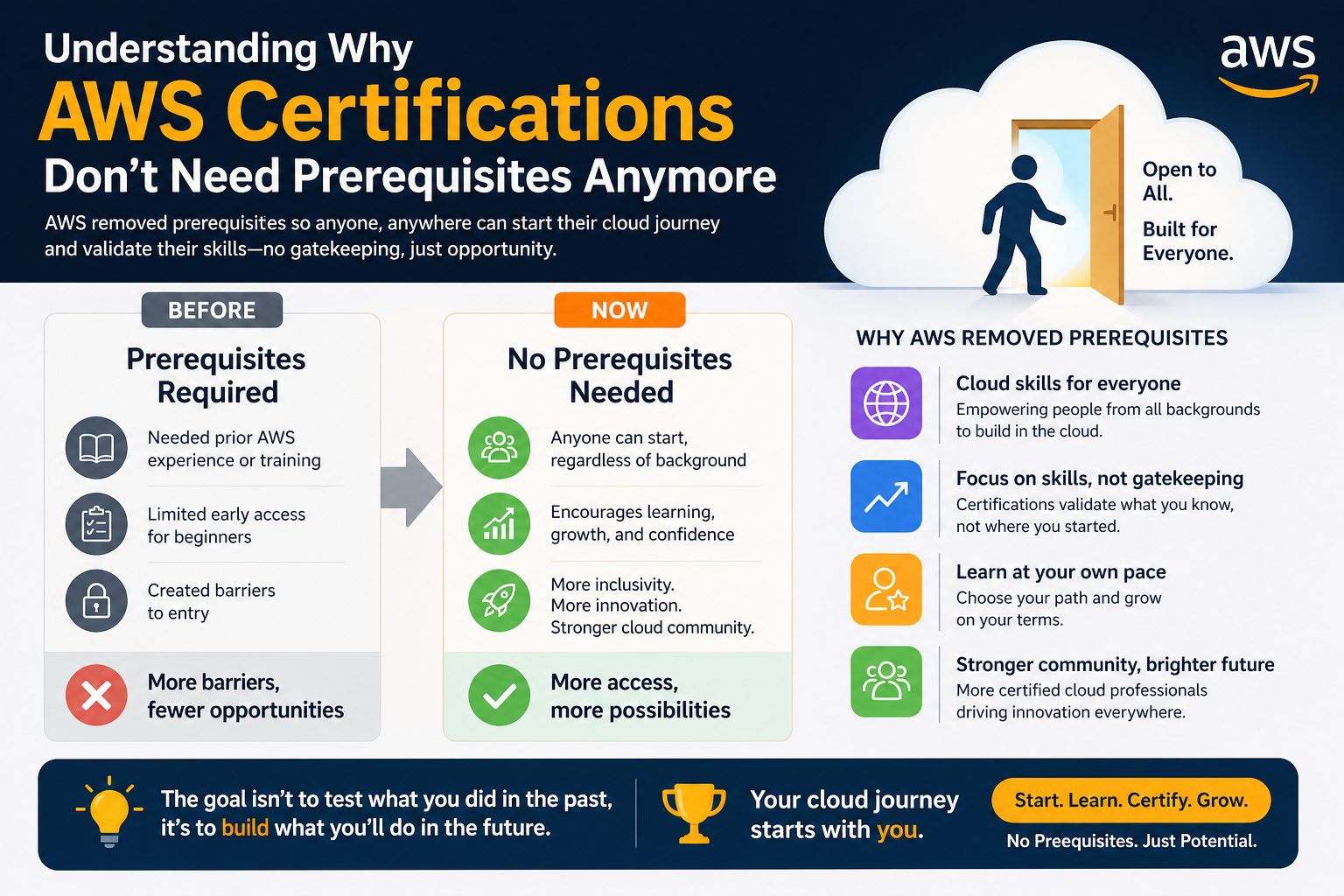
The structure of AWS certifications has evolved significantly over time as cloud computing itself has matured. In the early days, certification pathways were more rigid, often requiring candidates to follow a fixed progression from foundational knowledge to advanced expertise. This was based on the assumption that learners needed a structured, step-by-step journey to build competence. However, as the industry expanded and cloud adoption became mainstream, it became clear that professionals were entering cloud roles from many different backgrounds, not just traditional IT paths. This shift pushed AWS to rethink how certification pathways should work in a more diverse and fast-moving ecosystem.
As cloud services became more widely used across industries, learners began to approach certifications with varying levels of experience. Some already had years of hands-on exposure in real environments, while others were completely new to technology. A rigid prerequisite system started to feel limiting for experienced professionals who were capable of handling advanced topics without needing to complete lower-level exams first. This change in learner profile played a major role in reshaping the certification model into a more flexible structure.
Reason Behind Removing Prerequisites
The removal of prerequisites was not a random decision but a response to how learning and career development have changed in the digital era. One of the key reasons is accessibility. Cloud computing is now relevant to a wide range of professions, including developers, analysts, security specialists, and even business professionals. By removing barriers, AWS made it possible for anyone to directly attempt the certification that aligns with their role or interest.
Another important reason is efficiency. Many learners were spending unnecessary time completing certifications that did not match their career goals. For example, someone aiming to specialize in advanced architecture concepts might not benefit significantly from being forced to complete a foundational certification first. Allowing direct access to relevant certifications reduces wasted time and makes learning more goal-oriented.
Additionally, the industry itself values practical skills over formal progression. Employers are more interested in whether a candidate can design, deploy, and manage cloud solutions effectively rather than whether they have completed a sequence of exams. This shift in employer expectations encouraged AWS to design certifications that assess real-world capabilities directly.
Shift Toward Role-Based Learning
Modern AWS certifications are structured around job roles rather than strict learning ladders. This means each certification is designed to reflect the skills needed for a specific type of job, such as cloud architect, developer, or operations engineer. Because of this role-based design, prerequisites become less necessary since each certification stands on its own as a complete validation of a specific skill set.
This approach aligns more closely with how professionals actually work in the industry. In real-world environments, tasks are not divided into levels like beginner or intermediate. Instead, individuals are expected to solve problems based on their role and experience. The certification system now mirrors this reality by allowing learners to focus directly on the skills they need.
Impact on Beginners Entering Cloud Computing
For beginners, the removal of prerequisites has both advantages and challenges. On the positive side, it lowers the barrier to entry. New learners no longer need to worry about completing multiple certifications before reaching their desired level. This makes cloud computing more inviting for students, career changers, and professionals from unrelated fields.
However, this flexibility also means beginners must take more responsibility for planning their learning path. Without a fixed structure, it is possible for new learners to attempt advanced certifications too early, which can lead to confusion or frustration. As a result, self-assessment becomes an important part of the learning journey. Learners need to evaluate their own understanding and choose certifications that match their readiness level.
Despite this challenge, the overall impact is positive because it encourages independence. Learners develop the ability to research, plan, and guide their own education, which is a valuable skill in the technology industry.
Changing Nature of Cloud Skill Validation
Certification in cloud computing is no longer about following a linear academic-style path. Instead, it has become a form of skill validation that reflects practical ability. AWS certifications are designed to test how well a person can apply knowledge in real scenarios rather than simply recall theoretical concepts.
Because of this, prerequisites are less relevant. A candidate who has already worked extensively with AWS services may be fully prepared for an advanced certification without needing to complete lower-level exams. The focus has shifted from “what you have completed before” to “what you can do now.”
This approach also supports continuous learning. Professionals can revisit certifications at different stages of their careers without being constrained by earlier choices. As cloud technology evolves, this flexibility becomes increasingly important.
Industry Acceptance of Flexible Certification Paths
Employers and organizations have largely adapted to the new certification structure. Instead of expecting candidates to follow a strict progression, they now evaluate certifications based on relevance to the job role. A candidate with an advanced certification is generally considered qualified regardless of whether they have completed foundational certifications beforehand.
This reflects a broader trend in the tech industry, where practical experience and demonstrated skills often carry more weight than formal educational sequences. Many hiring managers are more interested in project experience, problem-solving ability, and familiarity with cloud tools than in the order in which certifications were obtained.
As a result, the removal of prerequisites has not weakened the value of certifications. Instead, it has made them more aligned with real hiring needs.
Self-Directed Learning in the Cloud Era
The modern certification model encourages self-directed learning. Learners are expected to take responsibility for identifying gaps in their knowledge and choosing appropriate learning resources. This shift reflects the nature of cloud technology itself, which is constantly evolving and requires continuous upskilling.
Without prerequisites, learners have more freedom to explore different areas of cloud computing. Some may choose to specialize early, while others may explore multiple domains before deciding on a focus area. This flexibility supports diverse career paths and allows individuals to tailor their learning experience based on personal interest and industry demand.
Self-directed learning also builds adaptability. Since cloud technologies change frequently, professionals who are used to independent learning are better prepared to keep up with new services and updates.
Common Misunderstandings About Removing Prerequisites
One common misunderstanding is that the removal of prerequisites means certifications are easier or less valuable. This is not accurate. The difficulty of the exams has not decreased. Instead, the entry requirements have been simplified to allow more flexibility in access.
Another misconception is that beginners should always avoid advanced certifications. While it is true that experience helps, some learners may already have strong technical backgrounds that prepare them for higher-level exams. The absence of prerequisites allows these individuals to progress at their own pace without unnecessary delays.
It is also sometimes assumed that structured learning paths have disappeared entirely. In reality, structured recommendations still exist in the form of suggested learning journeys. The difference is that they are no longer mandatory.
Strategic Approach to Certification Selection
With no prerequisites in place, choosing the right certification becomes a strategic decision. Learners need to consider their current knowledge, career goals, and practical experience before selecting an exam. Instead of following a fixed ladder, they can evaluate which certification will provide the most value for their specific situation.
This requires a more thoughtful approach to learning. Rather than progressing automatically from one level to another, learners must actively decide where to focus their effort. This decision-making process is beneficial because it mirrors real-world professional environments where priorities must be set based on goals and requirements.
Over time, this flexibility helps individuals build more personalized and effective skill sets.
Long-Term Impact on Cloud Education
The removal of prerequisites has had a long-term impact on how cloud education is structured globally. It has influenced other certification providers as well, many of which have adopted similar flexible models. The trend reflects a broader shift in education toward modular, skill-based learning rather than rigid academic sequences.
This approach supports lifelong learning, which is essential in the technology sector. As cloud platforms continue to evolve, professionals must constantly update their knowledge. A flexible certification system makes it easier to return to learning at any stage without restarting from a basic level.
It also encourages broader participation in cloud education, helping bridge skill gaps across industries and regions.
Growing Demand for Cloud Skills Across Industries
The increasing adoption of cloud computing across industries has played a major role in shaping certification policies. Organizations in healthcare, finance, retail, education, and government sectors are all moving toward cloud-based infrastructure. This widespread adoption has created a demand for professionals who can quickly adapt to cloud environments without necessarily following traditional IT education pathways.
Because of this demand, the certification system needed to become more flexible. Employers are no longer exclusively hiring candidates with long, linear technical backgrounds. Instead, they are looking for individuals who can demonstrate practical understanding of cloud services, architecture, security, and deployment. Removing prerequisites supports this shift by allowing a broader range of candidates to validate their skills at the appropriate level.
This change also helps organizations fill skill gaps more quickly. Instead of waiting for candidates to progress through multiple certification stages, companies can hire individuals who already hold the specific certification aligned with their job requirements.
Alignment With Real-World Job Roles
Modern cloud environments are complex and require professionals to work across multiple domains simultaneously. A cloud architect, for example, may need knowledge of networking, security, storage, and application deployment all at once. Similarly, a developer working in the cloud must understand infrastructure as well as application design principles.
Because of this overlap in responsibilities, rigid certification ladders do not always reflect real-world job expectations. Removing prerequisites allows certifications to align more closely with actual job roles rather than theoretical learning stages. Each certification is now designed to represent a complete skill set required for a specific function.
This alignment helps professionals prepare more effectively for real-world responsibilities. Instead of focusing on incremental learning steps, they can concentrate on mastering the skills required for their target role.
Flexibility for Career Transitioners
Many individuals entering cloud computing today are not starting their careers from scratch. They often come from different fields such as networking, software development, system administration, or even non-technical backgrounds like finance or operations. For these individuals, rigid prerequisites can become a barrier rather than a helpful guide.
By removing these barriers, AWS certifications allow career transitioners to move directly into cloud roles that match their existing experience or career aspirations. A system administrator with years of infrastructure experience, for example, may be fully prepared for an associate or even professional-level certification without needing to complete entry-level exams first.
This flexibility significantly reduces the time required to transition into cloud-focused roles. It also makes career changes more practical for professionals who cannot afford long periods of retraining.
Emphasis on Practical Learning Resources
With the removal of prerequisites, learning resources have become more important than structured certification sequences. Candidates now rely heavily on hands-on labs, practice environments, tutorials, and real-world projects to build their understanding.
This shift encourages active learning rather than passive progression. Instead of following a predefined path, learners are expected to engage directly with cloud services and build practical experience. This approach helps reinforce concepts more effectively because learners are applying knowledge rather than simply reading about it.
Practical learning also better prepares candidates for certification exams, which are designed to test scenario-based understanding rather than memorized theory.
Increased Importance of Self-Evaluation
Without a fixed prerequisite structure, learners must develop the ability to evaluate their own readiness. This includes understanding whether they have enough experience with AWS services, whether they are comfortable with scenario-based questions, and whether they can apply concepts in practical environments.
Self-evaluation becomes a critical skill because it helps prevent premature attempts at advanced certifications. While there is no restriction on attempting any exam, success depends heavily on preparation and experience.
This encourages learners to be more reflective and strategic in their study approach. They must identify their strengths and weaknesses and decide which certification aligns best with their current skill level.
Shift in Learning Culture
The removal of prerequisites has contributed to a broader cultural shift in cloud education. Learning is no longer viewed as a rigid sequence but as a continuous and flexible process. Individuals are encouraged to learn at their own pace and revisit topics as needed.
This culture supports experimentation and exploration. Learners can explore different areas of cloud computing without being constrained by mandatory progression paths. This freedom helps build curiosity and deeper engagement with the subject matter.
It also reflects how technology learning happens in real environments, where professionals often need to solve problems across multiple domains without following a predefined order.
Impact on Training Providers and Educators
Training providers have also adapted to the new certification structure. Instead of offering strictly sequential courses, many now provide modular learning paths that allow students to choose topics based on their goals. This makes training more flexible and personalized.
Educators are also focusing more on practical, scenario-based teaching methods. Rather than emphasizing exam progression, they encourage learners to build real projects and gain hands-on experience with AWS services.
This change has improved the overall quality of cloud education by making it more aligned with industry expectations. Students are better prepared for real-world challenges because they are exposed to practical use cases rather than only theoretical knowledge.
Encouragement of Lifelong Learning
Cloud computing is not a static field. New services, features, and best practices are introduced regularly. Because of this constant evolution, professionals must continuously update their skills throughout their careers.
The removal of prerequisites supports this need for lifelong learning. Professionals can return to certification at any stage without worrying about outdated progression rules. This makes it easier to stay current with new technologies and maintain relevant skills over time.
It also encourages experienced professionals to upskill or reskill as needed, rather than feeling locked into a fixed learning path.
Reduction of Entry Barriers for Global Learners
Another important effect of removing prerequisites is increased accessibility for learners worldwide. In many regions, access to formal technical education or structured training programs may be limited. Flexible certification pathways allow individuals to learn independently using available resources and still pursue globally recognized credentials.
This helps bridge the gap between different educational backgrounds and economic conditions. Anyone with access to learning materials and determination can attempt AWS certifications without needing formal academic progression.
This global accessibility has contributed to the rapid growth of cloud professionals across different countries and industries.
Encouragement of Problem-Solving Mindset
Since certifications are no longer tied to a strict sequence, learners are encouraged to develop a problem-solving mindset. Instead of focusing on passing a series of exams in order, they must focus on understanding how cloud systems work and how to apply solutions in real scenarios.
This mindset is essential in cloud computing because real-world challenges are rarely structured in a linear way. Professionals must often combine knowledge from different areas to solve complex problems.
By removing prerequisites, the certification system indirectly promotes this type of thinking, helping learners become more adaptable and resourceful.
Personalized Certification Journeys
With the absence of mandatory prerequisites, certification journeys have become highly personalized. Each learner now has the freedom to design a path that fits their background, experience, and career goals. This personalization means that two individuals preparing for the same certification may follow completely different study approaches depending on their strengths and prior knowledge.
Some learners may focus heavily on hands-on practice, while others may rely more on structured courses or documentation. This flexibility ensures that learning is not restricted to a single method. Instead, it adapts to individual preferences, making the process more effective and sustainable over time.
Personalized learning paths also allow professionals to combine multiple areas of expertise. For example, someone working in development may choose to strengthen their understanding of cloud architecture while simultaneously exploring security concepts. This blended approach is increasingly valuable in modern cloud environments where roles often overlap.
Role of Experience in Certification Success
Even though prerequisites have been removed, experience still plays a critical role in determining success. AWS certifications are designed to test applied knowledge, which means that practical exposure to cloud environments significantly improves performance.
Candidates with real-world experience tend to understand scenarios more intuitively. They can relate exam questions to situations they have already encountered in their work or practice environments. This reduces the learning curve and helps them make more accurate decisions during exams.
However, lack of professional experience does not prevent success. Many learners build equivalent understanding through labs, simulations, and project-based learning. The key factor is not formal experience but familiarity with cloud concepts in practical contexts.
Growth of Hands-On Learning Platforms
As certification pathways became more flexible, hands-on learning platforms gained importance. Learners now rely heavily on interactive environments where they can deploy services, test configurations, and experiment with different architectures.
These platforms allow users to learn by doing, which is essential in cloud computing. Reading about a service is often not enough to understand how it behaves in real situations. Practical experimentation helps bridge this gap by providing immediate feedback and real-world context.
This shift has made learning more engaging and effective. Instead of passively consuming information, learners actively build and test solutions, which improves retention and understanding.
Importance of Cloud Thinking Over Memorization
One of the most significant changes in the certification landscape is the reduced emphasis on memorization. Earlier learning models often required candidates to remember specific details, commands, or configurations. However, modern AWS certifications focus more on understanding concepts and applying them in different scenarios.
This shift reflects the nature of cloud computing itself, where services are constantly evolving. Memorizing static information is less useful than developing a strong conceptual understanding of how systems interact.
Cloud thinking involves understanding relationships between services, recognizing architectural patterns, and knowing how to approach problems logically. This type of thinking is far more valuable in real-world environments than memorized knowledge.
Adaptation of Exam Design
AWS exams have evolved alongside the removal of prerequisites. Instead of testing isolated facts, they now focus on scenario-based questions that simulate real-world challenges. Candidates are often required to analyze situations and choose the most appropriate solution based on multiple factors.
This design ensures that certifications measure practical ability rather than theoretical knowledge. It also means that learners must develop deeper understanding rather than relying on surface-level familiarity.
The flexibility in certification entry does not reduce exam difficulty. Instead, it shifts the focus toward applied skills, making preparation more meaningful and relevant to actual job roles.
Encouragement of Continuous Skill Development
Without predefined learning sequences, professionals are encouraged to continuously upgrade their skills based on evolving industry needs. Cloud technology changes rapidly, and new services are introduced frequently.
This environment makes continuous learning essential. Professionals cannot rely on a single certification or fixed knowledge base. Instead, they must keep updating their understanding to remain effective in their roles.
The flexible certification system supports this by allowing individuals to pursue additional certifications whenever needed, without having to restart or follow a strict progression path.
Integration of Certifications With Real Projects
Another important development is the integration of certification preparation with real-world projects. Many learners now combine study with actual cloud implementations, whether in personal projects, freelance work, or professional environments.
This approach helps reinforce learning because concepts are applied immediately. It also provides practical experience that enhances both certification performance and job readiness.
Working on real projects allows learners to encounter challenges that cannot be fully replicated in study materials. This exposure improves problem-solving skills and builds confidence in using AWS services effectively.
Reduced Dependency on Traditional Learning Structures
Traditional education systems often rely on structured sequences, where each level must be completed before moving to the next. The AWS certification model moves away from this structure, reflecting the changing nature of professional learning.
Instead of following a fixed curriculum, learners are encouraged to explore topics based on interest and need. This reduces dependency on rigid systems and promotes independent thinking.
It also allows professionals to adapt quickly to changing job requirements. If a new service or technology becomes relevant, they can immediately focus on learning it without waiting for a structured progression.
Greater Emphasis on Real-World Problem Solving
Modern cloud certifications place strong emphasis on solving real-world problems. Candidates are expected to understand how different AWS services interact and how to design solutions that meet specific requirements.
This approach ensures that certified professionals are not just knowledgeable but also capable of applying their skills effectively in practical environments.
Problem-solving in cloud computing often involves trade-offs between cost, performance, scalability, and security. Understanding these trade-offs is a key part of certification preparation and reflects real job responsibilities.
Accessibility for Independent Learners
Independent learners benefit significantly from the removal of prerequisites. Individuals who prefer self-study or do not have access to formal training programs can still pursue certifications at their own pace.
This accessibility has opened doors for many learners who may not have traditional IT backgrounds. With enough dedication and practice, they can build strong cloud skills and achieve industry-recognized certifications.
Independent learning also encourages resourcefulness, as learners must identify and use various materials such as documentation, tutorials, and practice environments to build their knowledge.
Shift Toward Outcome-Based Learning
The overall certification system has moved toward outcome-based learning, where the focus is on what a learner can do rather than what they have completed in sequence. This approach aligns closely with industry expectations.
Employers are interested in outcomes such as the ability to design scalable systems, implement secure architectures, and manage cloud infrastructure effectively. Certifications now reflect these outcomes directly.
By removing prerequisites, the system allows learners to demonstrate their abilities based on results rather than predefined steps, making the certification process more relevant and practical.
Changing Expectations of Cloud Professionals
The modern cloud industry expects professionals to be adaptable rather than strictly sequential in their learning. As AWS removed prerequisites, it indirectly reinforced this expectation. Professionals are now judged more on what they can deliver in real environments than on how many structured steps they have completed in their certification journey.
This shift reflects how cloud roles operate in practice. Tasks are rarely isolated or linear. Instead, they involve continuous problem-solving across multiple services and systems. As a result, certification pathways have moved closer to real job expectations, where flexibility and applied knowledge matter more than following a fixed educational order.
Influence of Industry Speed on Certification Design
Cloud technology evolves at a rapid pace, with frequent updates, new services, and changing best practices. A rigid prerequisite system can slow down access to relevant certifications, making it harder for professionals to stay current.
By removing prerequisites, AWS has made it easier for learners to keep up with industry changes. Individuals can directly pursue certifications that reflect the latest technologies without waiting to complete older or less relevant stages. This ensures that certifications remain aligned with current industry needs rather than outdated learning structures.
This responsiveness is important in a field where delays in skill development can quickly lead to knowledge gaps.
Encouragement of Cross-Domain Knowledge
Cloud computing is not limited to a single discipline. It combines networking, security, development, data management, and system design. The removal of prerequisites encourages learners to explore multiple domains without restriction.
Instead of being locked into a single progression path, professionals can move freely between different areas of interest. This promotes broader knowledge development and helps create well-rounded cloud professionals.
Cross-domain understanding is especially valuable in real-world projects where multiple systems must work together. A professional who understands both infrastructure and application design, for example, can contribute more effectively to cloud solutions.
Reduction of Unnecessary Learning Barriers
In earlier certification structures, prerequisites often acted as formal checkpoints that did not always reflect actual skill readiness. Some learners were forced to complete exams that added little value to their specific goals.
Removing these barriers has streamlined the learning process. Learners can now focus directly on the knowledge that is most relevant to their objectives. This reduces unnecessary repetition and makes the learning experience more efficient.
It also helps prevent frustration among experienced professionals who already possess advanced skills but were previously required to complete lower-level certifications.
Improved Motivation Through Direct Goal Access
One of the indirect benefits of removing prerequisites is improved motivation. Learners are often more motivated when they can immediately pursue their desired goal rather than working through multiple mandatory steps.
Direct access to certifications allows individuals to focus their energy on the areas that matter most to their careers. This sense of progress can increase engagement and reduce dropout rates during preparation.
Motivation plays a significant role in certification success, especially in self-directed learning environments where discipline and consistency are essential.
Greater Emphasis on Real-Time Decision Making
AWS certifications increasingly test the ability to make decisions in real-world scenarios. Without a strict prerequisite structure, learners must develop decision-making skills earlier in their journey.
This involves understanding which services are best suited for specific use cases, how to balance cost and performance, and how to design scalable architectures. These decisions are central to cloud computing roles and are now directly reflected in certification exams.
By focusing on decision-making rather than progression stages, the certification system better prepares professionals for actual responsibilities in cloud environments.
Expansion of Global Learning Communities
The flexibility in certification access has contributed to the growth of global learning communities. Learners from different countries and backgrounds can now participate in the same certification pathways without being restricted by formal educational sequences.
These communities often share resources, study strategies, and practical experiences, helping others prepare more effectively. The collaborative nature of these groups enhances learning and provides support for individuals who are studying independently.
This global interaction also improves knowledge exchange, as learners bring different perspectives and experiences to cloud computing discussions.
Adaptation of Study Strategies
With no fixed prerequisite path, study strategies have become more adaptive. Learners now create personalized plans based on their strengths and weaknesses rather than following a standardized sequence.
Some focus on intensive hands-on labs, while others prefer structured reading or video-based learning. Many combine multiple approaches to strengthen their understanding.
This adaptability helps learners develop more effective preparation methods that suit their individual learning styles. It also reflects the flexible nature of cloud environments, where multiple approaches can often lead to the same solution.
Role of Practice Exams and Simulation Tools
Practice exams and simulation tools have become essential in the absence of structured progression. These tools help learners assess their readiness for certification without relying on formal prerequisites.
By simulating real exam conditions, they allow candidates to identify knowledge gaps and improve their understanding of key concepts. This self-assessment process is critical for success, especially when learners are choosing their own certification paths.
These tools also help reduce uncertainty by providing feedback on performance and highlighting areas that need improvement.
Impact on Professional Confidence
The ability to choose certifications freely can positively impact professional confidence. Learners are empowered to make decisions about their learning journey, which can increase their sense of control and ownership.
Successfully achieving certifications without following a mandatory sequence can also strengthen confidence in one’s abilities. It demonstrates that skill and understanding are more important than formal progression.
This confidence often translates into better performance in real job roles, where independent decision-making is essential.
Shift Toward Modular Knowledge Building
The certification system now supports modular knowledge building rather than linear progression. Each certification acts as a standalone module that contributes to a broader understanding of cloud computing.
This modular approach allows learners to focus on specific areas without being forced into a sequential path. Over time, they can combine multiple certifications to build a comprehensive skill set.
Modular learning is particularly effective in cloud computing because it mirrors the structure of cloud services themselves, which are designed as independent but interconnected components.
Reduction of Time-to-Skill Development
One of the most significant advantages of removing prerequisites is the reduction in time required to develop job-ready skills. Learners can now directly target certifications that align with their career goals.
This speeds up the process of becoming employable in cloud roles. Instead of spending time completing unrelated or lower-level certifications, individuals can focus immediately on relevant knowledge.
Faster skill development benefits both learners and employers, as it increases the availability of qualified professionals in the job market.
Encouragement of Strategic Career Planning
Without predefined learning sequences, career planning becomes more strategic. Learners must evaluate their goals carefully and decide which certifications will provide the most value for their chosen career path.
This involves understanding industry demand, job requirements, and personal interests. Strategic planning helps ensure that certification efforts are aligned with long-term objectives rather than short-term progression steps.
Over time, this approach leads to more intentional and focused career development within the cloud computing field.
Final Insight on Certification Flexibility
This flexible certification model ultimately reflects a broader transformation in how technical skills are learned and validated in the modern world. It recognizes that cloud professionals come from diverse backgrounds and that expertise cannot always be measured through a fixed educational sequence. By prioritizing practical ability, problem-solving, and real-world application, AWS certifications have become more aligned with industry needs and professional realities. This shift not only improves accessibility but also strengthens the overall value of certifications by ensuring they represent genuine, applicable skills rather than just structured progression.
Conclusion
The removal of prerequisites from AWS certifications represents a major shift toward flexibility, accessibility, and real-world relevance in cloud education. Instead of forcing learners into a fixed progression, the system now allows individuals to choose certifications based on their skills, experience, and career goals. This change reflects the evolving nature of the technology industry, where adaptability and practical knowledge are more important than following a strict sequence of exams.
It has also made cloud learning more inclusive by opening opportunities for beginners, career switchers, and experienced professionals alike. At the same time, it places greater responsibility on learners to assess their own readiness and design effective study paths. Overall, this approach aligns certification with industry expectations, focusing on what professionals can do rather than the order in which they learn it.