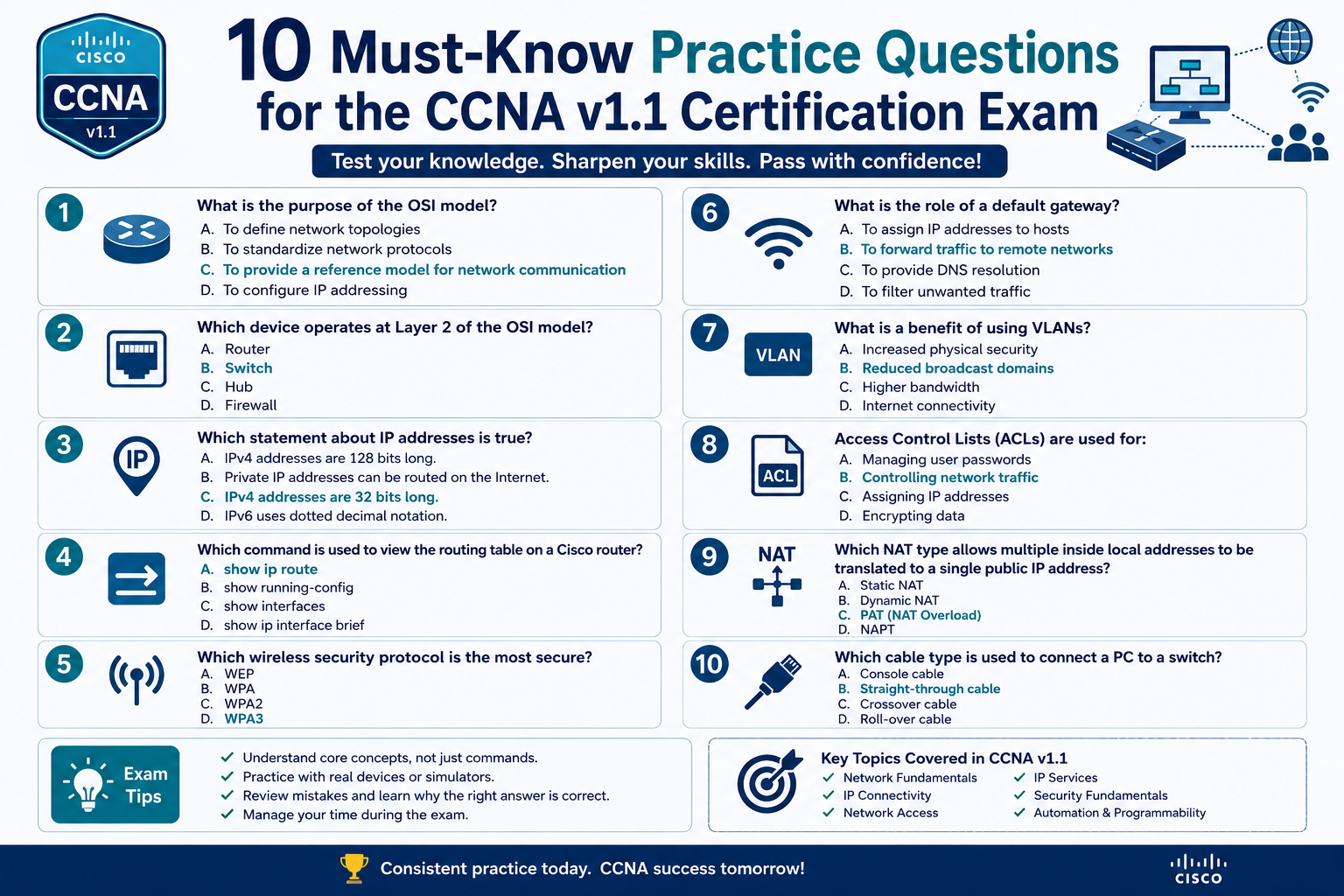
The CCNA v1.1 certification is one of the most valuable networking certifications for individuals looking to establish or advance their careers in information technology. It is recognized worldwide as a strong validation of foundational networking knowledge and practical technical ability. For professionals aiming to work in network administration, infrastructure support, systems operations, or security, earning this certification demonstrates competence in handling modern networking environments.
The certification is designed to test both theory and practical understanding. It does not simply ask candidates to memorize facts or definitions. Instead, it evaluates how well they understand networking concepts and how effectively they can apply those concepts to solve real-world technical challenges. Candidates are expected to think critically, analyze situations, and select the best possible technical solution.
Preparing for this exam requires a disciplined study strategy. Reading technical guides and watching instructional videos can build theoretical knowledge, but practical reinforcement is equally important. This is where practice questions become extremely valuable. Practice questions expose candidates to the style and difficulty level of actual exam content while strengthening understanding of technical concepts.
A candidate who regularly solves practice questions becomes better at recognizing patterns, identifying correct answers quickly, and avoiding common mistakes under pressure. These questions act as both assessment tools and learning opportunities. They help reveal weak areas so additional study can be focused where it is needed most.
The exam itself covers a broad range of technical topics. These include network fundamentals, IP connectivity, routing protocols, switching technologies, wireless networking, security principles, automation concepts, and troubleshooting methods. Since networking systems are interconnected, understanding how these topics relate to one another is essential.
Candidates who succeed on the CCNA exam usually combine several preparation methods. They study official materials, complete labs using simulators or physical devices, review notes consistently, and solve realistic practice questions.
This guide presents carefully selected CCNA practice questions designed to challenge your knowledge and improve your confidence. Each question includes detailed explanations to reinforce understanding and help you prepare effectively.
Understanding the Exam Format
The CCNA v1.1 exam is structured to evaluate practical networking readiness.
Candidates are typically given approximately 120 minutes to complete the exam. Within that time, they may face around one hundred questions. The exact number may vary, but the pressure of time management remains consistent.
Questions appear in multiple formats, including multiple-choice questions, drag-and-drop tasks, scenario-based problem solving, and simulation exercises requiring command-line interaction.
Simulation questions are particularly important because they assess real-world technical skills. These questions often require candidates to configure interfaces, troubleshoot routing problems, or verify network behavior through command-line analysis.
The passing score is generally around 800 out of 1000, though exact scoring standards may vary.
To perform well, candidates must demonstrate competence across several technical domains.
Network fundamentals involve understanding network components, models, topologies, and communication protocols.
Network access covers switching concepts, VLAN configuration, wireless standards, and Ethernet behavior.
IP connectivity focuses on routing concepts, static routes, and dynamic routing protocols.
IP services include DHCP, NAT, DNS, and network management tools.
Security fundamentals examine device hardening, ACL implementation, VPN basics, and access control.
Automation and programmability introduce software-defined networking and modern automation tools.
Mastering all these domains requires steady preparation and repeated exposure to technical scenarios.
Why Practice Questions Are Essential
Practice questions provide more than simple test preparation.
They strengthen memory retention by forcing active recall, which is much more effective than passive reading.
When candidates solve questions, they engage their analytical thinking and reinforce technical logic.
This process improves speed and accuracy over time.
Practice questions also reveal weak points. Many candidates believe they understand a topic until they face a challenging scenario-based question. Identifying those weaknesses early allows focused improvement.
Another advantage is familiarity with exam wording.
Certification exams often phrase questions carefully to test precision and understanding. Candidates who regularly solve practice questions become more comfortable interpreting technical language under pressure.
Confidence also improves significantly.
Fear and uncertainty can hurt performance even when knowledge is strong. Practice reduces anxiety by making exam-style thinking feel familiar.
Candidates should never simply memorize answers. Instead, they should study why each correct answer works and why alternative answers are incorrect.
This builds flexible understanding that transfers to unfamiliar scenarios.
Practice Question One: OSI Model Responsibilities
Which OSI model layer is responsible for end-to-end communication and error recovery?
- A) Network
- B) Transport
- C) Data Link
- D) Physical
Correct Answer: B
The transport layer is responsible for reliable communication between devices.
Its functions include segmenting data for transmission, reassembling segments at the destination, controlling traffic flow, and detecting transmission errors.
TCP operates at this layer and ensures reliability through acknowledgments and retransmissions.
UDP also operates here but prioritizes speed over reliability.
Understanding these protocols helps troubleshoot performance issues and identify application behavior.
Reliable services such as file transfers typically use TCP.
Real-time services such as voice streaming often use UDP.
This distinction is essential for practical networking analysis.
Practice Question Two: VLAN Assignment
You need to assign VLAN 10 to a switch port while in interface configuration mode. Which command should you use?
- A) switchport access vlan 10
- B) vlan 10
- C) switchport mode trunk
- D) ip vlan 10
Correct Answer: A
The command switchport access vlan 10 assigns the selected interface to VLAN 10.
This command is used after placing the interface into access mode.
Access mode allows the port to carry traffic for a single VLAN.
This differs from trunk mode, which carries traffic for multiple VLANs using tagging.
Proper VLAN configuration improves network segmentation and security.
VLANs reduce unnecessary broadcast traffic and logically separate departments within an organization.
Understanding access and trunk configurations is critical for switch management.
Practice Question Three: Static Route Configuration
Which command creates a static route to network 192.168.1.0 with subnet mask 255.255.255.0 through next-hop address 10.1.1.1?
- A) ip route 192.168.1.0 255.255.255.0 10.1.1.1
- B) route 192.168.1.0 255.255.255.0 10.1.1.1
- C) static route 192.168.1.0 10.1.1.1
- D) ip static-route 192.168.1.0 10.1.1.1
Correct Answer: A
Static routes are manually configured paths used by routers to forward traffic.
The syntax requires destination network, subnet mask, and next-hop address.
Static routes are useful in small environments where routing paths rarely change.
They are also commonly used as backup routes.
Misconfigured static routes often cause connectivity failures.
Understanding route syntax helps candidates diagnose and fix these issues efficiently.
Routing remains one of the most heavily tested exam domains.
Practice Question Four: DHCP Process
Which DHCP message does a client send to accept an offered address?
- A) DHCPDISCOVER
- B) DHCPOFFER
- C) DHCPREQUEST
- D) DHCPACK
Correct Answer: C
The DHCP process follows four steps.
First, the client sends DHCPDISCOVER.
Next, the server responds with DHCPOFFER.
The client accepts using DHCPREQUEST.
Finally, the server confirms with DHCPACK.
This process enables automatic IP address assignment.
When DHCP fails, devices often receive invalid addresses or lose connectivity.
Understanding this sequence is essential for troubleshooting startup network issues.
Practice Question Five: Access Control Lists
Which ACL type filters traffic using both source and destination addresses?
- A) Standard ACL
- B) Extended ACL
- C) Dynamic ACL
- D) Named ACL
Correct Answer: B
Extended ACLs provide detailed filtering based on source address, destination address, protocol type, and port number.
This allows precise control of network traffic.
For example, administrators can allow web traffic while blocking file transfer traffic.
Standard ACLs only filter by source address.
Extended ACLs are typically placed close to the source of traffic to minimize unnecessary transmission.
ACL placement strategy is an important exam concept.
The Importance of Hands-On Practice
Reading theory alone is not enough for certification success.
Candidates should practice directly with devices or simulators.
Packet Tracer and GNS3 are excellent platforms for building realistic labs.
Hands-on practice reinforces concepts through repetition.
Configuring VLANs, static routes, ACLs, and DHCP services improves command-line confidence.
Troubleshooting labs teach logical problem solving.
These experiences build practical intuition that helps during simulation questions.
Candidates who practice consistently perform better than those who rely only on reading.
Developing Strong Study Habits
Consistency is more effective than cramming.
Candidates should create a study schedule with daily technical goals.
A balanced study plan includes reading, note review, labs, and practice questions.
Weak areas should receive extra attention.
Subnetting often requires repeated practice.
Routing protocols require command familiarity.
Security topics require conceptual understanding.
Reviewing mistakes is just as important as solving new questions.
Growth happens when errors become lessons.
Steady effort over time produces confidence and technical mastery.
Building Advanced Confidence for the CCNA v1.1 Exam
Preparing for the CCNA v1.1 exam requires more than understanding networking theory. It demands practical reasoning, command-line familiarity, troubleshooting confidence, and the ability to apply technical knowledge under pressure. Many candidates begin their studies with strong enthusiasm, but the challenge often becomes maintaining consistency and transitioning from passive learning to active problem-solving.
The difference between candidates who pass and those who struggle usually comes down to application. Reading about routing protocols or watching a demonstration of VLAN configuration can build awareness, but real understanding develops when you configure devices yourself, troubleshoot errors, and solve technical questions repeatedly.
The CCNA exam is designed to test this practical understanding. It expects candidates to analyze technical scenarios and determine the most effective solution quickly and accurately. Success depends on technical depth, confidence, and strategic preparation.
This section continues with additional practice questions covering critical exam topics. These questions focus on network automation, subnetting, troubleshooting, security measures, and wireless networking standards. Each explanation reinforces exam objectives while helping strengthen your technical thinking.
Regular exposure to questions like these improves memory retention, sharpens troubleshooting instincts, and increases familiarity with certification-level wording.
Candidates who consistently challenge themselves through realistic scenarios become more comfortable during the actual exam and perform better under time pressure.
Practice Question Six: Network Automation Tools
Which network automation tool is commonly used for configuration management and automation on Cisco devices?
- A) Chef
- B) Ansible
- C) Jenkins
- D) Docker
Correct Answer: B
Ansible is one of the most widely used automation tools in network operations.
It allows administrators to automate repetitive tasks such as configuration deployment, software updates, policy enforcement, and device management.
One of Ansible’s greatest advantages is its agentless architecture. Unlike some automation platforms, it does not require software agents to be installed on managed devices.
Ansible uses YAML-based playbooks that define automation tasks in a clear and human-readable format.
For network engineers, this means configurations can be standardized and deployed consistently across large infrastructures.
Automation reduces manual errors and improves operational efficiency.
As modern networks become increasingly software-driven, automation knowledge is becoming essential.
The CCNA v1.1 exam introduces candidates to foundational automation concepts to prepare them for evolving networking roles.
Understanding tools like Ansible demonstrates awareness of how infrastructure management is changing across enterprise environments.
Candidates should understand what automation tools do, why they matter, and how they improve network scalability.
Why Automation Matters in Modern Networking
Traditional network management often required administrators to configure devices manually.
As organizations expanded, manual management became inefficient and error-prone.
Automation solves this challenge by enabling centralized control and repeatable deployment processes.
Benefits include:
Faster provisioning
Reduced configuration errors
Improved consistency
Simplified compliance enforcement
Rapid rollback capability
Automation is not replacing engineers. It is allowing engineers to focus on design, analysis, and strategic improvement rather than repetitive command entry.
This shift makes automation literacy increasingly valuable.
Candidates should understand the broader purpose of automation rather than memorizing tool names alone.
Practice Question Seven: Subnetting Calculations
How many usable host addresses exist in a /26 subnet?
- A) 32
- B) 62
- C) 126
- D) 254
Correct Answer: B
A /26 subnet uses 26 bits for network identification.
Since IPv4 addresses contain 32 bits total, that leaves 6 host bits.
The formula for calculating total addresses is:
2^host bits
This gives:
2^6 = 64 total addresses
Two addresses are reserved:
One for the network address
One for the broadcast address
This leaves:
62 usable host addresses
Subnetting is one of the most important topics on the CCNA exam.
Candidates must quickly determine:
Subnet sizes
Broadcast addresses
Valid host ranges
Network boundaries
Strong subnetting skills improve routing analysis and troubleshooting performance.
Candidates should practice calculations until they can solve subnetting questions mentally and confidently.
Strategies for Mastering Subnetting
Many candidates struggle with subnetting because they attempt memorization instead of understanding binary relationships.
The most effective approach is repeated calculation practice.
Focus on powers of two and common subnet masks.
Examples include:
/24 = 254 hosts
/25 = 126 hosts
/26 = 62 hosts
/27 = 30 hosts
/28 = 14 hosts
Recognizing these values instantly saves time during the exam.
Candidates should also practice identifying network increments.
For example:
A /26 subnet increments by 64
This means network ranges begin at:
0
64
128
192
This pattern recognition dramatically speeds subnet analysis.
Confidence in subnetting often improves overall routing performance.
Practice Question Eight: Troubleshooting Connectivity
A PC can successfully ping its default gateway but cannot reach external websites. What command should be used next to diagnose the issue?
- A) show ip interface brief
- B) traceroute 8.8.8.8
- C) show running-config
- D) show version
Correct Answer: B
If a device can reach its default gateway, local network connectivity is functioning correctly.
The next step is identifying where communication fails beyond the local subnet.
Traceroute reveals each hop along the path to a destination.
This helps identify:
Routing failures
Blocked paths
External reachability problems
Intermediate device failures
If traceroute stops unexpectedly, engineers can isolate the failing segment.
This command is one of the most valuable troubleshooting tools.
It helps distinguish between local issues, routing issues, and external service failures.
Candidates should understand not only how to use traceroute but also how to interpret results effectively.
Developing Troubleshooting Logic
Strong troubleshooting follows a structured process.
First, verify physical connectivity.
Next, test local connectivity.
Then test gateway communication.
After that, verify routing and external reachability.
Finally, examine DNS resolution if IP connectivity succeeds but names fail.
This layered approach prevents wasted effort and improves efficiency.
Exam questions often test troubleshooting methodology rather than simple command recall.
Candidates should focus on logical sequencing when analyzing scenarios.
Structured reasoning leads to faster, more accurate solutions.
Practice Question Nine: Security Protection Against DoS Attacks
Which security measure is most effective for preventing Denial-of-Service attacks?
- A) Enabling port security
- B) Implementing an ACL
- C) Using Intrusion Prevention Systems
- D) Configuring static IP addresses
Correct Answer: C
An Intrusion Prevention System actively detects and blocks malicious traffic patterns.
Unlike passive monitoring tools, an IPS can automatically respond to threats in real time.
It identifies suspicious behavior such as excessive traffic bursts, malformed packets, and known attack signatures.
This makes it highly effective against Denial-of-Service attacks.
While ACLs can block known traffic sources, they lack advanced behavioral analysis.
Port security protects switch interfaces but does not address broader attack traffic.
Static IP addressing provides no protection against attack traffic.
Security fundamentals are increasingly emphasized because network resilience is essential in modern environments.
Candidates should understand layered defense strategies rather than viewing security as a single-tool solution.
The Importance of Layered Security
Effective network security uses multiple defensive layers.
These often include:
ACL filtering
Firewalls
Intrusion detection
Intrusion prevention
Endpoint security
Authentication controls
Segmentation through VLANs
No single measure protects everything.
Layered security creates resilience and reduces attack success.
The CCNA exam introduces these principles to build foundational security awareness.
Understanding why multiple protections work together is more valuable than memorizing isolated definitions.
Practice Question Ten: Wireless Networking Standards
Which wireless standard operates only on the 5 GHz band and provides higher performance than earlier standards?
- A) 802.11a
- B) 802.11b
- C) 802.11n
- D) 802.11ac
Correct Answer: D
802.11ac operates exclusively on the 5 GHz frequency band.
It delivers higher throughput and improved efficiency compared to earlier wireless standards.
Advantages include:
Higher data transfer speeds
Reduced interference
Improved channel bonding
Better support for multiple simultaneous users
Earlier standards had limitations.
802.11b used 2.4 GHz with lower speeds.
802.11a used 5 GHz but offered lower performance.
802.11n supported both 2.4 GHz and 5 GHz but lacked some advanced efficiency improvements.
Wireless networking is an important exam topic because modern organizations rely heavily on wireless infrastructure.
Candidates should understand frequency differences, performance tradeoffs, and standard capabilities.
Wireless Performance Considerations
Higher frequencies provide faster performance but shorter range.
Lower frequencies travel farther but experience more interference.
This creates practical tradeoffs.
Network engineers must balance:
Coverage requirements
Speed requirements
Interference levels
Device compatibility
Understanding these decisions helps with wireless design questions.
Candidates should recognize how standards influence deployment strategy.
Wireless optimization is becoming increasingly important as organizations expand mobile connectivity.
Improving Exam Readiness Through Consistency
Success on the CCNA exam does not come from occasional study bursts.
It comes from consistent effort over time.
Candidates should schedule dedicated study sessions.
A strong weekly plan includes:
Concept review
Lab practice
Practice questions
Error review
Timed mock exams
Consistency strengthens long-term retention.
Short daily study sessions often outperform infrequent marathon sessions.
Progress compounds through repetition.
Even small daily improvements create major readiness gains over several months.
Managing Exam-Day Performance
Technical knowledge alone is not enough.
Candidates must manage pressure effectively.
Exam stress often causes avoidable mistakes.
Good preparation reduces anxiety.
Additional strategies include:
Reading questions carefully
Eliminating clearly incorrect options
Watching time carefully
Avoiding overthinking
Trusting practiced reasoning
Simulation questions often consume extra time.
Candidates should remain calm and methodical.
Confidence comes from preparation and repetition.
The more realistic practice is completed beforehand, the more natural exam conditions will feel.
How to Prepare Effectively for the CCNA v1.1 Exam
Preparing for the CCNA v1.1 certification requires a structured and disciplined approach. While many candidates focus heavily on memorizing commands and definitions, true exam readiness comes from understanding how networking concepts work together in practical environments. The certification is designed to test both theoretical understanding and technical decision-making, which means candidates must develop analytical thinking rather than relying solely on memorization.
One of the most effective ways to prepare is by building a study plan that balances reading, practical lab work, review sessions, and practice testing. A study plan keeps progress organized and prevents candidates from feeling overwhelmed by the wide range of exam topics. Without a clear structure, many candidates waste valuable time jumping randomly between subjects, which often creates confusion and slows long-term retention.
A well-designed study plan allows candidates to focus on one concept at a time while steadily building a complete understanding of the certification objectives. It creates a logical learning sequence where foundational topics such as network models, IP addressing, and subnetting are mastered before progressing to more advanced areas like routing protocols, automation, and security implementation. This step-by-step progression strengthens confidence and makes complex topics easier to understand.
Effective study plans should include realistic daily and weekly goals. For example, one week may focus on mastering VLAN configuration and switch commands, while another may emphasize static routing, troubleshooting connectivity issues, and practicing route verification commands. Dividing preparation into manageable sections makes large objectives feel more achievable.
Review sessions are equally important because repeated exposure strengthens memory retention. Revisiting earlier material ensures candidates do not forget foundational concepts as they move into advanced topics. Practice testing should also be scheduled regularly to measure progress and reveal weak areas that need additional attention.
Flexibility is another important part of a strong study plan. If candidates struggle with a topic, they should adjust their schedule and dedicate more time to mastering it. Consistent effort, guided by an organized plan, reduces stress and creates steady progress toward exam readiness and long-term technical confidence.
Candidates should divide study time into focused sections.
One day may focus on network fundamentals.
Another may emphasize routing and switching.
A separate session may be dedicated to subnetting calculations or security concepts.
This segmented approach improves concentration and retention.
Setting measurable weekly goals also helps maintain consistency.
For example, a weekly objective might include completing five subnetting exercises, configuring three routing labs, and solving twenty practice questions.
Progress becomes easier to track when goals are clearly defined.
Small, steady improvements often produce better long-term results than short periods of intense study followed by long breaks.
Successful candidates build habits rather than depending on motivation alone.
Consistency creates mastery.
Using Official Study Resources
Official certification guides are among the most valuable resources available.
These guides are carefully aligned with exam objectives and provide detailed explanations of tested concepts.
Reading official material helps candidates understand not only technical definitions but also practical implementation details.
A strong study guide covers topics such as:
OSI and TCP/IP models
IPv4 and IPv6 addressing
Routing fundamentals
Switch configuration
VLAN implementation
Access control lists
Wireless networking
Security principles
Automation concepts
Troubleshooting methods
Candidates should read actively rather than passively.
Highlight important points.
Take notes.
Summarize concepts in your own words.
Writing technical explanations strengthens understanding and memory retention.
Reviewing notes regularly helps reinforce long-term recall.
Technical diagrams should also be studied carefully.
Visual learning often makes complex relationships easier to understand.
Topology diagrams, packet flow illustrations, and routing tables provide practical context that improves comprehension.
Candidates who combine reading with note-taking and review develop stronger conceptual understanding.
The Importance of Video Training
Video-based training offers another valuable learning method.
Watching experienced instructors explain technical concepts can simplify difficult topics and provide practical demonstrations.
Visual walkthroughs are especially helpful for:
Switch configuration labs
Routing protocol demonstrations
Subnetting calculations
Command-line troubleshooting
Wireless setup scenarios
Security implementation examples
Video learning is most effective when combined with active participation.
Pause frequently to practice commands yourself.
Repeat difficult sections.
Take notes on key commands and troubleshooting logic.
Avoid passive watching without engagement.
The goal is not simply exposure to information.
The goal is active learning and application.
Candidates who practice while watching retain significantly more information.
Video instruction can also clarify topics that feel confusing when learned only through reading.
Different teaching styles often reveal concepts from new perspectives.
Combining books and videos creates a stronger learning foundation.
Hands-On Practice Builds Real Skill
Practical experience is one of the most important factors in exam success.
The CCNA exam tests technical application, not just theory.
Candidates should use simulators or physical lab equipment whenever possible.
Simulation tools allow realistic practice without requiring expensive hardware.
Common tasks to practice include:
Creating VLANs
Assigning switch ports
Configuring static routes
Testing routing tables
Implementing ACL rules
Verifying DHCP operation
Troubleshooting interface failures
Examining packet paths
Repeated hands-on work develops command familiarity and troubleshooting confidence.
Candidates become comfortable recognizing expected outputs and spotting configuration errors quickly.
This practical intuition is difficult to gain through reading alone.
Mistakes made during labs are valuable learning experiences.
Each misconfiguration teaches troubleshooting logic and reinforces correct behavior.
Candidates should intentionally break configurations and practice repairing them.
This mirrors real-world troubleshooting and strengthens problem-solving ability.
The more technical repetition completed before exam day, the more natural simulation questions will feel.
Taking Mock Exams
Mock exams are essential preparation tools.
They simulate real test conditions and help candidates assess readiness honestly.
Timed mock exams improve:
Time management
Question interpretation speed
Focus under pressure
Decision-making confidence
Error recognition
Candidates should take full-length practice exams periodically throughout their study journey.
Results reveal progress and highlight weak areas.
Reviewing missed questions is critical.
Do not simply note the correct answer.
Study why the answer is correct and why alternatives are incorrect.
This transforms mistakes into learning opportunities.
Candidates often discover recurring weaknesses.
Common weak points include:
Subnetting speed
ACL logic
Routing protocol behavior
Wireless standard comparisons
Automation terminology
Focused review of these weak areas leads to rapid improvement.
Mock exams also reduce anxiety by making the testing experience familiar.
Candidates who regularly practice under timed conditions feel calmer during the real exam.
Confidence grows through exposure.
Developing Effective Exam Strategies
Even well-prepared candidates can lose points through poor exam strategy.
Reading carefully is essential.
Many technical questions include subtle wording differences that change the correct answer.
Candidates should avoid rushing.
Take time to identify key details.
Look for:
Protocol names
Network masks
Command syntax clues
Security context
Problem scope indicators
Process of elimination is highly effective.
Removing obviously incorrect answers increases the likelihood of selecting correctly.
If uncertain, logical reasoning often reveals the best choice.
Avoid changing answers without clear justification.
Initial instincts are often correct when preparation is strong.
Time awareness is equally important.
Monitor pacing throughout the exam.
Do not spend excessive time on one difficult question.
Move forward and maintain momentum.
Simulation questions often require extra attention, so plan accordingly.
Strategic discipline improves performance significantly.
Is the CCNA Certification Worth It?
Many candidates ask whether the investment of time and effort is worthwhile. The answer is yes for most aspiring networking professionals because the CCNA certification delivers both immediate and long-term career benefits. It validates practical networking knowledge and demonstrates that a candidate has developed the technical understanding required to configure, manage, and troubleshoot modern network environments.
Employers recognize the certification as evidence of technical competence and professional commitment. It shows hiring managers that a candidate has invested time into mastering industry-relevant skills and has met a recognized technical standard. This strengthens resumes, improves interview credibility, and often helps candidates stand out in competitive hiring environments where certifications can influence shortlisting decisions.
Certified professionals often qualify for roles such as network administrator, technical support engineer, infrastructure analyst, systems support specialist, junior network engineer, and security operations technician. These positions often serve as entry points into larger networking and infrastructure careers. For many professionals, earning the certification is the first major step toward more advanced technical responsibilities and leadership opportunities.
The certification also creates opportunities for career advancement by building a strong technical foundation for advanced certifications and specialized career paths. Candidates interested in cybersecurity, cloud networking, automation engineering, enterprise infrastructure, wireless architecture, or systems integration often begin with CCNA because it develops essential networking fundamentals that support deeper specialization later.
The technical knowledge gained remains valuable well beyond certification itself. Networking principles apply across nearly every modern IT role because nearly all digital systems depend on reliable communication infrastructure. Understanding routing, switching, addressing, segmentation, and connectivity improves overall technical versatility and enables professionals to solve problems across multiple technical domains.
This broad relevance increases long-term career value and adaptability. As technology continues to evolve through automation, cloud services, virtualization, and software-defined infrastructure, strong networking knowledge remains essential. Professionals with this foundation are often better prepared to adapt to new tools and emerging technologies, making the certification a worthwhile investment for sustained career growth and professional development.
Long-Term Career Growth
CCNA is not simply an exam.
It is a professional milestone.
The concepts learned create a framework for deeper specialization.
Future paths may include:
Advanced routing certifications
Cloud networking expertise
Cybersecurity specialization
Automation engineering
Enterprise architecture
Data center networking
Software-defined infrastructure
The foundational skills built through CCNA preparation support all these paths.
Candidates who invest fully in learning rather than memorization gain knowledge that remains valuable for years.
Technology evolves, but networking fundamentals remain essential.
This makes the certification a strong long-term investment.
Maintaining Motivation During Preparation
Long study journeys can become mentally exhausting. Motivation naturally rises and falls throughout the preparation process, especially when candidates encounter difficult technical concepts or experience slower progress than expected. Candidates should focus on discipline rather than temporary inspiration because discipline creates consistency, and consistency produces measurable improvement over time.
Setting milestones helps maintain momentum and provides a clear sense of direction. Breaking large goals into smaller weekly or monthly objectives makes progress easier to manage and less overwhelming. Celebrate progress whenever possible. Recognize completed labs, stronger troubleshooting performance, improved practice scores, and increased confidence with technical commands. Track improvement visibly through study logs, checklists, or performance charts. Small wins reinforce commitment and remind candidates that growth is happening, even when it feels gradual.
Joining study communities can also help significantly. Discussing concepts with peers improves understanding, exposes candidates to different problem-solving approaches, and creates accountability that keeps preparation on track. Teaching others strengthens personal retention because explaining technical concepts requires deeper understanding and clarity of thought.
Candidates should always remember their purpose. Whether pursuing promotion, career transition, technical growth, financial opportunity, or professional credibility, keeping those long-term goals visible sustains effort during difficult periods. Visual reminders of career goals can reinforce determination and focus.
It is also important to balance study with rest. Short breaks improve concentration and prevent burnout. Healthy routines such as proper sleep, exercise, and time away from technical material can refresh focus and improve retention. Progress may feel slow at times, but consistent practice compounds into expertise. Persistence produces results, and every study session builds the knowledge and confidence needed for success.
Common Mistakes to Avoid
Many candidates delay hands-on practice too long.
Theory alone is insufficient.
Begin practical labs early.
Another common mistake is avoiding weak topics.
Candidates often revisit comfortable material instead of confronting difficult concepts.
Improvement happens through focused challenge.
Cramming near exam day is also ineffective.
Retention improves through spaced repetition, not last-minute overload.
Neglecting review is another issue.
Previously mastered topics fade without reinforcement.
Regular review sessions preserve long-term memory.
Finally, candidates should avoid relying exclusively on answer memorization.
The exam rewards understanding and reasoning.
Memorized answers fail when scenarios change.
Deep comprehension always performs better.
Conclusion
Preparing for the CCNA v1.1 exam is a demanding but highly rewarding journey. It requires discipline, technical curiosity, practical repetition, and strategic preparation. Success comes from understanding how networks function, practicing configurations consistently, solving realistic questions, and learning from mistakes.
The ten practice questions explored throughout this guide reflect the type of thinking required for certification success. They reinforce critical concepts across routing, switching, security, automation, troubleshooting, wireless networking, and subnetting.
Candidates who combine structured study resources, hands-on lab practice, mock exams, and thoughtful review place themselves in the strongest position to succeed.
The certification is more than a professional credential. It represents technical growth, analytical development, and readiness for real-world networking challenges.
Every practice session builds confidence.
Every mistake corrected deepens understanding.
Every hour invested strengthens professional capability.
With persistence, consistency, and focused preparation, passing the CCNA v1.1 exam becomes an achievable milestone that opens doors to valuable career opportunities and long-term technical success.