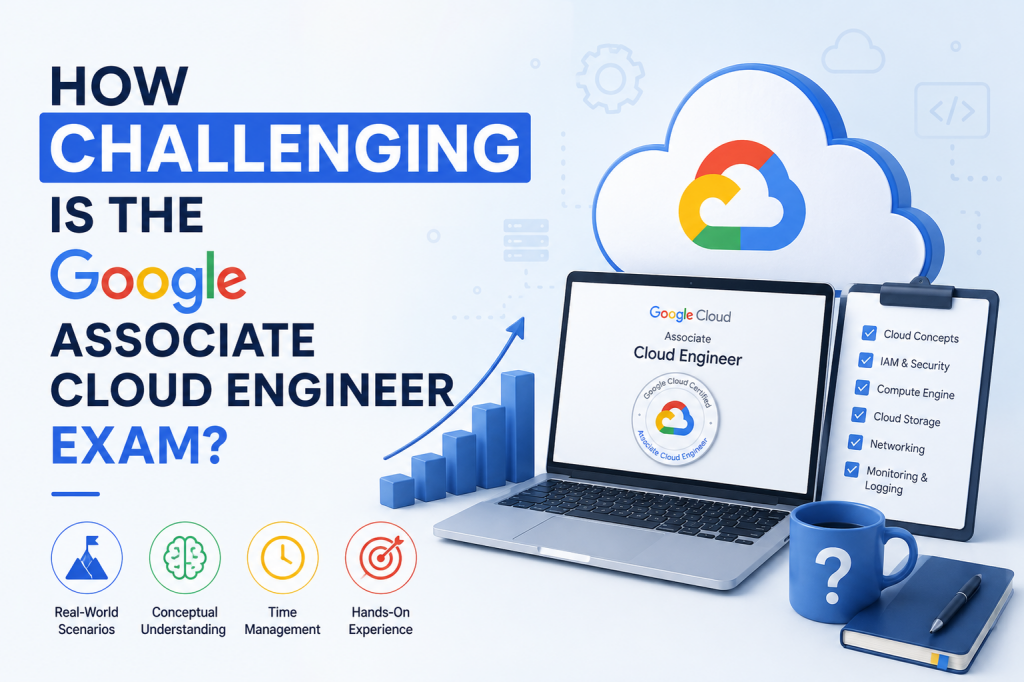
The Google Associate Cloud Engineer certification tests whether you can operate a cloud environment rather than merely recognize service names. Its difficulty depends on practical experience with projects, IAM, billing, deployment, networking, and monitoring, and on how well you can diagnose failures. Beginners may need both cloud foundations and Google-specific practice; experienced operators still need to test their assumptions against the current exam guide. A realistic readiness assessment focuses on tasks you can explain and repeat.
Why the exam feels difficult
The Associate Cloud Engineer (ACE) exam asks whether you can operate services in a real Google Cloud environment. A candidate who can name Compute Engine, Cloud Run, and Cloud Storage may still struggle to choose a service, configure its permissions, and diagnose an unsuccessful deployment. Difficulty comes from decisions across connected services, not from one unusually advanced algorithm. The practical question is whether you can explain what changed, why an operation failed, and which evidence would establish a fix.
An experienced systems administrator may already recognize operating-system, networking, and troubleshooting patterns, but still needs to learn Google Cloud’s resource hierarchy, IAM policies, billing relationships, and deployment tools. A beginner may need to acquire both those operational foundations and the platform-specific vocabulary. Neither candidate should rely on an unsupported claim about a universal pass rate or a fixed study duration. Assess each skill by completing a small task independently and recording the result.
Use the current standard exam requirements
Google Cloud’s Associate Cloud Engineer exam currently lists a two-hour standard assessment with 50–60 multiple-choice and multiple-select questions. There are no formal prerequisites, although Google recommends at least six months of hands-on Google Cloud experience. These are issuer-published logistics, not predictions of any candidate’s chances. Confirm the current exam guide, language, delivery rules, and fees before booking because certification programs can change.
First-time candidates and people whose credential has expired use the standard exam. Eligible holders renewing an active certification have separate options, including a shorter renewal exam or designated Google Skills learning paths. Those options have distinct conditions and should not be assumed to apply to a new candidate. In practice, start with the standard ACE objectives: setting up a cloud environment, planning and implementing services, operating deployed resources, and controlling access and security.
Projects, billing, and identity are connected
Before deploying anything, establish the organization or standalone project, its ownership, enabled APIs, billing account, and relevant quotas. Projects are major boundaries for resources and administration, while folders and organization policies can influence what configurations are allowed. The difference between a project hierarchy and a billing relationship is easy to overlook. In a useful ACE practice scenario, explain which project holds a resource, who is billed for it, and which policy prevents an otherwise valid deployment. A clear Google Cloud project hierarchy and billing map helps trace inherited policy and costs to a responsible owner before deployment.
IAM requires identifying the principal that actually makes a request: a human user, a group member, or a workload’s service account. Grant the narrowest role sufficient for the task at the appropriate resource scope, then test an allowed action and a denied one. A deployment that fails with a permission error should not be repaired automatically with project Owner access. During IAM troubleshooting in Google Cloud, verify the calling principal, requested permission, resource scope, effective allow and deny policies, and whether the wrong project was selected before changing an access binding.
Billing operations have their own failure modes. A project without the required billing setup or with an exhausted quota may prevent an otherwise correct deployment. Budgets and alerts help detect spending trends but are not, by themselves, a universal hard spending cap. A sound lab should record the estimated cost, create a budget alert when appropriate, identify billable resources, and remove them when the exercise is over. These checks matter because a technically successful test can still be a poor operating decision.
Choose compute services by operational responsibility
Compute Engine provides virtual machines with operating-system and instance-management responsibilities. Cloud Run runs containerized services with much of the underlying server management abstracted away, while Google Kubernetes Engine gives teams Kubernetes orchestration with its own cluster and workload configuration concerns. The most appropriate choice depends on application packaging, runtime behavior, control requirements, scaling, connectivity, and the team’s operating capacity—not which product name sounds more advanced.
Consider a small HTTP application. On Compute Engine, check VM networking, boot configuration, firewall rules, service process, and patching. On Cloud Run, confirm that the container starts, listens on the expected port, has the correct service identity, and receives traffic from the intended callers. When troubleshooting a Cloud Run deployment, distinguish a container startup error from an application response failure and verify the revision’s traffic allocation before changing IAM.
For a GKE workload, the operator must also consider Pods, Deployments, Services, node pools, resource requests, and relevant cluster access controls. Avoid assuming that one troubleshooting command diagnoses all three compute choices. Start with the symptom, identify the layer responsible, examine an appropriate log or resource state, and verify a correction with a fresh request. Document how the deployment would be rolled back if the change creates a new failure.
Networking and storage require precise troubleshooting
Google Cloud networking introduces VPC networks, regional subnets, routes, firewall rules, service identities, DNS, and different connectivity mechanisms. A request that cannot reach a destination may fail at name resolution, a missing route, a restrictive firewall policy, authentication, or the service itself. Diagnose those stages separately. Do not confuse Cloud NAT, which supports outbound connectivity for eligible resources, with a rule that makes a private workload publicly reachable.
Data services are equally dependent on requirements. Cloud Storage suits object data; Cloud SQL supplies managed relational databases; BigQuery supports analytical workloads. Within Cloud Storage, location, access controls, storage class, lifecycle rules, and retention all affect operation and cost. A correct choice for frequently accessed documents may differ from one for archival data. Access to a bucket and access to an object also require the right identities and permissions; a successful console sign-in does not prove authorization for a particular API operation.
Make a scenario concrete: a web service must read a private object, write operational logs, and remain within a chosen region. Draw the request path and identify the service account, resource locations, policy bindings, and failure signals. Then test denied access deliberately and inspect what evidence distinguishes IAM failure from network failure. This approach builds the service-selection judgment the ACE role requires.
Operate with Cloud Logging and Monitoring
An associate cloud engineer must know what to observe after a workload is deployed. Cloud Monitoring helps evaluate metrics and alerting conditions, while Cloud Logging supports inspection of application, platform, and audit-related events. The two are related but not interchangeable: a latency spike may appear in a metric, while the log entry for the affected request can explain a failure. Operational success requires connecting those observations to an action that can be tested.
For a service returning intermittent HTTP errors, identify when the errors started, whether the deployment version changed, which resources are affected, and whether a dependency or IAM policy was modified. Compare service logs with metrics such as request rate, latency, error count, and resource utilization. Use Cloud Logging, Monitoring, and alerting together to test whether a notification corresponds to a user-impacting failure rather than merely a change in a dashboard value.
Cloud cost and reliability should be considered together. Increasing capacity may improve response time but can increase spending; aggressive resource limits can reduce cost while causing failures under load. Check quotas, autoscaling behavior, budget signals, service health, and evidence of recovery before deciding that a configuration is adequate. A dashboard is useful only when it helps the operator choose and verify a responsible next step.
Build evidence through small, repeatable labs
A useful ACE study portfolio can begin with one project and two narrowly scoped identities. Enable only required services, configure billing awareness, deploy a small application, grant and test least-privilege access, generate a controlled failure, investigate logs, and clean up resources. Record expected behavior before each action and capture enough non-sensitive evidence to reproduce the result. Replace screenshots of completed tutorials with notes showing your own decisions and verification steps.
An additional exercise can compare deployment choices for the same simple workload. State which requirements favor a VM, container service, or Kubernetes, and which extra responsibilities each option introduces. Another can focus on storage: choose an object location and class, establish a retention expectation, verify an authorized read, and inspect a denied request. A networking exercise should demonstrate how DNS, routes, and firewall rules interact without exposing an unintended public endpoint.
After each lab, explain why the setup succeeded or failed, what permissions were necessary, which alerts were meaningful, and what costs or operational risks remained. Use the current Google Cloud exam guide and official sample questions to identify gaps, not to manufacture confidence from a fixed practice-score threshold. Do not use real customer data or production credentials for experiments. Reset or destroy billable resources and record how you verified cleanup.
Make a realistic readiness decision
The ACE exam is challenging when you must guess how services are administered; it becomes more manageable when you can explain and test the workflows. Before scheduling, check that you can create and organize projects, control IAM access, deploy a workload, choose storage and networking settings, read operational signals, and troubleshoot common failures without following every step of a tutorial. Practice explaining why an alternative would be less suitable under the stated constraints.
Time management still matters during the standard two-hour exam, but there is no evidence-based number of study weeks that fits everyone. Someone new to Linux, networking, or cloud identity may need foundational practice before platform labs. An experienced operator may be ready sooner but should still test Google-specific assumptions and current service capabilities. Choose a study sequence based on observed gaps rather than a calendar claim or a comparison with another vendor’s certification.
The strongest readiness signal is repeatable reasoning: describe the goal, choose a service and the minimum permissions it needs, test the result, investigate a failure, and account for cost and operational responsibility. Verify official logistics directly before booking. The credential may support a cloud operations career, but passing the assessment is not a guarantee of production competence or employment; sustained capability depends on how well those decisions hold up in real systems.