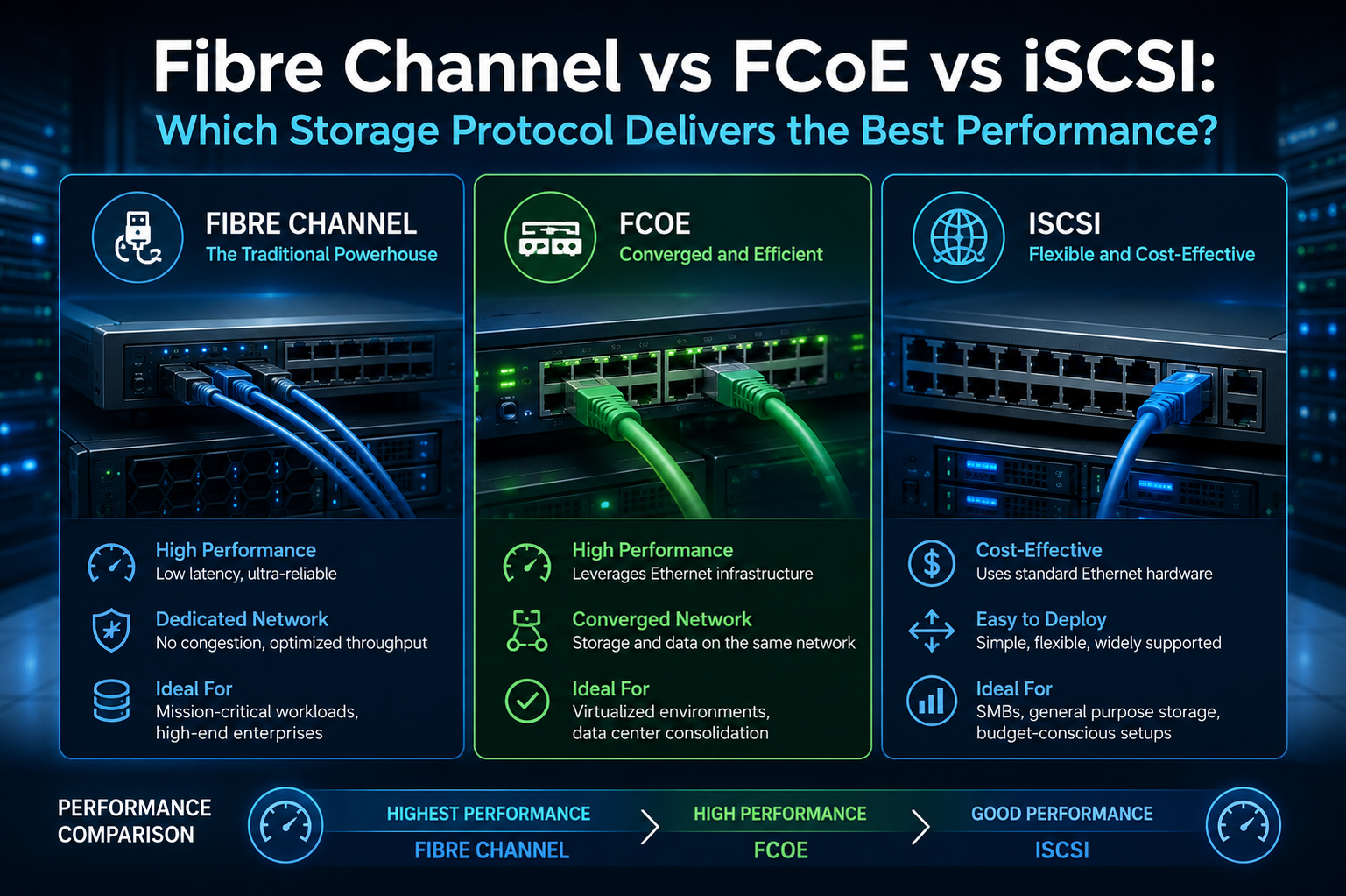
In today’s digital ecosystems, storage performance has become a defining pillar of IT infrastructure design. Applications are no longer isolated or static; they are dynamic, distributed, and heavily dependent on real-time data access. Whether it is enterprise analytics, virtualization platforms, transactional databases, or cloud-native applications, the underlying storage protocol plays a crucial role in determining responsiveness and scalability. Among the most established technologies in this space are Fibre Channel, Fibre Channel over Ethernet (FCoE), and iSCSI. While all three serve the same fundamental purpose of transporting storage traffic between servers and storage arrays, they differ significantly in architecture, efficiency, and real-world performance behavior. Understanding these differences requires more than a surface comparison; it demands an in-depth look at how each protocol behaves under pressure, how it handles congestion, and how it integrates into modern data center ecosystems.
Fundamental Design Philosophy of Fibre Channel
Fibre Channel is built on a philosophy of exclusivity and optimization. Unlike general-purpose networking protocols, it is designed specifically for storage traffic from the ground up. This specialization allows it to eliminate many of the inefficiencies found in shared network environments. Fibre Channel operates on a dedicated fabric, meaning storage traffic does not compete with regular data traffic such as email, web services, or application communication.
This isolation is one of the key reasons Fibre Channel consistently delivers predictable performance. Latency remains extremely low because data does not traverse congested or shared pathways. Instead, it moves through a tightly controlled environment where each component is optimized for speed and reliability. The protocol also uses credit-based flow control, which ensures that data is only transmitted when the receiving end is ready, effectively preventing packet loss and retransmissions.
Another important characteristic of Fibre Channel is its hardware-centric nature. It relies on specialized host bus adapters and dedicated switches, all designed to handle storage workloads with minimal overhead. This results in extremely efficient data movement, especially in high-performance environments such as large-scale databases and mission-critical enterprise applications.
However, this level of optimization comes with complexity. Fibre Channel networks require careful design, skilled administration, and higher capital investment. Despite this, many large organizations continue to rely on it because of its unmatched consistency and deterministic performance behavior.
Architectural Principles Behind FCoE Integration
Fibre Channel over Ethernet introduces a different architectural philosophy. Instead of maintaining separate networks for storage and data traffic, it merges them into a single Ethernet-based infrastructure while still preserving Fibre Channel communication semantics. This convergence is achieved by encapsulating Fibre Channel frames within Ethernet packets.
The main objective of FCoE is to simplify infrastructure without sacrificing performance. In theory, it allows organizations to reduce hardware complexity, cabling requirements, and operational overhead. However, achieving this balance requires a highly specialized Ethernet environment that supports lossless data transmission.
To maintain storage-grade reliability, FCoE depends on enhanced Ethernet features that prevent packet loss. Without these enhancements, storage performance would suffer due to retransmissions and congestion issues. When properly implemented, FCoE can deliver performance levels close to native Fibre Channel, especially in carefully engineered data center environments.
Despite its advantages, FCoE introduces dependency on the underlying Ethernet network. This means that performance is no longer fully isolated from other types of traffic unless strict segmentation is enforced. As a result, network design becomes more complex, and misconfiguration can lead to unpredictable latency behavior.
FCoE is often seen as a transitional technology, bridging traditional storage networking with modern converged infrastructure strategies. It is particularly useful in environments where consolidation is a priority but where Fibre Channel performance characteristics are still required.
iSCSI and the Evolution of IP-Based Storage Communication
iSCSI represents a fundamentally different approach by leveraging standard IP networks for storage communication. Instead of relying on specialized hardware or dedicated fabrics, it encapsulates SCSI commands into TCP/IP packets, allowing storage traffic to travel over conventional Ethernet infrastructure.
This design makes iSCSI highly accessible and cost-effective. Organizations can deploy storage networks without investing in specialized switches or adapters, significantly lowering the barrier to entry. It also simplifies integration with existing IT environments, especially those already built on IP-based communication.
From a performance standpoint, iSCSI has historically lagged behind Fibre Channel due to higher protocol overhead and reliance on general-purpose networking stacks. TCP/IP introduces additional latency through error checking, congestion control, and retransmission mechanisms. However, advancements in network speeds and hardware acceleration have significantly improved its performance in recent years.
Modern high-speed Ethernet environments have allowed iSCSI to scale effectively for many enterprise workloads. With proper network tuning, jumbo frames, and dedicated VLANs, iSCSI can deliver surprisingly strong performance. However, it still lacks the deterministic behavior of Fibre Channel, especially under heavy or unpredictable network load.
The flexibility of iSCSI makes it particularly attractive for virtualized environments, remote storage access, and cloud-based architectures. It integrates seamlessly with software-defined storage platforms, making it a key enabler of modern distributed systems.
Latency Behavior Across Storage Protocols
Latency is one of the most critical factors in storage performance evaluation. It directly impacts application responsiveness and user experience. Fibre Channel consistently offers the lowest latency due to its dedicated infrastructure and minimal protocol overhead. Since it avoids general-purpose networking stacks, data paths remain short and highly optimized.
FCoE introduces slightly higher latency compared to Fibre Channel, primarily due to encapsulation and dependency on Ethernet processing. However, in well-designed environments, this difference is often minimal and may not be noticeable for most enterprise workloads. The key challenge lies in maintaining consistent performance across the converged network.
iSCSI typically exhibits the highest latency among the three protocols. This is due to its reliance on TCP/IP, which adds processing overhead and introduces variability depending on network conditions. While modern hardware has reduced this gap significantly, iSCSI still tends to show more fluctuation in latency under load.
The importance of latency varies depending on application type. Real-time transactional systems require extremely low and stable latency, while backup or archival systems may tolerate higher values. This is why protocol selection often depends on workload sensitivity rather than raw performance alone.
Throughput and Bandwidth Utilization Efficiency
Throughput is another essential dimension of storage performance. Fibre Channel is highly efficient in sustaining high throughput under continuous workloads. Its architecture ensures that bandwidth is dedicated exclusively to storage traffic, minimizing contention and maximizing utilization.
FCoE can achieve comparable throughput levels when deployed on high-quality Ethernet infrastructure. However, its performance is closely tied to network configuration and traffic management. If the converged network is not properly segmented or optimized, throughput can become inconsistent.
iSCSI benefits from modern Ethernet speeds, allowing it to scale significantly compared to its early implementations. With high-speed networks, it can support demanding workloads effectively. However, because it shares infrastructure with other network traffic, throughput can fluctuate depending on congestion and prioritization policies.
Overall, Fibre Channel provides the most stable throughput, while FCoE and iSCSI offer more flexible but variable performance depending on environment design.
Scalability and Infrastructure Considerations
Scalability plays a crucial role in determining long-term suitability of a storage protocol. Fibre Channel scales well within enterprise environments but requires careful planning and investment in specialized hardware. As the network grows, maintaining optimal performance requires structured design and expert management.
FCoE introduces scalability benefits by reducing the number of physical networks required. However, it also introduces complexity in maintaining lossless Ethernet behavior at scale. As environments grow larger, ensuring consistent performance becomes more challenging.
iSCSI offers the highest scalability in terms of simplicity. Because it runs on standard IP networks, it can be expanded easily without requiring specialized components. This makes it ideal for rapidly growing or distributed environments. However, scalability in iSCSI often shifts complexity from hardware to network management and performance tuning.
Reliability and Data Integrity Considerations
Reliability is a non-negotiable factor in storage systems. Fibre Channel is engineered for lossless communication, ensuring that data integrity is maintained throughout transmission. Its built-in flow control mechanisms prevent congestion and eliminate packet loss scenarios.
FCoE inherits many of these reliability characteristics but depends on Ethernet enhancements to maintain lossless behavior. Without proper configuration, reliability can be compromised.
iSCSI relies on TCP/IP for reliability, which ensures data integrity through retransmissions and error correction. While this guarantees correctness, it can introduce performance penalties during network congestion.
Each protocol ensures data correctness, but the method and performance impact vary significantly.
Use Case Suitability in Real-World Environments
Fibre Channel is best suited for environments where performance consistency is critical. This includes high-frequency trading systems, large enterprise databases, and mission-critical applications where even minor latency variations can have significant consequences.
FCoE fits best in consolidated data center environments where organizations want to reduce infrastructure complexity while maintaining high performance. It is often used in transitional architectures.
iSCSI is ideal for cost-sensitive environments, virtualization platforms, and cloud-based infrastructures. Its flexibility makes it suitable for a wide range of use cases, especially where extreme performance is not the primary requirement.
Future Direction of Storage Protocols
The evolution of storage networking is increasingly influenced by software-defined infrastructure and cloud computing. While Fibre Channel continues to dominate high-performance enterprise environments, its growth is more incremental than disruptive. FCoE has seen limited adoption in new deployments, as organizations increasingly favor fully Ethernet-based or software-defined solutions.
iSCSI continues to evolve alongside network improvements and remains relevant due to its simplicity and adaptability. However, newer technologies such as NVMe over Fabrics are beginning to reshape the high-performance storage landscape, offering even lower latency and higher efficiency.
Despite these advancements, Fibre Channel, FCoE, and iSCSI remain foundational technologies that continue to support a vast range of enterprise workloads.
Conclusion
Selecting between Fibre Channel, FCoE, and iSCSI ultimately depends on balancing performance requirements, infrastructure complexity, and cost considerations. Fibre Channel delivers unmatched performance consistency and remains the preferred choice for mission-critical environments. FCoE offers a hybrid approach that combines consolidation benefits with strong performance, though it requires careful network design. iSCSI provides unmatched flexibility and cost efficiency, making it suitable for a wide range of modern applications.
There is no single universally superior protocol. Instead, each represents a different engineering philosophy optimized for specific operational needs. Fibre Channel prioritizes performance purity, FCoE emphasizes convergence, and iSCSI focuses on accessibility. Understanding these trade-offs allows organizations to design storage architectures that align precisely with their performance expectations and long-term strategic goals.