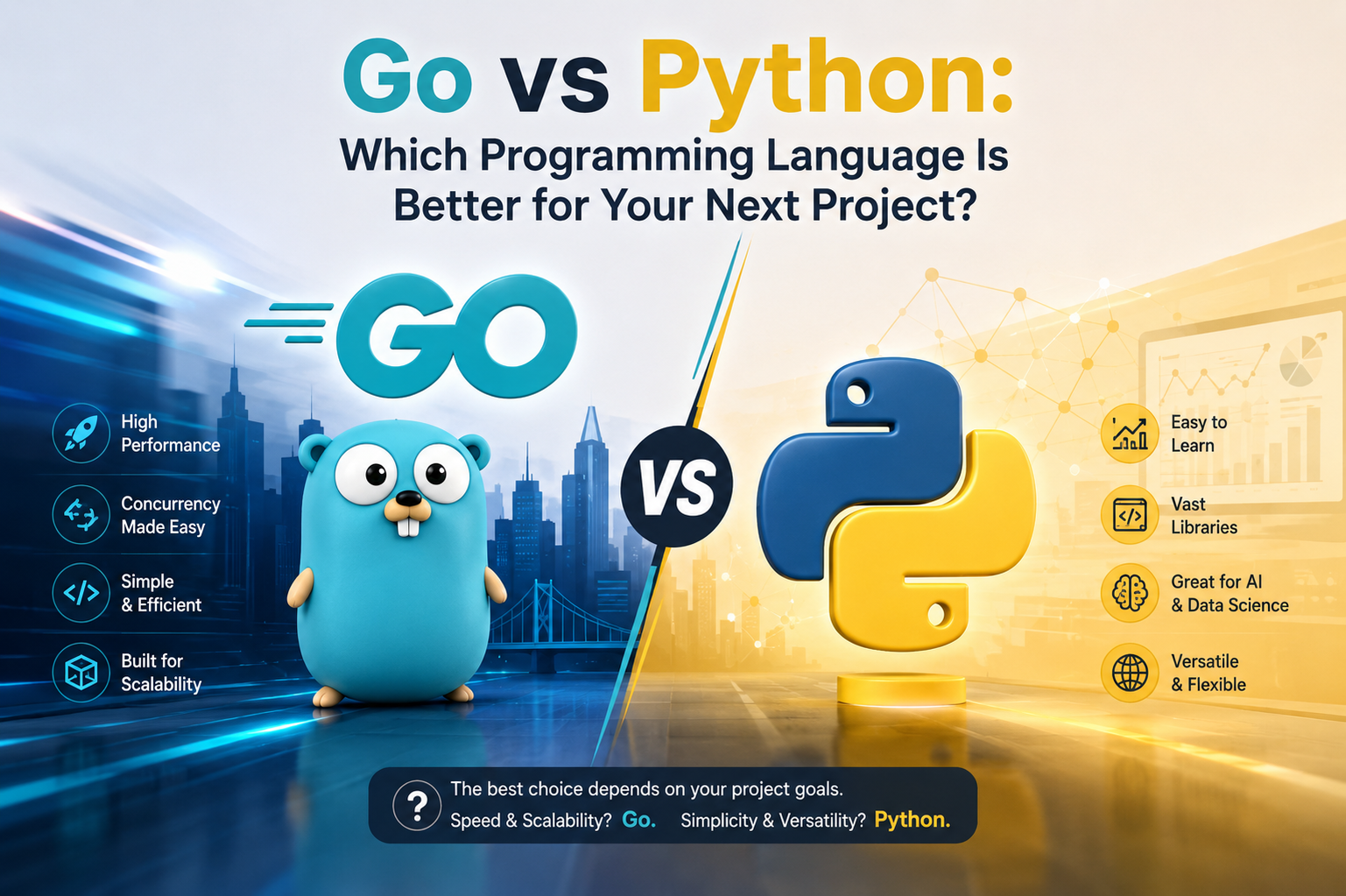
Choosing a programming language is one of the most important decisions in any software project. It affects performance, scalability, development speed, and even the long-term success of the product. Among modern programming languages, Go and Python are two of the most influential choices. They are both widely used, but they serve very different purposes and follow different design philosophies.
Go is built for performance, concurrency, and scalability. It is designed for systems where efficiency and reliability are critical. Python is built for simplicity, readability, and rapid development. It allows developers to focus on solving problems rather than worrying about complex syntax or low-level details.
Understanding the differences between these two languages helps developers choose the right tool for the right job instead of relying on popularity or personal preference.
The Philosophy Behind Go and Python
Go was created by Google engineers to solve real-world problems in large-scale systems. It was designed to simplify software development in environments where performance and concurrency are essential. Go emphasizes minimalism, strict structure, and efficiency. It avoids unnecessary complexity and gives developers a clean and predictable way to build software.
Python was designed with a completely different goal. Its focus is readability and ease of use. Python code is meant to look almost like plain English, making it one of the easiest programming languages to learn. It was created to help developers write less code while doing more.
These two philosophies define everything about the languages. Go is built for machines to run efficiently, while Python is built for humans to write easily.
Performance Differences in Real-World Applications
Performance is often the first major difference developers notice between Go and Python. Go is a compiled language, meaning it is converted directly into machine code before execution. This makes it extremely fast and efficient. It is capable of handling high-performance tasks such as web servers, cloud infrastructure, and distributed systems.
Python, being an interpreted language, executes code line by line. This makes it slower in comparison. However, Python often compensates for this through optimized libraries written in lower-level languages like C. In many applications, this makes the performance difference less noticeable.
Still, when raw speed and system efficiency matter, Go consistently outperforms Python.
Concurrency and Multitasking Strengths
One of the biggest advantages of Go is its built-in concurrency model. Go uses goroutines, which are lightweight threads managed by the Go runtime. These allow developers to run thousands of tasks simultaneously without consuming significant system resources.
This makes Go extremely powerful for backend systems, APIs, and cloud services that need to handle multiple requests at the same time.
Python also supports concurrency, but it has limitations due to the Global Interpreter Lock. This lock restricts true parallel execution in many cases. While Python provides solutions like multiprocessing and asynchronous programming, they are not as simple or efficient as Go’s built-in model.
For applications that require heavy multitasking or real-time processing, Go has a clear advantage.
Ease of Learning and Developer Experience
Python is often recommended as the first programming language for beginners. Its syntax is simple, clean, and intuitive. Developers can write functional programs with very little code. This makes it ideal for learning programming concepts and building quick prototypes.
Go is also considered relatively simple compared to older languages like C++ or Java, but it is more structured than Python. It enforces rules that improve code consistency but reduce flexibility. This makes Go slightly harder for beginners but easier to maintain in large projects.
In terms of developer experience, Python provides faster experimentation, while Go provides more discipline and structure.
Development Speed vs Execution Efficiency
One of the most important trade-offs between Go and Python is development speed versus execution efficiency.
Python allows developers to build applications quickly. Its simple syntax and large ecosystem of libraries reduce the time needed to write functional software. This makes it ideal for startups, prototypes, and fast-moving projects where speed to market is critical.
Go, on the other hand, requires more structure and planning. It may take slightly longer to write code, but the resulting applications are highly efficient and scalable. Go applications are easier to maintain in production environments where performance and stability matter.
This difference often determines which language is chosen based on project stage rather than project type.
Memory Usage and System Efficiency
Go is known for its efficient memory management. It uses garbage collection, but in a highly optimized way that minimizes latency and memory overhead. This makes it suitable for large-scale systems where resource usage must be tightly controlled.
Python consumes more memory compared to Go. This is due to its dynamic nature and higher-level abstraction. While this is not a problem for small or medium applications, it can become a limitation in systems that require high efficiency or run at scale.
For cloud infrastructure, microservices, and performance-sensitive applications, Go provides better resource control.
Scalability in Modern Software Systems
Scalability is one of the most important factors in modern software design. Go is specifically designed for scalable systems. Its concurrency model, fast execution, and low memory usage make it ideal for applications that need to grow quickly and handle large traffic loads.
Python can also scale, but it often requires additional tools, frameworks, or architectural adjustments. For example, Python applications may need more server resources or external optimizations to handle the same load that Go can manage natively.
In large distributed systems, Go often becomes the preferred choice for backend services.
Ecosystem and Library Support
Python has one of the richest ecosystems in the programming world. It is widely used in artificial intelligence, machine learning, data science, automation, and web development. Its libraries cover almost every domain, making it extremely versatile.
Go has a smaller ecosystem, but it is growing rapidly. It is particularly strong in cloud computing, DevOps tools, networking, and backend development. While it may not have as many libraries as Python, its standard library is powerful and well-designed.
If your project relies heavily on AI, analytics, or scientific computing, Python is usually the better option. If your focus is infrastructure or backend systems, Go is often more suitable.
Error Handling and Code Reliability
Go uses explicit error handling, meaning developers must handle errors directly in the code. This approach may seem repetitive, but it results in highly reliable and predictable software. It reduces hidden bugs and makes debugging easier.
Python uses exceptions for error handling, which is more flexible and easier to implement. However, it can sometimes lead to overlooked errors if not carefully managed.
Go prioritizes reliability and clarity, while Python prioritizes simplicity and speed of writing code.
Industry Adoption and Real-World Usage
Python is widely used across industries such as data science, artificial intelligence, education, automation, and web development. It is one of the most popular programming languages in the world and has a massive global community.
Go is widely adopted in cloud computing, backend engineering, DevOps, and large-scale infrastructure systems. Many tech companies use Go for performance-critical services and distributed systems.
Both languages are industry-standard, but they dominate different domains.
Long-Term Maintainability of Projects
When it comes to long-term maintenance, Go offers strong advantages in large systems. Its strict structure, clear syntax, and enforced error handling make it easier for teams to maintain consistent code over time.
Python is also maintainable, but its flexibility can sometimes lead to inconsistent coding styles across large teams unless strict guidelines are enforced.
In large enterprise systems, Go often provides better long-term stability.
Choosing Between Go and Python for Different Projects
If you are building a startup prototype, automation script, AI model, or data analysis tool, Python is usually the better choice. It allows you to build quickly, experiment easily, and access powerful libraries.
If you are building a scalable backend system, cloud service, API server, or high-performance application, Go is generally the better option. It is designed to handle load, concurrency, and efficiency at scale.
Many modern systems actually use both languages together, combining Python for intelligence and Go for performance.
Conclusion: Making the Right Decision
The choice between Go and Python is not about which language is better overall, but which one is better for your specific needs. Python excels in simplicity, rapid development, and rich ecosystems. Go excels in performance, scalability, and system-level efficiency.
If your goal is to move fast and experiment, Python gives you the flexibility to do so. If your goal is to build stable, high-performance systems that can scale efficiently, Go provides the tools you need.
In modern software development, the smartest approach is not choosing one over the other blindly, but understanding how each language fits into your project architecture. By aligning your choice with your goals, you can build software that is not only functional but also efficient, scalable, and future-ready.