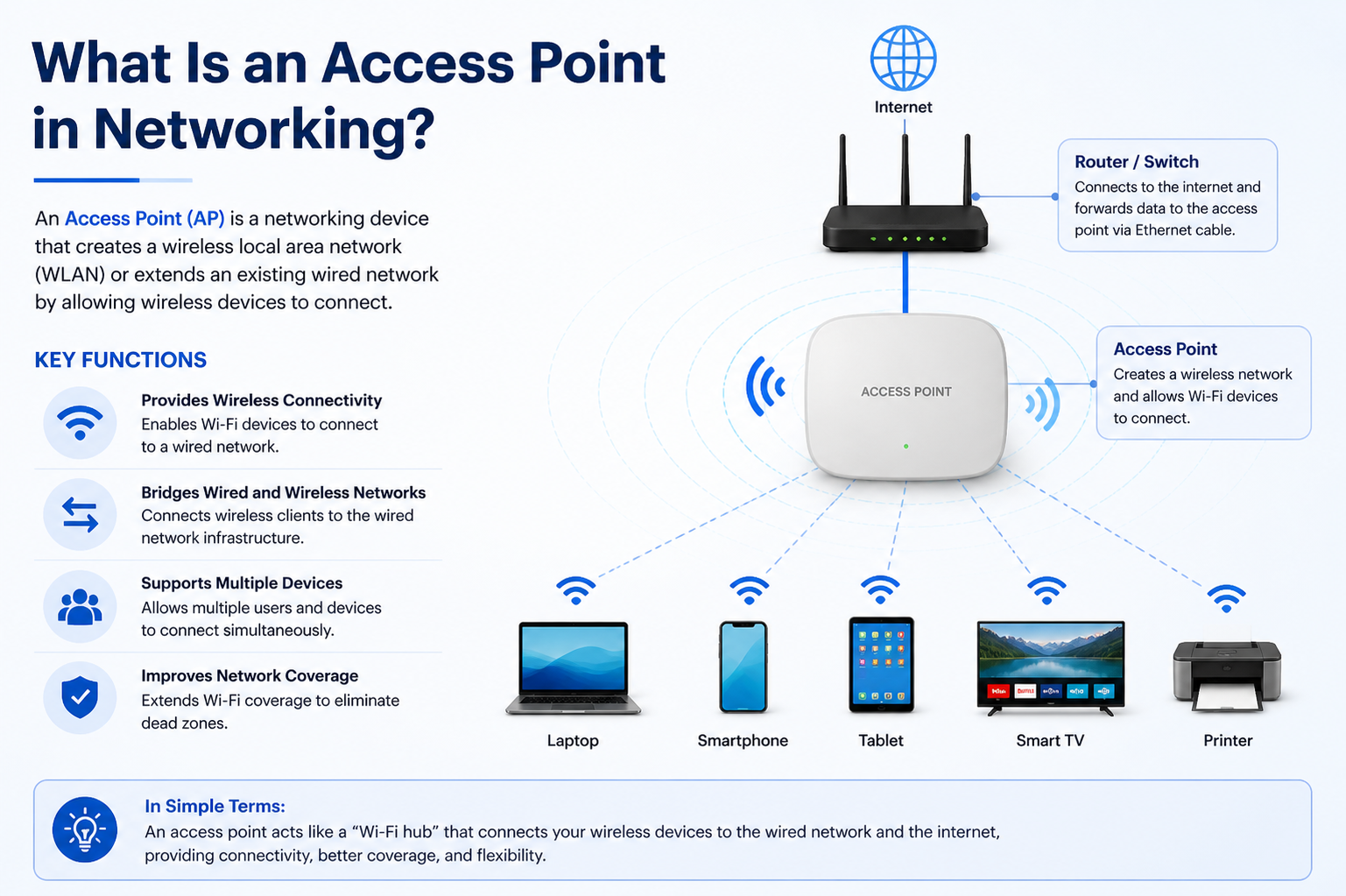
An access point in networking is a hardware device that enables wireless devices to connect to a wired network through Wi-Fi. It plays an important role in extending network access beyond the limitations of physical cables, allowing users to connect to the internet or internal systems without needing a direct wired connection. In simple terms, it acts as a communication bridge between wireless devices and a wired local area network, ensuring smooth data exchange in both directions.
An access point is commonly used in environments where multiple users need stable wireless connectivity, such as offices, educational institutions, hospitals, and large public venues. Instead of relying only on a single router, access points help distribute the network load and improve overall coverage, making it easier for users to stay connected even when they move around within a large area.
How an Access Point Works in a Network
An access point functions by receiving data from a wired network connection and converting it into a wireless signal that can be picked up by nearby devices. At the same time, it also receives wireless signals from connected devices and forwards them back to the wired network. This continuous two-way communication ensures that data flows efficiently between wireless devices and the main network infrastructure.
When a user connects a device such as a smartphone or laptop to Wi-Fi, the access point authenticates the device and allows it to join the network. After successful connection, data packets are transmitted through the access point to reach the internet or other devices on the same network. This process happens almost instantly, creating a seamless user experience without noticeable delays.
Access points can be connected to routers, switches, or even directly to a modem depending on the network design. In larger setups, multiple access points are often used together to create a wide and stable wireless coverage area, ensuring that users do not experience weak signals or disconnections while moving across different locations.
Difference Between an Access Point and a Router
Although access points and routers are often confused with each other, they serve different purposes within a network. A router is responsible for managing traffic between different networks, such as connecting a local network to the internet. It assigns IP addresses, manages data flow, and provides basic security functions.
On the other hand, an access point does not route traffic between networks. Instead, it extends the existing wired network by adding wireless connectivity. While some modern routers come with built-in wireless capabilities that function like an access point, dedicated access points are used in larger environments to improve performance and coverage.
In simple terms, a router creates and manages a network, while an access point expands that network to support wireless devices.
Types of Access Points in Networking
Access points come in different types based on their usage and deployment. The most common type is the standalone access point, which operates independently and is suitable for small to medium-sized environments. It is easy to install and configure, making it ideal for homes or small offices.
Another type is the controller-based access point, which is managed through a central controller. This type is commonly used in large organizations where multiple access points need to be monitored and controlled from a single system. It allows network administrators to manage settings, security, and performance more efficiently.
There are also mesh access points, which work together in a network to provide seamless coverage across large areas. In a mesh system, each access point communicates with others, ensuring that users remain connected even when moving between different coverage zones.
Importance of Access Points in Modern Networking
Access points are essential in modern networking because they support the growing demand for wireless connectivity. With the increasing use of mobile devices, laptops, and smart technologies, relying only on wired connections is no longer practical. Access points provide the flexibility needed to support multiple devices simultaneously without compromising performance.
They also help improve network scalability. As organizations grow, additional access points can be added to expand coverage without completely redesigning the existing network. This makes them a cost-effective solution for businesses that require reliable and expandable wireless infrastructure.
In addition, access points enhance user mobility. Employees, students, and customers can move freely within a coverage area without losing their network connection. This improves productivity and ensures a smoother digital experience in both professional and personal environments.
Key Features of an Access Point
Access points are designed with several important features that enhance wireless connectivity. One of the main features is dual-band or tri-band support, which allows devices to connect on different frequency bands for better performance and reduced interference.
They also include advanced security features such as encryption and authentication protocols to protect network data from unauthorized access. This ensures that only approved devices can connect to the network, maintaining a secure communication environment.
Another important feature is scalability, which allows multiple access points to be connected in a single network. This is especially useful in large buildings where a single device cannot provide sufficient coverage.
Access points also support roaming, which allows devices to switch between different access points automatically without disconnecting from the network. This creates a seamless browsing or working experience for users.
Benefits of Using an Access Point
One of the main benefits of using an access point is improved wireless coverage. It eliminates dead zones in large areas and ensures consistent signal strength across the network. This is especially useful in multi-floor buildings or outdoor environments.
Another benefit is better network performance. By distributing the load across multiple access points, network congestion is reduced, leading to faster and more stable connections for all users.
Access points also provide flexibility in network design. They can be placed in different locations to optimize coverage based on user needs. This allows organizations to customize their network layout according to physical space and usage patterns.
In addition, they support a large number of connected devices simultaneously. This makes them ideal for environments with high user density, such as conferences, campuses, and commercial spaces.
Where Access Points Are Commonly Used
Access points are widely used in various environments where wireless connectivity is essential. In corporate offices, they ensure employees have reliable internet access throughout the building, supporting communication, collaboration, and productivity tools.
In educational institutions, access points allow students and teachers to connect to online learning resources from anywhere on campus. This supports modern digital education systems and e-learning platforms.
In public places such as airports, shopping malls, and hotels, access points provide internet access to visitors, enhancing customer experience and convenience. They are also used in healthcare facilities to support medical devices and communication systems.
Even in residential areas, access points are sometimes used in large homes to extend Wi-Fi coverage to every room, ensuring uninterrupted connectivity for all family members.
Security in Access Points
Security is one of the most critical aspects of an access point because it directly controls who can connect to a network and how data is protected during transmission. Modern access points use advanced encryption methods to ensure that unauthorized users cannot easily intercept or access network traffic. These security mechanisms help protect sensitive information such as login credentials, business data, and personal communications.
Access points typically support authentication methods that require users to verify their identity before gaining access to the network. This may include passwords, security keys, or enterprise-level authentication systems. Once a device is authenticated, the access point ensures that communication remains secure throughout the connection session.
In addition to encryption and authentication, access points often include firewall features and intrusion detection capabilities. These tools monitor network activity and help identify suspicious behavior, such as unauthorized access attempts or unusual data traffic patterns. By detecting threats early, access points contribute to maintaining a safe and stable network environment.
Wireless Standards and Performance
Access points operate based on specific wireless communication standards that define how data is transmitted over Wi-Fi networks. These standards determine speed, range, and overall performance. Over time, wireless technology has evolved to support faster data transfer rates, improved stability, and better handling of multiple devices.
Modern access points are designed to support multiple generations of wireless standards, ensuring compatibility with both older and newer devices. This backward compatibility allows users with different types of devices to connect to the same network without issues.
Performance in an access point is influenced by factors such as signal strength, interference, and network congestion. Environmental obstacles like walls, metal objects, and electronic devices can affect wireless signals. To address these challenges, access points use technologies that optimize signal distribution and reduce interference, ensuring more consistent connectivity across coverage areas.
Placement and Installation of Access Points
The placement of an access point plays a major role in determining the quality of wireless coverage. Proper positioning ensures that signals are distributed evenly and that users experience stable connectivity throughout the area. In most cases, access points are installed in central or elevated locations to maximize coverage and reduce signal obstruction.
In large environments, multiple access points are strategically placed to create overlapping coverage zones. This allows users to move between different areas without losing connection, a process known as seamless roaming. Careful planning is required to avoid interference between access points operating on similar frequencies.
Installation also involves connecting the access point to a wired network through Ethernet cables. Once connected, the device is configured according to network requirements, including security settings, network names, and access permissions. Proper installation ensures that the access point functions efficiently and supports the expected number of users.
Role of Access Points in Business Environments
In business environments, access points are essential for maintaining productivity and communication. They allow employees to connect to corporate networks from different areas within an office building, supporting flexible work arrangements and collaborative tasks.
Access points also support business applications that rely on stable internet connectivity, such as video conferencing, cloud computing, and real-time data sharing. Without reliable wireless infrastructure, many modern business operations would face delays and inefficiencies.
For larger organizations, access points are often integrated into a centralized network management system. This allows IT administrators to monitor performance, manage security policies, and control network access from a single platform. Such centralized control improves efficiency and helps maintain consistent network quality across all locations.
Access Points in Educational Institutions
Educational institutions heavily rely on access points to support digital learning environments. They enable students and teachers to connect to online resources, learning platforms, and digital libraries from anywhere within the campus.
With the increasing use of smart classrooms and online learning systems, access points play a vital role in delivering educational content efficiently. They support interactive learning tools such as video lectures, virtual labs, and collaborative projects that require stable internet access.
Access points also help educational institutions manage large numbers of simultaneous users. During peak usage times, such as class hours or exams, they ensure that network performance remains stable and responsive, allowing uninterrupted access to academic resources.
Access Points in Public and Commercial Spaces
In public and commercial spaces, access points provide internet connectivity to a large number of users, including customers, visitors, and employees. Locations such as airports, hotels, shopping centers, and restaurants rely on access points to offer wireless internet services.
In these environments, access points must be capable of handling high traffic loads while maintaining consistent performance. They are often configured with bandwidth management features to ensure fair usage among all connected devices.
Providing Wi-Fi through access points also enhances customer experience. People expect reliable internet access in public places, and businesses that offer strong connectivity often gain a competitive advantage. This makes access points an important part of modern customer service strategies.
Scalability and Network Expansion
One of the strongest advantages of access points is their ability to scale with network growth. As the number of users or devices increases, additional access points can be added to expand coverage and improve performance without replacing the entire network infrastructure.
This scalability is particularly important for growing businesses and organizations. Instead of investing in a completely new system, they can simply install more access points to meet increasing demand. This makes network expansion more cost-effective and flexible.
Scalable access point systems also allow for future upgrades. As wireless technology improves, organizations can gradually replace or upgrade individual access points without disrupting the entire network, ensuring long-term sustainability.
Challenges and Limitations of Access Points
Despite their advantages, access points also face certain challenges. One of the main limitations is signal interference. Many electronic devices, walls, and physical obstacles can weaken or disrupt wireless signals, affecting overall performance.
Another challenge is network congestion. When too many devices connect to a single access point, it can lead to slower speeds and reduced efficiency. Proper planning and distribution of access points are required to avoid such issues.
Security risks can also arise if access points are not properly configured. Weak passwords or outdated security protocols can make networks vulnerable to unauthorized access. Regular updates and proper configuration are essential to maintain network safety.
Future of Access Point Technology
The future of access point technology is focused on improving speed, efficiency, and intelligence. With the rise of advanced wireless standards, access points are becoming faster and more capable of handling large amounts of data with minimal delay.
Artificial intelligence and automation are also being integrated into access point systems. These technologies help optimize network performance by automatically adjusting settings based on user demand and environmental conditions.
As smart devices and Internet of Things (IoT) systems continue to grow, access points will play an even more important role in connecting everything together. They will act as central communication hubs for a wide range of devices, from household appliances to industrial equipment.
Access Point Architecture in Networking
The architecture of an access point is designed to support efficient wireless communication between devices and a wired network. At its core, an access point contains a radio transceiver that sends and receives wireless signals, a processor that manages data flow, and firmware that controls its operations. These components work together to ensure smooth transmission of data between connected devices and the main network infrastructure.
In most network setups, access points are connected to a switch or router through Ethernet cables. This wired connection provides the backbone for data transfer, while the wireless radio handles communication with end-user devices. The architecture is designed to minimize latency and ensure that data packets are transmitted quickly and accurately.
Modern access points also include multiple antennas to improve signal strength and coverage. These antennas help distribute wireless signals evenly across different directions, reducing dead zones and improving overall connectivity. Some advanced models use technologies such as beamforming, which directs signals toward specific devices to enhance performance.
Bandwidth Management in Access Points
Bandwidth management is an important function of access points that helps control how network resources are distributed among users. In environments where many devices are connected simultaneously, bandwidth management ensures that no single user consumes excessive resources, which could negatively affect others.
Access points can prioritize certain types of traffic, such as video conferencing, voice calls, or business-critical applications. This ensures that important tasks receive stable and consistent connectivity, even during peak usage periods. Less critical activities, such as background downloads, may be assigned lower priority to maintain overall network balance.
By efficiently managing bandwidth, access points help maintain smooth performance across all connected devices. This is especially important in offices, schools, and public networks where multiple users rely on the same connection at the same time.
Roaming and Seamless Connectivity
One of the key features of modern access points is seamless roaming, which allows devices to move between different coverage areas without losing connection. This is achieved by deploying multiple access points within a network, each overlapping slightly with the next.
When a user moves from one area to another, their device automatically connects to the nearest access point with the strongest signal. This process happens without manual intervention, ensuring uninterrupted connectivity during movement. It is particularly useful in large buildings, campuses, and industrial environments.
Seamless roaming improves user experience by eliminating disconnections and reducing delays. It supports activities such as video streaming, online meetings, and real-time communication, where stable connectivity is essential.
Power over Ethernet in Access Points
Many modern access points use Power over Ethernet technology, which allows them to receive both power and data through a single Ethernet cable. This simplifies installation and reduces the need for additional power outlets near the device.
Power over Ethernet is especially useful in locations where electrical wiring is difficult or expensive to install. It allows access points to be placed in optimal positions for coverage without being limited by power source availability.
This technology also improves network reliability by reducing dependency on separate power supplies. In case of minor electrical issues, the access point can continue operating as long as the Ethernet connection remains active.
Cloud-Managed Access Points
Cloud-managed access points are becoming increasingly popular in modern networking environments. These devices are controlled through a cloud-based platform, allowing administrators to manage multiple access points from a central online dashboard.
With cloud management, network settings, security policies, and performance monitoring can be handled remotely. This eliminates the need for on-site configuration and makes network management more efficient, especially for organizations with multiple locations.
Cloud-managed systems also provide real-time insights into network performance. Administrators can monitor connected devices, detect issues, and make adjustments instantly. This improves response time and ensures consistent network quality across all locations.
Load Balancing in Wireless Networks
Load balancing is a technique used by access points to distribute connected devices evenly across the network. When too many users connect to a single access point, performance can degrade. Load balancing helps prevent this by redirecting devices to less congested access points.
This process ensures that no single access point becomes overloaded, maintaining stable performance for all users. It is especially important in high-density environments such as stadiums, conference halls, and large offices.
By distributing network traffic efficiently, load balancing improves speed, reduces latency, and enhances overall user experience. It also increases the lifespan of network equipment by preventing excessive strain on individual devices.
Access Points in Smart Environments
Access points play a key role in supporting smart environments, where multiple connected devices communicate with each other through the internet. These environments include smart homes, smart offices, and industrial automation systems.
In smart homes, access points connect devices such as security cameras, smart lights, thermostats, and voice assistants. This allows users to control and monitor their home systems remotely through mobile applications.
In industrial environments, access points support automation systems, sensors, and monitoring devices. They enable real-time data collection and communication between machines, improving efficiency and productivity.
As smart technologies continue to grow, access points will become even more important in managing and connecting various intelligent systems.
Energy Efficiency in Access Points
Energy efficiency is an important consideration in modern access point design. Manufacturers are developing devices that consume less power while maintaining high performance. This helps reduce operational costs and supports environmentally friendly networking solutions.
Some access points include power-saving modes that automatically adjust performance based on network demand. When traffic is low, the device reduces energy consumption without affecting connectivity.
Energy-efficient access points are particularly useful in large deployments where many devices operate continuously. By reducing overall power usage, organizations can achieve significant long-term savings.
Common Issues in Access Point Networks
Despite their advantages, access point networks can experience certain issues that affect performance. One common problem is signal interference caused by other wireless devices, physical barriers, or overlapping networks. This can lead to reduced speed and unstable connections.
Another issue is improper configuration, which can result in weak security or inefficient network performance. Incorrect placement of access points can also create coverage gaps or overlapping signals that cause interference.
Network congestion is another challenge, especially in environments with a high number of users. Without proper planning, too many devices may connect to a single access point, leading to slow speeds and poor performance.
Maintenance and Optimization of Access Points
Regular maintenance is essential to ensure that access points continue to perform efficiently. This includes updating firmware, monitoring network performance, and checking for security vulnerabilities.
Optimization involves adjusting settings such as channel selection, signal strength, and bandwidth allocation to improve performance. Proper optimization helps reduce interference and ensures balanced network usage.
Administrators also monitor device connectivity and user activity to identify potential issues early. By maintaining and optimizing access points regularly, networks can remain stable, secure, and efficient over time.
Final Overview of Access Points in Networking
Access points are a vital component of modern wireless networking systems, providing the foundation for seamless communication between devices and wired networks. They support scalability, mobility, and high-performance connectivity across a wide range of environments.
From architecture and bandwidth management to smart systems and cloud integration, access points continue to evolve with advancing technology. Their ability to support growing digital demands makes them an essential part of both small and large-scale networks.
As wireless technology continues to develop, access points will remain at the center of connectivity, enabling faster, more reliable, and more intelligent communication systems in the future.
Advanced Technologies Used in Access Points
Modern access points are no longer simple wireless bridges; they now include advanced technologies that significantly improve performance, stability, and efficiency. One of the most important technologies is MU-MIMO, which allows an access point to communicate with multiple devices at the same time instead of serving them one by one. This reduces waiting time and improves overall network speed in environments with many connected users.
Another important innovation is beamforming, which focuses the wireless signal directly toward a connected device instead of spreading it evenly in all directions. This targeted approach strengthens signal quality, increases range, and reduces interference from other devices. It is especially useful in large offices and crowded environments where multiple signals overlap.
Access points also use band steering technology, which automatically directs devices to the most suitable frequency band, such as 2.4 GHz or 5 GHz. This ensures that older devices use stable long-range connections while newer devices take advantage of faster speeds on less congested bands. Together, these technologies make wireless networks more intelligent and efficient.
Access Point Security Enhancements in Modern Systems
Security in access points has evolved significantly to handle increasing cyber threats and unauthorized access attempts. Modern access points support WPA3 encryption, which provides stronger protection compared to older security protocols. This ensures that data transmitted over the network remains protected from interception.
In addition to encryption, access points now include advanced authentication systems that verify users before granting access. These systems may involve enterprise credentials, digital certificates, or multi-factor authentication methods. This adds an extra layer of protection, especially in corporate and educational environments.
Some access points also feature rogue access point detection, which identifies unauthorized devices attempting to mimic legitimate network access points. Once detected, the system alerts administrators and blocks suspicious activity, helping maintain network integrity and safety.
Role of Access Points in Cloud Computing and IoT
Access points play a critical role in supporting cloud computing environments by ensuring stable and continuous connectivity to cloud-based applications and services. Since most modern software and storage systems operate in the cloud, reliable wireless access is essential for uninterrupted productivity.
In Internet of Things environments, access points act as central communication hubs that connect thousands of smart devices. These devices may include sensors, cameras, appliances, and industrial machines that continuously exchange data. Access points ensure that this communication happens efficiently and in real time.
The growing number of connected devices in IoT ecosystems has increased the demand for high-capacity access points capable of handling large data traffic loads without performance degradation. This has led to the development of more powerful and intelligent networking systems.
Network Optimization Techniques in Access Points
To maintain high performance, access points use several optimization techniques that improve efficiency and reduce congestion. One common technique is channel selection, where the access point automatically chooses the least crowded wireless channel to minimize interference.
Another important method is traffic shaping, which controls the flow of data based on priority levels. This ensures that critical applications receive sufficient bandwidth while less important tasks do not affect overall network performance.
Access points also use adaptive power control, which adjusts signal strength depending on device distance and network conditions. This helps reduce energy consumption and minimizes interference between nearby access points.
Access Points in Large Scale Enterprises
In large enterprises, access points are deployed in complex network architectures that cover multiple floors, buildings, or even campuses. These networks require careful planning to ensure complete coverage and consistent performance across all areas.
Enterprise-grade access points are often centrally managed through controllers or cloud platforms. This allows IT teams to configure settings, monitor performance, and troubleshoot issues from a single interface. Such centralized control is essential for maintaining large-scale network stability.
These systems are also designed for redundancy, meaning that if one access point fails, others can automatically take over its load. This ensures continuous connectivity and minimizes downtime, which is critical for business operations.
Future Trends in Access Point Technology
The future of access point technology is moving toward higher speeds, lower latency, and greater intelligence. With the introduction of next-generation wireless standards, access points will be capable of supporting extremely fast data transmission rates suitable for advanced applications like virtual reality, augmented reality, and real-time cloud processing.
Artificial intelligence will play a major role in future access points by enabling self-optimizing networks. These intelligent systems will automatically adjust settings, detect issues, and improve performance without human intervention.
Another emerging trend is the integration of access points with edge computing. This allows data to be processed closer to the source rather than relying entirely on centralized servers, reducing latency and improving response times for critical applications.
Practical Applications of Access Points in Real Life
Access points are widely used in everyday environments where reliable wireless connectivity is required. In modern homes, they help extend Wi-Fi coverage to every room, ensuring that devices such as smartphones, laptops, smart TVs, and home automation systems stay connected without interruptions. This becomes especially important in larger houses where a single router cannot provide strong signals in all areas.
In workplaces, access points are essential for supporting employee productivity. They allow staff to connect to internal systems, cloud platforms, and communication tools from anywhere within the office. This flexibility improves workflow efficiency and supports modern work styles such as hybrid and remote working setups.
In public spaces, access points provide internet access to large numbers of users at the same time. Locations such as airports, shopping malls, and cafes depend on them to offer stable connectivity for visitors. This not only improves user experience but also supports businesses in attracting and retaining customers who expect constant internet access.
Educational institutions also rely heavily on access points. Schools, colleges, and universities use them to support digital learning environments where students and teachers access online resources, attend virtual classes, and collaborate on projects. This helps create a more interactive and technology-driven learning experience.
Performance Factors of Access Points
The performance of an access point depends on several factors that influence signal quality and network speed. One of the most important factors is distance. The farther a device is from the access point, the weaker the signal becomes, which can lead to slower speeds or unstable connections.
Physical obstacles such as walls, doors, and metal structures can also interfere with wireless signals. These barriers reduce signal strength and may create dead zones where connectivity is weak or unavailable. Proper placement of access points helps minimize these issues.
Network congestion is another important factor. When too many devices connect to a single access point, it can overload the system and reduce performance. This is why multiple access points are often used in busy environments to distribute the load evenly.
Environmental interference from other electronic devices can also impact performance. Devices like microwaves, cordless phones, and other wireless networks operating on similar frequencies may cause signal disruption.
Importance of Proper Configuration
Proper configuration is essential for ensuring that access points operate efficiently and securely. Settings such as network name, security protocols, and channel selection must be correctly configured to avoid interference and unauthorized access.
Incorrect configuration can lead to performance issues, weak security, or connectivity problems. For example, using outdated security settings can make the network vulnerable to attacks, while improper channel selection can cause signal overlap with nearby networks.
Regular updates and monitoring are also important to maintain optimal performance. Firmware updates help improve functionality, fix bugs, and enhance security features, ensuring that the access point remains reliable over time.
Conclusion
Access points are a fundamental part of modern networking systems, enabling seamless wireless communication between devices and wired infrastructure. They provide essential functions such as network extension, load balancing, security management, and performance optimization, making them indispensable in today’s connected world.
With continuous advancements in technology, access points have evolved into highly intelligent devices capable of supporting complex environments such as smart homes, enterprises, educational institutions, and IoT ecosystems. Their ability to handle large numbers of users while maintaining stable performance highlights their importance in modern digital communication.
As wireless demand continues to grow, access points will remain at the center of networking innovation. Future developments will focus on faster speeds, improved automation, and deeper integration with emerging technologies, ensuring that access points continue to deliver reliable, secure, and high-performance connectivity for years to come.