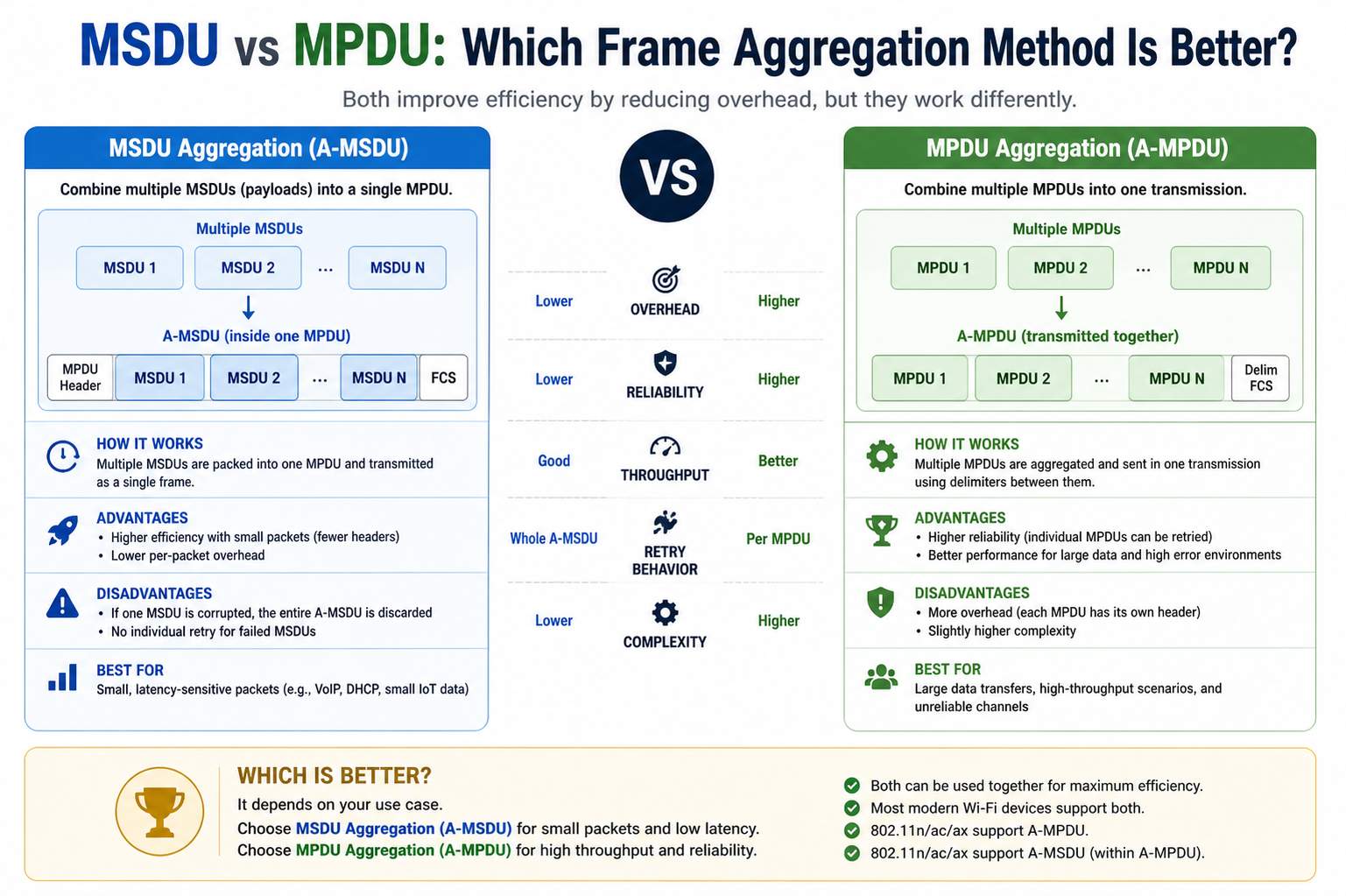
Frame aggregation is a key optimization technique in modern wireless communication systems designed to improve throughput and reduce protocol overhead. In wireless environments, every transmitted frame carries additional information such as headers, acknowledgments, and control fields. When data is sent in small individual packets, this overhead becomes inefficient and wastes valuable bandwidth. Frame aggregation solves this problem by combining multiple smaller units into a larger transmission block, reducing the number of transmissions required and improving overall efficiency.
In wireless standards such as IEEE 802.11n, 802.11ac, and 802.11ax, aggregation plays a critical role in achieving high data rates. Without aggregation, the network would spend more time handling overhead than actual payload data. This is especially important in high-density environments like offices, public hotspots, and enterprise networks where large volumes of data are transmitted continuously.
Two major aggregation techniques are used in these systems: MSDU aggregation and MPDU aggregation. While both aim to improve efficiency, they function at different layers and handle data differently, leading to distinct performance characteristics.
What is MSDU Aggregation?
MSDU aggregation, or MAC Service Data Unit aggregation, works at a higher layer in the data transmission process. At this level, data packets from the upper layers (such as IP packets) are combined before they are encapsulated into a MAC frame. Essentially, multiple MSDUs are packed together into a single large payload and then transmitted as one frame after being given a shared MAC header and trailer.
This method significantly reduces overhead because multiple data units share a single set of control information. Instead of sending many small frames, the system sends one large frame containing multiple data packets. This improves spectral efficiency and reduces channel contention, which is particularly useful in high-traffic scenarios.
However, MSDU aggregation has a limitation in terms of error handling. Since multiple data units are bundled together, a failure in transmission can potentially affect the entire aggregated frame depending on how the receiver processes it. This can lead to retransmission of a larger amount of data, which may reduce efficiency in unstable wireless environments.
What is MPDU Aggregation?
MPDU aggregation, or MAC Protocol Data Unit aggregation, operates at a lower layer compared to MSDU aggregation. Instead of combining raw data packets, MPDU aggregation bundles multiple complete MAC frames together into a single physical transmission unit.
Each MPDU retains its own MAC header and error-checking information. This structure allows for more granular control during transmission and error recovery. If one MPDU in the aggregated block is corrupted, only that specific unit needs to be retransmitted rather than the entire aggregated frame.
This makes MPDU aggregation more resilient in environments with interference, signal degradation, or high packet loss. It is widely used in modern wireless networks where reliability is just as important as speed.
Key Differences in Layer Operation
One of the most important differences between MSDU and MPDU aggregation lies in the layer at which they operate. MSDU aggregation occurs at a higher layer, closer to the data source, where multiple service data units are combined before MAC processing. MPDU aggregation occurs at the MAC layer, where already formed frames are grouped together for transmission.
This difference affects how data is structured, processed, and recovered during transmission. MSDU aggregation focuses more on efficiency at the data packaging level, while MPDU aggregation focuses on transmission efficiency and reliability at the frame level.
Because of this, MSDU aggregation is generally more efficient in terms of reducing overhead, while MPDU aggregation provides better robustness against errors.
Performance and Throughput Considerations
Throughput improvement is one of the main reasons aggregation techniques are used. MSDU aggregation typically provides higher throughput in stable environments because it minimizes header overhead by combining multiple payloads into a single frame. This reduces the number of MAC headers transmitted, which increases the proportion of useful data in each transmission.
MPDU aggregation also improves throughput but in a slightly different way. While it does not eliminate as much overhead as MSDU aggregation, it allows multiple frames to be sent in a single transmission opportunity. This reduces contention on the wireless channel and improves efficiency, especially in congested networks.
In real-world scenarios, the best performance is often achieved when both methods are used together. Modern wireless systems frequently implement a combination of MSDU and MPDU aggregation to balance throughput and reliability.
Error Handling and Reliability Differences
Error handling is one of the most significant distinctions between the two aggregation methods. Wireless communication is inherently prone to interference, signal fading, and noise. Therefore, how efficiently a system handles errors directly affects performance.
In MSDU aggregation, multiple data units are combined before MAC encapsulation. If an error occurs during transmission, the recovery process can be less granular depending on implementation. This may result in retransmission of a larger aggregated frame, which increases overhead in poor signal conditions.
In contrast, MPDU aggregation provides better error isolation. Since each MPDU contains its own header and checksum, corrupted frames can be identified and retransmitted individually. This selective retransmission improves efficiency in noisy environments and reduces unnecessary data repetition.
Because of this difference, MPDU aggregation is generally preferred in environments where signal quality is unpredictable or interference is common.
Impact on Latency and Delay
Latency is another important factor influenced by aggregation methods. MSDU aggregation can introduce slightly higher delay because data must be collected and combined at the higher layer before transmission. This waiting period can increase packet delivery time, especially when traffic is light.
However, once aggregated, MSDU transmission can be very efficient, reducing overall channel usage. This makes it suitable for bulk data transfer scenarios where slight delay is acceptable.
MPDU aggregation tends to offer more balanced latency characteristics. Since frames are already formed before aggregation, they can be transmitted more quickly without requiring significant buffering at higher layers. This makes MPDU aggregation more suitable for latency-sensitive applications such as voice communication and real-time gaming.
Efficiency in High-Density Networks
In environments with many devices competing for wireless access, such as offices, stadiums, or urban hotspots, efficiency becomes critical. MSDU aggregation helps reduce the number of transmissions by packing more data into fewer frames. This reduces contention and improves overall network efficiency.
MPDU aggregation complements this by ensuring that each transmission opportunity is used effectively. Instead of sending one frame at a time, multiple frames are sent together, reducing channel access overhead.
Together, they significantly improve performance in high-density environments. Modern Wi-Fi standards are designed to take advantage of both techniques to maximize efficiency.
Compatibility with Modern Wi-Fi Standards
Modern wireless standards such as IEEE 802.11n introduced both A-MSDU (Aggregated MSDU) and A-MPDU (Aggregated MPDU) mechanisms. Later standards like 802.11ac and 802.11ax further enhanced these techniques to support higher data rates and more efficient channel utilization.
A-MPDU has become more widely used in recent systems due to its better error resilience and support for block acknowledgments. However, A-MSDU is still useful in specific scenarios where low overhead and high efficiency are prioritized.
Most modern devices dynamically choose between the two methods depending on network conditions, signal quality, and traffic type.
Trade-Off Between Efficiency and Reliability
The choice between MSDU and MPDU aggregation ultimately comes down to a trade-off between efficiency and reliability. MSDU aggregation prioritizes efficiency by reducing header overhead and maximizing payload density. MPDU aggregation prioritizes reliability by enabling selective retransmission and better error handling.
In ideal conditions, MSDU aggregation may provide slightly better throughput. However, in real-world wireless environments, MPDU aggregation often delivers more consistent performance due to its robustness.
This balance is why modern systems rarely rely on only one method. Instead, they combine both to adapt dynamically to changing network conditions.
Practical Use in Real Networks
In practical wireless networks, users rarely experience the direct effects of MSDU or MPDU aggregation individually. Instead, these mechanisms operate behind the scenes within Wi-Fi hardware and drivers.
For example, when streaming video, downloading files, or browsing the internet, the system automatically determines how to aggregate data for optimal performance. In stable conditions, more aggressive aggregation may be used to maximize throughput. In unstable conditions, the system may reduce aggregation size to improve reliability.
This adaptability is one of the reasons modern Wi-Fi performance is significantly better than older generations.
MSDU and MPDU aggregation are both essential techniques in modern wireless communication, each serving a distinct purpose. MSDU aggregation focuses on reducing overhead and improving efficiency at the data packaging level, while MPDU aggregation focuses on improving transmission reliability and error recovery at the frame level.
Neither method is universally superior. Instead, their effectiveness depends on network conditions, application requirements, and environmental factors. In most modern systems, they are used together to achieve a balance between high throughput, low latency, and strong reliability, ensuring optimal wireless performance across a wide range of scenarios.
Advanced Implementation Details of MSDU Aggregation
MSDU aggregation is implemented closer to the higher layers of the networking stack, where data packets are still in their logical form before full MAC processing. At this stage, multiple service data units are combined into a single large payload. This aggregation happens before encryption and MAC header encapsulation, depending on the implementation in the wireless chipset.
One important detail is that MSDU aggregation has strict size limitations. Because all MSDUs share a single MAC header, the combined frame must stay within the maximum transmission unit allowed by the standard. This naturally limits how many packets can be combined in a single aggregation cycle. As a result, MSDU aggregation works best when traffic consists of similarly sized packets that can be efficiently packed together.
Another important implementation factor is alignment and padding. Since different MSDUs may have varying lengths, padding is often required to ensure proper alignment within the aggregated frame. While this improves processing efficiency at the receiver side, it can slightly increase overhead if packet sizes are not uniform.
MSDU aggregation also requires careful buffering at the sender side. The system must wait until enough packets are available to form an efficient aggregate. This introduces a trade-off between latency and efficiency, as waiting too long can delay transmission, while sending too early reduces aggregation benefits.
Advanced Implementation Details of MPDU Aggregation
MPDU aggregation operates at the MAC layer, where each frame is already fully constructed with its own header, payload, and error-checking information. These complete frames are then grouped together into a single physical transmission burst.
One of the most important aspects of MPDU aggregation is its use of block acknowledgment mechanisms. Instead of acknowledging each frame individually, the receiver sends a single acknowledgment bitmap indicating which MPDUs were successfully received. This greatly reduces control overhead and improves efficiency in high-throughput networks.
MPDU aggregation also supports retransmission at a very granular level. If a specific MPDU fails transmission, only that frame is retransmitted. This selective retransmission significantly improves performance in environments with interference or signal fading.
Another key aspect is that MPDU aggregation is highly compatible with modern encryption schemes. Since each MPDU is individually constructed before aggregation, encryption and integrity checks can be applied consistently across all frames, improving security and reliability.
Role of Block Acknowledgment in Aggregation Efficiency
Block acknowledgment is a critical feature that enhances the performance of MPDU aggregation. Instead of sending an acknowledgment after every single frame, the receiver collects multiple frames and responds with a single control message indicating which frames were successfully received.
This reduces the number of acknowledgment packets on the network, freeing up more bandwidth for actual data transmission. In high-throughput wireless environments, this reduction in control overhead can significantly improve performance.
In MSDU aggregation, acknowledgment behavior is less granular, which can sometimes lead to less efficient retransmission handling. MPDU aggregation benefits more directly from block acknowledgment because each unit remains independently identifiable.
The efficiency of block acknowledgment becomes especially important in dense networks where many devices are transmitting simultaneously. By reducing control traffic, it helps maintain smoother network operation.
Impact of Aggregation on Wireless Channel Utilization
Wireless channels are shared resources, meaning multiple devices compete for access. Aggregation techniques help reduce the number of channel access attempts by combining multiple data units into a single transmission opportunity.
MSDU aggregation reduces the number of MAC headers and thus reduces overhead per transmission. MPDU aggregation reduces the number of separate transmissions entirely by bundling multiple frames into a single burst.
This improved channel utilization leads to higher effective throughput. Instead of the channel being used for frequent small transmissions, it is used more efficiently for fewer but larger transmissions.
However, excessive aggregation can also lead to increased latency, especially in low-traffic conditions where data packets arrive sporadically. This is why adaptive aggregation strategies are commonly used in modern systems.
Adaptive Aggregation in Modern Wireless Systems
Modern Wi-Fi systems do not rely on fixed aggregation strategies. Instead, they dynamically adjust aggregation levels based on real-time network conditions such as signal strength, interference levels, traffic load, and device capabilities.
When the network is stable and traffic is heavy, larger aggregation sizes are used to maximize throughput. In contrast, when the network is unstable or latency-sensitive applications are active, aggregation size is reduced to ensure faster delivery.
This adaptive behavior ensures that both MSDU and MPDU aggregation are used efficiently depending on the situation. The system continuously balances throughput, latency, and reliability without requiring user intervention.
This adaptability is one of the reasons modern wireless performance feels seamless even under varying conditions.
Security Considerations in Aggregated Frames
Security is an important factor in wireless communication, and aggregation introduces specific considerations. Since multiple data units are combined, encryption and integrity checks must ensure that each unit remains secure and unaltered.
In MSDU aggregation, encryption typically occurs after aggregation, meaning the entire combined payload is treated as a single encrypted block. This can simplify processing but may reduce flexibility in error handling.
In MPDU aggregation, each frame is usually encrypted individually before aggregation. This provides better modularity and ensures that each frame maintains its own integrity verification.
From a security standpoint, MPDU aggregation offers better isolation between data units, reducing the impact of corruption or tampering on the entire transmission.
Performance in High-Latency and Long-Distance Networks
In long-distance wireless connections or environments with higher latency, such as rural networks or large enterprise deployments, aggregation behavior becomes even more important.
MSDU aggregation can help reduce overhead in such environments, but it may suffer from retransmission inefficiencies if errors occur frequently. MPDU aggregation tends to perform better in these scenarios because it allows selective retransmission and reduces wasted bandwidth.
High-latency environments benefit from MPDU aggregation’s ability to reduce the impact of individual frame failures. This ensures that overall throughput remains stable even when conditions are not ideal.
Use Cases in Modern Applications
Different applications benefit differently from MSDU and MPDU aggregation. High-bandwidth applications such as video streaming and file transfers benefit from MSDU aggregation because they can tolerate slight delays in exchange for higher throughput.
Latency-sensitive applications such as online gaming, voice communication, and real-time video conferencing benefit more from MPDU aggregation due to its faster retransmission handling and lower per-frame delay.
Enterprise networks often use a combination of both methods to support mixed workloads. For example, file servers may use aggressive aggregation while VoIP systems use minimal aggregation to maintain responsiveness.
Tuning and Optimization in Wireless Devices
Wireless devices often expose internal parameters that control aggregation behavior. These settings allow optimization based on specific use cases, such as prioritizing throughput or reducing latency.
Increasing aggregation limits can improve throughput but may introduce additional delay. Reducing aggregation improves responsiveness but may lower overall efficiency. Finding the right balance depends on the network environment and application requirements.
Advanced systems automatically tune these parameters based on continuous performance monitoring. This ensures optimal performance without requiring manual configuration.
Common Misconceptions About MSDU and MPDU
One common misconception is that MPDU aggregation is always better than MSDU aggregation. In reality, each serves a different purpose and performs better under different conditions.
Another misconception is that aggregation always improves performance. While it generally increases throughput, excessive aggregation can increase latency and reduce responsiveness in certain applications.
It is also often assumed that these techniques are only relevant in modern Wi-Fi systems. However, similar concepts exist in other networking technologies, even if they are implemented differently.
Future Trends in Frame Aggregation
As wireless standards continue to evolve, aggregation techniques are becoming more intelligent and adaptive. Future systems are expected to use machine learning-based algorithms to dynamically optimize aggregation size and type in real time.
With the rise of ultra-low latency applications such as augmented reality, virtual reality, and autonomous systems, aggregation methods will need to become even more flexible. Balancing throughput and latency will remain a key challenge.
Newer Wi-Fi standards are also focusing on improving multi-user efficiency, where aggregation plays a central role in coordinating simultaneous transmissions from multiple devices.
Final Evaluation of MSDU vs MPDU Aggregation
MSDU and MPDU aggregation represent two complementary approaches to improving wireless network performance. MSDU aggregation focuses on reducing overhead by combining data early in the transmission process, while MPDU aggregation focuses on improving reliability and transmission efficiency at the MAC layer.
Neither method is inherently superior. Instead, their effectiveness depends on network conditions, traffic types, and performance requirements. Modern wireless systems rely on both techniques together, dynamically adjusting their usage to achieve the best possible balance between speed, reliability, and responsiveness.
This combination ensures that wireless networks can handle everything from high-bandwidth data transfers to real-time communication with consistent and efficient performance.
Practical Scenarios Where MSDU Aggregation Performs Better
MSDU aggregation tends to perform best in environments where network conditions are stable and interference is minimal. In such scenarios, the primary goal is to maximize throughput while minimizing protocol overhead. Since MSDU aggregation combines multiple service data units before MAC processing, it significantly reduces the number of headers transmitted over the air, which improves overall efficiency.
In controlled environments such as enterprise offices with high-quality access points and limited signal disruption, MSDU aggregation can deliver excellent performance. Applications that generate continuous streams of similar-sized packets, such as file transfers or bulk data synchronization, benefit greatly from this approach. The reduction in per-packet overhead allows more useful data to be transmitted in each wireless frame.
Another scenario where MSDU aggregation is effective is in environments with low retransmission rates. When the likelihood of packet loss is minimal, the risk of retransmitting large aggregated frames is reduced. This makes MSDU aggregation highly efficient because it avoids the overhead of handling frequent retransmissions.
However, in environments where traffic is unpredictable or bursty, MSDU aggregation may become less efficient. If data arrives irregularly, the system may either wait too long to form an aggregate or send smaller aggregates that reduce efficiency. This is why its performance is highly dependent on traffic consistency.
Practical Scenarios Where MPDU Aggregation Performs Better
MPDU aggregation is particularly effective in real-world wireless environments where interference, congestion, and signal fluctuations are common. Unlike MSDU aggregation, MPDU aggregation maintains independent MAC headers for each frame, allowing selective retransmission. This makes it far more resilient in unstable conditions.
In environments such as public Wi-Fi networks, crowded urban areas, or industrial settings with high electromagnetic interference, MPDU aggregation consistently outperforms MSDU aggregation in terms of reliability. Even if some frames are lost during transmission, only those specific frames need to be retransmitted, reducing wasted bandwidth.
Latency-sensitive applications also benefit from MPDU aggregation. Since each frame is already fully constructed before aggregation, the system can transmit data more quickly without waiting for large batches to accumulate. This improves responsiveness in applications such as online gaming, voice calls, and real-time video communication.
MPDU aggregation is also highly effective in scenarios with mixed traffic types. When different devices generate varying packet sizes and transmission patterns, MPDU aggregation adapts more efficiently because it does not rely on uniform packet grouping.
Hardware and Driver-Level Optimization Differences
The performance of MSDU and MPDU aggregation is not only determined by network conditions but also by hardware and driver-level implementations. Wireless chipsets play a crucial role in deciding how aggressively aggregation is applied.
In MSDU aggregation, the driver must efficiently buffer incoming packets and decide how many can be combined without exceeding frame size limits. Poor implementation can lead to inefficient buffering, increased latency, or underutilization of available bandwidth.
In MPDU aggregation, hardware support is critical for managing block acknowledgments and retransmission tracking. Advanced chipsets can handle large aggregation windows and efficiently track the status of each MPDU, improving overall performance.
Modern wireless drivers are designed to dynamically adjust aggregation thresholds based on real-time feedback. This includes monitoring retransmission rates, signal-to-noise ratio, and channel congestion. These optimizations ensure that both MSDU and MPDU aggregation are used in the most effective way possible.
Effect on Network Congestion and Airtime Efficiency
One of the most important benefits of frame aggregation is improved airtime efficiency. Wireless channels are shared, and every transmission consumes valuable airtime. By reducing the number of transmissions required, aggregation frees up channel resources for other devices.
MSDU aggregation reduces the number of MAC headers, which lowers overhead per transmission and improves efficiency when traffic is steady. MPDU aggregation reduces the number of transmission attempts altogether by sending multiple frames in a single burst.
In congested networks, MPDU aggregation often provides better performance because it reduces the number of contention events. Fewer transmissions mean fewer opportunities for collisions and backoff delays, which helps stabilize network performance under heavy load.
However, if aggregation is too aggressive, it can lead to increased channel occupancy per transmission, which may temporarily block other devices. This is why adaptive tuning is essential to balance fairness and efficiency across the network.
Latency Trade-Offs in Detail
Latency behavior differs significantly between MSDU and MPDU aggregation. MSDU aggregation introduces delay at the sender side because it requires collecting multiple service data units before forming an aggregate. This buffering delay can be noticeable in low-traffic scenarios.
Once transmitted, MSDU aggregation is highly efficient, but the initial delay can impact time-sensitive applications. This is why it is often disabled or minimized in real-time communication systems.
MPDU aggregation reduces this initial buffering delay because frames are already complete before aggregation. This allows quicker transmission opportunities, making it more suitable for applications where responsiveness is critical.
However, MPDU aggregation can still introduce latency if block acknowledgments are delayed or if retransmissions are required. In high-error environments, repeated retransmissions can increase end-to-end delay despite the more efficient recovery mechanism.
Impact on Quality of Service (QoS)
Quality of Service mechanisms in wireless networks interact closely with aggregation techniques. Traffic types are often prioritized based on sensitivity to delay, jitter, and packet loss.
MSDU aggregation is typically more suitable for lower-priority traffic such as file downloads, backups, or bulk data transfers. These applications benefit from high throughput and can tolerate slight delays introduced by buffering.
MPDU aggregation is better aligned with high-priority traffic such as voice, video conferencing, and interactive applications. Its ability to reduce retransmission overhead and maintain more consistent latency makes it more suitable for QoS-sensitive workloads.
Modern systems often dynamically adjust aggregation behavior based on QoS classification, ensuring that high-priority traffic receives minimal delay while lower-priority traffic is optimized for throughput.
Error Recovery Efficiency Comparison
Error recovery is one of the strongest differentiators between MSDU and MPDU aggregation. In MSDU aggregation, errors can have a broader impact depending on how the aggregated frame is structured. If corruption occurs, it may require retransmission of a larger data block, reducing efficiency.
MPDU aggregation provides finer control over error recovery. Each MPDU is independently identifiable, allowing selective retransmission. This significantly reduces wasted bandwidth in error-prone environments.
This difference becomes especially important in mobile environments where signal quality changes frequently. MPDU aggregation ensures that only corrupted frames are resent, improving overall efficiency and stability.
Scalability in Modern Wireless Systems
As wireless networks scale to support more devices, aggregation becomes increasingly important. In dense environments such as smart homes, offices, and public infrastructure, efficient channel utilization is essential.
MSDU aggregation scales well in stable, high-quality networks where large data streams dominate. MPDU aggregation scales better in heterogeneous environments with mixed traffic patterns and varying signal conditions.
Modern Wi-Fi standards are designed to handle both small and large-scale deployments by dynamically adjusting aggregation strategies based on device density and traffic load.
Energy Efficiency Considerations
Aggregation also impacts power consumption in wireless devices. By reducing the number of transmissions, both MSDU and MPDU aggregation help conserve energy.
MSDU aggregation can be more energy-efficient in stable environments because fewer transmissions mean reduced radio activity. However, buffering requirements may slightly increase processing load.
MPDU aggregation reduces retransmission overhead, which is particularly beneficial for battery-powered devices. Fewer retransmissions mean less energy wasted on repeated data transfer.
This makes aggregation especially important in mobile devices such as smartphones, tablets, and IoT devices where power efficiency is critical.
Comparison in Real-World Terms
In practical terms, MSDU aggregation is best understood as a method that improves efficiency by reducing overhead before transmission, while MPDU aggregation improves efficiency by optimizing how frames are transmitted and recovered.
MSDU aggregation is ideal for clean, stable networks with predictable traffic, where maximizing throughput is the main goal. MPDU aggregation is ideal for real-world, unpredictable environments where reliability and responsiveness are more important.
Modern wireless systems do not choose one over the other exclusively. Instead, they combine both techniques dynamically to ensure optimal performance across different scenarios. This hybrid approach allows networks to deliver high speed, strong reliability, and balanced latency simultaneously, making wireless communication more efficient and adaptable than ever before.
MSDU vs MPDU in Real-World Wireless Performance Tuning
In real-world wireless deployments, MSDU and MPDU aggregation are not treated as static choices but as dynamic tools that are continuously tuned based on network behavior. Modern access points and client devices constantly evaluate channel conditions such as signal strength, interference levels, retransmission rates, and traffic patterns before deciding how aggressively to apply aggregation.
MSDU aggregation is typically increased when the system detects stable throughput conditions. For example, during sustained downloads or streaming sessions, the system may bundle more service data units together to maximize efficiency. This reduces MAC overhead and improves spectral efficiency, especially when the channel is clean and error rates are low.
MPDU aggregation, on the other hand, is often adjusted based on reliability metrics. If the network experiences rising interference or packet loss, the system may reduce aggregation size to avoid large retransmission penalties. Because each MPDU can be acknowledged individually, tuning MPDU aggregation allows finer control over retransmission behavior.
This adaptive tuning ensures that wireless performance remains stable even as conditions fluctuate. Without such adjustments, fixed aggregation settings would either waste bandwidth or increase latency under changing network conditions.
Interaction Between Aggregation and Modulation Techniques
Aggregation does not work in isolation. It interacts closely with other physical and MAC layer mechanisms such as modulation schemes, coding rates, and channel width selection. Higher modulation rates like 256-QAM or 1024-QAM increase throughput but require better signal quality. In such cases, aggregation becomes even more important to fully utilize available bandwidth.
MSDU aggregation complements high modulation efficiency by reducing overhead and ensuring that more of the transmitted bits represent actual user data. MPDU aggregation complements it by ensuring reliability is maintained even when higher modulation schemes are more sensitive to noise.
When signal conditions degrade, devices often reduce modulation rates and simultaneously adjust aggregation levels. This coordinated adaptation ensures that the network maintains stability rather than experiencing sudden drops in performance.
Behavior Under Roaming and Mobility Conditions
Wireless clients frequently move between access points in real-world environments. During roaming, signal conditions can change rapidly, affecting aggregation efficiency.
MSDU aggregation may become less effective during mobility because buffering delays can cause outdated or delayed transmission of data units. As a device moves, previously buffered data may no longer align with optimal transmission timing.
MPDU aggregation handles mobility more gracefully because each frame is independently managed. Even if signal conditions change mid-transmission, selective acknowledgment allows efficient recovery without large retransmission overhead.
This makes MPDU aggregation more suitable for mobile devices such as smartphones and laptops that frequently switch access points or move across coverage areas.
Impact on Network Fairness and Multi-User Environments
In multi-user wireless environments, aggregation strategies can influence fairness between devices. When one device uses aggressive aggregation, it may occupy more airtime per transmission, potentially reducing opportunities for other devices to access the channel.
MSDU aggregation can improve fairness when used carefully because it reduces the number of transmissions without excessively increasing airtime per burst. However, if overly aggressive, it can still lead to long transmission durations that delay other users.
MPDU aggregation tends to provide better balance in shared environments because it allows multiple smaller frames to be grouped while still maintaining granular control over retransmissions. This reduces the likelihood of one device dominating channel access for extended periods.
Modern wireless schedulers actively manage aggregation levels to ensure fair airtime distribution across all connected devices.
Buffer Management and Memory Utilization
Aggregation requires efficient buffer management at both transmitter and receiver ends. MSDU aggregation relies heavily on buffering at higher layers, where packets are temporarily stored before being grouped. This requires careful memory management to avoid delays or overflow.
If buffers fill too slowly, aggregation efficiency decreases. If buffers fill too aggressively, latency increases. Balancing this is a key challenge in high-performance wireless systems.
MPDU aggregation shifts much of the complexity to the MAC layer, where complete frames are buffered instead. This often results in more predictable memory usage patterns, making it easier to manage in hardware implementations.
Efficient buffer management is essential for maintaining stable performance, especially in high-throughput environments such as data centers or enterprise wireless networks.
Effect on Real-Time Applications
Real-time applications such as voice calls, video conferencing, and online gaming are highly sensitive to latency and jitter. In these scenarios, aggregation must be carefully controlled.
MSDU aggregation is often reduced or disabled for real-time traffic because buffering multiple packets can introduce unacceptable delays. Even small increases in latency can degrade user experience in interactive applications.
MPDU aggregation is generally more suitable because it introduces less pre-transmission delay and allows quicker recovery from errors. However, even MPDU aggregation must be tuned carefully to avoid excessive retransmission delays in unstable networks.
Quality of Service systems typically prioritize real-time traffic by limiting aggregation size and ensuring faster transmission cycles.
Throughput Saturation and Diminishing Returns
While aggregation improves throughput, there is a point at which increasing aggregation size yields diminishing returns. Beyond a certain threshold, additional aggregation may not significantly improve performance and can even reduce efficiency due to increased retransmission costs or buffering delays.
MSDU aggregation reaches this saturation point more quickly in unstable environments because large aggregated frames are more expensive to retransmit when errors occur.
MPDU aggregation has a higher tolerance for scaling because it allows partial retransmissions. However, even MPDU aggregation eventually faces diminishing returns when block acknowledgment overhead and scheduling complexity increase.
Optimal performance is achieved not by maximizing aggregation, but by balancing aggregation size with network conditions.
Impact on Wi-Fi Evolution and Standards Development
The evolution of Wi-Fi standards has been strongly influenced by improvements in aggregation techniques. Earlier standards had limited or no aggregation support, resulting in inefficient channel usage.
With the introduction of advanced aggregation in later standards, wireless performance improved dramatically. These improvements enabled multi-gigabit speeds and better support for dense device environments.
Future wireless systems are expected to further enhance aggregation by integrating artificial intelligence and predictive scheduling. These systems may dynamically predict optimal aggregation sizes based on traffic patterns and historical network behavior.
This evolution will likely make the distinction between MSDU and MPDU aggregation less visible to end users, as systems become more automated and adaptive.
Practical Engineering Trade-Off Summary
From an engineering perspective, MSDU aggregation represents a trade-off favoring reduced overhead and higher efficiency in controlled environments. It is most effective when packet loss is low and traffic is consistent.
MPDU aggregation represents a trade-off favoring reliability and flexibility. It performs better in real-world conditions where interference, mobility, and mixed traffic patterns are common.
The decision between the two is not binary. Instead, modern systems blend both approaches dynamically to optimize performance across multiple dimensions including throughput, latency, reliability, and energy efficiency.
Perspective on Aggregation Strategy Selection
The real value of MSDU and MPDU aggregation lies not in choosing one over the other, but in understanding how they complement each other. MSDU aggregation reduces overhead at the data packaging level, while MPDU aggregation enhances transmission robustness at the MAC layer.
In practical wireless systems, both techniques are essential building blocks that enable high-speed, reliable, and scalable communication. Their combined use allows modern Wi-Fi networks to deliver consistent performance across a wide range of environments, from simple home networks to complex enterprise and public infrastructure deployments.
Conclusion
MSDU and MPDU aggregation are both essential techniques in modern wireless communication, but they serve different purposes and operate at different layers of the network stack. MSDU aggregation focuses on improving efficiency by combining multiple data units before MAC processing, which reduces overhead and increases throughput in stable and low-error environments. MPDU aggregation, on the other hand, enhances reliability by grouping complete MAC frames and allowing selective retransmission, making it more effective in real-world conditions with interference and variable signal quality.
Neither method can be considered universally better because their performance depends heavily on network conditions and application requirements. MSDU aggregation excels in scenarios where traffic is consistent and channel quality is high, while MPDU aggregation performs better in environments where reliability, mobility, and error recovery are critical.
In modern wireless systems, the most effective approach is not choosing one over the other, but using both together in a dynamic and adaptive manner. This hybrid strategy allows networks to balance throughput, latency, and reliability efficiently. As wireless technology continues to evolve, these aggregation methods will remain fundamental, forming the backbone of high-speed and resilient communication systems.