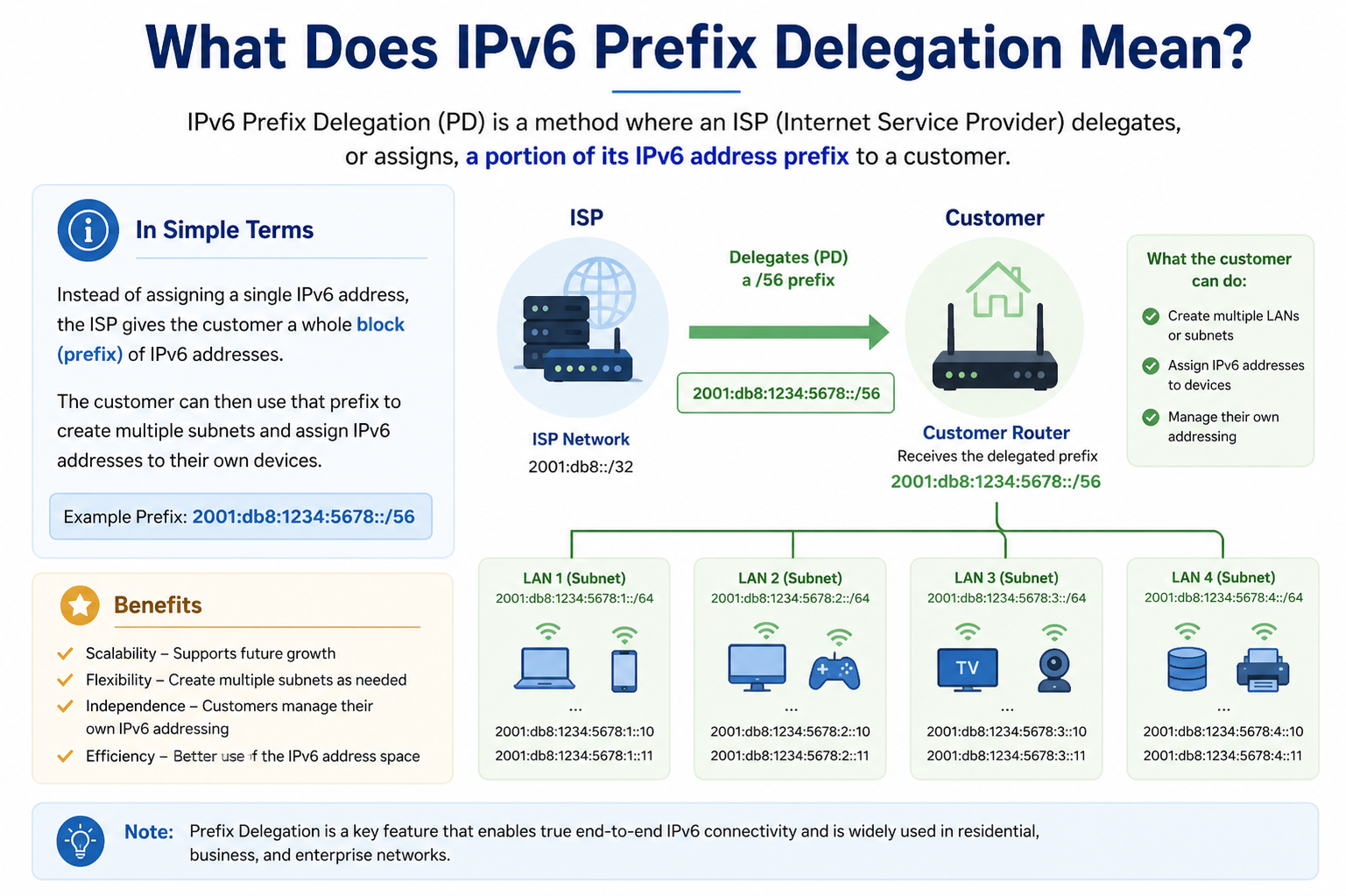
IPv6 Prefix Delegation operates as part of the IPv6 addressing and configuration ecosystem, typically using DHCPv6 (Dynamic Host Configuration Protocol for IPv6). When a device such as a home router connects to an internet service provider, it sends a request asking for an IPv6 prefix. Instead of receiving a single address, the router is assigned a block of addresses that it can further distribute within its own network.
The service provider allocates this prefix from its larger pool of IPv6 addresses. The size of the delegated prefix can vary, but it is commonly large enough to support multiple subnets inside the customer’s network. Once received, the router becomes responsible for managing and distributing individual IPv6 addresses to connected devices using methods such as SLAAC (Stateless Address Autoconfiguration) or DHCPv6 for internal assignment.
This separation of responsibilities allows the ISP to manage large-scale routing efficiently while giving end users flexibility and autonomy in designing their internal network structure.
Role of DHCPv6 in Prefix Delegation
DHCPv6 plays a central role in enabling IPv6 Prefix Delegation. Unlike IPv4, where NAT (Network Address Translation) is often required due to address scarcity, IPv6 eliminates this limitation by offering a vastly larger address space. DHCPv6-PD (Prefix Delegation) extends this capability by allowing entire address blocks to be assigned dynamically.
When a router requests a prefix, it sends a solicitation message. The ISP responds with an advertised prefix, which the router then requests formally. After acknowledgment, the prefix becomes active and usable. This process is automatic and requires minimal manual configuration, making it ideal for both residential and enterprise environments.
Structure of an IPv6 Delegated Prefix
An IPv6 prefix is essentially a range of addresses defined by a network portion and a prefix length. For example, a delegated prefix might represent a large block that contains many smaller subnets. The router receiving this prefix can divide it into smaller segments to serve different parts of a network such as guest Wi-Fi, internal devices, servers, or IoT systems.
Each subnet created from the delegated prefix remains globally unique, meaning devices inside those subnets can communicate directly over the internet without requiring address translation. This is one of the key advantages of IPv6 architecture.
Subnetting with IPv6 Prefix Delegation
Subnetting becomes significantly more flexible with IPv6 Prefix Delegation. Instead of being limited by a small number of IPv4 addresses, network administrators can divide the delegated prefix into multiple subnetworks without worrying about address exhaustion.
For example, a single delegated prefix can be split into separate segments for different departments in an organization. Each subnet can independently assign addresses to devices using SLAAC or DHCPv6. This improves organization, security, and traffic management across the network.
Because IPv6 supports extremely large address pools, subnet planning is simplified, and hierarchical network designs become easier to implement.
Autoconfiguration and Device Connectivity
One of the most powerful features supported by IPv6 Prefix Delegation is Stateless Address Autoconfiguration. Once a router receives its prefix, it can automatically generate network configuration parameters for connected devices without requiring a central server for every assignment.
Devices joining the network listen for router advertisements. These advertisements include information about the available prefix, allowing devices to construct their own unique IPv6 addresses. This reduces administrative overhead and ensures smooth connectivity even in large-scale environments.
This automatic process makes IPv6 highly efficient for environments where devices frequently join or leave the network, such as homes, offices, and smart device ecosystems.
Benefits of IPv6 Prefix Delegation
IPv6 Prefix Delegation provides several advantages that improve both performance and scalability of networks. One major benefit is the elimination of address scarcity. Since IPv6 provides an enormous number of addresses, networks no longer need to rely on techniques like NAT, which can introduce complexity and latency.
Another benefit is simplified network management. Administrators can delegate responsibility for address assignment to local routers, reducing the need for manual configuration. This also improves fault isolation, as each subnet operates independently within the larger delegated range.
It also enhances scalability. Whether a network has ten devices or ten thousand, the structure remains consistent, making expansion easier and more predictable.
Use in Home Networks
In home environments, IPv6 Prefix Delegation allows routers to manage multiple devices seamlessly. Modern homes often contain smartphones, laptops, smart TVs, security cameras, and IoT appliances. Each of these devices requires a unique IP address to function properly.
With prefix delegation, the home router receives a block of IPv6 addresses from the ISP and automatically distributes them to all connected devices. Users do not need to manually configure settings or worry about address conflicts. This results in a more stable and future-ready home network.
Use in Enterprise Networks
In enterprise environments, IPv6 Prefix Delegation is even more valuable. Large organizations often require complex network segmentation for security and performance reasons. By using delegated prefixes, companies can create multiple independent subnets for different departments, branches, or services.
This improves security by isolating traffic between segments. It also enhances performance by reducing congestion and improving routing efficiency. Additionally, IPv6 simplifies the integration of cloud services and remote access systems, which are increasingly important in modern business operations.
Security Considerations in Prefix Delegation
While IPv6 removes many limitations of IPv4, it also introduces new security considerations. Since every device can have a globally unique address, exposure to external networks increases. Proper firewall configuration becomes essential to protect internal systems.
Prefix Delegation itself does not inherently create security risks, but improper configuration can lead to unintended exposure of devices. Network administrators often implement filtering rules and monitoring systems to ensure only authorized traffic is allowed into internal networks.
Security policies should be designed with IPv6 awareness, ensuring that both inbound and outbound traffic is properly controlled.
Differences Between IPv4 and IPv6 Address Allocation
IPv4 relies heavily on NAT due to limited address availability, meaning multiple devices share a single public IP address. In contrast, IPv6 eliminates this requirement by providing a vast address space that allows every device to have its own unique global address.
IPv6 Prefix Delegation builds on this advantage by assigning entire address blocks instead of single addresses. This makes network design more flexible and reduces the complexity associated with address sharing and translation.
As a result, IPv6 networks are more efficient, scalable, and easier to manage compared to traditional IPv4 systems.
Common Issues in IPv6 Prefix Delegation
Although IPv6 Prefix Delegation is highly efficient, certain issues can occur if configuration is not properly handled. One common issue is failure to obtain a delegated prefix from the ISP, which may result from misconfigured router settings or unsupported service plans.
Another issue is improper subnet configuration within the delegated range, which can lead to connectivity problems between devices. Additionally, some older hardware may not fully support IPv6 features, leading to partial compatibility issues.
These problems are generally resolved through proper configuration updates, firmware upgrades, or ISP support adjustments.
Future of IPv6 Prefix Delegation
As the internet continues to grow, IPv6 Prefix Delegation will become increasingly important. The expansion of connected devices, including smart homes, industrial IoT systems, and cloud-based infrastructure, requires a scalable addressing system.
IPv6 is designed to meet these demands, and prefix delegation plays a key role in distributing address space efficiently. Over time, it is expected that IPv6 will fully replace IPv4 in most environments, making prefix delegation a standard feature in global networking.
The continued adoption of IPv6 will lead to more simplified network architectures, improved performance, and greater global connectivity.
Practical Flow of IPv6 Prefix Delegation in Real Networks
In a real networking environment, IPv6 Prefix Delegation follows a clear and structured flow that ensures smooth communication between the service provider and the customer’s router. The process begins when a router connects to the ISP and initiates a request for IPv6 configuration. This request is not just for a single IP address but for an entire prefix that will serve as the foundation of the local network.
Once the request is sent, the ISP evaluates available address pools and assigns a suitable prefix. This delegated prefix is then communicated back to the router, which accepts and configures it automatically. From this point onward, the router acts as the central distribution point for IPv6 addresses within the network, handling everything from assignment to management without requiring constant intervention from the ISP.
This automated flow significantly reduces complexity, especially in environments where network changes happen frequently or where multiple devices need instant connectivity.
How Routers Handle Delegated IPv6 Prefixes
After receiving a delegated prefix, the router begins internal processing to divide and manage the address space. It typically splits the prefix into smaller subnet ranges depending on network design requirements. Each subnet can be assigned to a different interface, such as wired LAN, wireless networks, or guest networks.
The router also prepares routing tables that define how traffic should move between these subnets and the outside internet. Since IPv6 does not rely on NAT, routing is more direct and efficient. Each device connected to the router receives a unique global address, allowing seamless communication without translation layers.
This behavior makes routers more intelligent in IPv6 environments, as they take on additional responsibilities compared to traditional IPv4 setups.
Interaction Between Prefix Delegation and Router Advertisements
Router advertisements play an important role in ensuring that devices inside a network are aware of available IPv6 configuration options. Once a prefix is delegated, the router begins broadcasting advertisements that include this prefix information.
Devices connected to the network listen for these advertisements and use them to generate their own IPv6 addresses. This process is automatic and does not require manual input from users. The combination of prefix delegation and router advertisements creates a fully self-configuring network environment.
This interaction ensures that new devices can join the network at any time and immediately receive a valid IPv6 address without delays or conflicts.
Dynamic Nature of IPv6 Prefix Delegation
One of the most important aspects of IPv6 Prefix Delegation is its dynamic nature. The delegated prefix is not always permanent. Depending on the ISP and network configuration, it may change over time, especially in residential connections.
When a new prefix is assigned, the router updates its internal configuration and reassigns addresses to connected devices. This process happens automatically, ensuring continuity of service. Devices may temporarily adjust their addresses, but modern operating systems are designed to handle these changes seamlessly.
This dynamic behavior allows ISPs to manage address resources efficiently while still providing uninterrupted service to users.
Impact on Network Scalability
IPv6 Prefix Delegation plays a major role in improving network scalability. Since each customer receives a large block of addresses, there is no need for complex address sharing or conservation techniques. Networks can grow organically without requiring structural changes to address allocation.
For organizations, this means new departments, branches, or services can be added without redesigning the entire network architecture. For home users, it means that adding new devices does not create address shortages or conflicts.
This scalability is one of the primary reasons IPv6 is considered a long-term solution for global networking.
Role in Modern Internet of Things (IoT) Environments
The rise of Internet of Things devices has increased the demand for efficient IP address management. Smart devices such as sensors, cameras, home automation systems, and wearable technology all require unique addresses to function properly.
IPv6 Prefix Delegation supports this requirement by providing virtually unlimited address space. A single delegated prefix can accommodate thousands or even millions of devices within a single network structure.
This capability makes IPv6 essential for IoT ecosystems, where devices continuously join, leave, and communicate with each other in real time.
Traffic Flow in a Prefix Delegated Network
In a network using IPv6 Prefix Delegation, traffic flow is more direct compared to IPv4 networks. When a device sends data, it uses its globally unique IPv6 address to communicate directly with the destination.
The router simply forwards packets based on routing rules without modifying the source or destination addresses. This reduces processing overhead and improves network performance.
Because there is no need for NAT translation, latency is reduced, and troubleshooting becomes easier since each device has a clearly identifiable address.
Prefix Delegation and Network Isolation
Network isolation is an important feature in both home and enterprise environments. With IPv6 Prefix Delegation, isolation can be achieved by assigning different subnets to different network segments.
For example, a router can separate guest devices from internal devices by using different parts of the delegated prefix. Each subnet operates independently, reducing the risk of unauthorized access between segments.
This approach improves security and ensures that sensitive devices remain protected within controlled network boundaries.
Administrative Control in Delegated Prefix Networks
Even though IPv6 Prefix Delegation automates many processes, administrators still retain full control over network configuration. They can decide how the delegated prefix is divided, which devices receive specific subnets, and how traffic is managed between segments.
Advanced configurations may include setting firewall rules, defining routing policies, and controlling access between different parts of the network. This flexibility ensures that IPv6 networks can meet both simple and highly complex requirements.
Challenges in Managing Delegated Prefixes
While IPv6 Prefix Delegation simplifies many aspects of networking, it can introduce challenges in certain situations. One challenge is maintaining consistency when prefixes change dynamically. If a prefix changes unexpectedly, devices may need to update their addresses, which can temporarily disrupt services.
Another challenge is ensuring compatibility with older systems that may not fully support IPv6 features. In such cases, hybrid configurations using both IPv4 and IPv6 may be required.
Proper planning and configuration help minimize these challenges and ensure stable operation.
Importance of Proper Router Configuration
Correct router configuration is essential for effective IPv6 Prefix Delegation. Misconfigured routers may fail to request or distribute prefixes properly, leading to connectivity issues. It is important to ensure that DHCPv6-PD settings are enabled and correctly aligned with ISP requirements.
Routers must also be capable of handling subnet division, routing rules, and address assignment efficiently. Modern routers are generally designed with these capabilities built-in, but firmware updates and proper setup remain important for optimal performance.
IPv6 Prefix Delegation in Cloud Connectivity
Cloud services rely heavily on scalable and efficient networking. IPv6 Prefix Delegation supports cloud connectivity by ensuring that devices can communicate directly with cloud servers using globally unique addresses.
This direct communication reduces the need for intermediary translation layers and improves performance for cloud-based applications. It also simplifies integration with distributed systems that require reliable and consistent addressing.
Evolution of Network Design with IPv6
The introduction of IPv6 Prefix Delegation has influenced the way modern networks are designed. Instead of focusing on conserving IP addresses, network architects can now focus on performance, security, and scalability.
This shift allows for more logical and hierarchical network structures. Subnets can be organized based on function rather than address limitations, leading to cleaner and more efficient designs.
As IPv6 adoption continues to grow, network design principles will continue to evolve toward greater simplicity and automation.
Advanced Behavior of IPv6 Prefix Delegation in Large Networks
In large-scale networks, IPv6 Prefix Delegation becomes more than just a simple address assignment mechanism. It transforms into a structured system for hierarchical network distribution. Service providers often allocate prefixes in a way that allows further delegation downstream, meaning a single ISP can distribute large address blocks to regional networks, which in turn can delegate smaller blocks to individual customers or branches.
This layered structure creates a scalable ecosystem where IPv6 addressing can expand without redesigning the entire infrastructure. Each level in the hierarchy operates independently while still remaining part of a globally routable system. This design is one of the key reasons IPv6 is well-suited for modern internet expansion.
Hierarchical Delegation and Network Design
Hierarchical delegation is a core principle behind efficient IPv6 usage. Instead of assigning flat address structures, networks are organized into tiers. At the top level, internet service providers manage large address pools. These pools are then subdivided and delegated to downstream networks such as enterprises, data centers, or regional providers.
Each delegated prefix can be further divided internally by the receiving network. This allows consistent and predictable network design, where each segment has a clear role. For example, one portion of a delegated prefix may be used for internal communication, while another is reserved for public-facing services.
This structured approach improves routing efficiency and reduces complexity in managing large networks.
Role of Aggregation in IPv6 Prefix Delegation
Aggregation is another important concept closely related to IPv6 Prefix Delegation. It refers to the ability to combine multiple smaller prefixes into a larger, summarized route. This reduces the number of routing entries required in global routing tables, improving performance across the internet.
When ISPs delegate prefixes in an aggregated manner, routers higher in the hierarchy can treat large blocks as single routing entries. This reduces processing overhead and ensures faster route computation.
Without aggregation, the global routing system would become inefficient due to the massive number of individual routes. IPv6 prefix delegation helps maintain this balance by enabling structured address distribution.
Stability and Renumbering in Delegated Prefix Networks
One of the challenges in IPv6 networks is renumbering, which occurs when a delegated prefix changes. Although IPv6 is designed to handle large-scale addressing efficiently, prefix changes can still affect internal device configurations.
Modern systems reduce this impact by using autoconfiguration mechanisms. Devices can detect changes in router advertisements and automatically update their addresses. This minimizes downtime and ensures continuity of service.
In well-designed networks, renumbering is rare and often seamless, but it remains an important consideration in prefix delegation planning.
Prefix Lifetimes and Lease Management
In IPv6 Prefix Delegation, assigned prefixes are not always permanent. They are typically associated with a lease duration, similar to how DHCP leases work in IPv4. This lease defines how long a delegated prefix remains valid.
When the lease approaches expiration, the router can request renewal from the ISP. If renewed, the same prefix continues to be used. If not, a new prefix may be assigned, requiring the network to adjust accordingly.
Lease-based management allows ISPs to efficiently reuse address space while maintaining flexibility in distribution.
Impact of Prefix Delegation on Routing Efficiency
IPv6 Prefix Delegation significantly improves routing efficiency by reducing the need for complex address translation and minimizing routing table fragmentation. Since each delegated prefix is globally unique and hierarchically structured, routers can make faster forwarding decisions.
This efficiency becomes especially important in backbone networks that handle large volumes of traffic. Fewer routing entries mean faster convergence times and more stable network performance.
Additionally, the elimination of NAT reduces processing overhead, allowing routers to focus purely on packet forwarding.
Security Enhancements Enabled by IPv6 Structure
IPv6 Prefix Delegation indirectly contributes to improved security by enabling clearer network segmentation and addressing transparency. Each device having a unique global address makes traffic easier to monitor and control.
Network administrators can apply security policies at the subnet level, ensuring that sensitive systems are isolated from less secure segments. Firewalls and intrusion detection systems can operate more effectively when address structures are predictable and hierarchical.
However, this transparency also requires careful configuration, as exposed addresses must be properly protected to prevent unauthorized access.
Prefix Delegation in Multi-Home Environments
Multi-home environments refer to networks connected to multiple ISPs for redundancy or load balancing. IPv6 Prefix Delegation plays a crucial role in such setups by allowing each ISP to assign its own prefix.
Devices within the network can then use multiple prefixes simultaneously. This provides resilience in case one connection fails, as traffic can automatically switch to another available route.
Multi-home configurations improve reliability and ensure continuous connectivity, especially in enterprise or mission-critical environments.
Load Distribution and Traffic Optimization
IPv6 Prefix Delegation also supports better load distribution across networks. Since each subnet operates independently, traffic can be balanced across different segments based on usage patterns.
For example, high-bandwidth applications can be assigned to specific subnets within a delegated prefix, while general traffic uses another segment. This separation improves performance and reduces congestion.
Routers can dynamically adjust routing policies to optimize traffic flow based on network conditions.
Automation in Modern Network Systems
Automation is a key advantage of IPv6 Prefix Delegation. Modern routers and network systems are designed to handle prefix assignment, subnet creation, and address distribution without manual intervention.
This automation reduces administrative workload and minimizes human error. In large organizations, automated prefix handling ensures consistent configuration across multiple locations.
Network management systems can also monitor prefix usage and adjust allocations dynamically based on demand.
Integration with Virtualized and Cloud Networks
Virtualized environments and cloud infrastructures rely heavily on flexible networking. IPv6 Prefix Delegation fits naturally into these systems by providing scalable address allocation for virtual machines, containers, and distributed services.
Each virtual network can be assigned a delegated prefix, allowing independent operation while maintaining global connectivity. This simplifies deployment and improves resource utilization in cloud-based systems.
As virtualization continues to expand, IPv6 delegation becomes even more critical for managing dynamic workloads.
Performance Improvements in End-to-End Communication
One of the most noticeable benefits of IPv6 Prefix Delegation is improved end-to-end communication performance. Since there is no need for NAT translation, packets travel directly between source and destination without modification.
This reduces latency and improves reliability, especially for real-time applications such as video conferencing, online gaming, and streaming services.
Direct addressing also simplifies troubleshooting, as network paths are easier to trace and analyze.
Challenges in Global Adoption of Prefix Delegation
Despite its advantages, IPv6 Prefix Delegation still faces challenges in global adoption. Some regions and networks continue to rely heavily on IPv4 infrastructure, which limits full implementation.
Compatibility between IPv4 and IPv6 systems requires dual-stack configurations, which can increase complexity. Additionally, older hardware may not fully support modern IPv6 features, requiring upgrades or replacements.
Education and awareness also play a role, as network administrators must understand IPv6 principles to implement prefix delegation effectively.
Future Role in Internet Expansion
As the number of connected devices continues to grow globally, IPv6 Prefix Delegation will become increasingly essential. It provides the foundation for scalable, efficient, and automated network addressing that can support future internet demands.
Emerging technologies such as smart cities, autonomous systems, and advanced IoT ecosystems will rely heavily on IPv6 infrastructure. Prefix delegation will ensure these systems can expand without limitations.
Over time, it is expected that IPv6 will fully replace IPv4, making prefix delegation a standard component of all internet-based communication systems.
Operational Reliability of IPv6 Prefix Delegation in Continuous Networks
IPv6 Prefix Delegation is designed to support continuous and stable network operation, even in environments where connectivity changes frequently. Once a prefix is assigned, routers maintain ongoing communication with the service provider to ensure that the delegated block remains valid and usable. This constant coordination helps prevent abrupt interruptions in service and ensures that devices within the network remain reachable.
In many modern systems, routers are capable of automatically recovering from temporary disconnections. When connectivity is restored, the router re-establishes the prefix delegation session and revalidates its assigned address block. This resilience is essential for networks that require high availability, such as business environments and smart infrastructure systems.
Prefix Delegation in Residential Broadband Systems
In residential broadband setups, IPv6 Prefix Delegation operates quietly in the background, enabling seamless internet usage without user intervention. Home routers receive a delegated prefix from the ISP and distribute it internally across connected devices such as phones, computers, smart televisions, and home automation equipment.
This process eliminates the need for manual IP configuration, which was often required in older IPv4 systems. Users simply connect their devices to the network, and IPv6 addressing is handled automatically. Even when multiple devices are added or removed, the delegated prefix remains the foundation for consistent internal communication.
Dynamic Address Behavior Within Delegated Prefixes
Inside a delegated IPv6 prefix, addresses are not fixed permanently to devices unless specifically configured that way. Instead, many devices use dynamic address generation techniques that allow them to create temporary or stable addresses based on network conditions.
This flexibility helps improve privacy and security while also supporting efficient address utilization. Devices can rotate or update their addresses without disrupting connectivity, ensuring that communication remains smooth even in changing network environments.
Impact on Network Diagnostics and Troubleshooting
IPv6 Prefix Delegation improves network diagnostics by making address structures more transparent and logically organized. Since each subnet originates from a clearly defined prefix, identifying the source of network issues becomes easier for administrators.
When a connectivity problem occurs, network tools can trace traffic directly back to a specific delegated prefix, reducing the time required for troubleshooting. Unlike IPv4 networks that often rely on NAT translation, IPv6 provides clearer visibility into end-to-end communication paths.
This clarity enhances monitoring, logging, and performance analysis across the entire network.
Prefix Delegation in Mobile and Wireless Networks
Mobile and wireless networks also benefit from IPv6 Prefix Delegation. As users move between different access points or towers, delegated prefixes can be reassigned dynamically to maintain continuous connectivity.
This adaptability is especially important in environments where mobility is constant. Devices can maintain active sessions while transitioning between networks without requiring manual reconnection or configuration changes.
Wireless infrastructure uses prefix delegation to ensure that addressing remains consistent even as physical network points change.
Energy Efficiency and Processing Optimization
IPv6 Prefix Delegation contributes indirectly to energy efficiency in networking equipment. By eliminating the need for NAT processing and reducing address translation overhead, routers and network devices consume fewer computational resources.
This reduction in processing requirements leads to lower energy consumption, especially in large-scale networks that handle significant traffic volumes. Efficient routing and simplified packet handling also reduce hardware strain, extending the operational life of network devices.
Scalability in Data Center Environments
Data centers rely heavily on scalable and automated networking systems, making IPv6 Prefix Delegation highly relevant. Each server cluster or virtual environment can be assigned a dedicated prefix, allowing independent scaling without affecting other systems.
This approach simplifies network segmentation and improves performance isolation between workloads. As data centers expand, new prefixes can be delegated and integrated seamlessly into existing architectures.
The result is a highly flexible infrastructure that can grow dynamically with minimal disruption.
Interaction Between IPv6 Prefix Delegation and DNS Systems
IPv6 Prefix Delegation indirectly interacts with domain name systems by ensuring that devices have stable and reachable addresses. As prefixes are assigned and distributed, DNS records can map domain names to IPv6 addresses within those prefixes.
This integration allows users to access services using human-readable names while the underlying network handles IPv6 routing automatically. When prefixes change, DNS updates ensure that connectivity remains consistent without requiring user intervention.
This coordination between addressing and naming systems is essential for modern internet functionality.
Redundancy and Failover Mechanisms
IPv6 Prefix Delegation supports redundancy and failover mechanisms in advanced network configurations. If a primary connection fails, routers can switch to a secondary ISP and request a new prefix without disrupting internal network operations.
Devices within the network can continue functioning using updated prefixes, ensuring minimal downtime. In enterprise environments, this capability is crucial for maintaining service continuity and avoiding disruptions in critical operations.
Redundancy planning often includes multiple delegated prefixes to ensure seamless failover behavior.
Policy Control in Delegated IPv6 Networks
Network administrators can implement detailed policy controls within IPv6 Prefix Delegation environments. These policies define how traffic flows between subnets, which devices are allowed to communicate, and how bandwidth is allocated across different segments.
Because the addressing structure is hierarchical, policies can be applied at different levels of the network. This allows for precise control over both internal and external traffic without requiring complex translation rules.
Such control mechanisms are essential for maintaining security and performance in large-scale deployments.
Long-Term Address Stability Considerations
While IPv6 provides an extremely large address space, stability within delegated prefixes remains important for long-term network planning. Organizations often design systems to minimize frequent prefix changes in order to maintain predictable network behavior.
Stable prefixes reduce the need for constant reconfiguration and ensure that services remain consistently reachable. Even though dynamic delegation is supported, many enterprise systems prefer longer lease durations or static allocations to improve reliability.
Evolution Toward Fully Autonomous Networks
IPv6 Prefix Delegation is a step toward fully autonomous networking systems. As automation increases, networks are becoming capable of self-configuring, self-healing, and self-optimizing behavior.
Prefix delegation plays a key role in this evolution by providing the foundation for automatic address distribution. Combined with advanced routing protocols and intelligent network management systems, it enables networks to operate with minimal human intervention.
This trend is expected to continue as artificial intelligence and machine learning become more integrated into network management.
Conclusion
IPv6 Prefix Delegation is a key mechanism that enables modern networks to operate in a scalable, organized, and highly automated way. By assigning an entire block of IPv6 addresses instead of a single address, it allows routers to independently manage internal networks and distribute addresses to connected devices without manual configuration. This significantly reduces complexity and improves efficiency across both small and large network environments.
It also plays an important role in supporting the growth of the internet, especially with the increasing number of connected devices in homes, businesses, and IoT ecosystems. With its hierarchical structure, dynamic allocation, and seamless integration with routing and autoconfiguration systems, IPv6 Prefix Delegation eliminates many limitations found in older addressing methods.
Overall, it provides a foundation for future-ready networking by improving scalability, simplifying administration, enhancing performance, and enabling direct end-to-end communication across the global internet.