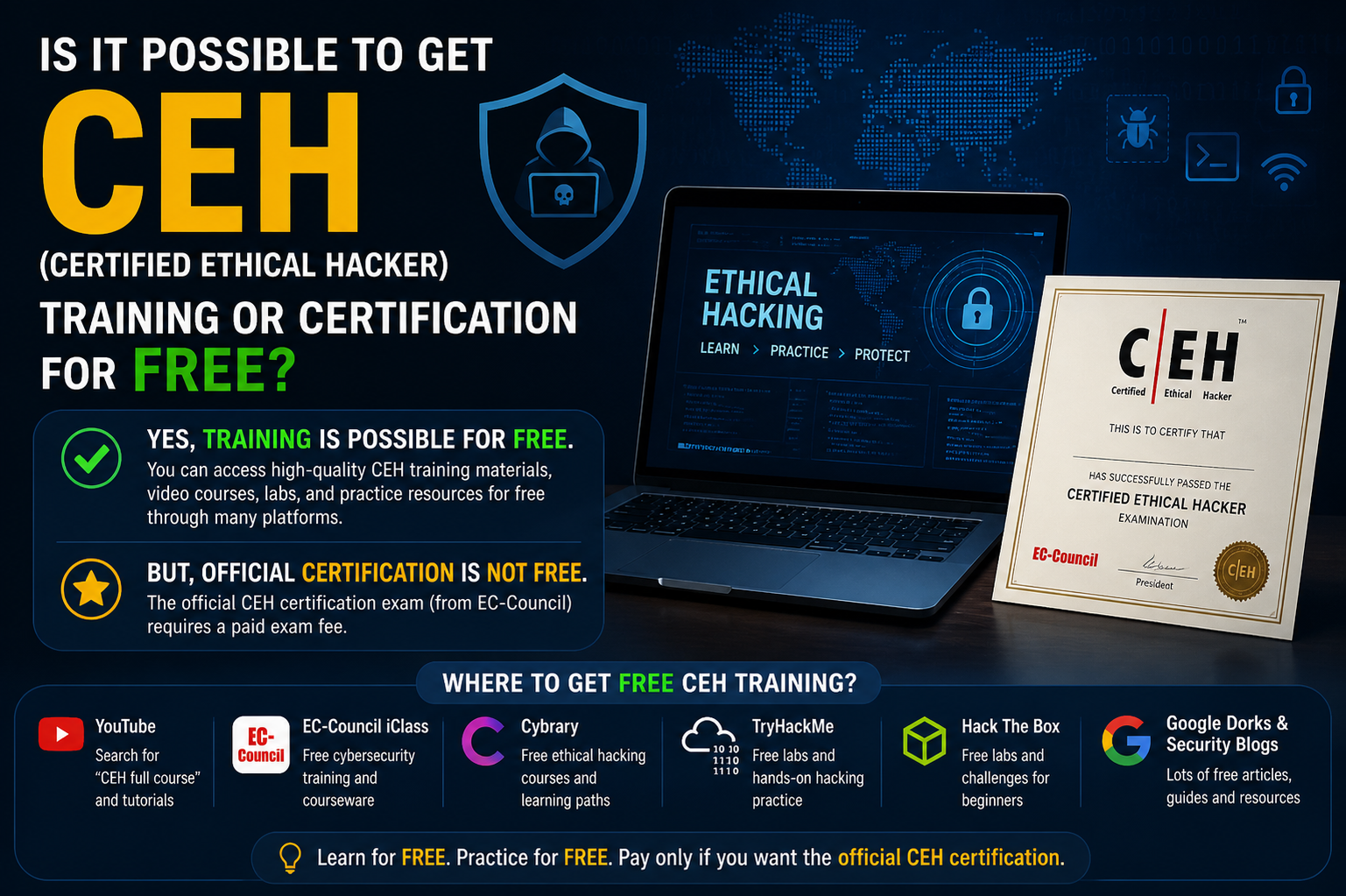
The Certified Ethical Hacker certification is one of the most recognized credentials in the cybersecurity industry, designed to validate a professional’s ability to think like a hacker in order to defend systems from real-world attacks. Because of its reputation and structured examination process, many learners wonder whether it is possible to obtain CEH training or even the certification itself without paying significant fees. While the idea of free access is appealing, the reality is more complex and depends heavily on how one defines “free” in terms of learning, preparation, and certification.
Structure and Requirements of CEH Certification
The CEH certification is not just a simple online course but a structured program that includes formal training, practical understanding of hacking tools, and a proctored examination. The certification is governed by strict eligibility requirements, and candidates are expected to either complete official training or demonstrate relevant cybersecurity experience before attempting the exam. This structured system is one of the main reasons why the certification cannot typically be accessed for free in its official form.
The exam itself evaluates knowledge across multiple domains such as network security, malware threats, penetration testing methodologies, system hacking, and web application vulnerabilities. Because of this wide scope, candidates are expected to have a strong foundational understanding before attempting certification.
Why CEH Certification Is Not Free
The main reason CEH certification cannot be fully obtained for free is because it is managed under a professional accreditation framework that includes training materials, examination security, and certification validation systems. These components require infrastructure, expert instructors, and exam monitoring systems, all of which involve cost.
Additionally, the certification is globally recognized, which means it must maintain consistent standards across different regions and candidates. This level of quality control makes it difficult to offer the certification without a financial requirement. However, this does not mean that learning the skills associated with CEH is impossible without spending money.
Free Learning Opportunities in Ethical Hacking
While the official certification is paid, there are numerous ways to begin learning ethical hacking without financial investment. Many learners start their journey using freely available cybersecurity content that introduces them to fundamental concepts such as networking basics, operating system security, and common attack techniques.
These free learning resources help build a strong foundation before moving into advanced topics. For example, understanding how networks communicate, how firewalls function, and how vulnerabilities are exploited can all be studied without cost through educational platforms, community tutorials, and open-source documentation.
Building a Strong Foundation Before Certification
Before attempting CEH certification, it is important to develop a strong base in cybersecurity concepts. Ethical hacking is not just about tools but also about understanding how systems behave and how attackers exploit weaknesses. Beginners often focus on learning topics such as IP addressing, DNS systems, encryption methods, and basic programming concepts.
Without this foundation, even paid CEH training can feel overwhelming. This is why many professionals recommend starting with general cybersecurity knowledge first and then gradually moving toward specialized ethical hacking skills.
Role of Practical Experience in Ethical Hacking
One of the most important aspects of CEH preparation is hands-on practice. Ethical hacking is a practical field where theoretical knowledge alone is not sufficient. Real understanding comes from experimenting with virtual environments, testing vulnerabilities, and observing system behavior.
Although official CEH labs are part of paid training, learners can still gain practical exposure through self-built environments and simulation tools. These allow individuals to safely practice hacking techniques in a controlled setup without violating laws or ethical boundaries.
Self-Learning vs Formal Training Path
There are generally two approaches to preparing for CEH certification. The first is formal training, which is structured, instructor-led, and directly aligned with exam requirements. The second is self-learning, which involves using free or low-cost resources to build equivalent knowledge independently.
Self-learning can be highly effective for disciplined learners, but it requires more effort, consistency, and self-direction. Formal training, on the other hand, provides a guided path but comes at a financial cost. Both paths can lead to certification success, but neither guarantees free access to the official exam.
Understanding Exam Costs and Certification Value
The CEH certification carries a significant cost because it is considered a professional-level credential in cybersecurity. The exam fee, training materials, and optional lab access contribute to the overall expense. This cost also reflects the value of the certification in the job market, where CEH holders are often considered for roles in penetration testing, security analysis, and information security management.
Because of this professional value, the certification is positioned as an investment rather than a free educational resource. However, the return on this investment can be substantial for individuals pursuing a career in cybersecurity.
Free Tools and Platforms for Skill Development
Although official certification requires payment, many tools and platforms used in ethical hacking are freely available. These tools allow learners to practice penetration testing, network scanning, vulnerability assessment, and system analysis in legal environments.
Using such tools responsibly helps learners gain familiarity with real-world cybersecurity practices. Combined with structured study, these tools can significantly improve readiness for CEH certification.
Common Misconceptions About Free CEH Certification
A common misconception is that CEH certification can be fully obtained through free online resources or shortcuts. In reality, while knowledge can be acquired freely, the certification process itself is controlled and requires formal examination.
Another misconception is that only paid training guarantees success. Many professionals have successfully cleared the certification through self-study, demonstrating that dedication and structured learning matter more than financial investment alone.
Strategic Approach to Preparing Without High Costs
For learners who cannot immediately afford CEH certification, a strategic approach is to gradually build skills over time. This involves starting with free cybersecurity education, practicing ethical hacking techniques in safe environments, and then transitioning to formal certification when ready.
This approach reduces financial pressure while still allowing steady career progression. It also ensures that candidates are better prepared when they eventually attempt the official exam.
Importance of Ethics in Ethical Hacking
Ethical hacking is not just a technical skill but also a discipline rooted in responsibility and legality. Understanding ethical boundaries is essential before engaging in any form of security testing. CEH certification emphasizes this ethical aspect strongly, ensuring that professionals use their skills to protect systems rather than exploit them unlawfully.
Free learning resources also stress this responsibility, helping learners understand the difference between ethical hacking and malicious activity.
Challenges in Self-Learning CEH Skills
While self-learning is possible, it comes with challenges such as lack of structured guidance, difficulty in understanding complex topics, and limited access to professional labs. Learners must be highly motivated and disciplined to overcome these obstacles.
Additionally, without mentorship or feedback, it can be difficult to assess readiness for the official exam. This is why many learners eventually transition to formal training after building initial knowledge independently.
Career Benefits of CEH Certification
Despite the cost, CEH certification offers strong career benefits. It is widely recognized by employers in cybersecurity roles and can open doors to positions such as security analyst, penetration tester, and network security engineer.
The certification demonstrates not only technical knowledge but also a commitment to professional standards in cybersecurity. This recognition is one of the main reasons learners invest time and money into obtaining it.
Advanced Preparation Path for CEH Without Immediate Cost
After building a basic understanding of cybersecurity concepts, the next stage in preparing for CEH involves moving into more advanced topics such as penetration testing methodologies, system exploitation techniques, and defensive security strategies. At this stage, learners start connecting theoretical knowledge with practical applications, which is essential for performing well in ethical hacking scenarios.
Progressing without paid training is still possible, but it requires a structured self-study approach. Many learners create personal study plans that break down CEH domains into manageable sections. This helps ensure consistent progress instead of random learning. Topics like reconnaissance, scanning networks, enumeration, and vulnerability analysis become key focus areas during this phase.
Importance of Hands-On Practice in Skill Development
Practical experience becomes increasingly important as learners advance. Ethical hacking is not a subject that can be mastered through reading alone, since real-world security environments are dynamic and complex. At this stage, learners often begin practicing in virtual environments where they can safely simulate attacks and defenses.
Even without official labs, it is possible to create isolated environments using virtualization tools. These setups allow experimentation with different operating systems, network configurations, and security vulnerabilities. The goal is to understand how systems respond under different types of stress or intrusion attempts.
Developing a Hacker Mindset
One of the key aspects of CEH preparation is developing what is often referred to as a hacker mindset. This does not mean engaging in illegal activity, but rather learning how attackers think when identifying system weaknesses. This perspective helps security professionals anticipate threats and strengthen defenses.
This mindset shift takes time and practice. Instead of simply learning how systems work, learners begin questioning how those systems could be exploited. For example, they analyze how weak passwords, misconfigured servers, or outdated software can become entry points for attacks.
Role of Networking Knowledge in CEH Success
Networking is one of the most critical areas of ethical hacking. Without a strong understanding of how data moves across systems, it becomes difficult to identify vulnerabilities. Concepts such as TCP/IP protocols, routing, firewalls, and subnetting play a major role in CEH-related topics.
Learners who invest time in mastering networking fundamentals often find it easier to understand advanced hacking techniques later. This knowledge forms the backbone of penetration testing and system analysis, making it a necessary step in preparation.
Understanding Cybersecurity Tools and Their Applications
Ethical hackers rely heavily on tools that help them scan, analyze, and test systems. While CEH certification includes training on various tools, learners can also explore similar tools in free environments to gain familiarity.
These tools are used for tasks such as network scanning, password analysis, vulnerability detection, and traffic monitoring. The key is not just learning how to use them, but understanding why and when they are used in real-world scenarios.
Building Analytical Thinking for Security Assessment
Beyond technical skills, CEH preparation requires strong analytical thinking. Ethical hackers must be able to evaluate complex systems and identify weak points that may not be obvious at first glance. This involves logical reasoning and attention to detail.
For example, a small misconfiguration in a system can lead to significant security risks. Being able to identify such issues requires practice and experience. Analytical thinking improves as learners work through different scenarios and challenges over time.
Challenges Faced During Self-Study Journey
While self-study offers flexibility and cost savings, it also comes with challenges. One of the biggest difficulties is maintaining consistency over time. Without structured classes or instructors, learners may struggle with motivation or direction.
Another challenge is information overload. There is a vast amount of cybersecurity content available, and not all of it is organized in a way that aligns with CEH requirements. This can lead to confusion or wasted time on irrelevant topics.
To overcome these challenges, learners often rely on structured study plans and community support to stay focused.
Importance of Cybersecurity Communities
Online cybersecurity communities play an important role in self-learning. These communities provide guidance, discussions, and shared experiences from other learners and professionals. They help beginners understand difficult topics and stay updated with industry trends.
Engaging in discussions also helps learners clarify doubts and gain different perspectives on ethical hacking concepts. This collaborative environment can partially replace the guidance provided in formal training programs.
Transitioning from Learning to Certification Readiness
As learners progress, the focus gradually shifts from general learning to exam preparation. At this stage, it becomes important to review CEH domains systematically and ensure that all topics are covered thoroughly.
Practice tests and scenario-based questions help learners assess their readiness. These exercises simulate exam conditions and help identify weak areas that need further improvement.
Financial Planning for Certification Attempt
Even when learning is done for free, the actual certification attempt requires financial planning. Many learners prepare in advance for exam fees, training costs, and potential retake expenses.
Some individuals choose to delay the certification until they are fully confident in their skills, while others seek employer sponsorship or educational support programs. This financial planning ensures that learners are not rushed into the exam before they are ready.
Long-Term Value of CEH Certification Effort
The effort invested in preparing for CEH, whether through free or paid learning, has long-term value. The skills gained during preparation are applicable in real-world cybersecurity roles, even beyond the certification itself.
Understanding how systems are attacked and defended builds a strong foundation for a career in information security. This knowledge remains useful regardless of whether the certification is obtained immediately or later.
Final Stage of CEH Preparation and Transition to Certification
At the final stage of CEH preparation, the focus shifts from learning individual concepts to integrating all knowledge areas into a complete understanding of ethical hacking. This is where learners begin to think and act more like professional security testers rather than beginners studying isolated topics. The ability to connect reconnaissance, scanning, exploitation, and reporting into a single workflow becomes essential for success.
At this level, consistency and revision matter more than learning new concepts. Most of the CEH syllabus is already covered, so the emphasis moves toward strengthening weak areas and improving speed in solving scenario-based questions. Many learners also begin simulating full penetration testing cycles to mirror real-world conditions.
Developing Exam Strategy and Time Management
A critical aspect of final preparation is learning how to manage time effectively during the exam. CEH questions are often scenario-based and require careful reading and analysis. Without proper time management, even well-prepared candidates may struggle to complete the exam within the given duration.
Learners often practice by solving mock exams under timed conditions. This helps build familiarity with pressure situations and improves decision-making speed. Over time, candidates become more efficient at identifying key information in questions and eliminating incorrect options quickly.
Importance of Revision and Concept Reinforcement
Revision plays a major role in ensuring long-term retention of ethical hacking concepts. Instead of continuously learning new material, candidates focus on revisiting previously studied topics such as network security, cryptography, malware threats, and system vulnerabilities.
This stage is also important for connecting theoretical knowledge with practical understanding. For example, knowing how encryption works is useful, but understanding how it is bypassed or misconfigured in real systems is what truly prepares a candidate for CEH-level thinking.
Role of Practice Exams in Final Readiness
Practice exams are one of the most effective tools at the final stage of preparation. They help simulate the actual certification environment and provide insight into question patterns, difficulty levels, and topic distribution.
By repeatedly taking practice tests, learners can identify recurring weaknesses and adjust their study focus accordingly. Over time, this process builds confidence and reduces exam anxiety, which is often a major barrier for first-time candidates.
Transitioning from Student to Security Professional Mindset
At this stage, learners begin transitioning from a student mindset to a professional cybersecurity mindset. This means thinking beyond just passing the exam and focusing on how ethical hacking skills apply in real-world scenarios.
Instead of memorizing steps, candidates start understanding why certain techniques are used and how attackers adapt their methods. This deeper understanding is what separates certified professionals from basic learners.
Understanding Real-World Application of CEH Skills
The knowledge gained during CEH preparation is not limited to the exam itself. It has direct applications in real cybersecurity roles such as penetration testing, security auditing, and risk assessment.
Professionals use these skills to identify vulnerabilities in corporate systems, secure sensitive data, and prevent cyberattacks. This real-world relevance is one of the reasons CEH remains a popular certification in the industry.
Challenges During Final Preparation Phase
Even at the final stage, learners often face challenges such as information overload, self-doubt, and difficulty in retaining complex concepts. Ethical hacking covers a wide range of topics, and it is natural to feel overwhelmed during revision.
Another common challenge is balancing confidence with accuracy. Some learners become overconfident after repeated practice, while others underestimate their preparation level. Maintaining a balanced mindset is important for consistent performance.
Importance of Ethical Responsibility in Cybersecurity
As learners approach certification readiness, ethical responsibility becomes increasingly important. CEH is not just about technical ability but also about understanding legal and ethical boundaries in cybersecurity work.
Professionals are expected to use their skills only for authorized testing and defensive purposes. This ethical foundation is a core part of the certification’s value and is emphasized throughout the learning journey.
Financial Reality of Certification Completion
At this final stage, learners must also face the financial reality of obtaining the official certification. While the preparation journey can be done with minimal or no cost, the actual exam and certification process require payment.
This is why many learners treat CEH as a long-term goal, preparing first and planning financially later. Some also seek employer sponsorships or career advancement opportunities that cover certification expenses.
Long-Term Career Impact of CEH Preparation
Even before obtaining the certification, the preparation process itself has significant career value. The skills developed during CEH study are directly applicable to cybersecurity roles and can improve job performance and employability.
Employers often value practical knowledge and problem-solving ability, which are developed during ethical hacking training. This means that even partial preparation can enhance career opportunities.
Final Perspective on Free Learning vs Paid Certification
In conclusion, while CEH certification cannot be fully achieved for free, the learning journey itself can begin without financial barriers and still provide strong career benefits. Free resources allow learners to build foundational and intermediate knowledge, while structured preparation leads to certification readiness.
The key takeaway is that free learning is valuable for skill development, but certification requires formal investment. A balanced approach that combines self-study, practice, and eventual certification planning offers the most effective path for success in ethical hacking and cybersecurity careers.
Final Integration of CEH Knowledge into Real-World Cybersecurity Skills
At the most advanced stage of CEH preparation, the learner’s focus naturally shifts from exam readiness to real-world application. This is where ethical hacking knowledge stops being theoretical and starts becoming a practical skill set used in professional cybersecurity environments. The ability to analyze systems, identify vulnerabilities, and suggest defensive improvements becomes more refined and structured.
At this point, learners are not just studying individual attack techniques anymore. Instead, they are learning how entire attack chains work, how systems respond under pressure, and how security defenses can be strengthened at different layers of infrastructure.
Strengthening Problem-Solving and Security Thinking
One of the most important outcomes of CEH-level preparation is improved problem-solving ability. Cybersecurity challenges rarely come with straightforward answers, so professionals must evaluate multiple possibilities before reaching conclusions.
This stage involves developing a structured thinking approach where every system is analyzed from multiple angles. For example, a vulnerability might not just be a coding error but could also be related to configuration, user behavior, or network design. Understanding these relationships is a key part of advanced ethical hacking.
Understanding Defensive Security Alongside Offense
Although CEH focuses on ethical hacking techniques, it also builds a strong understanding of defensive security. Learners begin to see how organizations protect their systems using firewalls, intrusion detection systems, encryption, and access controls.
This dual understanding of attack and defense is essential because it allows cybersecurity professionals to think like both an attacker and a defender. This balanced perspective is what makes ethical hacking valuable in real-world security roles.
Practical Exposure and Simulation-Based Learning
At this stage, simulation-based learning becomes extremely important. Real-world cybersecurity environments are complex, and learners must experience similar complexity in training environments to fully understand how attacks unfold.
By simulating different scenarios such as phishing attacks, network breaches, or malware infections, learners gain insight into how systems behave under real conditions. This helps bridge the gap between theoretical knowledge and practical execution.
Improving Accuracy and Decision-Making Under Pressure
Advanced CEH preparation also improves decision-making skills, especially under time constraints. In real cybersecurity situations, decisions often need to be made quickly and accurately.
This is why many learners continue practicing timed challenges even after mastering basic concepts. The goal is to reduce hesitation and improve confidence when analyzing unfamiliar scenarios.
Developing Documentation and Reporting Skills
A critical but often overlooked aspect of ethical hacking is reporting. In professional environments, identifying a vulnerability is not enough. It must be clearly documented with evidence, risk assessment, and recommended fixes.
At this stage, learners start practicing how to create structured reports that explain technical issues in a clear and understandable way. This skill is essential for communicating with both technical teams and non-technical stakeholders.
Transitioning Toward Professional Cybersecurity Roles
Once CEH preparation is complete or near completion, learners are often ready to transition into entry-level cybersecurity roles. These may include positions such as security analyst, junior penetration tester, or IT security support roles.
Even before official certification, the knowledge gained during preparation can help candidates stand out in interviews and practical assessments. Employers often value hands-on understanding of cybersecurity concepts more than theoretical knowledge alone.
Limitations of Free Learning in Final Certification Stage
While free learning resources are extremely valuable in earlier stages, they have limitations when it comes to final certification readiness. Without structured evaluation, it can be difficult to accurately measure whether a candidate is fully prepared for the CEH exam.
This is why many learners eventually move toward official training or paid practice exams to validate their knowledge. These resources provide exam-level difficulty and help identify final gaps in preparation.
Financial Planning and Certification Strategy
At this stage, financial planning becomes an important consideration. Since CEH certification requires payment, learners often plan their exam attempt strategically. Some wait until they are fully confident, while others align certification with job applications or career transitions.
In some cases, organizations may sponsor certification costs for employees, especially if cybersecurity skills are directly relevant to their job role. This can reduce financial pressure while still allowing candidates to obtain certification.
Long-Term Skill Retention Beyond Certification
One of the most important aspects of CEH preparation is that the knowledge remains useful even after the exam is completed. Cybersecurity is a constantly evolving field, and the foundational concepts learned during CEH preparation continue to apply across new technologies and threats.
Professionals often continue learning even after certification, as new vulnerabilities, tools, and attack techniques emerge regularly. CEH serves as a foundation for lifelong learning in cybersecurity.
Final Perspective on Free CEH Learning Journey
In conclusion, while CEH certification itself cannot be fully obtained for free, the entire learning journey leading up to it can be significantly supported through free resources. From foundational knowledge to advanced ethical hacking skills, learners can build strong technical expertise without immediate financial investment.
However, the final certification stage still requires formal examination and associated costs. The most effective approach is to use free learning for skill development and then transition into structured certification preparation when ready. This balanced pathway ensures both affordability and professional readiness in the field of cybersecurity.
Final Understanding of Free CEH Learning Path and Certification Reality
At this point in the overall journey, it becomes clear that the idea of obtaining CEH certification entirely for free is not practically realistic. However, what remains equally important is recognizing that the learning process itself can be almost entirely built through free and self-driven study if approached with discipline and structure.
Ethical hacking is a skill-based discipline, which means knowledge, practice, and consistency matter more than shortcuts. Even without formal training, learners can gradually develop strong technical ability by focusing on understanding systems, networks, vulnerabilities, and security defense mechanisms in depth.
Clarifying the Difference Between Learning and Certification
One of the most important distinctions to understand is the difference between learning ethical hacking and obtaining certification. Learning refers to gaining knowledge and skills, which can be done through free resources, experimentation, and practice. Certification, on the other hand, is a formal validation process that requires passing a structured exam under official standards.
Many learners confuse these two aspects, expecting that free learning should also lead directly to certification. In reality, free resources help build readiness, but the certification itself remains a paid and regulated process.
How Free Learning Still Creates Strong Career Value
Even without certification, free learning in ethical hacking can create significant career value. The cybersecurity industry places high importance on practical skills and problem-solving ability. A learner who understands how systems are attacked and defended can still contribute meaningfully in entry-level roles or internships.
This means that knowledge gained during free preparation is not wasted. It directly contributes to employability and long-term career development in cybersecurity.
Building Discipline and Structured Study Habits
Success in ethical hacking depends heavily on discipline. Since free learning does not come with strict schedules or instructors, learners must create their own structure. This includes setting goals, following topic sequences, and regularly practicing skills in real or simulated environments.
Without discipline, even high-quality free resources may not lead to meaningful progress. Consistency is what transforms basic knowledge into professional-level understanding.
Evolving from Beginner to Skilled Practitioner
As learners continue their journey, they gradually evolve from beginners into skilled practitioners. At first, concepts like networking, encryption, and system security may seem complex. Over time, repeated exposure and practice make these topics more understandable and practical.
Eventually, learners begin thinking in terms of systems and vulnerabilities rather than isolated concepts. This shift in thinking is a key milestone in ethical hacking development.
Recognizing the Value of Certification in Career Growth
While free learning builds knowledge, certification still plays an important role in career advancement. CEH certification is widely recognized in the cybersecurity industry and often serves as proof of standardized knowledge.
Employers may use certifications as a benchmark during hiring decisions, especially for competitive roles. This is why many professionals eventually pursue certification even after gaining practical experience through free learning.
Balancing Cost, Effort, and Career Goals
The most effective strategy is to balance free learning with long-term certification planning. Starting with free resources allows learners to explore cybersecurity without financial pressure. Once confidence and skill level increase, investing in certification becomes a logical next step.
This balanced approach reduces financial risk while ensuring steady career progression.
Conclusion
The Certified Ethical Hacker (CEH) certification is a respected qualification in cybersecurity, but it is not something that can realistically be obtained completely free. The official exam, training structure, and certification process are paid because they follow strict global standards and require proper assessment systems. This makes the certification itself a financial investment rather than a free credential.
At the same time, the journey toward CEH is where free learning becomes highly valuable. A wide range of resources can help build strong foundational and intermediate cybersecurity knowledge without cost. These materials allow learners to understand networking, security principles, ethical hacking techniques, and real-world attack methods before moving into formal certification preparation.
The most practical approach is to treat free learning as the foundation stage. It helps develop essential skills, build confidence, and prepare mentally for advanced topics. Once a strong base is established, learners can transition into structured CEH preparation and eventually attempt the official certification when financially and technically ready.
In the end, while the certification itself is not free, the knowledge required to achieve it can be built step by step with minimal investment. Success depends more on consistency, practice, and understanding than on how early someone pays for formal training.