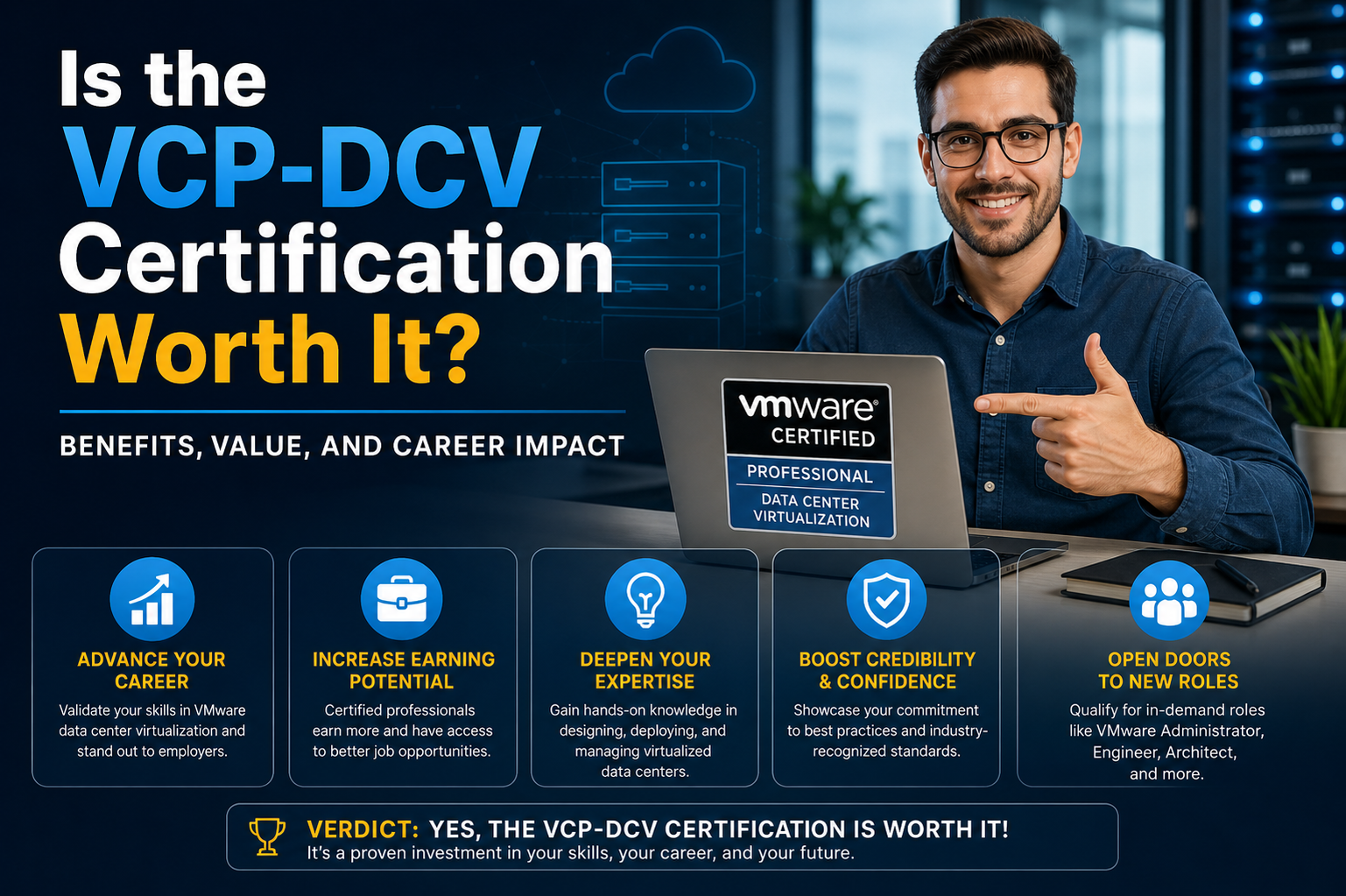
The VCP-DCV certification continues to be one of the most respected credentials for IT professionals who want to specialize in virtualization and data center technologies. In an era where organizations are rapidly shifting toward cloud-first and hybrid infrastructure models, the demand for skilled virtualization experts has increased significantly. This certification serves as a strong proof of capability in managing complex virtual environments, ensuring system efficiency, and supporting enterprise-level IT operations. For many professionals, it becomes a turning point in their career journey, helping them transition from general IT roles into more specialized and higher-paying positions.
Understanding the Role of VCP-DCV in Modern IT Environments
The VCP-DCV certification focuses on validating skills related to data center virtualization, which is the backbone of modern IT infrastructure. Virtualization allows multiple virtual machines to run on a single physical server, improving resource utilization and reducing operational costs. Professionals with this certification are trained to deploy, manage, and optimize virtual environments effectively. This includes working with compute resources, storage systems, networking layers, and performance monitoring tools that ensure smooth operations across enterprise systems.
Core Skills Developed Through the Certification
One of the biggest advantages of pursuing this certification is the development of strong technical skills that are directly applicable in real-world environments. Candidates gain expertise in configuring virtual machines, managing distributed resource scheduling, and implementing high availability solutions. They also learn how to troubleshoot performance issues and optimize infrastructure for better efficiency. These skills are not theoretical alone; they are designed to be practical so professionals can immediately apply them in enterprise environments.
Importance of Virtualization Knowledge in Today’s Industry
Virtualization has become a foundational element in modern IT architecture. Almost every large organization relies on virtual infrastructure to run applications, manage workloads, and scale operations efficiently. Without virtualization, maintaining large-scale systems would be significantly more expensive and less flexible. This is why professionals who understand virtualization technologies are in high demand. The VCP-DCV certification ensures that individuals have a structured understanding of these systems and can contribute effectively to IT teams.
Career Opportunities After VCP-DCV Certification
One of the most attractive aspects of earning this certification is the wide range of career opportunities it opens. Professionals can pursue roles such as system administrator, virtualization engineer, cloud infrastructure specialist, and data center technician. As organizations continue to modernize their IT environments, these roles are becoming more critical. The certification acts as a gateway to advanced technical positions where professionals are responsible for managing large-scale infrastructure and ensuring system reliability.
Impact on Salary and Professional Growth
From a financial perspective, the VCP-DCV certification often leads to improved salary packages. Employers value certified professionals because they bring verified skills and require less training time. This can translate into better compensation compared to non-certified peers in similar roles. Additionally, the certification helps professionals stand out in competitive job markets, increasing their chances of promotions and leadership opportunities within IT departments.
Industry Demand for Virtualization Experts
The demand for virtualization specialists remains strong across industries such as finance, healthcare, telecommunications, and technology. These sectors rely heavily on stable and scalable IT systems, making virtualization expertise essential. As organizations expand their digital infrastructure, the need for professionals who can manage virtual environments efficiently continues to grow. This trend ensures long-term relevance for individuals holding the VCP-DCV certification.
Difficulty Level and Learning Curve
The VCP-DCV certification is considered moderately challenging, especially for individuals who are new to virtualization technologies. It requires both theoretical knowledge and hands-on experience with virtualization platforms. Understanding concepts like resource pools, storage policies, and network virtualization can take time and practice. However, with consistent study and practical exposure, most candidates are able to successfully clear the certification exam and apply their knowledge effectively in real-world scenarios.
Prerequisites and Recommended Experience
While the certification is accessible to IT professionals at various levels, having prior experience in system administration or networking is highly beneficial. Familiarity with server management, operating systems, and basic cloud concepts can make the learning process smoother. Many candidates choose to gain practical experience before attempting the certification to improve their chances of success. This combination of experience and structured learning is key to mastering the required skills.
Real-World Applications of VCP-DCV Skills
The knowledge gained through this certification is directly applicable in real-world IT environments. Professionals often work on tasks such as deploying virtual machines, managing infrastructure scalability, and ensuring system uptime. They also play a critical role in disaster recovery planning and performance optimization. These responsibilities make them valuable assets to IT teams, especially in organizations that rely heavily on digital infrastructure.
Comparison with Other IT Certifications
When compared to other IT certifications, the VCP-DCV stands out due to its specialization in virtualization. While general certifications cover broad IT concepts, this certification focuses deeply on data center virtualization technologies. This specialization makes it particularly valuable for professionals who want to build a niche career in infrastructure management. It complements other certifications in cloud computing and networking, creating a strong foundation for advanced career paths.
Common Challenges Faced by Candidates
Many candidates face challenges during preparation, especially when dealing with complex virtualization concepts. Understanding system architecture and performance tuning requires both theoretical study and hands-on practice. Another common challenge is keeping up with updates in virtualization technologies, as the field evolves rapidly. However, these challenges can be overcome through structured learning, practical labs, and consistent practice.
Preparation Strategy for Success
A successful preparation strategy involves a combination of study materials, hands-on labs, and real-world practice. Candidates should focus on understanding core concepts rather than memorizing information. Practical experience plays a crucial role in building confidence and improving problem-solving abilities. Regular practice with virtual environments helps reinforce theoretical knowledge and ensures better performance during the certification exam.
Long-Term Value of the Certification
The long-term value of the VCP-DCV certification lies in its ability to keep professionals relevant in a rapidly changing IT landscape. As organizations continue to adopt virtualization and cloud technologies, the demand for skilled professionals remains strong. This certification not only helps in securing better job opportunities but also provides a foundation for continuous career growth in advanced IT domains.
Career Investment
Investing time and effort into the VCP-DCV certification can be a strategic move for IT professionals aiming to specialize in virtualization. It offers a combination of technical skill development, career advancement opportunities, and industry recognition. While it requires dedication and practical experience, the long-term benefits often outweigh the initial effort, making it a valuable step for those serious about building a career in modern IT infrastructure.
Advanced Career Growth After VCP-DCV Certification
After earning the VCP-DCV certification, many professionals notice a shift in the type of roles they become eligible for within IT organizations. Instead of handling basic system administration tasks, they often move toward more specialized responsibilities that involve designing, implementing, and managing complex virtual infrastructures. This transition is important because it marks the move from operational support work to more strategic and architecture-focused roles. Employers start trusting certified professionals with higher responsibility systems where downtime, performance, and scalability are critical.
Role in Cloud and Hybrid Infrastructure Environments
Modern IT environments are no longer limited to traditional data centers. Most organizations now operate in hybrid models that combine on-premises infrastructure with cloud platforms. The VCP-DCV certification helps professionals understand how virtualized environments integrate with cloud systems. This knowledge is essential when working in hybrid setups where workloads may shift between private data centers and cloud platforms based on demand, cost, or performance requirements. Professionals with this certification are better prepared to support these transitions smoothly.
Contribution to System Stability and Performance
One of the most important responsibilities of virtualization professionals is ensuring system stability and performance. Virtual environments must be carefully managed so that resources like CPU, memory, and storage are distributed efficiently. The VCP-DCV certification trains individuals to monitor system health, identify performance bottlenecks, and optimize workloads. This directly impacts business operations because even small performance issues can affect multiple applications and users in a virtualized setup.
Importance in Enterprise-Level IT Operations
Large organizations depend heavily on virtualization to run their daily operations. From email systems to business applications and databases, almost everything is hosted on virtual infrastructure. The VCP-DCV certification ensures that professionals understand how to maintain these systems at scale. It prepares them to handle enterprise-level challenges such as high availability, load balancing, disaster recovery, and infrastructure scaling. These skills are essential in environments where downtime can result in significant financial loss.
Hands-On Experience and Practical Exposure
One of the key strengths of this certification is its focus on practical learning. The concepts covered are not just theoretical but are designed to be applied in real environments. Professionals gain experience in setting up virtual machines, configuring networks within virtual environments, and managing storage systems. This hands-on exposure is crucial because virtualization is a highly practical field where real-world problem-solving matters more than memorized knowledge.
Evolution of Virtualization Technologies
Virtualization technology continues to evolve rapidly, especially with the integration of cloud computing, automation, and artificial intelligence. Modern data centers are becoming more intelligent and automated, reducing manual intervention. The VCP-DCV certification provides a foundation that allows professionals to adapt to these changes. Even as tools and platforms evolve, the core principles of virtualization remain the same, making this certification relevant for the long term.
Job Security and Market Demand
Job security is one of the major concerns for IT professionals, and specialization in virtualization significantly improves stability in the job market. Since most organizations cannot operate without reliable infrastructure, skilled virtualization experts are consistently in demand. The VCP-DCV certification increases employability because it proves that a candidate has verified skills in managing critical IT systems. This makes professionals less vulnerable to job market fluctuations compared to general IT roles.
Global Recognition and Industry Acceptance
The certification is recognized globally, which means professionals are not limited to opportunities in a single region. Many international companies value this credential because it follows standardized training and assessment practices. This global acceptance allows certified professionals to explore job opportunities in different countries or remote positions with multinational organizations. It also strengthens professional credibility when working in diverse IT environments.
Integration with Other IT Domains
Another important advantage of the VCP-DCV certification is its compatibility with other IT domains such as cloud computing, networking, and cybersecurity. Virtualization acts as a foundation for these technologies. For example, cloud platforms rely heavily on virtualization, and secure infrastructure depends on properly configured virtual environments. Professionals who combine virtualization expertise with other skills often become more valuable to employers and can move into senior technical or architectural roles.
Challenges in Real-World Implementation
While the certification provides strong knowledge, real-world implementation can still be challenging. Every organization has different infrastructure setups, policies, and performance requirements. Professionals must adapt their skills to fit specific environments. Issues such as resource contention, legacy system integration, and scalability planning can require advanced problem-solving abilities. Experience plays a major role in overcoming these challenges effectively.
Importance of Continuous Learning
The IT industry changes quickly, and professionals cannot rely on a single certification throughout their careers. Continuous learning is essential to stay updated with new technologies and industry practices. The VCP-DCV certification provides a strong foundation, but professionals are encouraged to expand their knowledge into cloud platforms, automation tools, and container technologies. This continuous growth ensures long-term career relevance and advancement.
Leadership Opportunities in IT Teams
As professionals gain experience with virtualization technologies, they often move into leadership roles within IT teams. These roles involve planning infrastructure strategies, guiding junior engineers, and making decisions about system architecture. The VCP-DCV certification helps build the confidence and technical credibility required for such positions. Leadership in IT is not only about management skills but also about deep technical understanding, which this certification supports.
Impact on Organizational Efficiency
Organizations benefit significantly when they employ certified virtualization professionals. Efficient virtual infrastructure reduces hardware costs, improves system performance, and enhances scalability. It also allows businesses to deploy applications faster and respond quickly to market changes. Professionals with VCP-DCV certification contribute directly to these improvements, making them valuable assets to any IT department.
Long-Term Career Stability
In the long run, the VCP-DCV certification supports stable and sustainable career growth. As long as virtualization remains a core part of IT infrastructure—which is expected for many years—professionals with this expertise will continue to be in demand. Even as technologies evolve, the foundational knowledge gained through this certification remains relevant, providing a strong base for future learning and specialization.
Overview of Its Value
Overall, the VCP-DCV certification is more than just a technical credential; it is a career-building tool for IT professionals who want to specialize in virtualization and infrastructure management. It offers strong practical knowledge, global recognition, and long-term career advantages. While it requires effort and continuous learning, the benefits in terms of job opportunities, salary growth, and professional development make it a worthwhile investment for anyone serious about advancing in the IT industry.
Future Scope of VCP-DCV Certification in IT Industry
The future scope of the VCP-DCV certification remains strong because virtualization continues to be a core pillar of modern IT infrastructure. Even as cloud computing, containers, and automation tools become more popular, virtualization still serves as the foundation for most enterprise systems. Organizations are not moving away from virtualization; instead, they are building more advanced systems on top of it. This ensures that professionals with VCP-DCV skills will continue to be relevant in evolving IT environments for many years.
Relevance in Cloud-Driven Digital Transformation
As companies adopt cloud-first strategies, virtualization skills are becoming even more important. Cloud platforms are heavily dependent on virtualization technologies to allocate resources efficiently and manage workloads dynamically. The VCP-DCV certification helps professionals understand how these systems function at the core level. This knowledge becomes especially valuable when working with hybrid cloud environments where on-premises data centers are integrated with cloud services to create flexible and scalable infrastructure.
Growing Demand for Infrastructure Automation
Automation is transforming the IT industry by reducing manual tasks and improving efficiency. Virtualized environments are now being managed using automation tools that handle provisioning, scaling, and monitoring. Professionals with VCP-DCV certification are better positioned to work with these automated systems because they understand the underlying infrastructure. This combination of virtualization knowledge and automation awareness is becoming a highly sought-after skill set in modern IT roles.
Expansion of Enterprise IT Systems
Large organizations are continuously expanding their IT systems to support growing business needs. This expansion requires reliable and scalable infrastructure, which is often built on virtualization technology. The VCP-DCV certification prepares professionals to handle these complex environments by teaching them how to design and maintain efficient virtual systems. As enterprises grow, the need for skilled virtualization engineers also increases, creating consistent demand in the job market.
Integration with Emerging Technologies
Virtualization is no longer an isolated technology; it is now integrated with several emerging IT trends. Technologies such as artificial intelligence, big data, and edge computing rely on virtual infrastructure to process and manage large volumes of information. The VCP-DCV certification provides a strong foundation for understanding how these systems interact. Professionals with virtualization expertise can easily transition into roles involving advanced technologies because they already understand the core infrastructure layer.
Career Flexibility Across IT Domains
One of the strongest advantages of VCP-DCV certification is career flexibility. Professionals are not restricted to a single job role or industry. They can work in system administration, cloud engineering, network management, or infrastructure architecture. This flexibility allows individuals to shift their careers based on market demand and personal interest. It also provides stability, as skills remain applicable across multiple IT domains.
Increased Focus on Efficiency and Cost Optimization
Organizations are constantly looking for ways to reduce IT costs while improving performance. Virtualization plays a key role in achieving this balance by allowing multiple workloads to run on fewer physical servers. Professionals with VCP-DCV certification understand how to optimize resource usage, reduce hardware dependency, and improve system efficiency. This makes them valuable contributors to cost-saving initiatives within organizations.
Importance in Disaster Recovery and Business Continuity
Modern businesses cannot afford downtime, which makes disaster recovery and business continuity planning extremely important. Virtualized environments simplify backup, replication, and recovery processes. The VCP-DCV certification trains professionals to design systems that can quickly recover from failures and minimize disruption. This skill is critical for organizations that rely heavily on continuous digital operations.
Opportunities in Senior and Architectural Roles
With experience and continued learning, VCP-DCV certified professionals can move into senior-level positions such as virtualization architect or infrastructure consultant. These roles involve designing large-scale systems, making strategic decisions, and leading technical teams. The certification acts as a stepping stone toward these advanced career paths by providing strong technical grounding and industry credibility.
Role in Multi-Cloud Environments
Many organizations are now adopting multi-cloud strategies, where they use services from multiple cloud providers to avoid dependency on a single platform. Virtualization plays a key role in enabling this flexibility. Professionals with VCP-DCV knowledge understand how workloads can be moved, balanced, and managed across different environments. This makes them valuable in modern IT setups where adaptability is essential.
Continuous Industry Evolution
The IT industry is constantly evolving, but virtualization remains a stable and essential component. Even as new technologies emerge, they often build upon existing virtualization frameworks. This ensures that the VCP-DCV certification maintains its relevance over time. Professionals who stay updated with industry changes and continue learning new tools will find long-term career benefits.
Real Industry Use Cases of VCP-DCV Skills
The skills gained through the VCP-DCV certification are widely used in real enterprise environments where virtualization is at the core of IT operations. In large organizations, virtualization is used to host business-critical applications, manage internal communication systems, and run database servers. Professionals with this certification are often responsible for ensuring that these systems remain stable, scalable, and efficient. Their work directly supports daily business operations, making their role highly important in maintaining continuity and performance.
Virtualization in Data Center Management
Data centers are the backbone of modern IT infrastructure, and virtualization plays a central role in their operation. Instead of relying on individual physical servers for every application, organizations use virtual machines to maximize resource efficiency. VCP-DCV certified professionals are trained to manage these environments by configuring host systems, balancing workloads, and ensuring optimal performance. This helps organizations reduce hardware costs while improving system flexibility and scalability.
Role in Server Consolidation Strategies
One of the most common use cases of virtualization is server consolidation. Instead of running multiple physical servers with low utilization, organizations combine workloads into fewer high-performance systems. This reduces energy consumption, hardware expenses, and maintenance costs. Professionals with VCP-DCV certification understand how to design and implement consolidation strategies without affecting system performance or reliability, which makes them valuable in cost-optimization projects.
Application in High Availability Systems
High availability is a critical requirement for businesses that operate 24/7. Virtualization makes it easier to design systems that automatically recover from hardware or software failures. VCP-DCV certified professionals learn how to configure clusters, redundancy systems, and failover mechanisms. These skills ensure that services remain accessible even during unexpected disruptions, minimizing downtime and protecting business operations.
Importance in Virtual Desktop Infrastructure (VDI)
Virtual Desktop Infrastructure is another important application of virtualization technology. It allows organizations to deliver desktop environments to users remotely, improving security and flexibility. Employees can access their work systems from different devices without compromising data security. VCP-DCV professionals play a key role in deploying and managing VDI solutions, ensuring smooth performance and secure access across the organization.
Use in Software Development and Testing Environments
Virtualization is widely used in software development and testing environments because it allows developers to create isolated systems quickly. Instead of relying on physical hardware, virtual machines can be created, modified, and deleted as needed. This improves efficiency and reduces development time. VCP-DCV certified professionals help maintain these environments by managing resources and ensuring that testing systems remain stable and consistent.
Role in Backup and Disaster Recovery Solutions
Backup and disaster recovery are critical components of IT infrastructure. Virtualization simplifies these processes by allowing entire systems to be backed up as virtual images. In case of failure, systems can be restored quickly without extensive downtime. Professionals with VCP-DCV certification are trained to design recovery strategies that ensure business continuity even during major system failures or disasters.
Contribution to Network Optimization
Virtualization also improves network efficiency by enabling software-defined networking. Instead of relying on physical network devices for every configuration, virtual networks can be created and managed dynamically. This allows organizations to optimize traffic flow, improve security, and reduce complexity. VCP-DCV professionals understand how virtual networks interact with compute and storage systems, making them essential in network optimization projects.
Role in Enterprise Security Management
Security is a major concern in virtualized environments. While virtualization improves flexibility, it also requires careful configuration to prevent unauthorized access or data breaches. VCP-DCV certified professionals are trained to implement security best practices such as role-based access control, secure network segmentation, and system isolation. This ensures that virtual environments remain secure while maintaining performance and usability.
Integration with Cloud Migration Projects
Many organizations are migrating from traditional data centers to cloud-based environments. Virtualization plays a critical role in this transition because it allows workloads to be moved more easily. VCP-DCV professionals are often involved in cloud migration projects where they help assess existing infrastructure, plan migration strategies, and ensure smooth transitions with minimal downtime. Their expertise helps organizations modernize their IT systems efficiently.
Impact on IT Infrastructure Scalability
Scalability is one of the biggest advantages of virtualization. Organizations can easily increase or decrease resources based on demand without purchasing additional physical hardware. VCP-DCV certified professionals understand how to configure systems that support dynamic scaling. This ensures that businesses can handle workload fluctuations efficiently, especially during peak usage periods.
Role in Hybrid IT Environments
Most modern organizations operate in hybrid IT environments that combine on-premises infrastructure with cloud services. Managing such environments requires strong understanding of virtualization principles. VCP-DCV professionals are equipped to handle these complex systems by ensuring seamless integration between different platforms. This helps organizations maintain flexibility while optimizing costs and performance.
Long-Term Career Relevance of Skills
The skills gained through VCP-DCV certification remain relevant even as technology evolves. Virtualization continues to serve as the foundation for cloud computing, containerization, and modern IT architectures. Professionals who understand these core principles are better positioned to adapt to future technologies. This ensures long-term career stability and growth opportunities in a rapidly changing industry.
Final Insight on Practical Importance
Overall, the VCP-DCV certification provides more than theoretical knowledge; it delivers practical skills that are actively used in real-world IT environments. From data centers to cloud systems, from security management to disaster recovery, virtualization expertise plays a crucial role in modern organizations. This makes the certification highly valuable for professionals aiming to build a strong and sustainable career in IT infrastructure and system management.
Future Career Roadmap After VCP-DCV Certification
After completing the VCP-DCV certification, the next important step for IT professionals is to build a clear career roadmap. This certification acts as a foundation, but long-term growth depends on how effectively a professional expands their skills. Many individuals start by strengthening their hands-on experience in virtualization environments and gradually move toward advanced roles in cloud infrastructure and system architecture. The goal is not just to stay in operational roles but to progress into strategic positions where decision-making and system design become the main responsibilities.
Transition Toward Cloud Computing Expertise
One of the most natural progressions after VCP-DCV is moving into cloud computing technologies. Since virtualization is the backbone of cloud platforms, professionals already have a strong advantage. Learning cloud services, deployment models, and infrastructure management allows them to work in cloud engineer or cloud administrator roles. This transition is highly recommended because most organizations are shifting toward cloud-based systems, creating continuous demand for cloud-skilled professionals.
Importance of Automation and DevOps Skills
Modern IT environments rely heavily on automation to manage large-scale infrastructure efficiently. After gaining virtualization expertise, professionals often expand into DevOps practices and automation tools. This includes infrastructure as code, configuration management, and automated deployment pipelines. Combining VCP-DCV knowledge with DevOps skills significantly increases career value, as it allows professionals to manage complex systems with minimal manual effort and higher efficiency.
Specialization in Advanced Infrastructure Roles
As professionals gain more experience, they can specialize in advanced infrastructure domains such as virtualization architecture, enterprise system design, or data center optimization. These roles require deep technical understanding and the ability to design scalable, secure, and high-performing systems. The VCP-DCV certification provides the foundational knowledge needed to pursue these specialized career paths with confidence.
Growth Opportunities in Enterprise Organizations
Large enterprises offer significant growth opportunities for virtualization professionals. These organizations operate complex IT environments that require constant optimization and management. Certified professionals often move into senior roles where they oversee infrastructure planning, system upgrades, and performance optimization. With experience, they may also take on leadership roles where they guide technical teams and contribute to strategic IT decisions.
Long-Term Relevance of Virtualization Skills
Even as new technologies emerge, virtualization continues to remain a core component of IT infrastructure. This ensures that the skills gained through VCP-DCV certification will not become outdated quickly. Instead, they evolve alongside new technologies such as cloud computing, containerization, and edge computing. Professionals who continuously update their skills remain highly relevant in the job market over time.
Building a Strong Professional Identity
The VCP-DCV certification also helps professionals build a strong identity in the IT industry. It signals that they have a solid understanding of virtualization concepts and practical experience in managing enterprise systems. This credibility helps during job applications, interviews, and professional networking. Over time, it contributes to building a reputation as a skilled and reliable IT expert.
Final Overview of VCP-DCV Certification Value
The VCP-DCV certification continues to hold strong value in the IT industry because it focuses on one of the most essential areas of modern infrastructure: virtualization. As organizations depend more on digital systems, cloud environments, and scalable architectures, the need for skilled virtualization professionals remains consistently high. This certification provides not only technical knowledge but also practical understanding of how enterprise systems operate in real-world scenarios.
Overall Career Benefits and Industry Relevance
From a career perspective, the certification offers a clear advantage in terms of job opportunities, professional growth, and industry recognition. It helps professionals stand out in competitive job markets by validating their expertise in managing complex virtual environments. Employers value certified individuals because they bring proven skills that reduce training time and improve operational efficiency within IT teams.
Skill Development and Technical Confidence
One of the most important outcomes of this certification is the development of strong technical confidence. Professionals learn how to handle virtualization platforms, manage system resources, and troubleshoot performance issues effectively. These skills are not limited to theory but are applied in real enterprise environments, making candidates more capable and job-ready. Over time, this builds a deeper understanding of IT infrastructure as a whole.
Long-Term Stability in a Changing Industry
Even though technology is constantly evolving, virtualization remains a core part of IT systems. Whether it is cloud computing, hybrid environments, or enterprise data centers, virtualization continues to play a foundational role. This ensures that the skills gained through VCP-DCV certification remain relevant for the long term. Professionals who build on this foundation can adapt more easily to future technologies and industry changes.
Opportunities for Continuous Growth
The certification also acts as a starting point for continuous learning and career advancement. It opens pathways into advanced domains such as cloud architecture, DevOps, infrastructure automation, and system design. As professionals gain experience, they can move into senior technical or leadership roles where they contribute to strategic IT decisions and large-scale system planning.
Conclusion
The VCP-DCV certification remains a strong and valuable credential for IT professionals who want to build or advance a career in virtualization and data center technologies. It provides a structured understanding of how modern IT infrastructure works and equips professionals with practical skills that are directly applicable in real-world environments. From managing virtual machines and optimizing system performance to supporting enterprise-scale operations, the certification builds a solid technical foundation that is widely respected in the industry.
For those aiming to grow in fields like system administration, cloud infrastructure, or IT architecture, this certification offers clear long-term benefits. It improves job opportunities, strengthens technical credibility, and enhances career stability in a highly competitive job market. Since virtualization continues to play a central role in cloud computing, hybrid systems, and enterprise IT environments, the demand for skilled professionals is expected to remain strong.
While it requires dedication, hands-on practice, and continuous learning, the knowledge gained through this certification goes far beyond exam preparation. It develops problem-solving abilities, infrastructure understanding, and real-world technical confidence. Overall, the VCP-DCV certification is a worthwhile investment for professionals who are serious about building a stable, future-ready career in modern IT infrastructure.