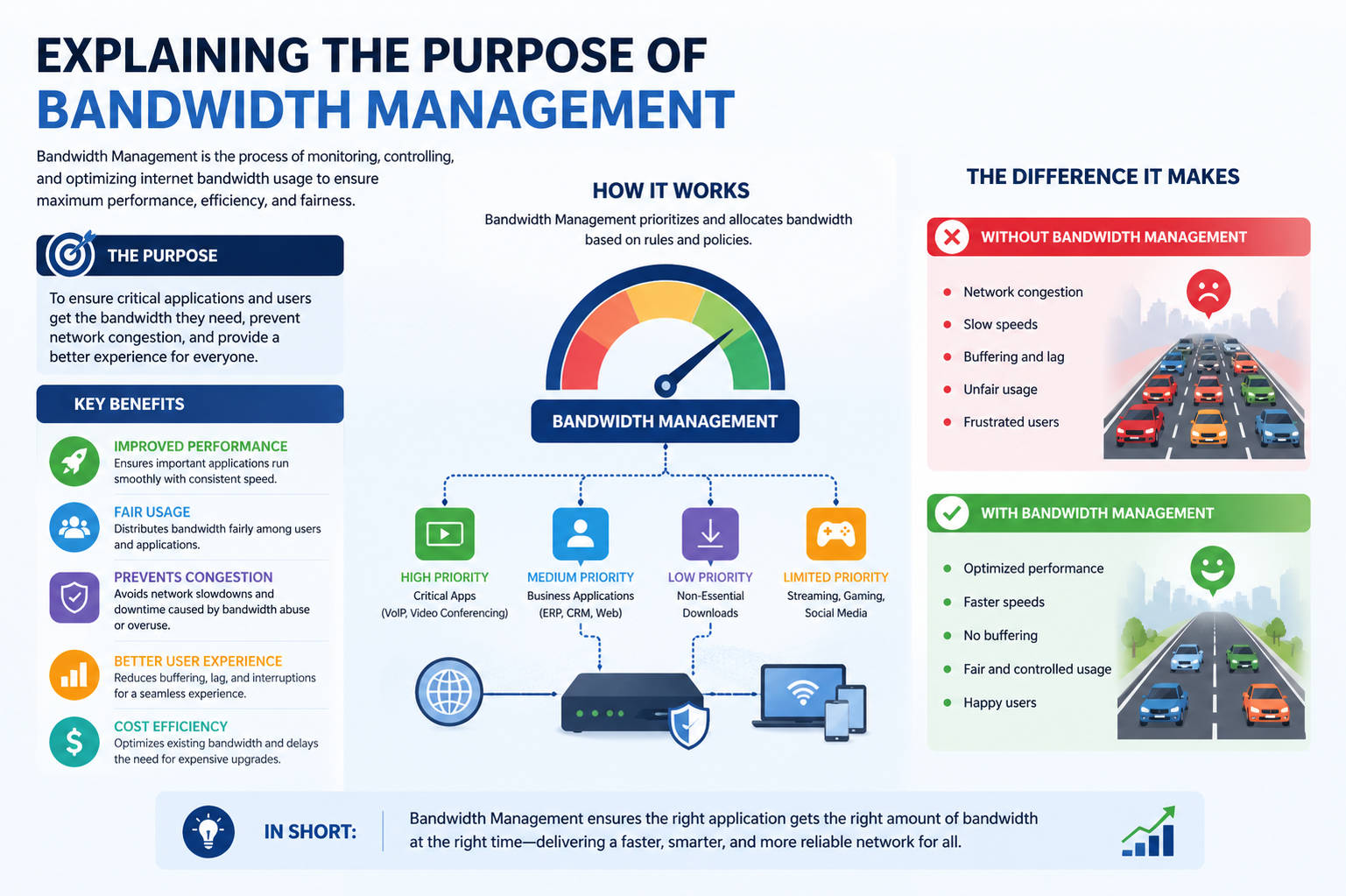
Bandwidth management is a fundamental aspect of modern networking that focuses on controlling the flow of data across communication systems. As digital usage continues to grow rapidly, the demand for stable, fast, and efficient internet connectivity has increased significantly. Bandwidth management ensures that this demand is handled in an organized manner so that networks remain functional, responsive, and fair for all users.
Importance in Modern Digital Environments
In today’s interconnected world, almost every activity depends on internet connectivity. From business operations and education to entertainment and communication, data transmission plays a central role. Without proper bandwidth management, networks can become overloaded, resulting in slow speeds, delays, and service interruptions. This makes bandwidth management essential for maintaining stability and ensuring that digital services operate smoothly under varying levels of demand.
How Bandwidth Management Works
Bandwidth management works by monitoring data traffic and applying rules to control how bandwidth is distributed. It analyzes the type of traffic, the amount of data being used, and the priority of different applications. Based on this analysis, it allocates resources in a way that balances performance and prevents any single application or user from consuming too much bandwidth. This structured approach helps maintain consistent network behavior even during peak usage periods.
Traffic Prioritization in Networks
One of the key elements of bandwidth management is traffic prioritization. Not all data is equally important. For example, real-time applications such as video calls and online meetings require immediate and uninterrupted data flow, while file downloads or background updates can tolerate delays. Bandwidth management identifies these differences and prioritizes traffic accordingly. This ensures that critical services remain stable even when the network is heavily loaded.
Preventing Network Overload
Network overload occurs when the demand for bandwidth exceeds the available capacity. This often leads to congestion, packet loss, and reduced performance. Bandwidth management helps prevent such situations by controlling how much data is allowed to pass through the network at any given time. By setting limits and distributing resources efficiently, it ensures that the network remains stable even under heavy demand.
Enhancing Efficiency of Data Transmission
Efficiency is a key objective of bandwidth management. When data flows are properly regulated, the network can operate more smoothly and deliver information faster. Efficient bandwidth usage reduces unnecessary strain on network infrastructure and allows more users to access services simultaneously without degradation in performance. This efficiency is especially important in environments with limited or shared bandwidth resources.
Role in Organizational Networks
In organizational settings, bandwidth management is particularly important. Companies often rely on multiple applications and services running simultaneously, such as cloud platforms, communication tools, and internal systems. Without proper management, certain departments or applications could consume excessive bandwidth, affecting overall productivity. By implementing structured control, organizations can ensure balanced usage across all departments and maintain operational efficiency.
Supporting Real-Time Applications
Real-time applications require continuous and uninterrupted data flow to function properly. Examples include voice communication, video conferencing, and live streaming services. Bandwidth management supports these applications by allocating them higher priority and ensuring they receive sufficient resources. This minimizes latency and prevents disruptions, which is essential for maintaining clear communication and smooth interaction.
Managing Peak Usage Periods
Network usage is not always constant. There are times when demand is significantly higher, such as during business hours or large online events. During these peak periods, bandwidth management becomes even more important. It helps distribute available resources intelligently so that performance does not degrade drastically. By controlling traffic flow, it ensures that all users experience acceptable levels of connectivity even during high demand.
Reducing Latency and Delay
Latency refers to the time it takes for data to travel from one point to another. High latency can result in slow responses and poor user experience. Bandwidth management reduces latency by optimizing traffic flow and preventing congestion. When data is transmitted efficiently, communication becomes faster and more responsive, improving overall network performance.
Improving Fair Access for Users
In shared networks, fairness is a major concern. Without proper control, some users may consume more bandwidth than others, leading to unequal access. Bandwidth management ensures that resources are distributed fairly among all users. This prevents abuse of network capacity and ensures that everyone has access to a stable and usable connection.
Controlling Unnecessary Traffic
Not all network traffic is essential. Background applications, automatic updates, and non-critical services can consume significant bandwidth without directly contributing to user productivity. Bandwidth management helps identify and control such unnecessary traffic. By limiting or scheduling non-essential data transfers, it ensures that important tasks receive priority.
Impact on Streaming and Media Services
Streaming services are highly dependent on consistent bandwidth. Buffering, interruptions, and quality drops often occur when bandwidth is not properly managed. Effective bandwidth control helps maintain stable streaming quality by ensuring that sufficient resources are allocated to media transmission. This results in smoother playback and a better viewing experience.
Supporting Cloud-Based Systems
Cloud computing has become a core part of modern technology infrastructure. These systems rely heavily on continuous data exchange between users and remote servers. Bandwidth management ensures that cloud services remain responsive and reliable by regulating traffic and preventing congestion. This is crucial for maintaining productivity and accessibility in cloud-based environments.
Security and Bandwidth Control
Bandwidth management also contributes indirectly to network security. Unusual spikes in data usage can sometimes indicate malicious activity or unauthorized access. By monitoring and controlling bandwidth usage, network administrators can detect abnormal patterns and take appropriate action. This helps protect the integrity of the network and reduces the risk of disruptions caused by security threats.
Optimizing Resource Allocation
Efficient resource allocation is at the core of bandwidth management. Networks have limited capacity, and this capacity must be distributed wisely. By analyzing usage patterns and adjusting allocation dynamically, bandwidth management ensures that resources are used where they are needed most. This prevents wastage and improves overall system performance.
Reducing Operational Costs
Poor bandwidth utilization can lead to unnecessary infrastructure costs, as organizations may need to upgrade systems frequently to handle inefficiencies. Bandwidth management helps reduce these costs by optimizing existing resources. When networks operate efficiently, the need for frequent upgrades or expansions is minimized, leading to better cost control.
Enhancing Quality of Service
Quality of Service refers to the overall performance and reliability of a network. Bandwidth management plays a major role in maintaining high quality of service by ensuring that important applications receive consistent support. This leads to fewer disruptions, better performance, and improved user satisfaction across all types of network usage.
Adaptability to Changing Network Demands
Modern networks are dynamic, with usage patterns constantly changing. Bandwidth management systems are designed to adapt to these changes in real time. They continuously monitor traffic and adjust allocation strategies based on current conditions. This adaptability ensures that the network remains efficient regardless of fluctuations in demand.
Long-Term Network Stability
Sustained network performance requires more than just short-term fixes. Bandwidth management contributes to long-term stability by preventing overuse, balancing load, and reducing strain on infrastructure. Over time, this leads to more reliable systems that can handle increasing demands without frequent failures or performance drops.
Advanced Techniques Used in Bandwidth Management
Bandwidth management is not a single fixed process; it uses several advanced techniques to control, monitor, and optimize network traffic. These techniques are designed to handle different types of data usage patterns and ensure that the network remains stable under all conditions. Modern systems rely on intelligent methods that adjust automatically based on real-time traffic behavior.
Traffic Shaping for Controlled Data Flow
Traffic shaping is a technique used to regulate the flow of data packets entering or leaving a network. It smooths out bursts of traffic by delaying or queuing packets when necessary. This prevents sudden spikes in data usage from overwhelming the system. By controlling the rate at which data is transmitted, traffic shaping helps maintain consistent performance and avoids congestion.
Bandwidth Throttling for Usage Control
Bandwidth throttling involves intentionally limiting the speed or volume of data that a user or application can consume. This technique is often used to ensure that no single user or service dominates the network. It is particularly useful in shared environments where fairness and equal access are important. Throttling helps maintain balance by preventing excessive consumption of network resources.
Quality of Service Mechanisms
Quality of Service mechanisms are essential for prioritizing different types of network traffic. They allow administrators to assign priority levels to applications based on their importance. For example, real-time communication services are given higher priority than background downloads. This ensures that critical tasks receive sufficient bandwidth even when the network is heavily loaded.
Packet Scheduling Techniques
Packet scheduling determines the order in which data packets are transmitted over the network. Different scheduling algorithms are used to manage traffic efficiently. These methods ensure that high-priority data is delivered quickly while still allowing lower-priority traffic to pass through when resources are available. This balanced approach improves overall network performance.
Load Balancing in Network Systems
Load balancing distributes network traffic evenly across multiple servers or pathways. This prevents any single point from becoming overloaded. By spreading data requests across different resources, load balancing improves reliability and reduces the risk of system failure. It also enhances speed and responsiveness for users.
Dynamic Bandwidth Allocation
Dynamic bandwidth allocation allows networks to adjust resource distribution in real time based on current demand. Instead of fixed limits, bandwidth is assigned flexibly depending on usage patterns. This ensures that unused bandwidth is not wasted and can be redirected to areas where it is needed most. It improves efficiency and adaptability.
Monitoring and Traffic Analysis
Continuous monitoring is a critical part of bandwidth management. Network systems analyze traffic patterns to understand how bandwidth is being used. This includes identifying peak usage times, heavy users, and application behavior. The collected data helps in making informed decisions about optimization and control strategies.
Role of Bandwidth Policies
Bandwidth policies are predefined rules that guide how network resources are used. These policies define limits, priorities, and restrictions for different users or applications. By enforcing structured rules, organizations can maintain control over their network and ensure consistent performance. Policies also help in preventing misuse of resources.
Congestion Avoidance Strategies
Congestion occurs when network demand exceeds available capacity. To avoid this, bandwidth management uses strategies such as early packet dropping, rate limiting, and traffic prioritization. These methods reduce pressure on the network before it becomes overloaded. Preventing congestion helps maintain smooth data flow and reduces delays.
Bandwidth Reservation Techniques
Bandwidth reservation involves setting aside a specific amount of bandwidth for critical applications. This ensures that essential services always have guaranteed access to network resources. It is commonly used in systems where reliability and real-time performance are crucial. Reserved bandwidth prevents interference from less important traffic.
Impact on Business Productivity
Effective bandwidth management has a direct impact on business productivity. When networks operate efficiently, employees can access tools, communicate, and share data without interruption. This improves workflow and reduces downtime. A well-managed network environment supports better decision-making and operational efficiency.
Improving User Satisfaction
User satisfaction is closely linked to network performance. Slow or unstable connections often lead to frustration and reduced productivity. Bandwidth management enhances user experience by providing stable and predictable performance. When users experience fewer disruptions, overall satisfaction increases significantly.
Handling Multiple Devices and Users
Modern networks support a large number of devices, including computers, smartphones, and IoT systems. Bandwidth management ensures that all these devices can operate simultaneously without causing network instability. It allocates resources efficiently so that multiple users can share the same infrastructure without conflict.
Adapting to Cloud and Remote Work Trends
With the rise of cloud computing and remote work, network demands have changed significantly. Bandwidth management has evolved to support these trends by prioritizing cloud applications and remote connectivity tools. This ensures that users working from different locations can still access systems reliably and efficiently.
Reducing Packet Loss in Networks
Packet loss occurs when data packets fail to reach their destination due to congestion or errors. Bandwidth management reduces packet loss by controlling traffic flow and preventing overload conditions. Stable transmission improves communication quality and ensures that data integrity is maintained.
Enhancing Video and Audio Communication
Video and audio communication require stable and continuous data streams. Bandwidth management ensures that these streams are not interrupted by other network activities. By prioritizing real-time media traffic, it improves clarity, reduces lag, and enhances overall communication quality.
Supporting Educational and Learning Platforms
Digital education platforms rely heavily on consistent internet connectivity. Bandwidth management ensures that students and educators can access learning materials, attend live sessions, and submit assignments without disruption. It plays a key role in enabling smooth online learning experiences.
Efficient Use of Network Infrastructure
Network infrastructure is expensive and limited in capacity. Bandwidth management ensures that this infrastructure is used efficiently without unnecessary expansion. By optimizing current resources, it extends the lifespan and effectiveness of existing systems while reducing operational strain.
Long-Term Scalability of Networks
As organizations grow, their network requirements also increase. Bandwidth management supports scalability by allowing systems to adapt to higher demands without major redesigns. This ensures that networks can expand smoothly while maintaining performance and reliability.
Reducing Downtime and Failures
Network downtime can have serious consequences, especially in business environments. Bandwidth management reduces the risk of failures by preventing overload and maintaining balanced traffic flow. This leads to more stable systems with fewer interruptions.
Bandwidth Management in Modern Technologies
Bandwidth management has become even more important with the rapid advancement of modern technologies. As digital systems evolve, networks are required to support more complex applications, larger data volumes, and a growing number of connected devices. This has made intelligent bandwidth control a necessity rather than an option.
Role in Cloud Computing Systems
Cloud computing depends heavily on stable and efficient data transmission between users and remote servers. Bandwidth management ensures that cloud services remain responsive by controlling traffic flow and prioritizing essential operations. It helps prevent delays when multiple users access cloud resources simultaneously, making cloud platforms more reliable and efficient.
Impact on Remote Work Environments
Remote work has significantly increased the demand for stable internet connections. Employees working from different locations rely on video conferencing, file sharing, and cloud-based tools. Bandwidth management ensures that these applications receive sufficient resources, reducing interruptions and maintaining productivity in distributed work environments.
Supporting Internet of Things Devices
The Internet of Things connects multiple smart devices that continuously exchange data. These devices generate a constant stream of network traffic that must be managed effectively. Bandwidth management helps distribute resources among IoT devices, ensuring smooth communication without overwhelming the network infrastructure.
Optimization in Data Centers
Data centers handle massive amounts of information and require highly efficient bandwidth usage. Bandwidth management in data centers ensures that servers communicate effectively without congestion. It improves processing speed, reduces delays, and supports large-scale data operations with minimal disruption.
Artificial Intelligence in Bandwidth Control
Modern bandwidth management systems increasingly use artificial intelligence to improve decision-making. AI can analyze traffic patterns, predict congestion, and automatically adjust bandwidth allocation. This makes networks more adaptive and capable of responding to changing conditions in real time without manual intervention.
Machine Learning for Traffic Prediction
Machine learning plays a key role in predicting network behavior. By studying past usage patterns, it can forecast peak traffic periods and adjust bandwidth distribution accordingly. This proactive approach helps prevent congestion before it occurs, improving overall network stability and performance.
Automation in Network Management
Automation reduces the need for constant manual monitoring of networks. Automated bandwidth management systems can detect issues, apply rules, and adjust settings instantly. This improves efficiency and ensures that networks operate smoothly even in complex environments with high data traffic.
Security Enhancement Through Bandwidth Control
Bandwidth management also contributes to network security by identifying unusual traffic patterns. Sudden spikes in data usage may indicate malicious activity such as cyberattacks or unauthorized access. By monitoring bandwidth behavior, systems can detect threats early and take preventive action to protect the network.
Preventing Denial of Service Attacks
Denial of Service attacks overload networks by flooding them with excessive traffic. Bandwidth management helps mitigate these attacks by limiting traffic flow and filtering suspicious data. This ensures that legitimate users can still access services even during attempted disruptions.
Improving Mobile Network Performance
Mobile networks face constant fluctuations in usage due to varying user density and movement. Bandwidth management helps mobile operators allocate resources dynamically, ensuring stable connectivity even in crowded areas. It enhances call quality, data speed, and overall mobile user experience.
Enhancing Video Streaming Platforms
Video streaming requires high and consistent bandwidth to deliver smooth playback. Bandwidth management ensures that streaming platforms can adjust video quality based on available network capacity. This prevents buffering and ensures uninterrupted viewing experiences for users.
Supporting Online Gaming Performance
Online gaming depends on low latency and stable connections. Bandwidth management prioritizes gaming traffic to reduce delays and packet loss. This improves responsiveness and ensures a smoother gaming experience, especially in competitive environments where speed is critical.
Efficient Use of Satellite Networks
Satellite communication systems often have limited bandwidth compared to terrestrial networks. Bandwidth management is essential in these systems to ensure efficient use of available resources. It helps prioritize critical communication and reduces unnecessary data transmission.
Environmental Impact of Efficient Networks
Efficient bandwidth usage can also contribute to reducing energy consumption in network infrastructure. When systems operate efficiently, they require less processing power and cooling, which indirectly reduces environmental impact. Optimized networks support more sustainable digital operations.
Bandwidth Management in Educational Institutions
Schools and universities rely heavily on digital learning platforms. Bandwidth management ensures that students and teachers can access online resources without interruption. It supports virtual classrooms, online exams, and collaborative learning tools effectively.
Improving Healthcare Systems
In healthcare, reliable communication networks are essential for telemedicine, patient monitoring, and data sharing. Bandwidth management ensures that critical medical data is transmitted without delay, supporting better patient care and faster decision-making.
Role in Financial Systems
Financial institutions require highly secure and fast data transmission for transactions and trading activities. Bandwidth management ensures that financial data is prioritized and transmitted without delays, reducing risks associated with latency and system overload.
Supporting Smart City Infrastructure
Smart cities rely on interconnected systems such as traffic control, surveillance, and public services. Bandwidth management ensures that these systems operate efficiently by distributing network resources among multiple services in real time.
Challenges in Bandwidth Management
Despite its advantages, bandwidth management faces challenges such as increasing data demand, evolving applications, and complex network environments. Managing these challenges requires continuous improvement in technology and adaptive strategies to keep up with growing requirements.
Future of Bandwidth Management
The future of bandwidth management is expected to be more intelligent and automated. With advancements in artificial intelligence, machine learning, and real-time analytics, networks will become more self-regulating. This will lead to faster, more efficient, and highly adaptive communication systems.
Challenges Faced in Bandwidth Management
Bandwidth management is essential for maintaining smooth network performance, but it also comes with several challenges. One of the major difficulties is the constantly increasing demand for data. As more users, devices, and applications connect to networks, the pressure on available bandwidth continues to grow. This makes it harder to maintain consistent performance without advanced optimization techniques.
Rapid Growth of Data Consumption
Modern digital activities such as video streaming, cloud computing, and online gaming consume large amounts of bandwidth. The rapid growth of these services often exceeds the capacity of existing infrastructure. Managing this growing demand requires continuous upgrades and smarter allocation strategies to avoid performance degradation.
Complexity of Network Environments
Today’s networks are highly complex, involving multiple devices, platforms, and communication protocols. Managing bandwidth across such diverse environments is challenging because each application has different requirements. Ensuring smooth coordination between these systems requires advanced monitoring and intelligent control mechanisms.
Balancing Performance and Fairness
One of the key challenges in bandwidth management is balancing performance with fairness. While some applications require high priority and more bandwidth, others must still receive adequate resources. Finding the right balance between efficiency and equal access is not always easy, especially in large shared networks.
Handling Unpredictable Traffic Patterns
Network traffic is not always stable or predictable. Sudden spikes in usage can occur due to events, updates, or user behavior changes. These fluctuations make it difficult to maintain consistent performance. Bandwidth management systems must be flexible enough to respond quickly to these unexpected changes.
Limitations of Infrastructure
Many networks operate on fixed physical infrastructure with limited capacity. Expanding this infrastructure can be costly and time-consuming. As a result, bandwidth management must work within existing limitations, making optimization a critical requirement for maintaining performance.
Security Risks and Misuse of Bandwidth
Bandwidth can sometimes be misused intentionally or unintentionally. Malicious activities such as cyberattacks or unauthorized data transfers can consume large amounts of network resources. This creates additional challenges for bandwidth management systems, which must detect and control such activities while maintaining normal operations.
Difficulty in Real-Time Decision Making
Effective bandwidth management often requires real-time decision-making. However, analyzing large volumes of traffic data instantly and adjusting allocations accordingly is a complex task. Delays in decision-making can lead to congestion, reduced performance, and poor user experience.
Compatibility with Emerging Technologies
New technologies such as artificial intelligence, Internet of Things, and edge computing introduce new requirements for bandwidth usage. Integrating bandwidth management systems with these technologies can be challenging because they often have unique and dynamic data needs.
Cost Constraints in Network Expansion
Improving bandwidth capacity often requires significant investment in infrastructure. Organizations may face financial limitations that prevent them from expanding their networks. As a result, they must rely heavily on efficient bandwidth management to maximize the use of existing resources.
Managing User Behavior
User behavior plays a major role in network performance. Activities such as excessive streaming, large downloads, or misuse of resources can negatively impact overall bandwidth availability. Managing these behaviors without restricting productivity is a delicate task for network administrators.
Latency Sensitivity in Applications
Some applications are extremely sensitive to delays, such as video conferencing and online gaming. Even small variations in latency can affect performance. Ensuring low latency for these applications while managing other traffic types adds complexity to bandwidth control strategies.
Scalability Challenges
As organizations grow, their network requirements increase. Scaling bandwidth management systems to handle larger and more complex environments can be challenging. Without proper planning, networks may struggle to maintain performance under increased load.
Evolving Cyber Threats
Cyber threats are constantly evolving, making it difficult for bandwidth management systems to stay ahead. Attackers may use sophisticated methods to bypass controls or overload networks. Continuous updates and adaptive security measures are necessary to address these risks.
Integration with Legacy Systems
Many organizations still rely on older systems that may not support modern bandwidth management techniques. Integrating new solutions with legacy infrastructure can be difficult and may require additional customization or upgrades.
Energy Consumption Concerns
Managing large-scale networks requires significant energy usage. As bandwidth management systems become more advanced, they also require more processing power. Balancing performance optimization with energy efficiency is an ongoing challenge.
User Privacy Considerations
Monitoring network traffic for bandwidth management purposes may raise privacy concerns. Ensuring that data is analyzed responsibly without violating user privacy is an important consideration in modern network systems.
Future Adaptation Challenges
As technology continues to evolve, bandwidth management systems must adapt to new requirements. Keeping up with emerging trends such as 5G, cloud-native applications, and AI-driven networks requires continuous innovation and improvement.
Future Trends in Bandwidth Management
Bandwidth management is continuously evolving to meet the demands of increasingly complex digital ecosystems. In the future, it is expected to become more intelligent, automated, and adaptive, driven by rapid advancements in networking technologies and computing systems.
Artificial Intelligence-Driven Networks
Artificial intelligence is expected to play a major role in future bandwidth management systems. AI will allow networks to analyze traffic patterns in real time, predict congestion, and automatically adjust bandwidth allocation. This reduces the need for manual intervention and improves overall efficiency, making networks more responsive and self-managing.
Greater Use of Machine Learning Algorithms
Machine learning will further enhance bandwidth optimization by learning from historical data. These algorithms can identify usage trends, detect anomalies, and forecast future demand. Over time, this enables more accurate and efficient distribution of network resources, ensuring better performance during peak and off-peak periods.
Expansion of 5G and Beyond Networks
The introduction and expansion of 5G technology will significantly impact bandwidth management. With faster speeds and lower latency, 5G networks will support more devices and applications simultaneously. Bandwidth management systems will need to become more advanced to handle this increased complexity and ensure stable connectivity.
Growth of Edge Computing
Edge computing brings data processing closer to the source of data generation. This reduces the load on central servers and improves response times. Bandwidth management in edge environments will focus on distributing traffic efficiently between local and centralized systems, ensuring smooth and fast data processing.
Increased Automation in Network Control
Future networks will rely heavily on automation to manage bandwidth dynamically. Automated systems will be able to detect network conditions, apply rules, and optimize performance without human input. This will reduce errors, improve efficiency, and allow networks to adapt instantly to changing demands.
Integration with Smart Technologies
As smart homes, smart cities, and intelligent transportation systems continue to grow, bandwidth management will play a crucial role in supporting these technologies. It will ensure that interconnected devices communicate efficiently without overwhelming the network infrastructure.
Enhanced Security Features
Future bandwidth management systems will include stronger security mechanisms to protect against evolving cyber threats. These systems will be able to identify suspicious activity more accurately and respond faster to potential attacks, ensuring safer and more reliable networks.
Improved User-Centric Control
Users will likely gain more control over how their bandwidth is used. Future systems may allow individuals and organizations to set personalized priorities, manage consumption more effectively, and optimize their own network experience based on specific needs.
Sustainability in Network Operations
Energy efficiency will become an important focus in future bandwidth management. Optimized data flow and intelligent resource allocation will help reduce unnecessary energy consumption, contributing to more environmentally sustainable network operations.
Real-World Importance of Bandwidth Management
Bandwidth management is not just a technical concept; it has real and direct importance in everyday digital life. Almost every online activity depends on how well bandwidth is controlled and distributed. Without proper management, even the most advanced networks can become slow, unstable, and unreliable.
Role in Everyday Internet Usage
For regular users, bandwidth management determines how smoothly they can browse the internet, stream videos, or use social media. When bandwidth is properly managed, web pages load faster, videos play without buffering, and online applications respond instantly. This creates a more seamless and enjoyable digital experience.
Importance in Business Communication
In business environments, communication tools such as video conferencing, emails, and cloud platforms rely heavily on stable bandwidth. Proper management ensures that meetings do not freeze, files are shared without delay, and communication remains consistent. This directly improves teamwork and productivity in organizations.
Impact on Entertainment Services
Entertainment platforms such as streaming services, online gaming, and digital media rely on continuous data flow. Bandwidth management ensures that users experience high-quality streaming without interruptions. It also helps maintain smooth gameplay by reducing lag and improving responsiveness in online gaming environments.
Support for E-Commerce Platforms
Online shopping platforms depend on fast and reliable networks to process transactions, display product information, and handle customer interactions. Bandwidth management ensures that these systems remain responsive even during high traffic periods such as sales or promotions, preventing crashes and slowdowns.
Contribution to Digital Education
In education, bandwidth management plays a vital role in supporting online learning platforms. Students attending virtual classes or accessing digital resources need stable connectivity. Proper bandwidth control ensures that lessons run smoothly, videos load properly, and learning is not disrupted by technical issues.
Role in Government and Public Services
Many government services are now available online, including registrations, payments, and public information systems. Bandwidth management helps ensure that these services remain accessible and efficient, especially during high-demand periods when many users access them simultaneously.
Support for Emergency Services
Emergency communication systems require highly reliable and prioritized bandwidth. In critical situations, such as natural disasters or emergencies, bandwidth management ensures that essential communication channels remain active and responsive, helping save time and lives.
Improving Digital Infrastructure Stability
Bandwidth management contributes to the overall stability of digital infrastructure. By preventing congestion and balancing traffic loads, it reduces the chances of system failures and outages. This ensures that networks remain functional even under heavy usage conditions.
Enhancing Global Connectivity
As the world becomes more connected, bandwidth management plays a key role in supporting global communication. It ensures that data can travel efficiently across different regions, enabling smooth international communication, collaboration, and information exchange.
Supporting Future Innovations
Emerging technologies such as virtual reality, augmented reality, and autonomous systems will require extremely stable and high-speed networks. Bandwidth management will be essential in supporting these innovations by ensuring that data is delivered quickly and reliably.
Conclusion
Bandwidth management is a critical component of modern and future networking systems. It ensures that data flows efficiently, resources are used fairly, and networks remain stable under increasing demand. Across all its functions—whether it is traffic control, prioritization, or optimization—it plays a vital role in maintaining smooth digital communication.
As technology continues to advance, bandwidth management will become even more intelligent and adaptive. With the integration of artificial intelligence, machine learning, automation, and next-generation networks, it will evolve into a highly dynamic system capable of self-regulation and real-time optimization.
Despite its challenges, bandwidth management remains essential for supporting modern digital life. From cloud computing and remote work to smart cities and advanced communication systems, it forms the backbone of reliable connectivity. Its future development will continue to shape how efficiently and effectively global networks operate, making it one of the most important areas in the field of networking.