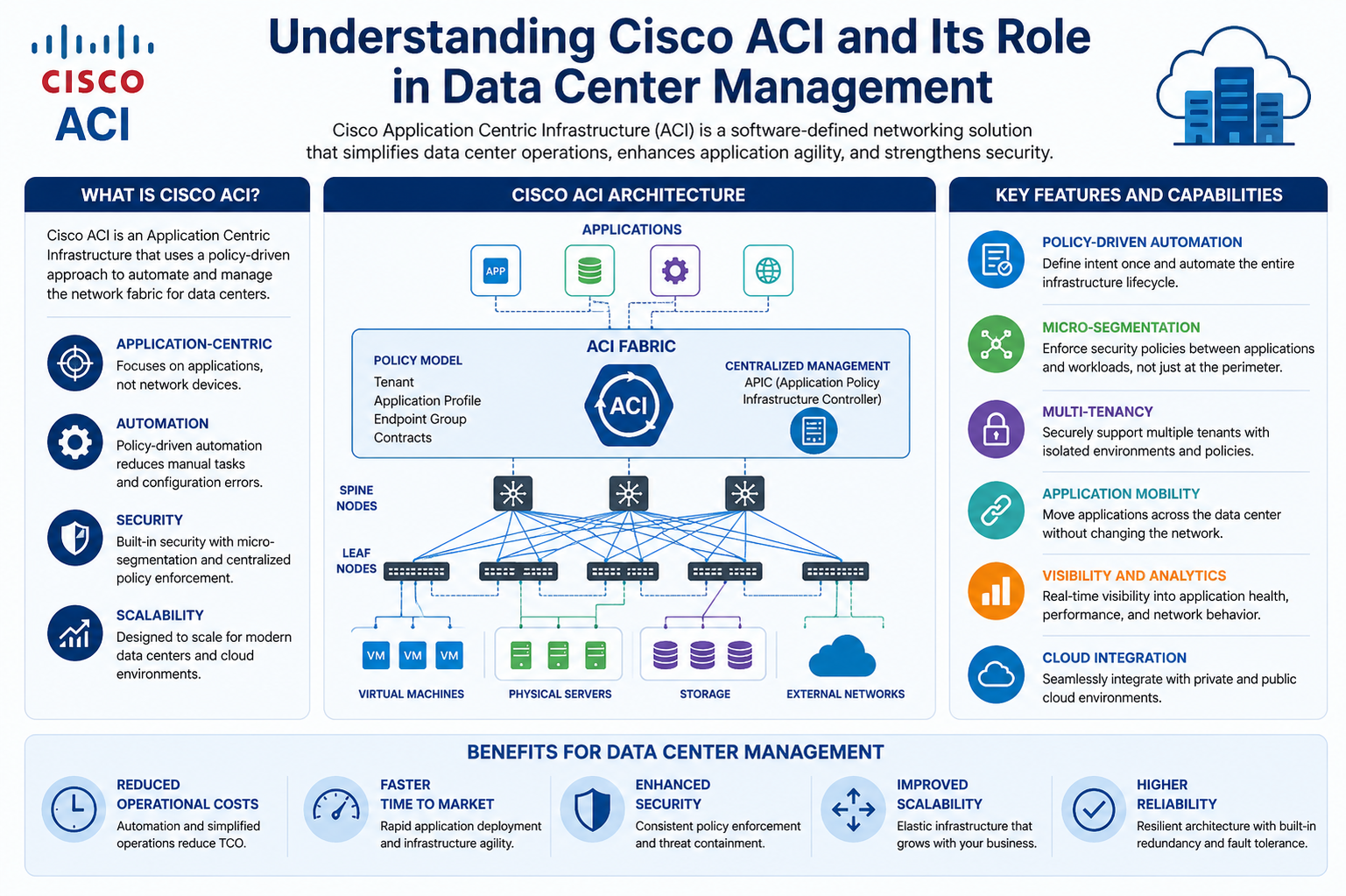
Cisco Application Centric Infrastructure is built on a fundamentally different design philosophy compared to traditional network architectures. Instead of relying on device-by-device configuration, it introduces a holistic, integrated system where the entire data center fabric operates as a single intelligent entity. This architecture is designed to support high performance, scalability, and automation while reducing operational complexity. At its core, Cisco ACI combines hardware, software, and policy-based control into a unified framework that aligns network behavior directly with application requirements.
The architecture is centered around a fabric model that connects all network resources through a structured and highly efficient design. This allows seamless communication between workloads, whether they are hosted on physical servers, virtual machines, or containerized environments. The infrastructure is engineered to ensure low latency, high throughput, and predictable performance across the entire data center.
Leaf-Spine Fabric Design
A key component of Cisco ACI is the leaf-spine architecture, which replaces traditional three-tier network designs. In this model, leaf switches act as the primary connection points for servers, storage systems, and edge devices, while spine switches function as the high-speed backbone that interconnects all leaf nodes. Every leaf switch connects to every spine switch, ensuring consistent latency and eliminating bottlenecks caused by hierarchical routing.
This design provides equal-cost multi-path forwarding, allowing traffic to flow efficiently across the network without reliance on complex routing hierarchies. The result is a flat, non-blocking architecture that is highly scalable and resilient. As additional capacity is required, administrators can simply add more leaf or spine switches without redesigning the entire network structure.
The leaf-spine design also simplifies troubleshooting and performance optimization. Since every connection follows a predictable path with uniform latency, identifying network issues becomes significantly easier compared to traditional architectures.
APIC Role in Cisco ACI
The Application Policy Infrastructure Controller (APIC) serves as the central management and control point for Cisco ACI. It is responsible for defining, managing, and enforcing policies across the entire fabric. Rather than configuring individual network devices, administrators interact with the APIC to define application requirements, which are then automatically translated into network configurations.
The APIC maintains a real-time view of the entire infrastructure, including network topology, endpoint locations, and policy relationships. It acts as the intelligence layer that drives automation and ensures consistency across the environment. Through its centralized control, it eliminates configuration drift and reduces the risk of human error.
In addition to policy management, the APIC also provides monitoring, analytics, and operational insights. It enables administrators to visualize application flows, identify performance issues, and optimize resource utilization across the data center.
Policy Model: The Foundation of ACI
Cisco ACI is fundamentally driven by a policy-based operational model. Instead of configuring network devices individually, administrators define what the application needs in terms of connectivity, security, and performance. These requirements are expressed as policies that the system automatically enforces.
This model shifts the focus from infrastructure-centric management to application-centric management. Applications become the primary drivers of network behavior, ensuring that IT infrastructure aligns closely with business objectives. Policies are consistent, reusable, and scalable, making it easier to manage large and complex environments.
The policy model also ensures that changes can be implemented quickly and safely. When application requirements evolve, administrators simply update the relevant policies, and the system automatically adjusts the underlying network configuration.
Endpoint Groups and Segmentation
Endpoint Groups (EPGs) are a fundamental building block in Cisco ACI. An EPG represents a collection of endpoints that share similar networking and policy requirements. These endpoints can include virtual machines, physical servers, or containers that perform similar functions within an application.
EPGs simplify segmentation by grouping workloads based on their role rather than their physical location. This abstraction allows policies to be applied consistently regardless of where the workload resides in the data center.
Segmentation through EPGs enhances both security and operational efficiency. By logically separating workloads, organizations can enforce strict communication rules while maintaining flexibility in workload placement. This approach supports modern application architectures, including microservices and distributed systems.
Contracts and Communication Control
Communication between Endpoint Groups is governed by contracts. A contract defines what type of traffic is allowed between EPGs, including protocols, ports, and directions of communication. This creates a highly controlled and secure environment where only explicitly permitted traffic is allowed.
Contracts act as policy enforcers that define interaction rules between different application components. For example, a web tier may be allowed to communicate with an application tier, but not directly with a database tier unless explicitly permitted. This ensures strict adherence to security and compliance requirements.
The use of contracts also simplifies firewall and access control management. Instead of configuring multiple distributed security rules, administrators define centralized policies that are automatically applied across the infrastructure.
Overlay Network and VXLAN
Cisco ACI uses overlay networking technology to provide flexibility and scalability across the data center. One of the key technologies used is VXLAN, which enables the creation of logical networks on top of the physical infrastructure.
Overlay networks allow multiple isolated network segments to coexist on the same physical infrastructure. This is particularly useful in multi-tenant environments where different applications or departments require separation without dedicated hardware.
By decoupling logical networks from physical topology, Cisco ACI enables workload mobility and seamless scaling. Applications can move across different physical servers or data center locations without requiring network reconfiguration.
Integration with Virtualization Platforms
Cisco ACI is designed to integrate seamlessly with virtualization technologies. It supports environments where workloads are hosted on virtual machines, containers, or hybrid infrastructures. This integration allows network policies to follow workloads dynamically as they move across different compute environments.
Through tight integration with virtualization platforms, ACI ensures that network configuration is automatically aligned with virtual machine lifecycle events. When a virtual machine is created, moved, or deleted, corresponding network policies are automatically applied or removed.
This level of integration reduces administrative overhead and ensures consistent policy enforcement across both physical and virtual infrastructure.
Service Graphs and L4-L7 Integration
Cisco ACI extends its capabilities beyond basic connectivity by supporting advanced service insertion through service graphs. Service graphs define how network services such as firewalls, load balancers, and intrusion detection systems are inserted into application traffic flows.
This allows organizations to design complex service chains that ensure traffic passes through necessary security and optimization devices before reaching its destination. These services can be dynamically applied based on application requirements.
Service graph integration enables a more flexible and scalable approach to managing network services. Instead of manually configuring service paths, administrators define policies that automatically orchestrate service insertion.
Automation and Orchestration
Automation is a core principle of Cisco ACI. The platform significantly reduces manual configuration tasks by automating provisioning, policy enforcement, and network adjustments. This automation is driven by the APIC controller and policy-based framework.
Orchestration capabilities allow Cisco ACI to integrate with external automation tools and workflows. This enables seamless coordination between network infrastructure and application deployment pipelines.
By reducing manual intervention, automation improves operational efficiency and reduces the likelihood of configuration errors. It also accelerates deployment times for new applications and services.
Security Model in Cisco ACI
Security in Cisco ACI is implemented through a combination of segmentation, contracts, and policy enforcement. The architecture supports micro-segmentation, which allows security policies to be applied at a very granular level, even down to individual workloads.
This approach reduces the attack surface within the data center by restricting lateral movement between applications. Only explicitly allowed communication paths are permitted, ensuring strict control over data flows.
Security policies are centrally managed and consistently enforced across the entire infrastructure. This eliminates inconsistencies that often arise in traditional distributed security models.
Operational Monitoring and Telemetry
Cisco ACI provides comprehensive visibility into network operations through advanced monitoring and telemetry capabilities. The system continuously collects data on traffic flows, application performance, and infrastructure health.
This real-time visibility allows administrators to quickly identify performance bottlenecks, troubleshoot issues, and optimize resource usage. The centralized view of the entire fabric simplifies operational management.
Telemetry data is also used to provide insights into application behavior, enabling better capacity planning and performance optimization.
Scalability in Enterprise Data Centers
Scalability is one of the strongest advantages of Cisco ACI. The architecture is designed to grow seamlessly as demand increases, without requiring major redesigns or disruptions.
New devices can be added to the fabric with minimal configuration, and they are automatically integrated into the existing policy framework. This allows organizations to scale both horizontally and vertically with ease.
The leaf-spine architecture further enhances scalability by providing a predictable and uniform network structure that can expand without performance degradation.
Multi-Site and Hybrid Cloud Capabilities
Cisco ACI supports multi-site deployments, enabling organizations to connect multiple data centers under a unified policy framework. This ensures consistent application behavior and security policies across geographically distributed environments.
It also extends into hybrid cloud environments, allowing integration between on-premises data centers and cloud infrastructure. This flexibility enables organizations to adopt cloud strategies while maintaining control over their core network policies.
Challenges and Considerations
While Cisco ACI offers significant advantages, it also introduces complexity in terms of initial deployment and learning curve. Organizations must invest in training and planning to fully leverage its capabilities.
Proper design of policies, EPGs, and contracts is essential to avoid operational inefficiencies. Additionally, integration with legacy systems may require careful planning to ensure smooth transitions.
Despite these challenges, the long-term benefits in terms of automation, scalability, and security often outweigh the initial complexity.
Deployment Models and Lifecycle Management
Cisco ACI supports multiple deployment models that allow organizations to tailor the infrastructure according to their operational needs and data center strategy. It can be deployed in greenfield environments where a completely new data center is designed around ACI principles, or it can be introduced into existing brownfield environments through phased migration approaches. This flexibility is important because most enterprises operate legacy systems that cannot be replaced instantly.
In a typical deployment lifecycle, the initial phase involves designing the fabric topology, including the selection of leaf and spine switches, followed by the setup of the APIC cluster. Once the physical foundation is in place, logical constructs such as tenants, application profiles, endpoint groups, and contracts are defined. These logical elements form the operational backbone of the environment and determine how applications interact within the network.
Lifecycle management in Cisco ACI is highly structured and policy-driven. Once policies are defined, the system automatically enforces them across the infrastructure, reducing the need for manual intervention during updates or expansions. This ensures that the environment remains consistent throughout its lifecycle, even as applications evolve or infrastructure scales.
Integration with Cloud and DevOps Ecosystems
Modern data centers are increasingly integrated with cloud platforms and DevOps workflows, and Cisco ACI is designed to operate seamlessly within these environments. It provides APIs and integration capabilities that allow it to connect with automation tools, container orchestration systems, and cloud management platforms.
In DevOps environments, infrastructure is often treated as code, and Cisco ACI aligns well with this philosophy. Policies can be defined, modified, and deployed programmatically, allowing infrastructure changes to be integrated directly into application deployment pipelines. This reduces delays between development and production environments and supports continuous delivery practices.
In hybrid cloud scenarios, ACI extends consistent networking policies across on-premises data centers and public cloud environments. This ensures that applications maintain consistent security and connectivity behavior regardless of where they are hosted. It simplifies workload mobility and supports cloud bursting strategies where workloads dynamically shift between environments based on demand.
Network Programmability and APIs
Cisco ACI is built with programmability at its core, offering a rich set of APIs that enable external systems to interact with the infrastructure. These APIs allow administrators and developers to automate configuration tasks, retrieve operational data, and integrate ACI with third-party tools.
The API-driven model supports full infrastructure automation, enabling organizations to eliminate repetitive manual processes. Network configurations, policy updates, and monitoring tasks can all be executed programmatically, which significantly improves operational efficiency.
This programmability also enables integration with orchestration platforms, where network provisioning is synchronized with application deployment. As a result, infrastructure becomes more dynamic and responsive to changing business requirements.
Operational Workflows and Management Efficiency
Cisco ACI introduces structured operational workflows that simplify day-to-day data center management. Instead of managing individual devices, administrators interact with logical constructs such as tenants, application profiles, and endpoint groups.
This abstraction reduces complexity and provides a more intuitive way of managing large-scale environments. Operational workflows are designed to ensure that changes are applied consistently and safely across the entire fabric.
Change management is also improved through policy validation and enforcement mechanisms. Before changes are applied, the system verifies compliance with existing policies, reducing the risk of misconfiguration or service disruption.
Performance Optimization in ACI Environments
Performance optimization in Cisco ACI is achieved through a combination of intelligent traffic engineering, high-speed fabric design, and real-time telemetry. The leaf-spine architecture ensures that latency remains consistent across the network, eliminating unpredictable performance variations.
Traffic flows are dynamically managed based on policy definitions, ensuring that critical applications receive the required bandwidth and priority. The system continuously monitors traffic patterns and adjusts forwarding behavior to optimize efficiency.
In addition, built-in analytics provide insights into application performance, allowing administrators to identify bottlenecks and optimize resource allocation. This proactive approach helps maintain high performance even under heavy workloads.
Troubleshooting and Diagnostic Capabilities
Cisco ACI includes advanced troubleshooting tools that simplify the process of identifying and resolving network issues. The centralized architecture allows administrators to trace application flows across the entire fabric, making it easier to pinpoint the root cause of problems.
Instead of manually inspecting multiple devices, administrators can use integrated tools that provide end-to-end visibility into traffic paths. This includes real-time flow analysis, fault detection, and policy verification.
The system also maintains a detailed operational history, which helps in diagnosing intermittent issues. By analyzing historical data, administrators can identify patterns and prevent recurring problems.
Use Cases in Enterprise Environments
In enterprise environments, Cisco ACI is widely used to support mission-critical applications that require high availability, security, and performance. It is particularly effective in environments with complex application dependencies and strict compliance requirements.
Large organizations use ACI to simplify data center operations, reduce manual configuration errors, and improve deployment speed for new applications. It also supports multi-tier application architectures commonly found in enterprise systems.
Financial institutions, healthcare organizations, and large-scale retail systems benefit from the strong security and segmentation capabilities provided by ACI, ensuring that sensitive data is protected and compliance standards are maintained.
Use Cases in Service Provider Networks
Service providers leverage Cisco ACI to build scalable and efficient infrastructure for hosting multiple customers and services. The multi-tenant architecture allows service providers to isolate customer environments while maintaining shared physical infrastructure.
This enables efficient resource utilization and simplifies service delivery. Providers can quickly provision new services, scale existing ones, and enforce consistent policies across customer environments.
The automation and programmability features also allow service providers to integrate ACI with their service orchestration platforms, enabling rapid service deployment and dynamic resource allocation.
Comparison with Traditional Networking Approaches
Traditional networking relies heavily on manual configuration of individual devices, which can be time-consuming and error-prone. In contrast, Cisco ACI introduces a centralized, policy-driven model that automates much of the configuration process.
While traditional architectures depend on static routing and segmented layers, ACI uses a dynamic fabric that adapts to application requirements. This eliminates many of the inefficiencies associated with legacy designs.
Another major difference is the focus on applications rather than infrastructure. Traditional networks are device-centric, whereas ACI is application-centric, aligning network behavior directly with business needs.
Best Practices for Implementation
Successful implementation of Cisco ACI requires careful planning and adherence to best practices. One important practice is to design a clear tenant and application structure before deployment, ensuring that policies are logically organized.
It is also important to define consistent naming conventions for endpoint groups and policies to simplify management and troubleshooting. Proper segmentation strategies should be established early to avoid complexity later.
Regular monitoring and validation of policies help ensure that the system continues to operate efficiently. Administrators should also leverage automation tools to reduce manual configuration and improve consistency.
Security Enhancements and Compliance Alignment
Security in Cisco ACI is deeply integrated into the architecture rather than added as an external layer. The micro-segmentation model ensures that workloads are isolated at a granular level, reducing the risk of lateral movement in case of a security breach.
Compliance requirements are easier to manage because policies are centrally defined and consistently enforced across the entire infrastructure. This helps organizations meet regulatory standards more effectively.
Audit and logging capabilities provide detailed records of network activity, which are essential for compliance reporting and security investigations.
Future Evolution of Cisco ACI
The evolution of Cisco ACI is closely aligned with trends in cloud computing, automation, and artificial intelligence. Future developments are expected to focus on deeper integration with cloud-native technologies and enhanced automation capabilities.
Machine learning and analytics are likely to play a larger role in optimizing network performance and predicting potential issues before they impact applications. This shift toward intent-based networking will further simplify operations and reduce manual intervention.
As organizations continue to adopt hybrid and multi-cloud strategies, Cisco ACI is expected to evolve as a central platform for unified network management across diverse environments.
Advanced Automation and Intent-Based Networking
Cisco ACI moves beyond traditional automation by introducing the concept of intent-based networking, where administrators define the desired outcome rather than manually configuring each network component. Instead of specifying individual settings, operators express what they want the network to achieve in terms of application behavior, security, and performance. The system then translates this intent into enforceable policies across the infrastructure.
This approach significantly reduces complexity in large-scale environments where manual configuration becomes impractical. Intent-based networking also improves consistency, as the system ensures that the defined intent is uniformly applied across all devices and workloads. Any deviation from the intended state is automatically detected and corrected, maintaining alignment between business requirements and network behavior.
Automation in Cisco ACI is not limited to initial provisioning. It extends throughout the entire lifecycle of applications and infrastructure. From deployment to scaling and eventual decommissioning, each stage is governed by policy-driven automation, reducing operational overhead and minimizing human error.
Multi-Tenant Architecture and Isolation
Cisco ACI is designed with a strong multi-tenant architecture, making it highly suitable for environments where multiple business units, departments, or customers share the same physical infrastructure. Each tenant operates as an isolated logical container with its own policies, network segments, and application structures.
This isolation ensures that changes within one tenant do not impact others, providing strong separation of concerns. It also enhances security by preventing unauthorized access between different environments. Within each tenant, administrators can define application profiles and policies tailored to specific business requirements.
The multi-tenant design is particularly valuable in service provider environments and large enterprises where shared infrastructure must support diverse workloads with varying performance and security needs.
Role of Contracts in Security Enforcement
Contracts play a central role in Cisco ACI’s security model by defining explicit communication rules between endpoint groups. These contracts specify what type of traffic is allowed, including protocols, ports, and directions of communication.
This model follows a whitelist approach, meaning that only explicitly permitted traffic is allowed between application components. Everything else is denied by default, significantly reducing the attack surface within the data center.
Contracts also enable reusable security policies. Instead of creating separate firewall rules for every connection, administrators define standardized contracts that can be applied across multiple applications and environments. This improves consistency and simplifies security management at scale.
Traffic Engineering and Load Distribution
Cisco ACI incorporates intelligent traffic engineering mechanisms that ensure efficient distribution of network traffic across the fabric. The leaf-spine architecture inherently supports equal-cost multipath forwarding, allowing traffic to take multiple optimal paths simultaneously.
This approach prevents congestion and ensures balanced utilization of network resources. In addition, ACI dynamically adjusts traffic flows based on real-time network conditions and policy requirements. Critical applications can be prioritized to receive higher bandwidth and lower latency, ensuring consistent performance.
Load distribution is also optimized at the application level, allowing workloads to scale horizontally without disrupting network behavior. This is particularly important in cloud-native and microservices-based architectures where application components frequently scale up or down.
Integration with Security Ecosystem
Cisco ACI is designed to integrate with external security tools and services, enhancing its native security capabilities. It supports integration with firewalls, intrusion detection systems, and advanced threat protection solutions.
Through service insertion, security functions can be embedded directly into application traffic flows. This ensures that all communication between workloads passes through required security checkpoints without manual intervention.
This integrated approach provides a more comprehensive security posture compared to traditional perimeter-based models. Instead of relying on a single security boundary, Cisco ACI enforces security policies throughout the entire network fabric.
Fault Management and High Availability
High availability is a core design principle of Cisco ACI. The architecture is built to eliminate single points of failure through redundancy at multiple levels, including APIC controllers, spine switches, and leaf nodes.
If one component fails, traffic is automatically rerouted through alternate paths without impacting application performance. This ensures continuous availability of services even in the event of hardware or software failures.
Fault management in ACI is centralized and proactive. The system continuously monitors infrastructure health and generates alerts when anomalies are detected. These alerts are correlated with application context, making it easier to understand the impact of issues on business services.
Data Center Modernization with ACI
Cisco ACI plays a key role in modernizing traditional data centers by replacing static, manual networking models with dynamic, automated infrastructures. This modernization enables organizations to respond more quickly to changing business demands.
Legacy networks often struggle with scalability and operational complexity, whereas ACI introduces a streamlined approach that aligns infrastructure with application needs. This transition supports digital transformation initiatives by enabling faster service delivery and improved agility.
Modernized data centers built on ACI are also better equipped to support emerging technologies such as artificial intelligence, big data analytics, and containerized applications.
Support for Containerized and Microservices Architectures
As organizations increasingly adopt containerization and microservices, Cisco ACI provides native support for these environments. It integrates with container orchestration platforms to ensure that network policies are dynamically applied to container workloads.
In microservices architectures, applications are composed of multiple small services that communicate frequently. ACI ensures that these communication patterns are efficiently managed and secured through fine-grained policies.
This dynamic adaptability is essential in environments where workloads are constantly created, scaled, and destroyed. ACI ensures that networking remains consistent and secure despite these rapid changes.
Operational Efficiency Through Centralization
One of the major advantages of Cisco ACI is the centralization of control and visibility. Instead of managing multiple distributed systems, administrators use a single control plane to oversee the entire infrastructure.
This centralization simplifies operations and reduces the cognitive load on IT teams. It also enables faster decision-making because all relevant information is available in one place.
Operational efficiency is further enhanced by automation and policy enforcement, which reduce the need for repetitive manual tasks and minimize configuration errors.
Capacity Planning and Resource Optimization
Cisco ACI provides detailed insights into resource utilization, enabling organizations to perform effective capacity planning. By analyzing traffic patterns, application behavior, and infrastructure performance, administrators can predict future resource requirements.
This predictive capability helps prevent over-provisioning and under-utilization of resources. It also ensures that applications receive the necessary resources to maintain performance under varying workloads.
Resource optimization is achieved through dynamic workload distribution and intelligent traffic management, ensuring efficient use of infrastructure.
Role in Digital Transformation
Cisco ACI is a key enabler of digital transformation initiatives. By providing a flexible, automated, and application-centric infrastructure, it allows organizations to modernize their IT environments and support new business models.
Digital transformation requires agility, scalability, and security, all of which are supported by ACI’s architecture. It enables faster deployment of digital services and improves collaboration between IT and business teams.
This alignment between infrastructure and business objectives is essential for organizations seeking to remain competitive in rapidly evolving markets.
Challenges in Large-Scale Deployments
While Cisco ACI offers significant benefits, large-scale deployments can present challenges related to design complexity, integration, and operational learning curves. Proper planning is essential to ensure successful implementation.
Organizations must carefully design their policy structures, segmentation strategies, and integration workflows. Without proper planning, environments can become overly complex and difficult to manage.
Training and skill development are also important factors, as administrators need to understand both networking concepts and ACI-specific operational models.
Future Trends and Innovations
The future of Cisco ACI is closely aligned with advancements in automation, artificial intelligence, and cloud-native computing. Future innovations are expected to further reduce manual intervention and enhance predictive capabilities.
Artificial intelligence will likely play a larger role in network optimization, anomaly detection, and automated troubleshooting. This will enable self-healing networks that can automatically resolve issues without human intervention.
Integration with multi-cloud environments will continue to expand, allowing organizations to manage distributed infrastructure through a unified policy framework.
Operational Intelligence and Analytics
Cisco ACI incorporates deep operational intelligence that goes far beyond basic monitoring. It continuously collects detailed telemetry from every part of the fabric, including endpoints, switches, and application flows. This data is processed in real time to provide a complete understanding of how applications are performing across the infrastructure.
Unlike traditional monitoring systems that focus only on device health, ACI correlates network behavior with application context. This means administrators can see not only where a problem is occurring, but also which application or service is affected. This level of insight significantly reduces troubleshooting time and improves operational decision-making.
The analytics framework also helps identify long-term trends in resource usage and traffic behavior. These insights allow organizations to make informed decisions about scaling infrastructure, optimizing workloads, and improving application design.
Predictive Insights and Proactive Management
One of the advanced capabilities of Cisco ACI is its ability to support proactive network management. By analyzing historical and real-time data, the system can identify patterns that may indicate potential issues before they impact services.
This predictive approach helps prevent downtime and performance degradation. For example, if unusual traffic spikes or resource consumption patterns are detected, administrators can take corrective action before users are affected.
Proactive management also extends to capacity planning and infrastructure health. The system can highlight underutilized resources as well as areas approaching saturation, enabling better long-term planning.
Integration with Artificial Intelligence and Machine Learning
Cisco ACI is increasingly aligned with artificial intelligence and machine learning technologies that enhance automation and decision-making. These technologies help the system learn from past behavior and improve future responses.
Machine learning algorithms can detect anomalies in network traffic, identify security threats, and optimize traffic flows dynamically. This reduces the need for manual intervention and allows the network to become more adaptive over time.
AI-driven insights also improve troubleshooting efficiency by automatically correlating events and identifying root causes. This reduces mean time to resolution and improves overall system reliability.
Hybrid Cloud Connectivity and Flexibility
Modern enterprises rarely operate within a single environment, and Cisco ACI addresses this by providing strong hybrid cloud connectivity. It enables consistent policy enforcement across on-premises data centers and public cloud platforms.
This consistency ensures that applications behave the same way regardless of where they are deployed. It simplifies workload mobility, allowing applications to move between environments without requiring network redesign.
Hybrid cloud integration also supports disaster recovery strategies by enabling seamless failover between different environments. This enhances business continuity and resilience.
Automation of Network Services
Cisco ACI automates not only basic networking functions but also advanced network services. Services such as load balancing, firewalling, and application delivery can be dynamically inserted into traffic flows based on policy definitions.
This automation eliminates the need for manual configuration of service chains. Instead, services are orchestrated automatically based on application requirements.
This approach improves efficiency and ensures that services are consistently applied across all relevant traffic flows. It also reduces configuration complexity and operational overhead.
End-to-End Application Visibility
One of the most powerful features of Cisco ACI is its ability to provide end-to-end visibility into application behavior. This includes tracking how data moves from one application component to another across the entire network fabric.
This visibility allows administrators to understand dependencies between different application layers and identify performance bottlenecks more effectively. It also helps in capacity planning and optimization of application architectures.
By linking network data with application context, ACI provides a unified view that simplifies both operations and troubleshooting.
Business Alignment and IT Agility
Cisco ACI plays a critical role in aligning IT infrastructure with business objectives. By focusing on application requirements rather than hardware configuration, it ensures that network behavior directly supports business needs.
This alignment improves IT agility, allowing organizations to respond quickly to changing market demands. New applications can be deployed faster, and existing services can be modified without major infrastructure changes.
The ability to rapidly adapt to business requirements is a key advantage in today’s competitive digital landscape.
Reduced Operational Complexity
Traditional data center networks are often complex and difficult to manage due to their distributed configuration models. Cisco ACI significantly reduces this complexity by centralizing control and automating configuration.
Administrators no longer need to configure individual devices manually. Instead, they define high-level policies that the system enforces automatically across the entire infrastructure.
This reduction in complexity leads to fewer configuration errors, faster deployments, and improved operational efficiency.
Cost Efficiency and Resource Utilization
Cisco ACI also contributes to cost efficiency by improving resource utilization and reducing operational overhead. Automation reduces the need for large operational teams, while dynamic resource allocation ensures that infrastructure is used efficiently.
By eliminating manual processes and optimizing workload distribution, organizations can achieve better performance with fewer resources. This leads to lower operational costs and improved return on investment.
In addition, the ability to scale infrastructure incrementally helps avoid over-provisioning, further optimizing capital expenditure.
Resilience and Business Continuity
High resilience is built into the design of Cisco ACI. The architecture ensures that no single point of failure can disrupt the entire system. Redundancy is implemented at multiple levels, including hardware, control plane, and data plane.
In the event of a failure, traffic is automatically rerouted through alternative paths, ensuring uninterrupted service availability. This makes ACI well-suited for mission-critical applications that require high uptime.
Business continuity is further strengthened through multi-site deployments and hybrid cloud integration, allowing organizations to maintain operations even during major disruptions.
Evolving Role in Modern IT Infrastructure
Cisco ACI continues to evolve as organizations shift toward more distributed, cloud-native, and software-driven infrastructures. Its role is expanding beyond traditional data centers to become a unified networking framework for hybrid environments.
As technologies such as edge computing, AI-driven applications, and container ecosystems grow, ACI is adapting to support these new paradigms. Its flexibility and programmability make it well-suited for future IT landscapes.
This evolution ensures that ACI remains relevant in an increasingly complex and dynamic digital ecosystem.
Conclusion
Cisco ACI represents a major transformation in the way modern data centers are designed, operated, and managed. By shifting from traditional device-centric networking to an application-centric, policy-driven model, it simplifies operations while enhancing scalability, security, and performance.
Through its leaf-spine architecture, centralized control, and automation capabilities, ACI eliminates many of the inefficiencies associated with legacy networking models. It enables organizations to deploy applications faster, manage infrastructure more effectively, and respond more quickly to changing business demands.
Its strong integration with cloud environments, DevOps practices, and emerging technologies ensures that it remains a foundational platform for modern IT infrastructure. Features such as micro-segmentation, predictive analytics, and intent-based networking further enhance its value in enterprise and service provider environments.
Ultimately, Cisco ACI is not just a networking solution but a comprehensive infrastructure strategy that aligns technology with business objectives. It empowers organizations to build agile, secure, and highly efficient data centers capable of supporting the demands of today’s digital economy and the innovations of the future.