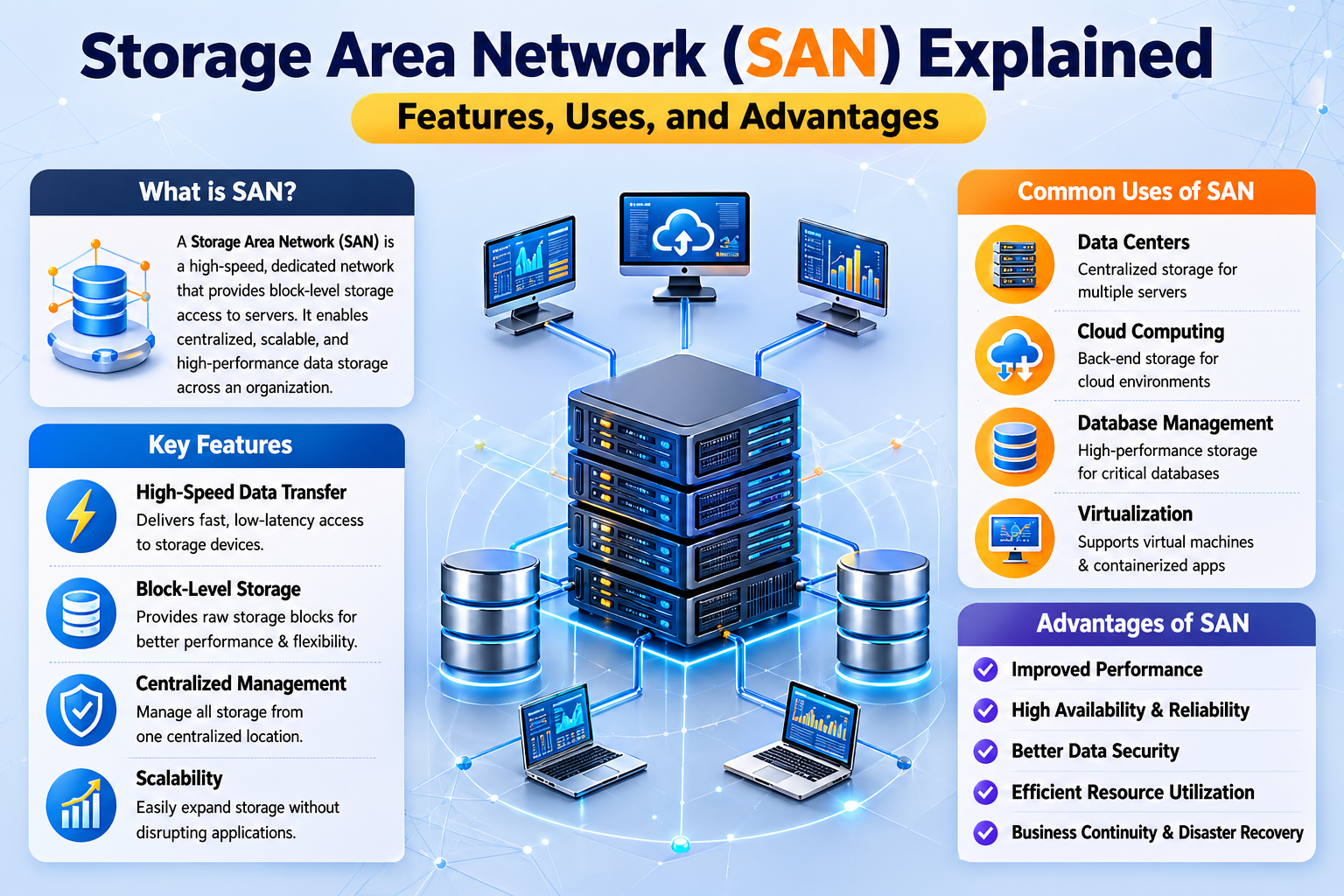
A Storage Area Network is built on a structured architecture that separates storage resources from computing systems and connects them through a dedicated high-speed network. This architecture is designed to improve data accessibility, reduce latency, and provide centralized control over large volumes of information. In a typical setup, multiple servers connect to a shared pool of storage devices, allowing efficient data sharing across an entire organization. Unlike traditional storage models where storage is directly attached to individual servers, SAN architecture removes this limitation and introduces a flexible and scalable environment for enterprise data management.
The architecture is designed with performance and reliability in mind. It ensures that storage traffic does not interfere with regular network traffic, which helps maintain consistent application performance. By isolating storage operations into a separate network, organizations can achieve better efficiency and reduce bottlenecks that commonly occur in conventional storage systems.
Core Components of SAN
A Storage Area Network is composed of several essential components that work together to provide seamless storage access. These components include storage devices, host servers, interconnecting switches, and host bus adapters.
Storage devices are the backbone of SAN systems. They are typically high-capacity disk arrays that store large volumes of data in a structured manner. These devices are designed for high-speed read and write operations and often include redundancy features to protect data.
Host servers are the systems that access the storage resources. They run applications and request data from the SAN as needed. Each server connects to the SAN through specialized hardware known as host bus adapters, which allow efficient communication between the server and storage network.
SAN switches act as the communication backbone of the network. They manage data traffic between servers and storage devices, ensuring that data packets are delivered quickly and efficiently. These switches are designed for high throughput and low latency, which is critical for enterprise workloads.
Together, these components form a unified storage ecosystem that delivers high performance, reliability, and scalability.
How SAN Works
A Storage Area Network works by creating a dedicated pathway for data transfer between servers and storage devices. When a server requests data, the request is transmitted through the SAN fabric, which consists of interconnected switches and communication protocols. The storage device then processes the request and sends the required data back to the server through the same high-speed network.
This process happens at the block level, meaning data is transferred in small chunks rather than entire files. This block-level access improves speed and efficiency, making SAN suitable for applications that require fast and consistent data processing.
Because SAN operates independently of local area networks, it prevents congestion and ensures that storage traffic does not affect other network operations. This separation of data and storage traffic is one of the key reasons why SAN systems are widely used in high-performance computing environments.
Types of SAN Technologies
Storage Area Networks can be implemented using different technologies depending on performance requirements and budget considerations. The most common types include Fibre Channel SAN, iSCSI SAN, and Fibre Channel over Ethernet.
Each technology has its own method of transmitting data between servers and storage systems. Fibre Channel is known for its high speed and reliability, making it suitable for large enterprises. iSCSI uses standard IP networks to transmit storage data, which makes it more cost-effective and easier to implement. Fibre Channel over Ethernet combines elements of both technologies to provide a unified infrastructure.
These variations allow organizations to choose a SAN solution that aligns with their operational needs and financial constraints.
Fibre Channel SAN
Fibre Channel SAN is one of the most widely used implementations in enterprise environments. It is designed specifically for storage networking and offers extremely high data transfer speeds and low latency. Fibre Channel uses dedicated hardware and protocols, which ensures that storage traffic is isolated from general network traffic.
This type of SAN is highly reliable and is often used in mission-critical environments such as financial systems, large databases, and virtualization platforms. The main advantage of Fibre Channel is its ability to handle large volumes of data with minimal delay, making it ideal for performance-sensitive applications.
However, it requires specialized equipment and expertise, which can increase implementation costs.
iSCSI SAN
iSCSI SAN is a more flexible and cost-effective alternative to Fibre Channel. It uses standard Ethernet networks to transmit storage data by encapsulating block-level storage commands into IP packets. This allows organizations to use existing network infrastructure without investing in specialized hardware.
One of the key benefits of iSCSI is its simplicity and ease of deployment. It is widely used in small to medium-sized businesses where budget constraints are a consideration. While it may not match the performance of Fibre Channel, it offers sufficient speed and reliability for many applications.
iSCSI SAN also provides good scalability, allowing organizations to expand storage systems as their needs grow.
Fibre Channel over Ethernet (FCoE)
Fibre Channel over Ethernet combines the strengths of Fibre Channel and Ethernet technologies. It allows Fibre Channel data to be transmitted over high-speed Ethernet networks, reducing the need for separate storage and data networks.
This convergence simplifies infrastructure management and reduces hardware costs while maintaining high performance. FCoE is often used in modern data centers where efficiency and consolidation are priorities.
By integrating storage and data traffic into a single network, organizations can reduce complexity and improve resource utilization.
SAN Topologies
Storage Area Networks can be designed using different topologies depending on the size and complexity of the environment. The most common topologies include point-to-point, arbitrated loop, and fabric topology.
Point-to-point topology is the simplest form, where a direct connection is established between a server and a storage device. It is limited in scalability and is rarely used in large environments.
Arbitrated loop topology connects multiple devices in a circular network. While it allows multiple connections, performance can be affected as more devices are added.
Fabric topology is the most advanced and widely used configuration. It uses multiple switches to create a fully interconnected network, allowing multiple simultaneous data paths. This topology offers high scalability, redundancy, and performance.
Performance Factors in SAN
The performance of a Storage Area Network depends on several factors, including network bandwidth, latency, hardware quality, and configuration. High-speed interconnects and optimized routing paths are essential for maintaining low latency and high throughput.
Storage device performance also plays a critical role. Faster disks or solid-state storage systems significantly improve overall SAN efficiency. Proper load balancing and traffic management ensure that no single component becomes a bottleneck.
Additionally, efficient caching mechanisms and data optimization techniques help enhance performance by reducing redundant data access.
Security in SAN
Security is a crucial aspect of Storage Area Networks because they handle sensitive and critical business data. SAN systems implement multiple layers of security to protect data from unauthorized access and corruption.
Access control mechanisms ensure that only authorized servers can communicate with storage devices. Zoning techniques are used to segment the network and restrict data flow between specific devices. Encryption may also be applied to protect data during transmission.
Regular monitoring and auditing help detect unusual activity and maintain system integrity. These security measures ensure that SAN environments remain safe and reliable for enterprise use.
Management and Monitoring
Managing a Storage Area Network requires specialized tools and expertise. Administrators use centralized management systems to configure, monitor, and optimize storage resources. These tools provide real-time insights into system performance, storage utilization, and network health.
Monitoring tools help identify potential issues before they affect operations. Alerts and automated responses ensure quick resolution of problems. Efficient management reduces downtime and improves overall system reliability.
Automation is also becoming increasingly important in SAN management, allowing routine tasks to be performed without manual intervention.
SAN vs Traditional Storage Systems
Storage Area Networks differ significantly from traditional direct-attached storage systems. In traditional storage, each server has its own dedicated storage device, which limits flexibility and scalability. In contrast, SAN provides a shared storage pool accessible by multiple servers.
This shared approach improves resource utilization and simplifies data management. It also enhances performance by allowing centralized optimization of storage resources. While traditional storage is simpler and cheaper, SAN offers far greater efficiency and scalability for large-scale environments.
Common Use Cases of SAN
Storage Area Networks are widely used in industries that require high-performance and reliable data storage. They are commonly deployed in data centers to support virtualization environments, where multiple virtual machines share the same storage resources.
They are also used in database management systems that require fast and consistent access to large datasets. In media and entertainment industries, SAN supports high-speed video editing and content storage workflows.
Backup and disaster recovery systems also rely heavily on SAN due to its ability to replicate and restore large volumes of data quickly.
Challenges and Limitations of SAN
Despite its advantages, SAN also presents certain challenges. The initial setup cost can be high due to specialized hardware and infrastructure requirements. Managing a SAN environment also requires skilled personnel, which can increase operational costs.
Complexity is another challenge, as configuring and maintaining a SAN involves multiple components and protocols. Additionally, improper configuration can lead to performance issues or data bottlenecks.
However, with proper planning and management, these challenges can be effectively addressed.
Future of Storage Area Networks
The future of Storage Area Networks is evolving with advancements in cloud computing, virtualization, and software-defined storage. Modern SAN systems are becoming more flexible and integrated with cloud environments, allowing hybrid storage solutions.
Automation and artificial intelligence are also playing a growing role in optimizing storage performance and management. These technologies help predict storage needs, detect issues early, and improve system efficiency.
As data volumes continue to grow, SAN will remain a critical component of enterprise infrastructure, adapting to new technologies and demands while maintaining its core strengths of speed, reliability, and scalability.
SAN in Virtualized Environments
Storage Area Networks play a critical role in modern virtualized infrastructure. In virtualization, multiple virtual machines run on a single physical server, and all of them require shared access to storage resources. SAN provides the ideal foundation for this environment because it offers centralized, high-speed, and flexible storage access.
In a virtualized setup, SAN allows virtual machines to move between physical hosts without affecting data availability. This process, often called live migration, depends heavily on shared storage. Since SAN presents storage as a unified pool, virtual machines can access their required data regardless of which physical server they are running on.
This flexibility improves system uptime and resource utilization. It also simplifies infrastructure management because administrators do not need to manage separate storage for each server. Instead, they can allocate storage dynamically based on workload requirements.
SAN also enhances performance in virtualization environments by reducing storage bottlenecks. Since multiple servers can access the same storage simultaneously through high-speed connections, applications run more smoothly even under heavy workloads.
SAN and Cloud Integration
Storage Area Networks have evolved significantly with the rise of cloud computing. In hybrid cloud environments, SAN is often used as the underlying storage layer for on-premises systems that connect to cloud infrastructure.
Organizations use SAN to maintain control over sensitive or critical data while still benefiting from cloud scalability. This combination allows businesses to store frequently accessed data locally on SAN systems and offload less critical data to cloud storage.
Cloud integration also enables better disaster recovery strategies. Data stored in SAN can be replicated to cloud environments, ensuring that backups are always available in case of system failure or natural disaster.
In modern architectures, SAN systems are increasingly being integrated with software-defined storage solutions. This allows storage resources to be managed through software rather than hardware, making systems more flexible and easier to scale.
Design Considerations for SAN Implementation
Designing a Storage Area Network requires careful planning to ensure performance, scalability, and reliability. One of the first considerations is determining the storage requirements of the organization. This includes estimating current data needs and forecasting future growth.
Network design is another critical factor. SAN environments rely on high-speed connections, so choosing the right communication technology is essential. Proper segmentation of storage traffic from general network traffic helps avoid congestion and performance degradation.
Redundancy is also an important design principle. Multiple paths between servers and storage devices should be implemented to ensure continuous availability in case of hardware failure. This is often achieved through redundant switches and controllers.
Scalability must be built into the design from the beginning. As data requirements grow, the SAN should be able to expand without major disruptions. This is achieved by using modular storage arrays and scalable network infrastructure.
Security considerations must also be included in the design phase. Proper zoning, authentication mechanisms, and encryption methods help protect sensitive data from unauthorized access.
Performance Optimization in SAN Systems
Optimizing performance in a Storage Area Network involves several strategies. One of the most important factors is load balancing, which ensures that storage requests are evenly distributed across available resources. This prevents any single component from becoming overloaded.
Caching is another technique used to improve performance. Frequently accessed data is stored in high-speed memory, allowing faster retrieval without accessing slower disk storage.
Proper configuration of storage tiers also enhances performance. Frequently used data can be stored on high-speed solid-state drives, while less critical data can be placed on traditional hard drives. This tiered approach ensures efficient use of resources.
Network optimization is equally important. Ensuring that SAN switches and connections are properly configured reduces latency and improves data transfer speeds. Regular monitoring helps identify performance bottlenecks and allows administrators to make necessary adjustments.
SAN vs NAS Storage Systems
Although Storage Area Networks and Network Attached Storage systems are both used for centralized data storage, they operate in fundamentally different ways.
SAN provides block-level storage, meaning it gives servers direct access to raw storage blocks. This allows operating systems to manage data more efficiently and is ideal for high-performance applications such as databases and virtualization.
NAS, on the other hand, provides file-level storage, where data is accessed through shared folders over a standard network. It is simpler to deploy and manage but may not deliver the same level of performance as SAN.
SAN is typically used in enterprise environments that require high speed, low latency, and scalability. NAS is more commonly used for file sharing, backups, and less performance-intensive applications.
The key difference lies in how data is accessed and managed. SAN offers more control and performance, while NAS offers simplicity and cost efficiency.
Data Protection in SAN Environments
Data protection is a core function of Storage Area Networks. Since SAN systems handle critical business information, ensuring data integrity and availability is essential.
One of the primary methods of protection is data replication. This involves creating copies of data across multiple storage devices or locations. If one device fails, another copy can be used to maintain continuity.
Snapshot technology is also commonly used in SAN systems. Snapshots capture the state of data at a specific point in time, allowing administrators to restore previous versions in case of corruption or accidental deletion.
Backup strategies are another important aspect of data protection. Regular backups ensure that data can be recovered in case of system failure or cyberattacks.
Advanced SAN systems also use error detection and correction mechanisms to maintain data accuracy during transmission and storage.
Troubleshooting SAN Issues
Despite their reliability, Storage Area Networks can experience issues that require troubleshooting. Common problems include connectivity failures, performance degradation, and configuration errors.
Connectivity issues often arise from faulty cables, misconfigured switches, or hardware failures. Diagnosing these problems involves checking physical connections and network configurations.
Performance issues may be caused by overloaded storage devices or improper load balancing. Monitoring tools can help identify bottlenecks and guide optimization efforts.
Configuration errors are another common issue, especially in complex environments. Incorrect zoning or authentication settings can prevent servers from accessing storage resources.
Effective troubleshooting requires a systematic approach that includes monitoring logs, analyzing performance data, and testing individual components.
Best Practices for SAN Management
Proper management of a Storage Area Network ensures long-term stability and efficiency. One of the best practices is regular monitoring of system performance and storage usage. This helps identify potential issues before they become critical.
Documentation is also important. Keeping detailed records of configurations, changes, and updates makes it easier to manage and troubleshoot the system.
Regular updates and maintenance help ensure that the SAN remains secure and efficient. This includes firmware updates, hardware checks, and security patches.
Capacity planning is another key practice. Organizations should continuously monitor storage usage trends and plan for future expansion accordingly.
Security best practices include implementing strong access controls, regular audits, and encryption of sensitive data.
Industry Applications of SAN
Storage Area Networks are used across a wide range of industries due to their performance and reliability. In the financial sector, SAN supports high-speed transaction processing and large-scale data analytics.
In healthcare, SAN is used to store and manage patient records, medical imaging data, and research information. The ability to quickly access large files is critical in medical environments.
The media and entertainment industry relies on SAN for video editing, rendering, and content storage. High-speed access to large media files is essential for production workflows.
In the IT and telecommunications sector, SAN supports virtualization, cloud services, and large-scale application hosting.
Challenges in Modern SAN Environments
While SAN technology offers many benefits, it also faces challenges in modern IT environments. One major challenge is complexity, as managing large-scale SAN systems requires specialized skills and knowledge.
Cost is another challenge, especially for small and medium-sized organizations. The hardware and infrastructure required for SAN can be expensive.
Scalability, while a strength, can also become complex to manage if not properly planned. Poor design decisions can lead to inefficiencies and performance issues.
Security threats are also a growing concern, as storage systems are increasingly targeted by cyberattacks. Protecting data requires constant vigilance and updated security measures.
Future Trends in Storage Area Networks
The future of Storage Area Networks is closely tied to advancements in cloud computing, artificial intelligence, and automation. SAN systems are becoming more intelligent, with automated management and optimization features.
Software-defined storage is expected to play a major role in the evolution of SAN. This approach separates storage software from hardware, allowing greater flexibility and scalability.
Integration with cloud platforms will continue to grow, enabling hybrid storage environments that combine on-premises and cloud resources.
Artificial intelligence will also enhance SAN management by predicting storage needs, optimizing performance, and detecting anomalies automatically.
As data continues to grow exponentially, SAN technology will remain a key component of enterprise infrastructure, adapting to new demands and technologies while maintaining its core strengths of speed, reliability, and centralized control.
Advanced SAN Architecture Concepts
Modern Storage Area Networks are not limited to simple storage connectivity anymore. They now include advanced architectural concepts that improve efficiency, scalability, and automation. One such concept is the use of multi-layered SAN fabrics, where multiple switching layers are used to distribute storage traffic intelligently across the network. This reduces congestion and ensures smoother data flow even in large enterprise environments.
Another important architectural advancement is virtualization within SAN itself. Storage virtualization abstracts physical storage devices and presents them as a single logical pool. This allows administrators to allocate storage dynamically without worrying about the physical location of data. It also improves utilization because unused storage space across different devices can be combined and managed as one system.
In modern setups, SAN architecture often includes automated provisioning systems. These systems allocate storage resources automatically based on application demands. This reduces manual intervention and helps organizations respond faster to changing workloads.
Role of SAN in Big Data Environments
Storage Area Networks play a crucial role in handling big data workloads. Big data applications generate massive volumes of structured and unstructured data that must be processed quickly and efficiently. SAN provides the high-speed, low-latency storage required for such workloads.
In big data analytics platforms, multiple servers work simultaneously on large datasets stored in SAN. The ability to access shared storage at high speed ensures that processing is not delayed by I/O bottlenecks. This is especially important in industries like finance, retail, and telecommunications where real-time analytics is required.
SAN also supports distributed computing frameworks that rely on shared storage for processing large-scale datasets. The centralized nature of SAN ensures data consistency and reduces duplication, which is essential in big data environments.
High Availability in SAN Systems
High availability is one of the most important design goals of Storage Area Networks. It ensures that storage resources remain accessible even in the event of hardware or software failures. This is achieved through redundancy at multiple levels.
Redundant paths between servers and storage devices ensure that if one connection fails, another can take over immediately. This is known as multipathing. It prevents downtime and ensures continuous access to data.
Storage arrays in SAN are often configured with redundant controllers. If one controller fails, another automatically takes over without interrupting operations. This failover mechanism is essential for mission-critical applications.
Data replication across multiple storage systems also contributes to high availability. By maintaining multiple copies of data, SAN ensures that information is not lost even if one system fails completely.
Scalability in Enterprise SAN Deployments
Scalability is a defining feature of Storage Area Networks. Enterprises often start with a small SAN setup and expand it gradually as data requirements grow. This scalability is achieved through modular design and flexible architecture.
Storage capacity can be increased by adding new storage arrays to the existing network. These new devices integrate seamlessly into the SAN without affecting ongoing operations. This allows organizations to scale storage independently of computing resources.
Network scalability is also important. Additional switches and connections can be added to support increased data traffic. Modern SAN designs support thousands of devices within a single storage fabric.
Scalability ensures that SAN systems can grow alongside business needs without requiring complete infrastructure redesigns.
Energy Efficiency and SAN Optimization
Energy efficiency has become an important consideration in modern SAN deployments. Large storage systems consume significant amounts of power, especially in data centers. To address this, modern SAN solutions include energy-saving features.
One approach is automated power management, where unused storage devices are placed in low-power states during periods of low demand. This reduces energy consumption without affecting performance.
Another optimization technique is data deduplication, which eliminates duplicate copies of data. By reducing storage redundancy, organizations can decrease both storage requirements and energy usage.
Efficient cooling systems and hardware optimization also contribute to lower energy consumption. As data centers become more environmentally conscious, energy-efficient SAN designs are becoming increasingly important.
SAN Automation and Artificial Intelligence Integration
Automation is transforming the way Storage Area Networks are managed. Traditional SAN administration required manual configuration and monitoring, but modern systems increasingly rely on automation tools.
Artificial intelligence is now being integrated into SAN management systems to predict storage demands, detect anomalies, and optimize performance. AI-based systems analyze usage patterns and automatically adjust storage allocation to prevent bottlenecks.
Predictive maintenance is another benefit of AI integration. By analyzing hardware performance data, AI can identify potential failures before they occur, allowing proactive maintenance and reducing downtime.
Automation also simplifies routine tasks such as backup scheduling, storage provisioning, and performance tuning. This reduces the workload on IT teams and improves overall system efficiency.
Security Enhancements in Modern SAN
As cyber threats continue to evolve, SAN security has become more advanced. Modern SAN systems implement multiple layers of protection to safeguard sensitive data.
Encryption is commonly used to protect data both at rest and in transit. This ensures that even if data is intercepted or accessed without authorization, it cannot be read.
Role-based access control is another important security feature. It restricts access to storage resources based on user roles and permissions. This minimizes the risk of unauthorized access.
Advanced monitoring systems continuously track SAN activity to detect unusual behavior. Any suspicious activity triggers alerts, allowing administrators to take immediate action.
Security compliance is also a major focus, especially in regulated industries such as healthcare and finance. SAN systems are designed to meet strict compliance standards to ensure data protection and privacy.
Disaster Recovery Strategies Using SAN
Disaster recovery is a critical function of Storage Area Networks. Organizations rely on SAN to ensure business continuity in the event of natural disasters, hardware failures, or cyberattacks.
One common disaster recovery method is remote replication, where data stored in SAN is continuously copied to a secondary location. This ensures that a backup is always available.
Snapshot-based recovery allows organizations to restore data to a specific point in time. This is useful in cases of accidental deletion or data corruption.
Failover systems automatically switch operations to backup storage systems when primary systems fail. This minimizes downtime and ensures continuous service availability.
Disaster recovery planning is essential for maintaining business continuity and protecting critical data assets.
SAN Performance Monitoring Techniques
Monitoring SAN performance is essential for maintaining optimal operation. Administrators use specialized tools to track metrics such as latency, throughput, and storage utilization.
Latency monitoring helps identify delays in data transfer, which can impact application performance. Throughput monitoring measures the amount of data being processed over time.
Storage utilization tracking ensures that storage resources are used efficiently and helps prevent overloading. Performance dashboards provide real-time insights into system health.
Historical performance analysis is also used to identify trends and plan for future capacity needs. This ensures that SAN systems remain efficient as workloads increase.
Emerging Technologies Impacting SAN
Several emerging technologies are shaping the future of Storage Area Networks. One of the most significant is NVMe over Fabrics, which provides ultra-low latency storage access over network fabrics.
Edge computing is also influencing SAN design. As data processing moves closer to the source, SAN systems are being adapted to support distributed storage architectures.
5G technology is expected to enhance SAN connectivity by providing faster and more reliable network links. This will improve data transfer speeds in distributed environments.
Quantum computing may also impact future storage systems by introducing new methods of data processing and encryption.
Economic Benefits of SAN Adoption
Although Storage Area Networks require significant initial investment, they provide long-term economic benefits. Centralized storage reduces the need for multiple storage systems, lowering maintenance costs.
Improved efficiency leads to better resource utilization, which reduces waste and operational expenses. Scalability ensures that organizations only invest in storage when needed, avoiding unnecessary upfront costs.
Reduced downtime and improved reliability also contribute to cost savings by minimizing business disruptions.
SAN Lifecycle Management
Managing the lifecycle of a Storage Area Network involves planning, deployment, operation, and eventual upgrade or replacement. Proper lifecycle management ensures long-term efficiency and reliability.
During the planning phase, organizations assess storage requirements and design the SAN architecture. Deployment involves installing hardware and configuring the system.
Operational management includes monitoring performance, applying updates, and optimizing resources. Over time, systems may need upgrades to accommodate growing data demands or new technologies.
Effective lifecycle management ensures that SAN systems remain aligned with business objectives throughout their operational lifespan.
SAN Evolution and Impact
Storage Area Networks have evolved into highly advanced, intelligent, and scalable systems that form the backbone of modern enterprise storage infrastructure. They provide the performance, reliability, and flexibility required to support complex applications and large-scale data environments.
With continuous advancements in automation, cloud integration, and artificial intelligence, SAN technology is expected to become even more efficient and adaptive. Its role in data-driven industries will continue to grow as organizations rely more heavily on fast, secure, and centralized storage solutions.
SAN Interoperability and Multi-Vendor Environments
In modern IT infrastructures, Storage Area Networks are rarely built using a single vendor’s ecosystem. Instead, enterprises often deploy multi-vendor environments where storage arrays, switches, and servers come from different manufacturers. SAN interoperability ensures that all these components can work together seamlessly.
This is achieved through standardized protocols such as Fibre Channel and iSCSI, which define how data is transmitted and interpreted across devices. These standards allow organizations to mix and match hardware while maintaining consistent performance and reliability.
Interoperability also provides flexibility in procurement and reduces vendor lock-in. Organizations can choose components based on performance, cost, or feature requirements rather than being restricted to a single provider.
However, managing multi-vendor SAN environments requires careful configuration and testing. Compatibility issues can arise if devices are not properly aligned with industry standards. Proper planning and validation help ensure smooth integration.
Role of SAN in Enterprise Backup Systems
Backup systems are one of the most important applications of Storage Area Networks. SAN provides the high-speed infrastructure needed to perform large-scale backups efficiently without disrupting production systems.
Unlike traditional backup methods that may slow down servers, SAN allows backup operations to run in parallel using dedicated storage paths. This reduces the impact on application performance.
Incremental and differential backups are commonly used in SAN environments to minimize storage usage and reduce backup time. Only changes made since the last backup are stored, making the process more efficient.
SAN also enables centralized backup management. Administrators can schedule, monitor, and manage backups from a single interface, improving control and reducing complexity.
In disaster recovery scenarios, SAN-based backups allow rapid restoration of systems, ensuring minimal downtime and data loss.
Storage Tiering in SAN Systems
Storage tiering is an important optimization strategy used in Storage Area Networks to improve performance and reduce costs. It involves categorizing data based on usage patterns and storing it on different types of storage media.
Frequently accessed data, often referred to as “hot data,” is stored on high-performance devices such as solid-state drives. Less frequently accessed data, known as “cold data,” is stored on slower but more cost-effective hard drives.
This tiered approach ensures that critical applications receive maximum performance while optimizing storage costs for less important data.
Automated tiering systems can dynamically move data between storage levels based on real-time usage patterns. This eliminates the need for manual intervention and ensures optimal resource utilization.
Latency Reduction Techniques in SAN
Latency is a critical factor in Storage Area Network performance. Even small delays in data transmission can impact application responsiveness. To address this, SAN systems use several latency reduction techniques.
One approach is the use of high-speed interconnects that minimize transmission delays. Fibre Channel and NVMe over Fabrics are commonly used technologies that provide ultra-low latency communication.
Caching mechanisms also play a key role in reducing latency. Frequently accessed data is stored in fast memory buffers, allowing quicker retrieval without accessing slower disk storage.
Efficient routing within SAN fabrics ensures that data takes the shortest possible path between servers and storage devices. This reduces unnecessary hops and improves overall speed.
Load balancing further helps reduce latency by distributing traffic evenly across available resources.
SAN in Artificial Intelligence and Machine Learning
Artificial intelligence and machine learning workloads require extremely fast and scalable storage systems. Storage Area Networks are increasingly being used to support these demanding applications.
AI and ML models rely on large datasets for training and analysis. SAN provides the high-throughput storage needed to process these datasets efficiently.
Multiple compute nodes can access shared datasets simultaneously through SAN, enabling parallel processing. This significantly reduces training time for complex models.
SAN also supports rapid data ingestion, which is essential for real-time AI applications. As data is generated, it can be immediately stored and accessed for processing.
In advanced AI environments, SAN is often integrated with GPU clusters and high-performance computing systems to maximize processing efficiency.
Role of SAN in Financial Systems
Financial institutions rely heavily on Storage Area Networks for transaction processing, data analytics, and risk management. The financial sector requires extremely high levels of reliability, speed, and data integrity.
SAN enables real-time transaction processing by providing fast access to financial databases. This ensures that transactions are completed quickly and accurately.
Risk analysis systems use SAN to process large volumes of market data in real time. This helps institutions make informed decisions based on up-to-date information.
Data integrity is critical in financial systems. SAN ensures that all transactions are stored securely and consistently, reducing the risk of errors or data loss.
High availability features in SAN also ensure that financial systems remain operational even during hardware failures or maintenance activities.
SAN in Healthcare Data Management
Healthcare organizations generate vast amounts of sensitive data, including medical records, imaging files, and research data. Storage Area Networks provide the infrastructure needed to manage this data efficiently and securely.
Medical imaging systems such as MRI and CT scans require high-speed storage access due to large file sizes. SAN enables quick retrieval and storage of these images, improving diagnostic efficiency.
Electronic health record systems rely on SAN for centralized data storage. This allows healthcare providers to access patient information from multiple locations in real time.
Data security and compliance are critical in healthcare. SAN systems implement encryption and access controls to protect patient information and meet regulatory requirements.
Backup and recovery systems in healthcare environments also depend on SAN to ensure data availability in case of emergencies.
SAN for Media and Entertainment Industry
The media and entertainment industry generates large volumes of high-resolution video, audio, and graphic content. Storage Area Networks are essential for managing these data-intensive workflows.
Video editing and production require fast access to large media files. SAN provides the necessary bandwidth to support real-time editing without delays.
Multiple editors and production teams can work on the same project simultaneously using shared SAN storage. This improves collaboration and efficiency.
Rendering processes, which require significant computational power, also benefit from SAN’s high-speed data access.
Content distribution and archiving systems use SAN to store and manage large media libraries efficiently.
Automation in SAN Data Management
Automation is becoming increasingly important in Storage Area Network management. It reduces manual workload and improves system efficiency.
Automated provisioning allows storage resources to be allocated instantly based on demand. This ensures that applications receive the storage they need without delay.
Policy-based management systems automatically enforce storage rules, such as data retention policies and access controls.
Automated monitoring tools continuously track system performance and trigger alerts when anomalies are detected.
Backup automation ensures that data is regularly protected without manual scheduling, reducing the risk of human error.
Challenges in Scaling SAN Infrastructure
While SAN systems are highly scalable, expanding them comes with certain challenges. As the network grows, managing complexity becomes more difficult.
Increased scale can lead to configuration errors if proper management practices are not followed. This can affect performance and reliability.
Network congestion may also occur if traffic is not properly balanced across the SAN fabric.
Hardware compatibility issues can arise when integrating new devices into an existing infrastructure.
To overcome these challenges, organizations must adopt strong planning, monitoring, and management strategies.
Environmental Impact of SAN Systems
Large-scale Storage Area Networks consume significant amounts of energy, especially in data centers. This has led to increased focus on sustainability and environmental impact.
Modern SAN systems are being designed with energy-efficient components to reduce power consumption.
Virtualization and storage consolidation help reduce the number of physical devices required, lowering energy usage.
Efficient cooling systems and smart power management also contribute to reduced environmental impact.
Sustainable SAN design is becoming an important consideration for organizations aiming to reduce their carbon footprint.
Evolution of SAN Over Time
Storage Area Networks have evolved significantly since their introduction. Early SAN systems were simple and expensive, requiring specialized hardware and complex configurations.
Over time, advancements in networking technology have made SAN more accessible and efficient. The introduction of iSCSI and Fibre Channel over Ethernet expanded deployment options.
Modern SAN systems now incorporate virtualization, automation, and cloud integration. These advancements have transformed SAN into a flexible and intelligent storage solution.
The evolution of SAN reflects the growing demand for scalable, high-performance data storage in modern computing environments.
Final Perspective on SAN Importance
Storage Area Networks remain a foundational technology in enterprise IT infrastructure. Their ability to deliver high-speed, centralized, and scalable storage makes them essential for modern data-driven organizations.
From virtualization and cloud computing to artificial intelligence and big data, SAN continues to support some of the most demanding workloads in the digital world.
As technology continues to advance, SAN systems will become even more intelligent, automated, and integrated, ensuring they remain a key pillar of enterprise storage architecture.
Conclusion
Storage Area Networks have become a vital part of modern IT infrastructure due to their ability to deliver high-performance, centralized, and scalable storage solutions. By separating storage from individual servers and connecting it through a dedicated high-speed network, SAN systems significantly improve data accessibility, reliability, and efficiency across enterprise environments.
Throughout various industries such as finance, healthcare, media, and cloud computing, SAN continues to prove its value by supporting mission-critical applications and handling large volumes of data with minimal latency. Its advanced features like redundancy, high availability, storage tiering, and automation make it a powerful solution for organizations that require uninterrupted access to data.
As data demands continue to grow rapidly, SAN technology is also evolving with innovations like virtualization, cloud integration, and artificial intelligence-based management. These advancements are making SAN systems more intelligent, flexible, and cost-effective than ever before.
In summary, Storage Area Networks remain a cornerstone of enterprise storage strategy, offering the performance, scalability, and reliability needed to support today’s data-driven world while adapting to the future of computing.